


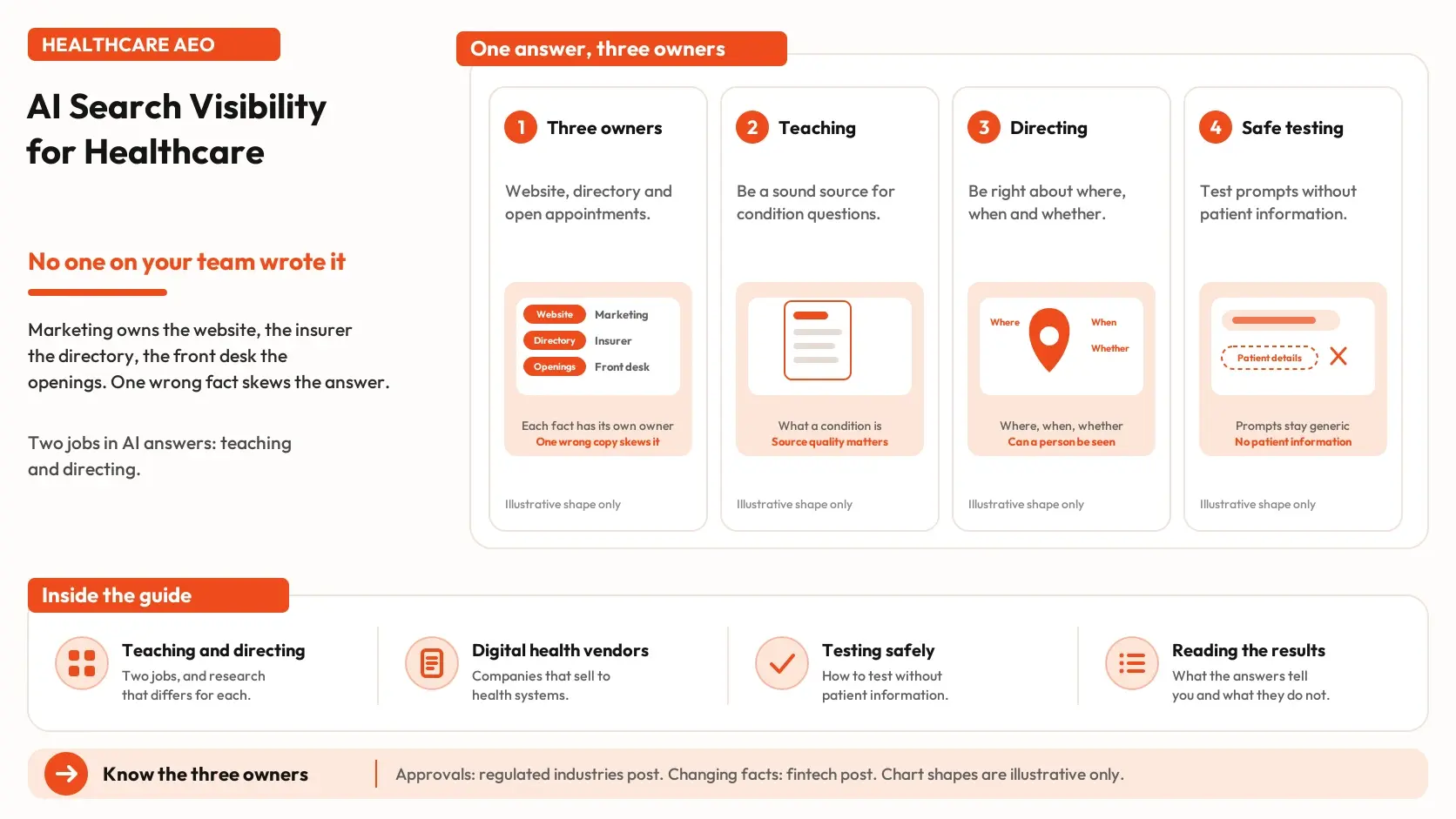


When someone asks AI to find a cardiologist who accepts their insurance and has appointments this month, the answer depends on three things: accurate medical information, an up-to-date insurance directory, and current appointment availability. Different teams own each fact, but AI can combine them into one answer. If even one is wrong, the patient gets misdirected. For healthcare organisations, AEO has two distinct challenges: becoming a trusted source for health information and ensuring AI provides accurate details about providers, insurance coverage and access to care.
This guide examines how AI sources healthcare answers, how to keep provider and service information accurate, how digital health vendors can build credibility with health systems, and how to test AI visibility without exposing patient information. It also explains how to measure results. For broader claim governance, see our AEO guide for regulated industries and our guide to AI search visibility for financial services and fintech for managing frequently changing facts.
Two jobs, two sets of sources
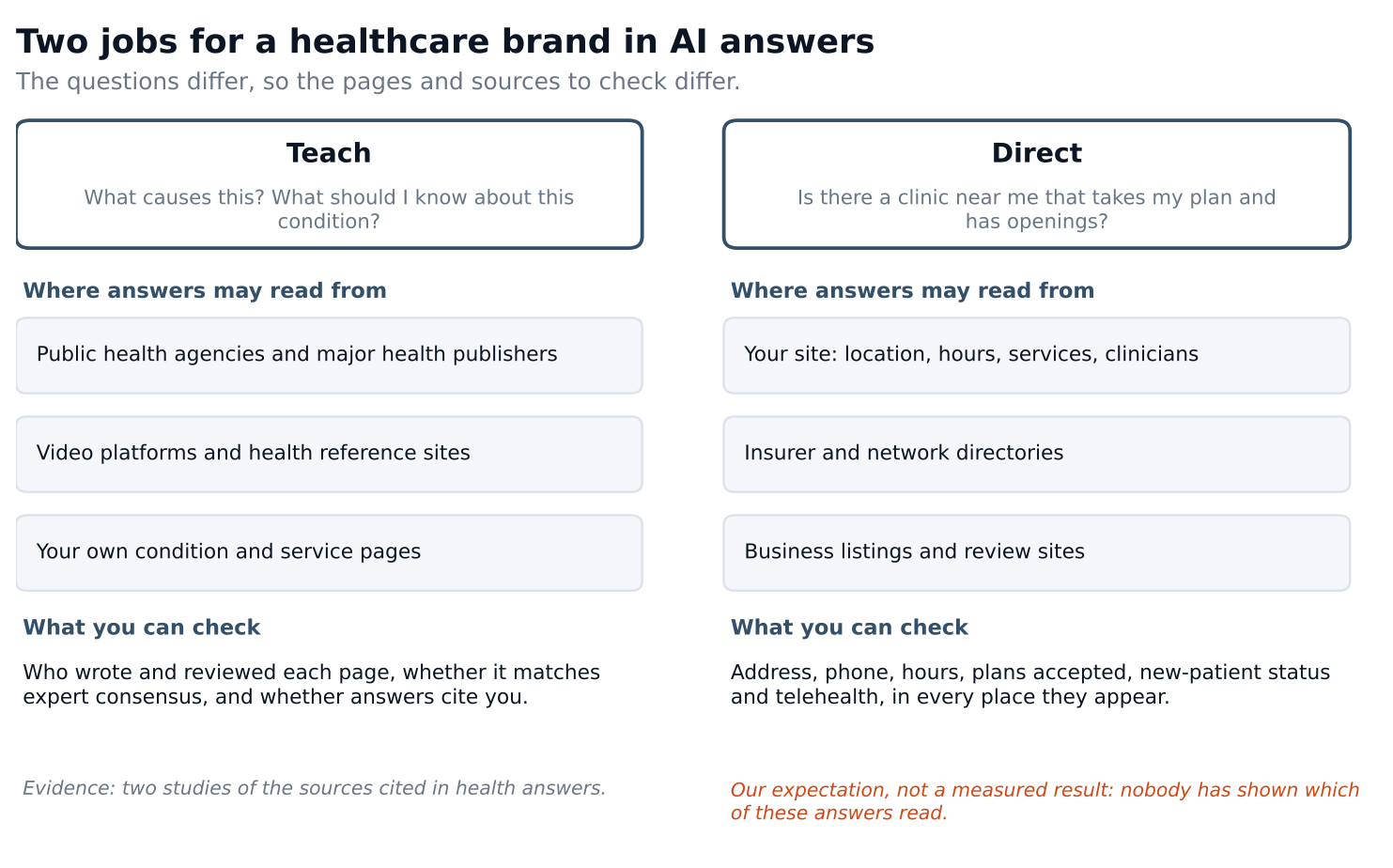
Figure 1. Two jobs for a healthcare brand in AI answers. The questions differ, so the pages and sources to check differ.
Teaching questions are about what is true: symptoms, causes, treatments, what to expect. Directing questions are about what is available: where, when, who, and on what terms. The first depends on the quality and sourcing of the pages that get read. The second depends on whether a handful of plain facts match across every place they are published. Most healthcare content programs invest heavily in the first and check the second rarely.
What people are doing with AI before they book
A KFF poll fielded from February 24 to March 2, 2026, with 1,343 U.S. adults, found that 32 percent had used AI for health information in the past year. Among those who had, 41 percent said they used it to look up information before deciding whether to see a provider, and 77 percent of all adults said they were concerned about the privacy of medical information shared with AI tools (KFF poll, March 2026). The poll has a margin of sampling error of about 3 percentage points. It measures use and attitudes, not which provider people end up choosing, so it shows that AI sits in the stage before a visit, not that it decides the visit.
What research says about health answers and their sources
Two independent studies look at where health answers come from. Both examine Google's AI Overviews, so neither tells you how other assistants behave.
A Dartmouth preprint ran 120 health queries across 12 topics and 11 countries in May 2026. In the U.S., YouTube was the most-cited domain in AI Overviews for health queries, ahead of Mayo Clinic, the CDC and the WHO. The authors note that their analysis works at the domain level and cannot judge the accuracy or quality of what was cited, and that it is a snapshot of a fast-changing system (Zha and Chang, arXiv 2609.06798).
A University of Zurich and Northeastern audit of baby care and pregnancy queries crawled in April 2025 tested 1,508 questions. AI Overviews appeared for 84 percent of them. Of the AI Overview answers, 89.4 percent carried no cue to consult a medical professional. In a manual review of the most-cited 10 percent of domains, low and medium credibility sources made up nearly half of the citations in AI Overviews and featured snippets. The study covers one topic area, U.S. English results and one crawl (Hu et al., arXiv 2511.12920).
Put together, these say that health answers draw on a mix of sources, that the mix is not just the most authoritative institutions, and that the answer itself often does not point the reader to care. They do not say how your own pages fare. Citations and mentions are separate things to count, and the cited domain is often the clue to which source an answer leaned on.
Directing: the facts that decide a booking
For care-finding questions, we list eight fields that patients and their assistants need: address, phone, hours, plans accepted, whether new patients are accepted, telehealth, services and, for clinicians, credentials. Each one is published in several places, and the places have different owners.
The reason to check them all is that the surrounding data has a long record of errors. Testimony to the Senate Finance Committee in May 2023 by the president of the American Medical Association cited a 2018 federal review in which nearly 49 percent of provider locations listed by 52 Medicare Advantage organizations had at least one inaccuracy, and a 2022 Health Affairs study of Oregon Medicaid managed care in which 58.2 percent of mental health directory listings were "phantom" providers who did not see Medicaid patients (Senate Finance Committee testimony). Those findings are about insurer directories, not about AI answers, and some are years old. They show why a directory is a risky place for a fact to live. We found no study that shows which directories an AI answer reads.
A second point is arithmetic. A listing with several fields is fully right only if every field is right.
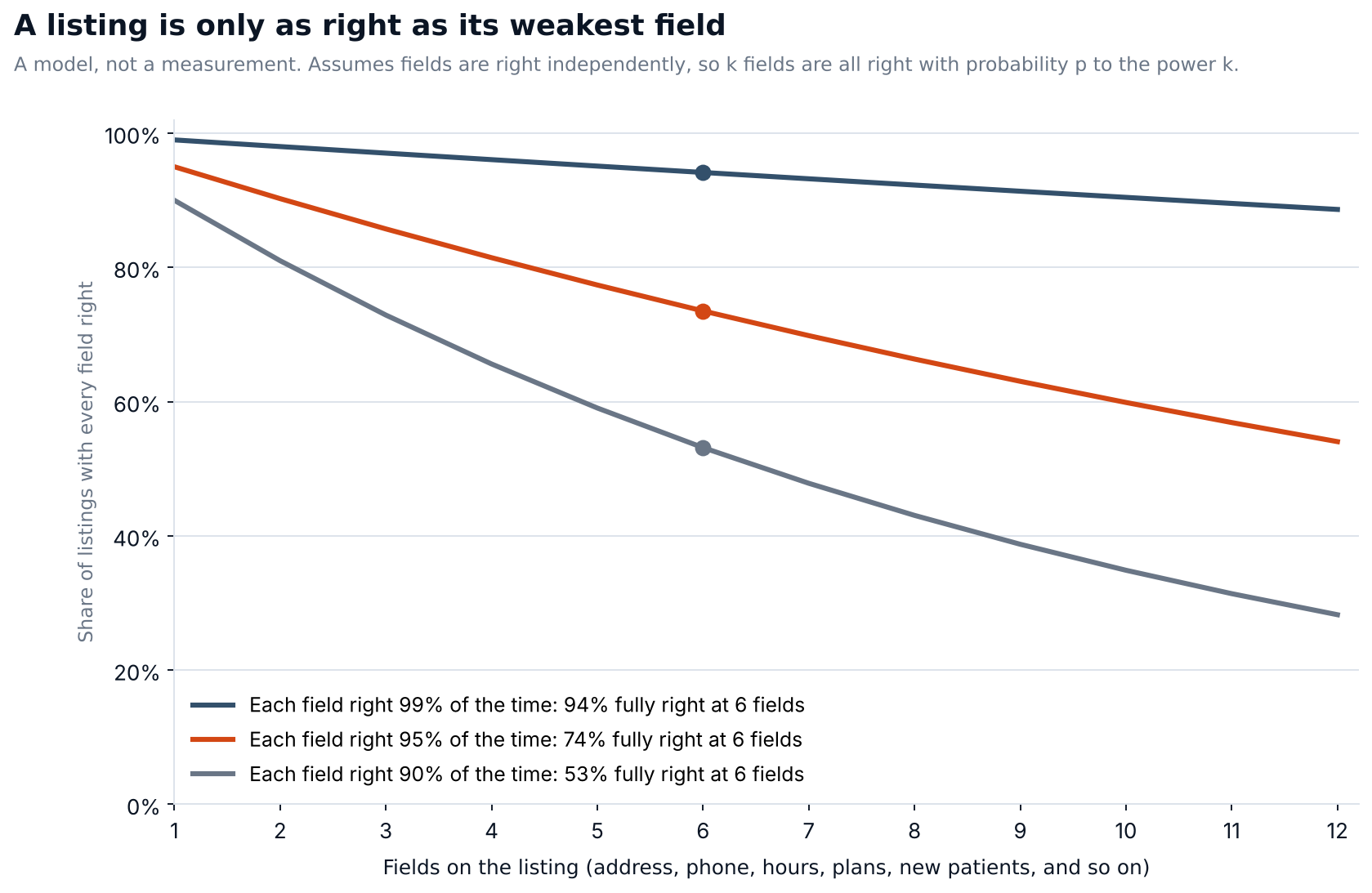
Figure 2. A model of how fields compound. It is not a measurement, and it assumes each field is right independently.
If each of six fields is right 95 percent of the time, only about 74 percent of listings are right in every field. That is why the worksheet at the end tracks both the share of checks that match and the share of locations and clinicians that are fully consistent. A source can look good field by field and still have most of its listings wrong somewhere.
Teaching: show who wrote it and who checked it
Google's guidance says that content on topics such as health should be highly accurate and consistent with established expert consensus. It encourages accurate authorship information, such as bylines, where readers would expect it, asks whether content is written or reviewed by someone who demonstrably knows the topic, and treats deceptive authorship as a sign of a low-quality page (Google Search Central, helpful content, updated October 2026). We found no independent study showing that these signals change how often an AI answer cites a health page, so treat the following as our recommendations, not proven levers.
| Practice | What it looks like |
|---|---|
| Name the people | The author and the clinical reviewer on every condition or service page, with credentials and a visible "last reviewed" date |
| Show the sources | A list of what the page relies on, in plain wording that matches current guidance from public health agencies |
| Keep pages general | Individual medical questions routed to care, with clinical and compliance review signing off on wording as for any claim |
| Put key facts in text | Who a service is for and what a visit involves, stated so a single sentence can be lifted without the rest of the page |
If you sell to health systems
Digital health and health IT vendors face the directing job in a different form. A buyer at a health system asks about privacy and security handling, integration with the record systems the hospital runs, the evidence behind your outcomes, and what implementation takes. We suggest one plain-text page section for each, with an owner and a date. This is our checklist, and we found no study of how health system buyers use AI tools to research vendors.
| Proof area | What to state in plain text |
|---|---|
| Privacy and security | What you state about handling patient data and which independent audits you hold, with counsel approving the wording |
| Integrations | The named record systems and tools you connect to, kept in step with release notes |
| Evidence | The study or pilot, its population, its date and its limits, with no claim beyond what it showed |
| Implementation | Typical steps, the timeline you will stand behind, and what the customer must provide |
| Pricing model | How you charge, even if exact numbers need a conversation |
| Support | Hours, channels and who owns the account after the sale |
The same one-record-per-fact method from the fintech post applies to a vendor's certifications, integration lists and pricing plan.
Test with prompts that contain no patient information
Write each prompt as a general question a person might ask, with a city or region and no personal details. Never use a real patient's name, dates, record numbers or health details in a prompt or in a saved answer. The KFF figure above, with 77 percent of adults concerned about medical privacy, is a reason to keep your tracking clean as well as a compliance matter.
Keep two sets of prompts, one for each job. A teaching prompt asks about a condition or service you cover. A directing prompt asks for a clinic, a clinician or an appointment near a named place, with a plan or a service in the question. State the place in the prompt and record it, because the Dartmouth study found that the share of localized citations in English-language queries varied widely by country, from 48.2 percent in Australia and 33.7 percent in the U.S. to 0.2 percent in Nigeria. Designing prompts for AI visibility tracking covers the rules for keeping prompts fixed and versioned.
Answers vary from run to run (why citations change between runs), so save more than one answer to each prompt. Re-run directing prompts after any change to a master fact, and on a schedule matched to how often your hours, plans and openings change (how often to track AI search). For each saved answer, record the fact tested, what it stated, whether it matched your record and what kind of source it cited.
Read the results with ranges
Report differences as a share of checks, with the number of checks beside it. The table below comes from the worksheet's invented example rows, and it is not a finding.
| Source | Checks | Differences | Share (95% range) |
|---|---|---|---|
| Own site | 21 | 1 | 5% (1% to 23%) |
| Insurer or network directory | 10 | 4 | 40% (17% to 69%) |
| Business listing | 9 | 2 | 22% (6% to 55%) |
| Hospital or affiliate directory | 4 | 2 | 50% (15% to 85%) |
| Review or ratings site | 4 | 1 | 25% (5% to 70%) |
Across all 48 checks in the example, 10 differ, which is 21 percent with a range of about 12 to 34 percent, and 1 of 5 locations and clinicians is fully consistent. Among 18 saved answers in the example, 7 differ from the record, 39 percent with a range of about 20 to 61 percent, and the differing answers mostly cite directories and listings, not the organization's own site. That pattern is built into the invented rows. In your own data it may look different, and the method is the point: find which sources differ, fix the ones you control, ask the owners of the rest to correct theirs, then save new answers and compare. A source with 4 checks can look bad or good by chance, so read the range before you act on a ranking.
Audit one location in a worksheet
The worksheet has a master record, a source audit, an answer log and a summary. Grey rows are invented examples with invented locations, clinicians, plans and values, so replace them before you read any output. Do not enter patient information anywhere in it.
- On the Settings tab, set the as-of date, the days an issue may stay open and your field list.
- On the Master record tab, add one row per location or clinician with the value you publish for each field. This is the record every source is compared with.
- On the Source audit tab, enter each check as an entity, a source, a field and the value you found. The master value is looked up and the result is calculated as Matches, Differs or Missing. Use the reviewer verdict to override a result when the wording differs but the meaning does not.
- On the Answer checks tab, log each saved answer with the fact it tests, what it stated, the result and the source type it cited.
- On the Summary tab, read consistency by source and by field with ranges, the share of fully consistent locations and clinicians, and answer differences by source type.
Frequently asked questions
Can we publish condition information without giving medical advice?
Keep pages general, name the author and clinical reviewer, show a review date, and send individual medical questions to care. Clinical and compliance review decide the wording, as they would for any claim. We found no study that measures how this affects citations.
Which listings should we fix first?
Start with the ones that your tracked prompts cite, and with the places that hold plans accepted and new-patient status, since those change most and have a different owner than your website. We did not find a verified way to make an engine drop an old value, so the lever is to make the correct fact easy to find in more places than the wrong one.
Do we need special structured data for clinics and clinicians?
Google says no special structured data is needed to appear in its AI features, and that any structured data you use should match the visible text (Google Search Central, AI features). Keep it consistent with the page, and state the fact in text.
Is this only for providers?
No. Providers mostly manage location, plan and availability facts. Digital health and health IT vendors mostly manage privacy and security statements, integrations, evidence and implementation. The master record and the answer log work for both, with different fields.
Can we use real patient questions as prompts?
No. Write general questions with no personal or health details, keep saved answers free of patient information, and follow your organization's privacy policy for anything else.
Audit one location against five sources this week
Pick one location. Write its master record in eight fields, and have one person own each field. Then check five places that show the location: your own site, an insurer directory, a business listing, a hospital or affiliate directory and a review site. Note every field that differs or is missing. Save an answer to one general question about the location, such as which clinics near the city take a given plan, and note which kind of source it cited. Fix the sources you control first, then send the correct record to the owners of the rest.
If you want a first reading on one of those questions before you build the log, the AI Search Visibility Checker gives you one. If you want to ask the same teaching and directing questions over time, AI Search Intelligence tracks individual prompts, so the questions stay fixed while the facts change.