


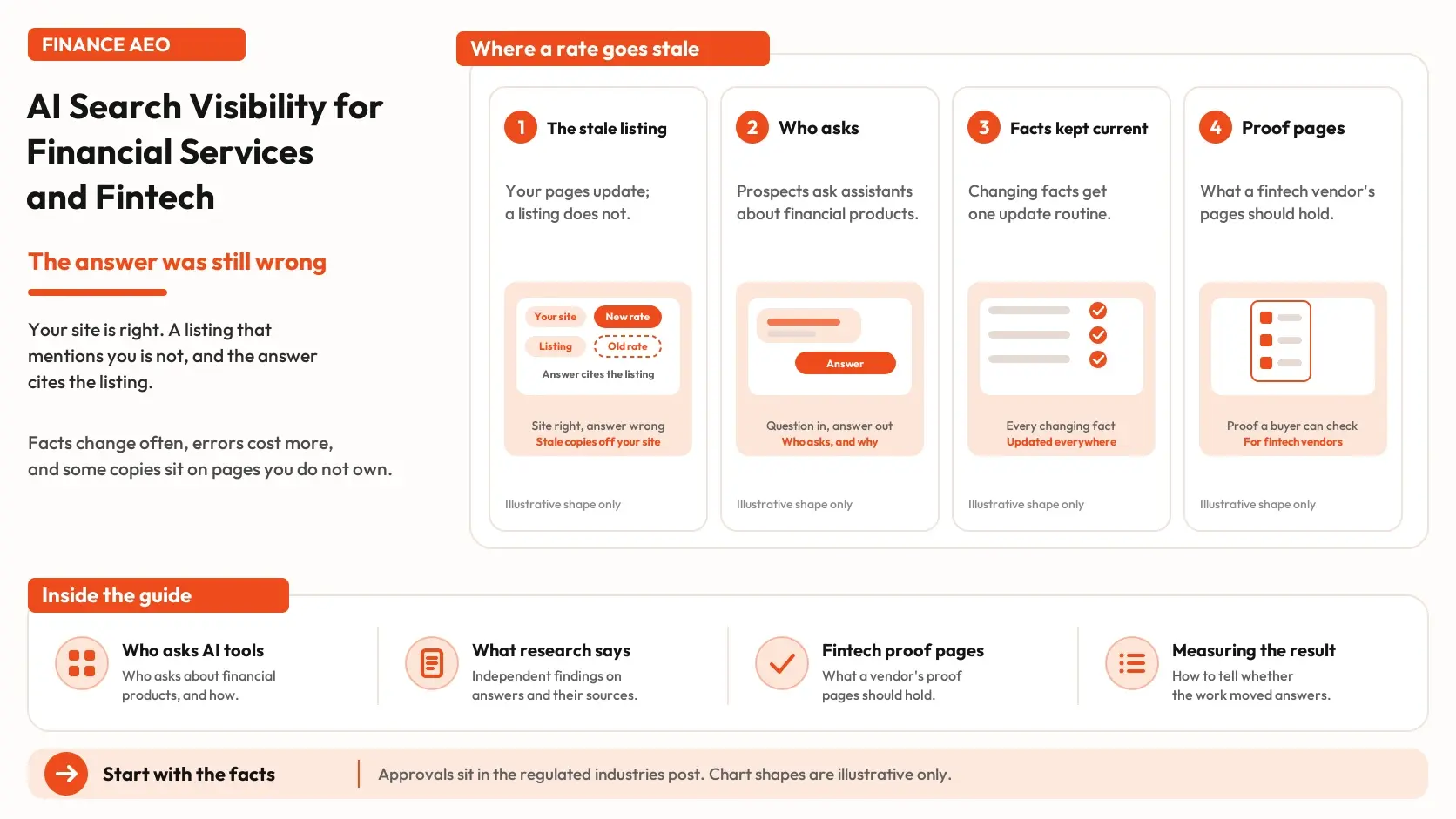


Your interest rate is correct. Your fees are up to date. Your product page has been reviewed. So why is AI giving potential customers outdated information about your financial product?
Because AI answers depend on more than what you publish on your own website. Third-party comparison sites, review platforms and other sources can shape what customers see, even when their information no longer reflects your current offering.
For fintech and financial services teams, this makes AEO an ongoing accuracy challenge. This guide covers how customers research financial products through AI, what research reveals about answer accuracy and citations, how to keep changing product facts current, what vendor proof pages need to demonstrate, and how to measure visibility. For claim approvals and escalation processes, see our guide to AEO for regulated industries.
Why finance asks more of an answer
Google treats money topics as a higher-stakes category. Its guidance on helpful content says trust is the most important part of E-E-A-T, that its systems weigh E-E-A-T more heavily for topics that affect people's finances, and that this kind of content should be highly accurate and consistent with established expert consensus (Google Search Central, helpful content, updated October 2026). That is guidance about Google's ranking systems, and it tells you what a careful reader and a careful system both want from a page about rates, fees and eligibility.
Google also says there are no additional requirements or special optimizations for its AI Overviews and AI Mode beyond normal search fundamentals, that no special structured data is needed, that structured data you do use should match the visible text, and that important content should be available as text (Google Search Central, AI features and your website). For a finance brand, that points to a plain job: put the current, dated, accurate facts in visible text on pages that are easy to read.
Who is asking, and about what
Finance has at least four kinds of asker, and each uses different questions. The prompts below are illustrative examples of ours, not data about what people type.
| Asker | Illustrative prompts | Facts that decide the answer |
|---|---|---|
| Consumer comparing accounts | "Which savings accounts have no monthly fee?" | Rate, fee, minimum balance, eligibility |
| Small business owner | "Business checking with accounting integrations" | Fees, limits, integration list |
| Finance team evaluating a fintech vendor | "Payments API with a security audit and fast settlement" | Security certification, pricing model, settlement time, integrations |
| Adviser or analyst | "How does [product] compare with [other product]?" | Features, licensing or registration, published terms |
Two pieces of independent research sit behind the idea that these askers are real. In the 2024 National Financial Capability Study, run by the FINRA Investor Education Foundation, 23 percent of respondents were interested in AI-based financial advice, and people who already used fintech services were much more likely to be interested (an odds ratio of 2.20) (Reiter, Journal of Financial Planning, July 2026). The study measured interest, not use, the survey did not define "AI-based financial advice," and the data is from 2024. It is cross-sectional, so it shows an association, not a cause.
On the work side, a Federal Reserve Board note using the Real-Time Population Survey found that about 63 percent of workers in finance used generative AI for work as of November 2025 (Federal Reserve Board FEDS Note, April 2026). That says people in finance use these tools. It does not say they use them to shortlist vendors, and the note does not look at that.
What the research says about accuracy and sources
The first tested accuracy on personal finance questions. Researchers at North Dakota State University put 554 questions from two financial literacy quizzes to ten models, with no added context, and scored each answer right or wrong. The mean accuracy was about 68 percent. Averages by model ran from about 53 percent to about 80 percent, and some models scored 40 percent on credit card questions.
The authors note that the models rely on historical training data, so their answers can be out of date (Hean, Saha and Saha, arXiv 2412.19784, an accepted draft for Applied Economics). Read the study for what it is: quiz questions, 2024 model versions, and no test of engines that search the web at answer time. It supports one narrow point. A model's general knowledge of finance is uneven, and anything that changes quickly is the weakest part.
The second compared where answers come from. A team at HKUST (Guangzhou) and Rutgers ran 55,936 queries through six AI search engines and two traditional engines in mid-2025. Only 38 percent of the domains in the AI results were shared with traditional search, 37 percent were unique to the AI engines, and the AI engines cited fewer domains per response on average (3.4, against 7.3) (Zhang et al., arXiv 2512.09483).
The queries were not limited to finance. The practical reading is that your search ranking list is not your citation list, so look at which domains the answers cite for your own prompts. Citations and mentions are different things to count, and the cited domain is often the clue to which copy of a fact is being read.
Keep changing facts current
Most of a financial brand's risk sits in a short list of facts that move: rates, fees, limits and thresholds, eligibility rules, licensing or registration statements, security certifications, integration lists and pricing plans. We use one rule for all of them. Each fact gets one dated record with its value, its effective date, an owner and a next-review date, and every copy is checked against that record.
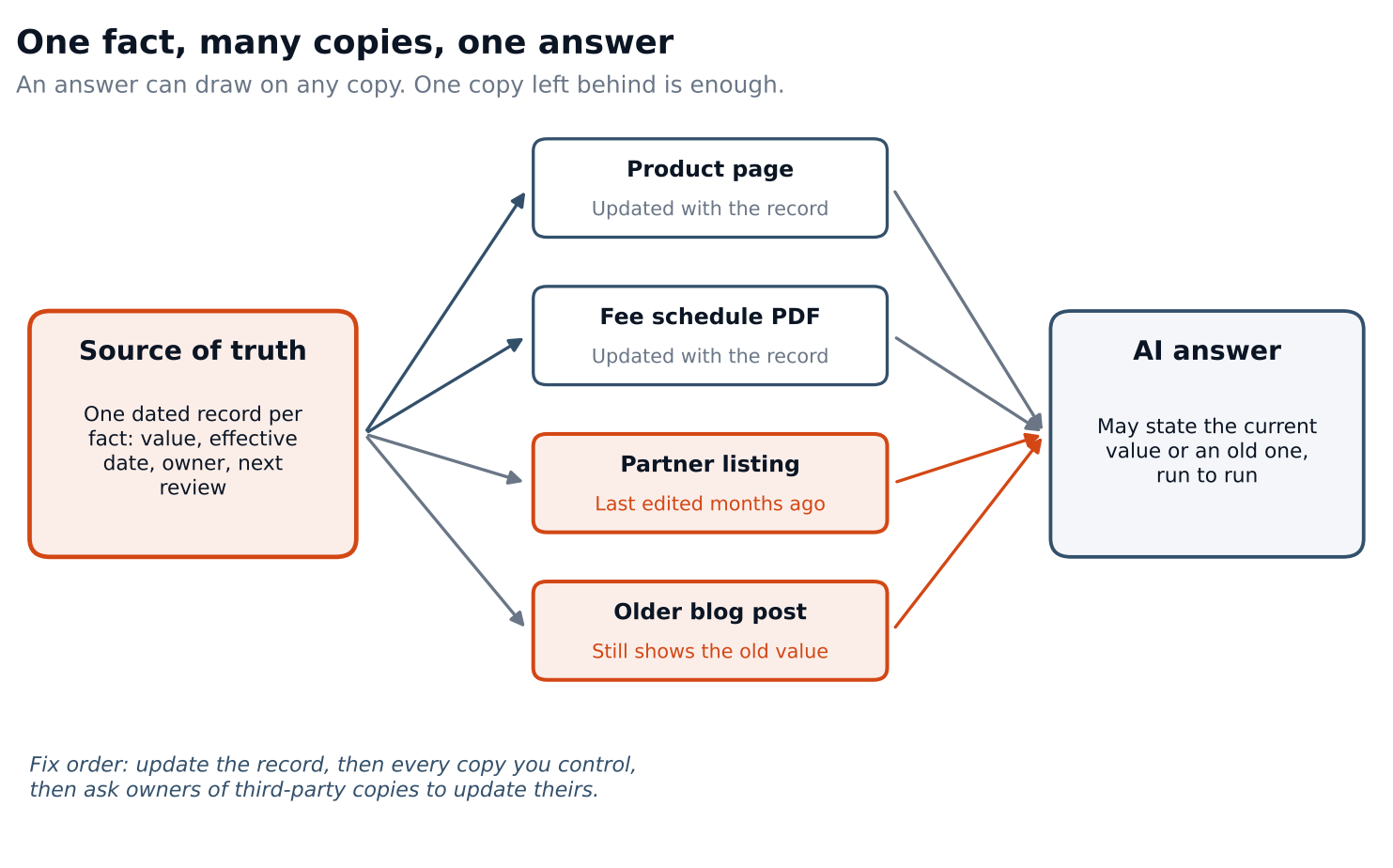
Figure 1. One fact, many copies, one answer. An answer can draw on any copy, so one copy left behind is enough.
The table shows where old copies tend to hide. The "why it goes stale" column is our judgment, so replace it with what you know about your own products.
| Fact type | Why it goes stale | Where old copies hide |
|---|---|---|
| Rate or APY | Changes often, sometimes by market move | Comparison listings, older posts, email archives |
| Fee or limit | Changes on a product update | Fee schedule PDFs, help articles, partner pages |
| Eligibility rule | Changes with policy or partner terms | Application pages, FAQs, directory entries |
| Licensing or registration | Changes with a charter or partner bank | Footers, regulator or registry entries, press kits |
| Security certification | Renews on a cycle | Trust pages, security questionnaires, marketplace profiles |
| Integration or partner list | Changes with releases | Partner directories, marketplace listings, older case studies |
Three habits help. First, put the current value and its effective date in visible text on the page that owns the fact, with "as of" wording where the value can change. Do not leave the only copy in an image, because Google's guidance is that important content should be available as text. Second, search your own site for the old value whenever a fact changes, and update or retire every page that still states it.
Third, keep a list of third-party copies you know about, and ask each owner to update theirs. We did not find a verified way to make an engine drop an old value, and that is covered in the regulated industries post. The reliable lever is to make the current value easy to find in more places than the old one. Review speed matters, and a calendar alone will not cover the fastest-changing facts. The model below is not data. It assumes changes arrive at random and a copy is corrected only at its next review.
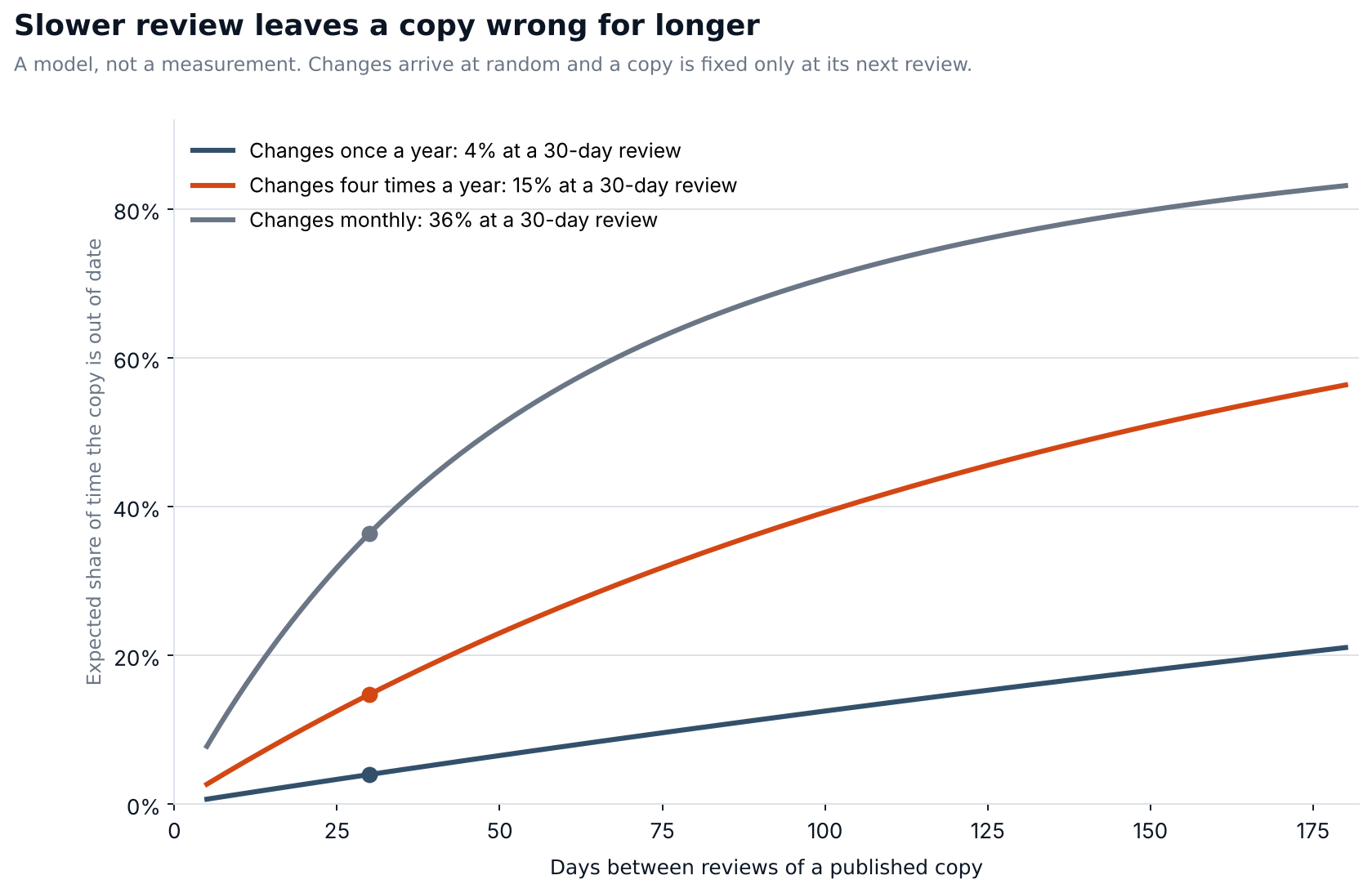
Figure 2. A model of how review speed changes the time a copy is wrong. It is a model, not a measurement of any engine.
A fact that changes four times a year and is reviewed every 30 days is out of date about 15 percent of the time in this model. If it changes monthly, the same 30-day review leaves a copy out of date about 36 percent of the time, and even a weekly review leaves it out of date about 11 percent. For the fastest facts, tie the update to the change itself: the person who changes the rate updates the record and every copy you control that day, and the calendar review is the backstop.
What a fintech vendor's proof pages should hold
If you sell to banks, credit unions or finance teams, the questions are about proof. A finance team evaluating a vendor will look for security evidence, licensing or registration, who supports the product, how it integrates, how it is priced and how long implementation takes. We suggest one plain-text page section for each, with an owner and a date.
| Proof area | What to state in plain text |
|---|---|
| Security | Which independent audit or certification you hold, when it was issued, and how a buyer can get the report |
| Licensing or registration | What you are licensed or registered for and where, or which partner institution holds the accounts, with a link to your disclosure page |
| Integrations | The named tools you integrate with, kept in step with your release notes |
| Pricing model | How you charge, even if the exact numbers need a conversation |
| Implementation | Typical steps and the timeline you will stand behind |
| Support | Hours, channels and who owns the account after the sale |
The buyer prompt library is a good place to find how a buyer might ask about these in other categories. Write the pages so a reader, human or machine, can lift a single fact from a heading and a sentence without reading the whole page. Have compliance approve the wording as it would for any claim.
Choose prompts by product and fact type
Track a fixed set of prompts for each product, and keep each prompt tied to the fact it tests. For a savings product that means one prompt each for the rate, the fee, the minimum, the eligibility rule and the licensing statement, asked as a buyer would ask them, with branded and non-branded versions reported separately. Designing prompts for AI visibility tracking covers the rules, and the same questions should be asked the same way each time so changes in the answer reflect changes in the answer, not in the prompt.
Answers vary from run to run (why citations change between runs), so one clean check proves little. Re-run the prompts for any fact right after it changes, then on a regular schedule matched to how often it moves (how often to track AI search). For each saved answer, record the value it stated, whether it matched your record, and what kind of source it cited: your own site, a partner or marketplace listing, a review or directory page, a regulator or registry, a news or blog page, or no source.
Read the results with ranges
Report issues as a share of answers checked, with the number checked beside it. With 24 saved answers, an issue share of 46 percent has a 95 percent range of about 28 to 65 percent, which is wide enough that you should not rank products on small differences. The worksheet applies the same range to each product and to each source type.
The table below comes from the worksheet's invented example rows. It is not a finding.
| Source type cited | Answers citing it | Answers with an issue |
|---|---|---|
| Own site | 10 | 0 |
| Partner or marketplace listing | 4 | 4 |
| Review or directory page | 5 | 5 |
| News or blog page | 2 | 2 |
| No source cited | 3 | 0 |
In this invented example every issue traces to a copy outside the brand's own site, so the fix list starts with partner listings and directories, then older posts. Your own data may look different, and the point of the table is the method: sort issues by the source they cite, then fix the copies you can reach first. An answer that looks right does not clear a prompt, and repeated runs treated as independent give a best-case range.
Track every fact in one worksheet
The worksheet has a fact register, an answer log and a summary. Grey rows are invented examples with invented products and values, so replace them before you read any output.
- On the Settings tab, set the as-of date, the days before a review that count as due soon, the days an issue may stay open, your product list, and for each fact type the changes per year you expect and the review interval in days.
- On the Fact register tab, add each fact with its product, type, value as published, effective date, owner, the number of copies you control and third-party copies you know of, and the date you last reviewed it. The next review date, status and modeled out-of-date share are calculated.
- On the Answer checks tab, log each saved answer with the fact it tests, what it stated, the result, the source type it cited and the handling status. Days open and the overdue flag are calculated.
- On the Summary tab, read each product's issue share with its range, the issues by source type, and the model of how review speed changes the time a copy is wrong.
Frequently asked questions
Should rates and fees be in a calculator, a PDF or plain text?
Put the current value and its effective date in plain visible text on the page that owns it. Google's guidance is that important content should be available as text. We did not test which engines read calculators, scripts or PDFs, so do not rely on them as the only copy of a fact.
Do partner and marketplace listings matter?
They can. In the source study above, AI engines cited a different mix of domains from traditional search, so a listing can be the page an answer cites even when your own page ranks well. Check which domains your tracked prompts cite, keep a list of the listings that carry your facts, and ask each owner to update theirs. We found no study that measures how much a listing changes an answer.
Do we need special structured data?
Google says no special structured data is needed to appear in its AI features, and that any structured data you use should match the visible text. Keep it consistent with the page, and do not treat it as a substitute for stating the fact in text.
Who should own the record for a rate, fee or certification?
One named person per fact, with compliance or legal approving the wording where your rules require it. The owner updates the record, then the copies you control, and logs the date. The regulated industries post covers review tiers and escalation.
Is this for banks and lenders only, or for fintech vendors too?
Both, with different fact lists. A bank or lender is mostly managing consumer-facing rates, fees, limits and eligibility. A fintech vendor selling to finance teams is mostly managing security evidence, integrations, pricing model and implementation. The one-record-per-fact method and the answer log work for either.
Date-stamp your five fastest-changing facts this week
List the five facts that change most often across your products. For each, find every copy you can: your product page, PDFs, help articles, older posts, and the partner and directory listings you know of. Write one dated record for each fact with an owner. Then save one answer to a plain question about each, note what it stated and which kind of source it cited, and fix the copies that disagree with the record, starting with the ones you control.
If you want a first reading on one of those questions before you build the log, the AI Search Visibility Checker gives you one. If you want to ask the same rate, fee and trust questions about each product over time, AI Search Intelligence tracks individual prompts, so the questions stay fixed while the facts change.