


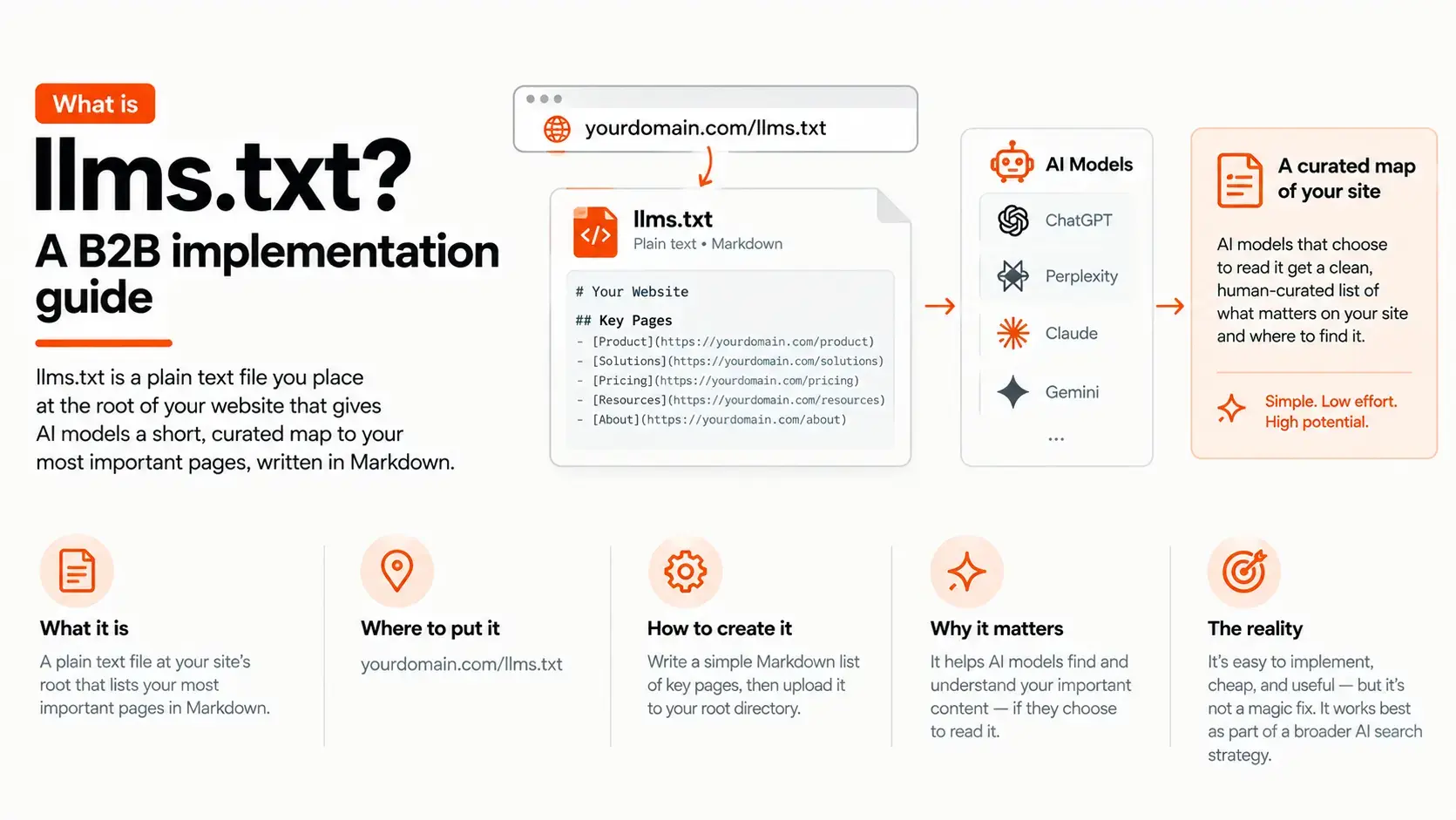


llms.txt is a plain text file you place at the root of your website that gives AI models a short, curated map to your most important pages, written in Markdown. Think of it as a table of contents built for language models rather than for people or search crawlers. You publish it at yourdomain.com/llms.txt, and any tool that chooses to read it gets a clean, human-curated list of what matters on your site and where to find it.
That is the whole idea. It is simple to make, it costs almost nothing, and it has become one of the most talked-about tactics in AI search circles. It has also been badly oversold. So this guide does two things: it shows you exactly how to write and publish a good llms.txt file for a B2B site, and it tells you, plainly, what to expect from it. Both matter, because the gap between the pitch and the reality is where a lot of teams waste a week.
What the file is, in one paragraph
An llms.txt file is a Markdown document with a specific, loose shape: a top-level heading with your company or project name, a one-line summary of what you do, and then grouped lists of links to your best pages, each link followed by a short description. The name is fixed and lowercase: llms.txt. The location is fixed: the root of your domain. Everything else, the sections and which pages you include, is your editorial call. Because it is Markdown, it is readable by a person and trivially parseable by a machine, which is the point. It is not code, it is not configuration, and it does not change how your site behaves. It is a hint.
Where the idea came from
The proposal came from Jeremy Howard, co-founder of Answer.AI, in September 2024, and the spec lives at llmstxt.org. The reasoning behind it is sound. Language models work with a limited context window, and raw HTML pages are full of navigation, scripts, cookie banners, and markup that waste that window and bury the actual content. An llms.txt file, plus an optional companion called llms-full.txt that holds the concatenated text of your key pages, gives a model clean, ready-to-use content without the noise. For anyone building tools on top of LLMs, or pasting documentation into a model, that is a real convenience.
It is worth being precise about what was proposed and by whom, because the origin gets stretched. This is a community proposal from one respected practitioner and his company. It is not a standard published by OpenAI, Google, Anthropic, or a standards body, and adopting it is voluntary on both sides: you choose to publish one, and a tool chooses whether to read it.
What an llms.txt file looks like
The structure is small enough to hold in your head. There are five parts, and they go in order.
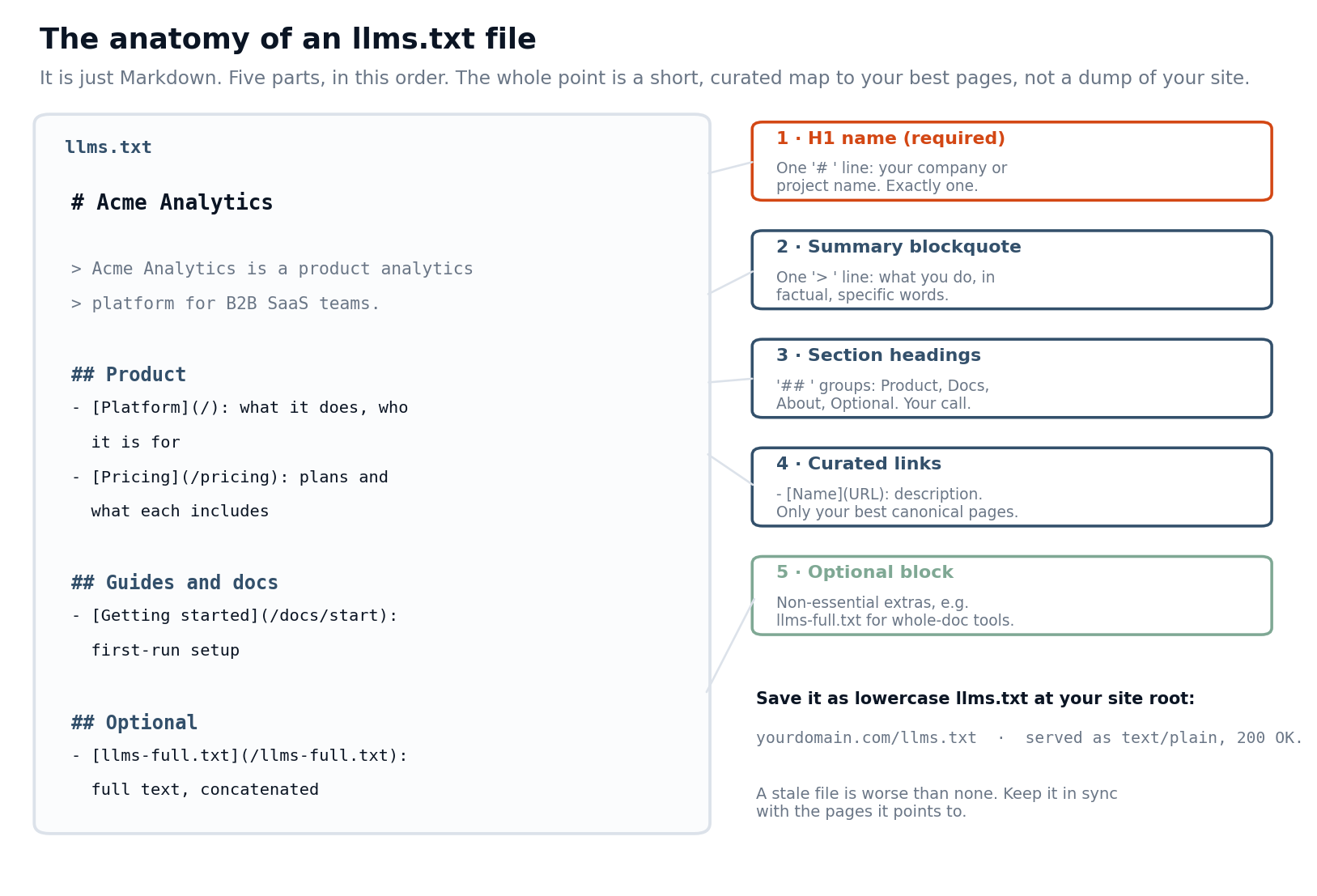
First, a single top-level heading with your name, written with one hash and a space. There should be exactly one of these. Second, a blockquote summary, a line beginning with a greater-than sign, giving one or two factual sentences about what you do and who you serve. Third, section headings written with two hashes, grouping your links into buckets like Product, Guides and docs, and About. Fourth, the links themselves, each as a Markdown bullet in the form of a bracketed name, a URL in parentheses, then a colon and a short description. Fifth, an optional section, conventionally headed Optional, for things that are useful but not essential, such as a link to your llms-full.txt.
The descriptions are the part people skip and the part that does the work. A bare list of links tells a model very little. A link followed by a specific description tells it what each page is for, which is exactly the context that makes the file worth reading.
How it differs from robots.txt and sitemap.xml
If you have worked on a website you already know two other files that live at the root: robots.txt and sitemap.xml. It is tempting to file llms.txt in the same mental folder, but they do different jobs, and confusing them leads to bad decisions.
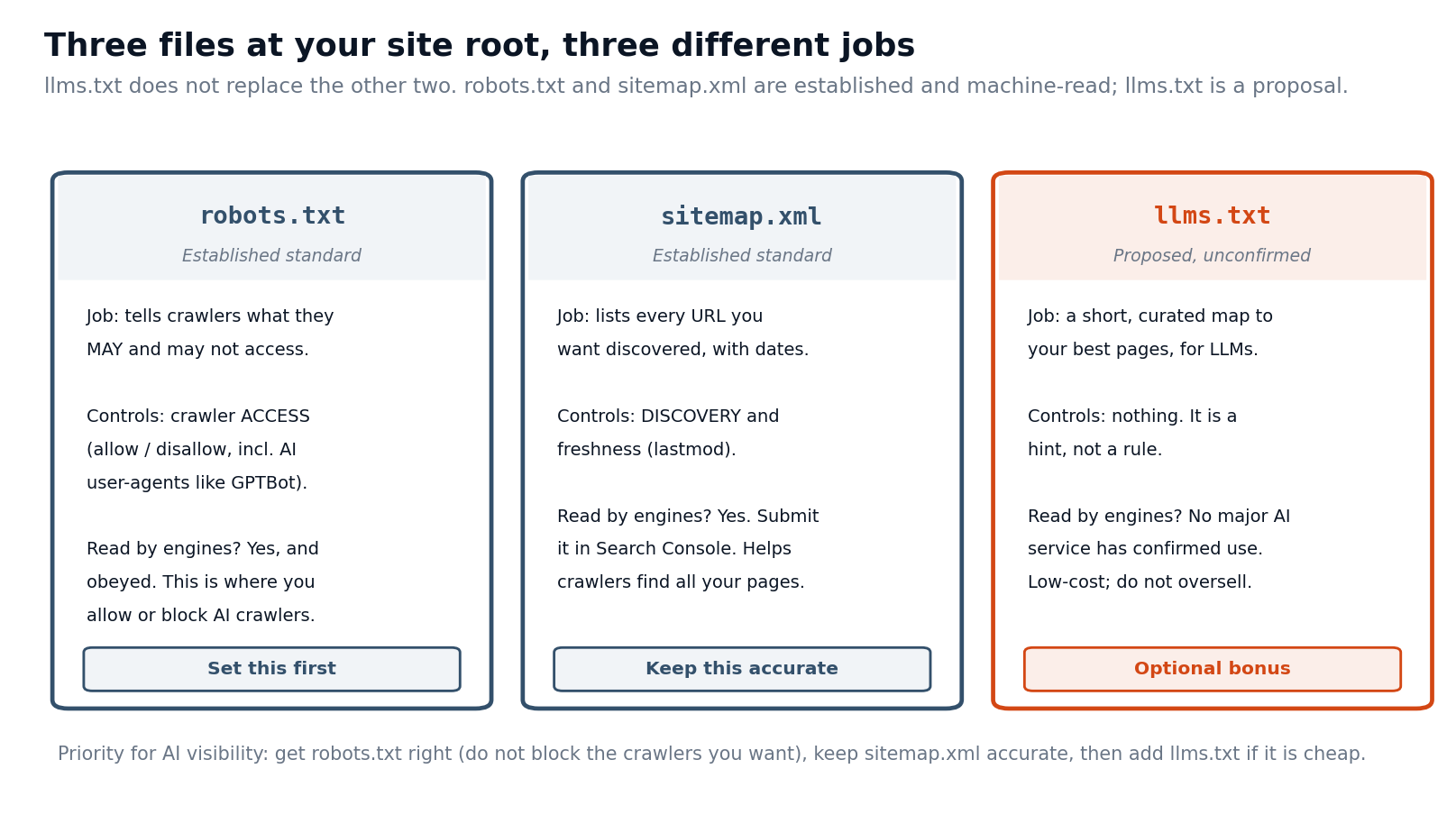
robots.txt controls access. It tells crawlers, including AI crawlers with user-agents like GPTBot and ClaudeBot, what they are allowed to fetch. Engines read it and obey it. It is the file that actually decides whether an AI crawler can reach your content at all, which makes it far more consequential for AI visibility than llms.txt. sitemap.xml controls discovery. It lists every URL you want found, with last-modified dates, and search engines read it and use it. Both of these are established, machine-read, and load-bearing.
llms.txt controls nothing. It does not grant or deny access, and it does not guarantee discovery. It is a curated suggestion that a tool may or may not consult. That is not a criticism of the format, it is just its nature, and it sets the priority order: get robots.txt right first so you are not accidentally blocking the crawlers you want, keep your sitemap accurate, and then add llms.txt as a low-cost extra. If you want the full picture of the access-and-rendering layer, our B2B guide to technical AEO covers robots.txt, AI crawlers, and rendering in depth.
How to write one for a B2B site
Here is a working template for a generic B2B SaaS company. Copy it, swap in your own name, summary, and pages, and delete the notes block before you publish. You can also download the full version at the end of this guide.
# Your Company
> One or two sentences on what your company does and who it is for.
> Keep it factual and specific: a model uses this line to describe you.
## Product
- [Platform overview](https://www.example.com/): what the product does and who it is for
- [Pricing](https://www.example.com/pricing): plans and what each includes
- [Key feature](https://www.example.com/feature): the capability and the problem it solves
- [Security](https://www.example.com/security): security and compliance posture
## Guides and docs
- [Getting started](https://www.example.com/docs/getting-started): first-run setup
- [Core how-to guide](https://www.example.com/blog/how-to-guide): your best educational asset
- [Comparison page](https://www.example.com/vs-competitor): how you compare, in your buyers' words
## About
- [About us](https://www.example.com/about): company, team, and what you stand for
- [Customer results](https://www.example.com/customers): named outcomes and case studies
## Optional
- [llms-full.txt](https://www.example.com/llms-full.txt): the full text of the pages above, concatenated
Pick pages a buyer or a model would actually want, not pages you want to promote. The best candidates are your canonical, evergreen assets: the product overview, pricing, security, your strongest educational guides, and clear proof of results. Leave out thin pages, campaign landing pages, anything gated, and anything with tracking parameters in the URL. A short file of ten to twenty excellent links beats a long file that mirrors your whole site. The instinct to include everything is the most common way to make the file useless.
Write descriptions the way you would brief a new hire on each page in one line. Specific and factual beats clever. If your pages are already written so a machine can lift a clean answer from them, the file points to content that pays off; if they are not, the file points to weak pages. That upstream work matters more than the file itself, and our guide on how to structure B2B content for LLMs covers it.
Save the file as plain text named exactly llms.txt, all lowercase, and place it at your domain root so it resolves at yourdomain.com/llms.txt. Serve it with a 200 status and a Content-Type of text/plain. That is the entire technical requirement. Most content management systems let you add a root file directly or through a redirect, and a developer can do it in minutes.
Does it actually help you get cited?
This is the question that matters, and the honest answer is: probably not much, at least not yet, and not on its own.
Here is what is true today. No major AI search service has confirmed that it reads llms.txt to decide what to cite. Google has publicly compared the idea to the old keywords meta tag, a signal that sounded useful, was easy to game, and ended up ignored.
The AI crawlers that feed the big assistants find your content the ordinary way, by crawling your pages, not by reading a curated hint file. So if your goal is to be cited more often in ChatGPT, Perplexity, or Google's AI answers, llms.txt is not the lever. The levers are the ones that were always the levers: content a model can extract a clean answer from, technical access so crawlers can reach it, and enough authority and consistency that engines trust you.
Here is what is also true. llms.txt has a real, proven use that has nothing to do with search citations: it makes your documentation easy to feed into AI tools. When a developer, a prospect, or a support agent wants to load your docs into a model to ask questions, a clean llms.txt or llms-full.txt turns that from a copy-and-paste chore into a single link. For companies whose buyers evaluate the product by working with it, that convenience is worth something on its own.
So the format is neither a scam nor a silver bullet. It is a cheap, tidy convenience with an uncertain future as a ranking signal. Treat it that way and you will not be disappointed. Treat it as an AI-visibility strategy and you will spend effort that belongs elsewhere.
When it is worth doing
Publish an llms.txt file if you already have documentation or a set of strong, canonical pages, and producing the file costs you an hour or two. The downside is close to zero and the upside, better ingestion by AI tools now and a small hedge if adoption grows later, is real enough. It is a reasonable thing to have.
Do not publish one, or at least do not prioritize it, if your pages are not yet structured so a model can pull clean answers from them, if AI crawlers are blocked at your robots.txt or CDN, or if you are treating the file as a substitute for that foundational work. Fixing what a crawler can actually reach and read will do far more for your visibility than any curated hint file. If you are unsure whether AI engines can even fetch your pages, start with the technical layer, not with llms.txt.
Mistakes that make it worthless
Dumping the whole site is the big one. An llms.txt with two hundred links is a sitemap wearing a costume, and it defeats the purpose, which is curation. Keep it short and high-value. Letting it go stale is the next one. A file that points to pages you have moved, renamed, or deleted is worse than having none, because it actively misleads any tool that reads it. If you publish one, put it on the same review cycle as the pages it links to.
Including the wrong URLs is a quiet failure. Tracking parameters, staging links, gated pages, and anything sensitive do not belong in a public file that you are handing to machines. Use clean, canonical, public URLs only.
Confusing it with robots.txt is the costly one. Some teams add an llms.txt and feel they have handled AI, while their robots.txt or Cloudflare settings are still blocking GPTBot and the other crawlers by default. The hint file does nothing if the crawlers cannot reach your content in the first place.
How to check yours works
You do not need tooling to verify the basics. Open yourdomain.com/llms.txt in a browser: it should load as plain text and return a 200 status, which you can confirm in your browser's network tab or with a quick request from your developer. Read it as if you were a model with no other context, and ask whether the summary and the descriptions would let you accurately describe the company and route someone to the right page. If a link is dead or a description is vague, fix it. Then, separately, confirm the thing that actually gates AI visibility: that your robots.txt is not blocking the AI crawlers you want, and that your key pages return their content in the served HTML. Those two checks matter more than the llms.txt file itself.
Frequently asked questions
Is llms.txt required?
No. It is optional and voluntary. Nothing breaks if you do not have one, and no engine penalizes you for skipping it.
Will llms.txt get me cited more in ChatGPT or Perplexity?
There is no confirmation that these services use it to decide citations, so do not count on it for that. It helps most as a clean way to feed your content into AI tools.
What is llms-full.txt?
An optional companion file that contains the full text of your key pages concatenated into one document, so a tool can ingest everything in a single fetch rather than following each link.
Do I still need robots.txt and sitemap.xml?
Yes. Those are the established, machine-read files that control crawler access and discovery. llms.txt does not replace either, and getting them right matters more.
How often should I update it?
Whenever the pages it links to change. Tie it to your normal content review so it never points to moved or deleted pages.
Is there a downside to publishing one?
Almost none, as long as it is short, accurate, and kept current. The only real risk is treating it as a visibility strategy and neglecting the work that actually earns citations.
Where to start this week
If you have solid documentation and canonical pages, spend an hour building an llms.txt from the template above, publish it at your root, and move on. Do not let it become a project. The higher-value work sits underneath it: making sure AI crawlers can reach your pages, and making sure the pages themselves are written so a model can lift a clean, correct answer. Get those right and the citations follow, with or without a hint file.
Then confirm it is working. The point of any of this is to show up in AI answers, so check whether you actually do. You can see where you stand right now with our AI Search Visibility Checker, and if you want to track whether your pages are being cited over time, that is what live model checks are for. Omnibound's AI Search Intelligence shows you which of your pages engines cite, so you can spend your effort on the work that moves the number rather than on files nobody has confirmed they read.