

Table Of Contents
Marketing leaders in B2B software and services constantly wrestle with the fact that AI‑generated copy can become stale the moment a new product page goes live, a competitor launches a fresh landing page, or the internal glossary is updated, and the lag creates missed opportunities in search visibility and pipeline signals. The typical cadence of a monthly website sync feels too slow when major site redesigns happen within the same month, leaving AI content out of sync and eroding buyer trust.
At the same time, expanding data sources such as Google Search Console introduces richer competitor intelligence but also adds complexity that most teams are not equipped to handle without a clear framework. By establishing a systematic, continuous data orchestration process that aligns website updates, competitor signals, and taxonomy mapping, you can keep AI‑driven assets current, authoritative, and tightly tied to intent data. This guide walks you through a practical, step‑by‑step approach that senior marketers can adopt today to eliminate bottlenecks, reduce reliance on manual adjustments, and boost overall search visibility.
Why Real‑Time Data Sync Matters for AI Content
When AI engines generate answers, they pull from the most recent indexed content; any lag between your website updates and the AI’s knowledge base creates a gap where outdated messaging can appear alongside fresh competitor insights, weakening your brand’s authority. Competitor intelligence that is not reflected in your AI‑ready assets can cause search engines to surface rival citations instead of yours, especially in a landscape dominated by zero‑click search where users rarely click through to a site. As one VP of Marketing put it, "we expect to sync with the website every month, but ... we are making really solid new changes on our websites over the next one month, and we would like it to be synced as we go along." That quote captures the core tension between the speed of change and the rigidity of monthly sync cycles. To stay competitive, you need a workflow that updates AI‑relevant content in near‑real time, ensuring that every new product feature, pricing tweak, or blog post is instantly available for citation.
Real‑time sync also amplifies the value of first‑party data because the most recent visitor behavior, conversion events, and on‑site interactions can be fed directly into prompt templates, aligning AI output with the actual buyer journey. According to a zero‑click search study, a significant share of searches now end at the SERP, making it essential that your AI‑generated snippets are accurate and up‑to‑date. By reducing the latency between content creation and AI ingestion, you improve the chances that your brand appears as the trusted source in those SERP answers, which directly influences pipeline generation.
Implementing a continuous sync strategy starts with defining the data freshness SLA for each content type, then selecting automation tools that can poll your CMS, extract changes, and push them to the AI indexing layer without human intervention. At the same time, maintain a lightweight manual review checkpoint for high‑impact pages to verify tone, compliance, and brand alignment before the data is published to the AI model. This hybrid approach balances speed with quality, ensuring that you capture the benefits of automation while preserving the strategic oversight needed for high‑stakes content.
Recommended Read: AI Consolidation in Marketing: Streamlining Tools for Quick Decisions - Explores how integrated data pipelines can accelerate AI‑driven marketing initiatives.
Mapping Your Website Structure to a Unified Taxonomy
Every piece of website content lives within a hierarchy pages, sections, tags, and metadata that must be translated into a common taxonomy so AI can retrieve the right information when a user asks a question. A unified taxonomy aligns product terminology, industry jargon, and buyer intent phrases, creating a shared language that bridges the gap between raw HTML and AI prompt structures. By normalizing headings, meta descriptions, and schema.org markup into standardized taxonomy nodes, you enable the AI engine to surface precise answers rather than generic, low‑relevance snippets. This step is especially crucial for structured content, where consistent data models improve both indexing speed and citation accuracy.
Below is a sample mapping matrix that shows how typical website elements map to taxonomy categories used in AI prompt engineering. The table illustrates the source field, the corresponding taxonomy node, and the recommended transformation rule.
| Website Element | Taxonomy Category | Transformation Rule | Example |
|---|---|---|---|
| Page Title (H1) | Product Feature | Extract key noun phrase | "Secure Data Transfer" → "Data Transfer Security" |
| Meta Description | Buyer Intent | Map to intent phrase list | "Find a scalable analytics solution" → "Analytics Scalability Intent" |
| Header Tags (H2‑H4) | Content Theme | Group by thematic cluster | "Integration Options" → "Integration Theme" |
The matrix demonstrates that a clear, repeatable mapping process reduces ambiguity and ensures that AI prompts reference the exact terminology buyers use, improving relevance and click‑through rates.
After establishing the mapping, embed the taxonomy into your content management workflow so that every new page automatically inherits the correct tags and schema. Use validation scripts to check for missing or mismatched taxonomy entries before publishing, and schedule periodic audits to reconcile any drift between the live site and the taxonomy repository. This disciplined approach not only supports topic clusters that reinforce topical authority but also feeds clean, structured data into the AI model, enhancing both search visibility and the quality of downstream pipeline signals.
Recommended Read: Connecting CRM, Support & Competitor Data for Unified B2B Intelligence - Shows how unified data models can power cross‑functional insights.
Integrating Competitor Signals and Search Console Insights
Competitor intelligence provides a real‑time benchmark for the topics and keywords that are resonating in your market, and feeding that data into AI content pipelines helps you close gaps before they widen. By pulling SERP position data, keyword rankings, and content themes from tools like Google Search Console, you can surface emerging keyword opportunities and align your AI prompts with the language that actually drives clicks. This integration also supports the creation of topic clusters that reflect both your own content strategy and the competitive landscape, ensuring that AI‑generated answers stay relevant and differentiated.
When you connect competitor URLs and search console data to your AI workflow, you create a feedback loop where performance metrics such as click‑through rates and impression share inform the next round of content creation. According to a SEO CTR study, structured content that aligns with high‑performing search intents can lift click‑through rates significantly, reinforcing the business case for continuous competitor signal harvesting. By tagging competitor insights with the same taxonomy used for your own site, you can compare gaps side‑by‑side and prioritize AI‑generated content that directly addresses unmet buyer questions.
To operationalize this, set up an automated extraction job that runs daily, pulls the latest search console reports, and maps the top‑performing queries to your taxonomy. Combine this with a competitor scraper that extracts headline structures, meta tags, and content outlines, then normalizes them into the same taxonomy framework. The result is a unified data lake where both first‑party and competitor signals coexist, ready to be fed into prompt templates that guide AI models toward the most impactful language.
Designing a Continuous Data Orchestration Pipeline
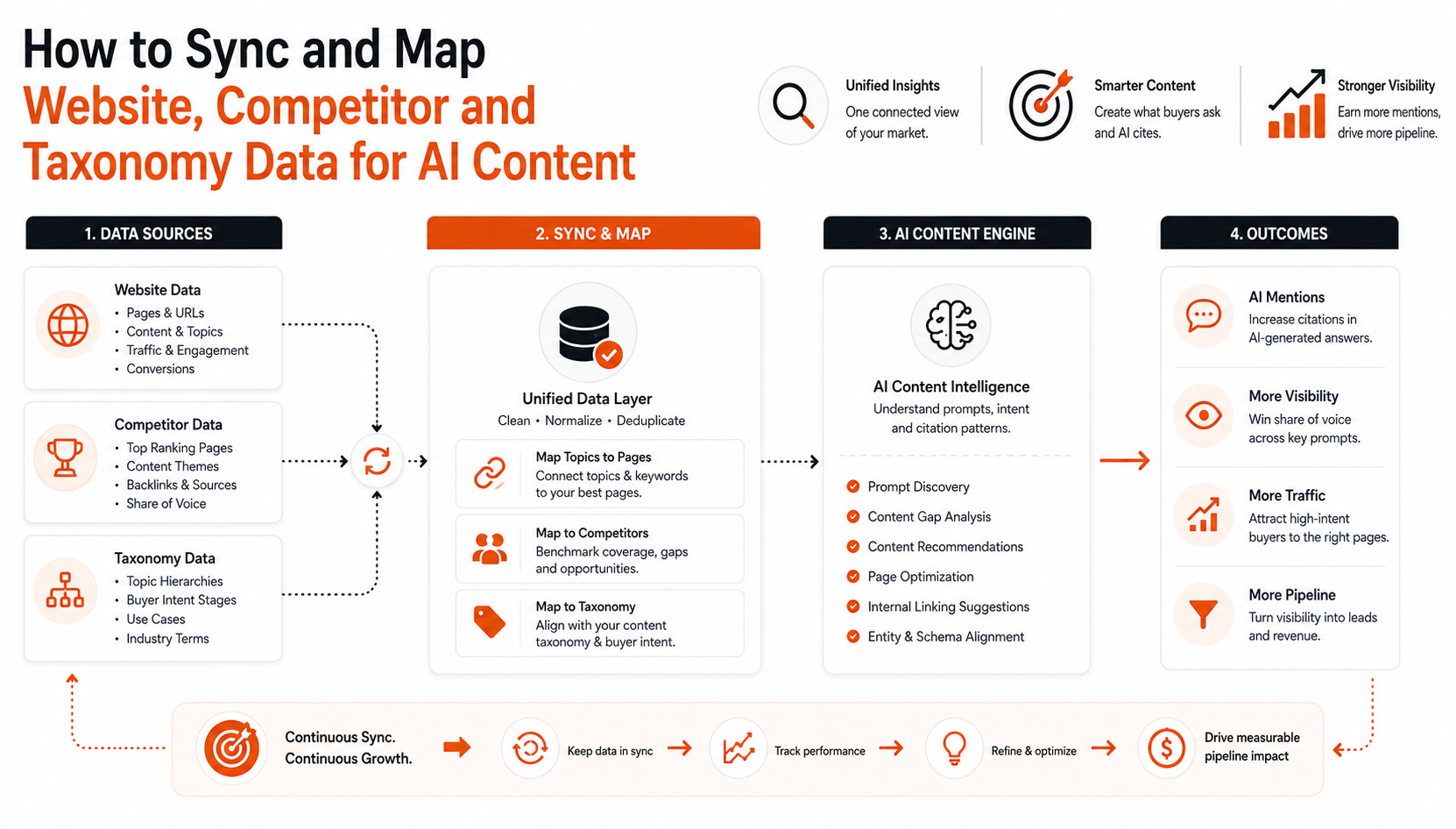
Data orchestration is the glue that binds website crawls, taxonomy updates, and competitor insights into a single, repeatable workflow that powers AI content generation at scale. The pipeline should consist of three core stages: extraction, transformation, and loading (ETL), each governed by clear success criteria and monitoring dashboards. Extraction pulls raw HTML, API feeds, and CSV exports; transformation normalizes fields, applies taxonomy mapping rules, and enriches records with intent tags; loading pushes the clean dataset into the AI indexing service where it becomes searchable for prompt generation.
Implementing the pipeline with a low‑code orchestration tool or a managed workflow service reduces engineering overhead while providing built‑in error handling, retry logic, and alerting. For example, schedule a nightly crawl of your CMS, trigger a transformation job that validates taxonomy compliance, and then invoke an API call to update the AI model’s knowledge base. By automating these steps, you eliminate the manual bottleneck that typically slows down content refresh cycles and you create a reliable source of truth for AI‑driven search visibility.
Even with full automation, retain a strategic manual oversight checkpoint for high‑value assets such as product launch pages or regulatory disclosures. Use a simple dashboard that surfaces pipeline health metrics run time, record counts, error rates and allows marketers to approve or reject changes before they are published to the AI layer. This hybrid model ensures that you benefit from the speed of automation while maintaining the quality and compliance needed for enterprise‑level content.
Balancing Automation with Manual Oversight and Measuring Success
While automation accelerates data sync, unchecked automation can introduce taxonomy drift, duplicate content, or compliance breaches, especially when new regulatory language emerges. A balanced approach pairs automated ETL jobs with periodic manual reviews that focus on high‑impact content, brand voice consistency, and legal compliance. Establish a review cadence weekly for critical pages, monthly for the broader site and assign ownership to senior marketers who can validate that AI prompts still reflect the intended buyer journey.
Success should be measured against concrete KPIs that reflect both AI performance and business outcomes. Track search visibility metrics such as impression share and citation rate, monitor the volume of pipeline signals generated from AI‑referenced assets, and evaluate the impact of structured content on click‑through rates. By correlating these metrics with the frequency of data sync events, you can quantify the ROI of a continuous orchestration strategy and make data‑driven decisions about where to invest further automation.
Finally, create a feedback loop where insights from the KPI dashboard inform the next iteration of the taxonomy and the data ingestion rules. This iterative cycle ensures that your AI content remains aligned with evolving market language, competitor moves, and internal product updates, delivering a sustainable advantage in the competitive B2B search landscape.
FAQs
1. How often should my website data be synced to keep AI content current?
For most B2B SaaS organizations, a near‑real‑time sync triggered by each CMS publish event provides the best balance between freshness and operational overhead. If your platform cannot support instant sync, aim for daily batch updates and supplement with manual refreshes for high‑impact pages. This cadence ensures that AI‑generated answers reflect the latest product features and messaging, reducing the risk of outdated citations that could confuse prospects.
2. What is the role of a unified taxonomy in AI‑driven content?
A unified taxonomy standardizes the language across your website, competitor data, and internal glossaries, enabling AI models to match buyer intent with the exact terminology used in your assets. By mapping page titles, meta descriptions, and schema markup to taxonomy nodes, you create a single source of truth that drives consistent prompt generation, improves citation relevance, and supports the creation of robust topic clusters.
3. How can competitor intelligence improve my AI content strategy?
Competitor intelligence uncovers gaps in your keyword coverage and reveals the topics that drive the most engagement for rivals. By ingesting competitor SERP data and aligning it with your taxonomy, you can prioritize AI‑generated content that fills those gaps, thereby increasing your citation share in zero‑click search results and strengthening overall search visibility.
4. What tools can help automate the data orchestration process?
Low‑code workflow platforms, cloud‑based ETL services, and API‑first integration hubs can automate the extraction, transformation, and loading of website, competitor, and taxonomy data. Look for solutions that offer built‑in scheduling, error handling, and monitoring dashboards so you can maintain pipeline health without writing extensive custom code.
5. How do I measure the impact of my sync and mapping efforts?
Key performance indicators include AI citation rate, search visibility (impression share), click‑through rates on structured snippets, and the number of pipeline signals generated from AI‑referenced content. By tracking these metrics before and after implementing a continuous sync pipeline, you can quantify improvements in content relevance, buyer engagement, and ultimately revenue influence.
Conclusion
Keeping AI‑generated content aligned with rapid website changes, competitor signals, and a coherent taxonomy is no longer a nice‑to‑have it is essential for maintaining search visibility and driving qualified pipeline signals in today’s AI‑first landscape. By adopting a continuous data orchestration pipeline, mapping every content element to a unified taxonomy, and balancing automation with strategic manual oversight, you create a resilient foundation that delivers timely, authoritative answers to buyer queries. Apply these principles to your own workflows, monitor the right KPIs, and watch your AI citations and pipeline influence grow steadily over time.
Recommended Authority Resources
- Reference: In 2026, Less than One Third of Google Searches Still Send a Click - Provides recent zero‑click search statistics that illustrate the importance of accurate AI citations.
- Reference: SEO CTR stats to inform your 2024 SEO strategy - Offers empirical data on how structured content improves click‑through rates, supporting the case for taxonomy alignment.
Turn Your Content Into AI-Search Winners
Get cited across ChatGPT, Claude & Perplexity — not just ranked on Google.
- Increase AI citations
- Improve answer visibility
- Track brand mentions in LLMs