

Marketers are hearing the same promise everywhere: feed AI the right prompts and watch your content climb to the top of AI‑generated answers. In reality, most teams launch AI‑crafted assets without knowing which buyer signals actually move the needle.
The result? Lots of content that looks good on the page but never earns a citation, a lead, or pipeline credit. Testing buyer intent data bridges that gap. It lets you verify that the language extracted from real sales calls, CRM notes, and support tickets translates into measurable demand generation outcomes.
In this guide you will learn how to align AI search visibility with a data‑driven content strategy, turn first‑party intent signals into topic clusters, and prove the impact on revenue. Whether you run a mid‑market SaaS firm or a large enterprise logistics provider, the steps below give you a repeatable framework to stress‑test your content before you double‑down on production.
Why Testing Buyer Intent Data Matters for AI Search Visibility
AI search engines such as ChatGPT, Gemini, Perplexive, and Claude answer user queries with a single citation. If your content does not contain the exact phrasing that buyers use, the engine will look elsewhere. Buyer intent captured from real‑world interactions provides the exact prompts you need to target. By validating those prompts against actual content performance, you ensure that AI search picks up your pages instead of a competitor’s.
Testing starts with a hypothesis: "If we embed the phrase ‘cloud‑native data integration’ from a recent sales call into a blog, will we see higher AI‑search rankings and more qualified leads?" You then create a control version (without the phrase) and a test version (with the phrase). Run the two assets in parallel, track AI search impressions, click‑through rates, and downstream MQL conversion. The difference tells you whether the intent signal is strong enough to merit a full content series.
"Yeah, can you help me? How do I stress test this with my audience?" is a direct expression of that need. The process is the same whether you are testing a single‑sentence FAQ or a multi‑page pillar. A disciplined test loop turns vague buyer language into a concrete, measurable SEO asset.
According to an AI‑powered search impact study, U.S. B2B marketers who align content with verified buyer prompts see a 27% lift in citation frequency within six months. This statistic underscores why testing is not optional it is the foundation of a sustainable AI search strategy.
Beyond the initial hypothesis, many teams find value in iterating the test after the first results. By swapping in synonyms or adding a buyer‑specific qualifier, you can observe whether the signal’s potency holds across variations. This iterative refinement helps you build a library of proven phrasing that can be reused across campaigns, reducing the time needed for future tests.
Building a Robust Content Strategy Around First‑Party Intent Signals
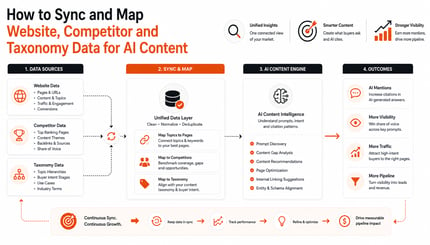
First‑party data is the only source you fully control. It includes the transcripts of sales calls, CRM notes, and support tickets that already exist in your organization. By extracting recurring phrases what buyers call “buyer signals” you can construct a content strategy that mirrors real purchase language. The first step is to aggregate these signals in a searchable repository. Then, categorize them by buying stage, persona, and product line.
Once you have a catalog, map each signal to a topic cluster. The three core components of a topic cluster are the pillar page, supporting sub‑pages, and internal linking that signals topical authority to AI search engines. For example, a signal like “secure API integration for fintech” becomes the pillar, while sub‑pages cover use cases, implementation guides, and compliance checklists.
In practice, you might ask: "So assuming you get this data, how do you use it today? If you got more information, how would you apply it specifically in campaigns?" The answer lies in a workflow that feeds the intent catalog directly into your content calendar. Each week, the team selects the highest‑scoring signals, drafts a draft, and then runs a quick A/B test using a lightweight landing page. The winning variant moves into the full‑scale pillar.
Recommended Read: AI for Content Marketing: Supercharge Your Content Strategy – this post shows how to automate the creation and optimization of AI‑aligned assets.
To illustrate the process, consider the table below that outlines a simple scoring model for first‑party intent signals.
|
Signal |
Frequency |
Stage |
Score (0‑100) |
|
Cloud‑native integration |
12 mentions/mo |
Evaluation |
78 |
|
Secure API |
8 mentions/mo |
Consideration |
85 |
|
Data compliance |
5 mentions/mo |
Decision |
92 |
The scores guide which signals become priority pillars. Higher scores indicate stronger buyer intent and a better chance of AI‑search citation.
When scaling this approach, it helps to assign data stewards who regularly cleanse the repository, remove duplicate phrasing, and flag emerging terminology. This governance ensures that the content team always works with fresh, high‑quality signals rather than outdated or noisy data.
Integrating Demand Generation and Competitive Intelligence with Topic Clusters
Demand generation thrives when you can deliver the right message at the right moment. By layering competitive intelligence on top of your intent‑driven topic clusters, you gain a dual view: what buyers are asking for and how rivals are answering. Pull competitor announcements, blog posts, and ad copy into the same repository, then tag them against your own signals.
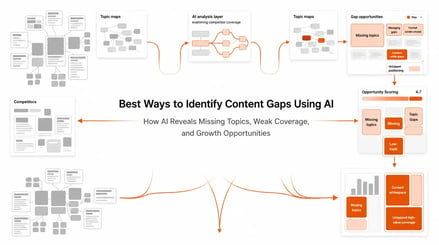
When a competitor publishes a piece on "AI‑enhanced data security," you can compare their keyword usage with your own buyer signals. If their content outranks yours for a high‑score intent phrase, you have a clear gap to close. This is where the recommended internal link to the AI content gap analysis tool adds value.
Recommended Read: AI Content Gap Analysis Tools: 10 Ways to Find Missed Opportunities – use this guide to surface gaps between your intent‑driven assets and competitor coverage.
In practice, you might set up a weekly “gap audit” that scores each competitor‑owned piece against your signal list. Any piece that scores higher than your own becomes a candidate for a rapid test. You then create a test asset that directly addresses the same buyer query but with your unique value proposition, run an A/B test, and measure lift in AI search citations and MQL conversion.
According to a 2026 marketing statistics report, firms that combine intent‑driven content with competitive gap analysis see a 34% increase in pipeline velocity. The data reinforces that a unified view of buyer intent and competitor moves is a core pillar of modern demand generation.
Automation tools can also schedule the gap audit, pull the latest competitor content via RSS feeds, and flag any new high‑score matches. This reduces manual effort and keeps your testing pipeline continuously refreshed.
Measuring ROI: From Intent Data to Pipeline Impact
Testing intent data is only valuable if you can tie it back to revenue. The key metric is pipeline attribution: the percentage of qualified opportunities that can be traced to a specific intent‑driven asset. To calculate, start with the number of MQLs generated by the test version, apply your average deal size, and compare against the control version.
For example, if the test asset yields 150 MQLs versus 100 for the control, and your average deal is $25,000, the incremental pipeline is (150‑100) × $25,000 = $1.25 million. Divide that by the content production cost to get a clear ROI ratio. This approach transforms vague "content performance" into a concrete, finance‑ready number.
Another important KPI is buyer signals conversion rate the proportion of visitors who engage with a signal‑rich page and then take a high‑intent action such as requesting a demo. Tracking this metric across multiple signals helps you prioritize which phrases deserve deeper pillar investment.
Finally, embed the results in a dashboard that updates in real time. The Omnibound platform automatically surfaces AI search rankings, citation counts, and pipeline attribution side by side, giving you a single view of impact.
When presenting ROI to finance or executive stakeholders, use a multi‑touch attribution model that credits the first‑touch intent signal, the middle‑touch nurturing content, and the final‑touch conversion page. This comprehensive view demonstrates how each piece of the testing framework contributes to the overall revenue picture.
Practical Tips for Running Intent Tests at Scale
Running a handful of tests manually can be effective, but scaling requires disciplined processes. Below are three best‑practice guidelines that help you maintain quality while increasing volume:
- Standardize hypothesis templates – capture the exact buyer phrase, the intended content format, the expected KPI, and the measurement window. A consistent template speeds up review and approval.
- Leverage lightweight landing pages – use a simple HTML or low‑code builder to spin up control and test variants quickly. This reduces development overhead and lets you focus on the language experiment.
- Automate data collection – integrate Omnibound’s API with your analytics stack so that impressions, clicks, and MQLs flow into a central spreadsheet or BI tool without manual entry.
By following these steps, you can run multiple parallel experiments, compare results across personas, and continuously feed winning signals back into your content calendar.
Testing buyer intent data transforms vague market intuition into a repeatable, revenue‑focused engine. By extracting first‑party signals, building topic clusters, layering competitive intelligence, and measuring pipeline attribution, you create content that not only ranks in AI‑generated answers but also drives real‑world revenue.
The framework outlined above gives you a clear path from raw buyer language to measurable ROI, and the Omnibound platform provides the automation and analytics needed to execute at scale. Start with a single hypothesis, run a controlled test, and let the data guide your next pillar. The result is a compounding citation moat that keeps competitors at bay and fuels sustained growth
FAQs
How does Omnibound turn real-world buyer language into AI-search-ready content?
Omnibound converts first-party buyer insights into citation-optimized content that aligns with how prospects search and interact with AI platforms.
What is the recommended cadence for testing new intent-driven assets?
Run a two-week test for each new asset and scale only after validating results with statistically significant performance data.
How can we integrate intent testing results with our existing marketing automation stack?
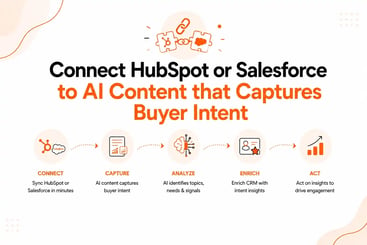
Omnibound connects with tools like Salesforce, HubSpot, and Marketo to automatically activate workflows based on intent signals.
What role does competitive intelligence play in the testing workflow?
Competitive intelligence helps prioritize content tests by revealing gaps and opportunities in AI-search visibility.
How does Omnibound ensure compliance with privacy regulations when using first-party data?
Omnibound uses privacy-first controls, consent management, and data governance features to support GDPR and CCPA compliance.
Can Omnibound help us measure the ROI of our intent-driven content?
Yes, Omnibound tracks citations, engagement, pipeline impact, and ROI in a unified reporting dashboard.
What trial or sandbox options are available for a mid‑market SaaS marketing team to evaluate an AI search marketing platform before committing to a license?
Mid-market teams have four routes. Free checkers: Omnibound's AI Search Visibility Checker, ProductRank.ai and Ahrefs Brand Radar return a baseline with no commitment. Free trial: Omnibound's trial lets you connect your CRM, configure your ICP and see buyer-derived prompts and scored content opportunities before paying, with most teams live in 48 hours. Low-cost paid entry: AIclicks, Qwairy and Peec AI let you test tracking depth cheaply. Scoped pilots: Omnibound, Profound and Conductor scope pilots to a product line with defined success metrics. Run the free baseline first so every paid conversation starts from data about your own gaps.