


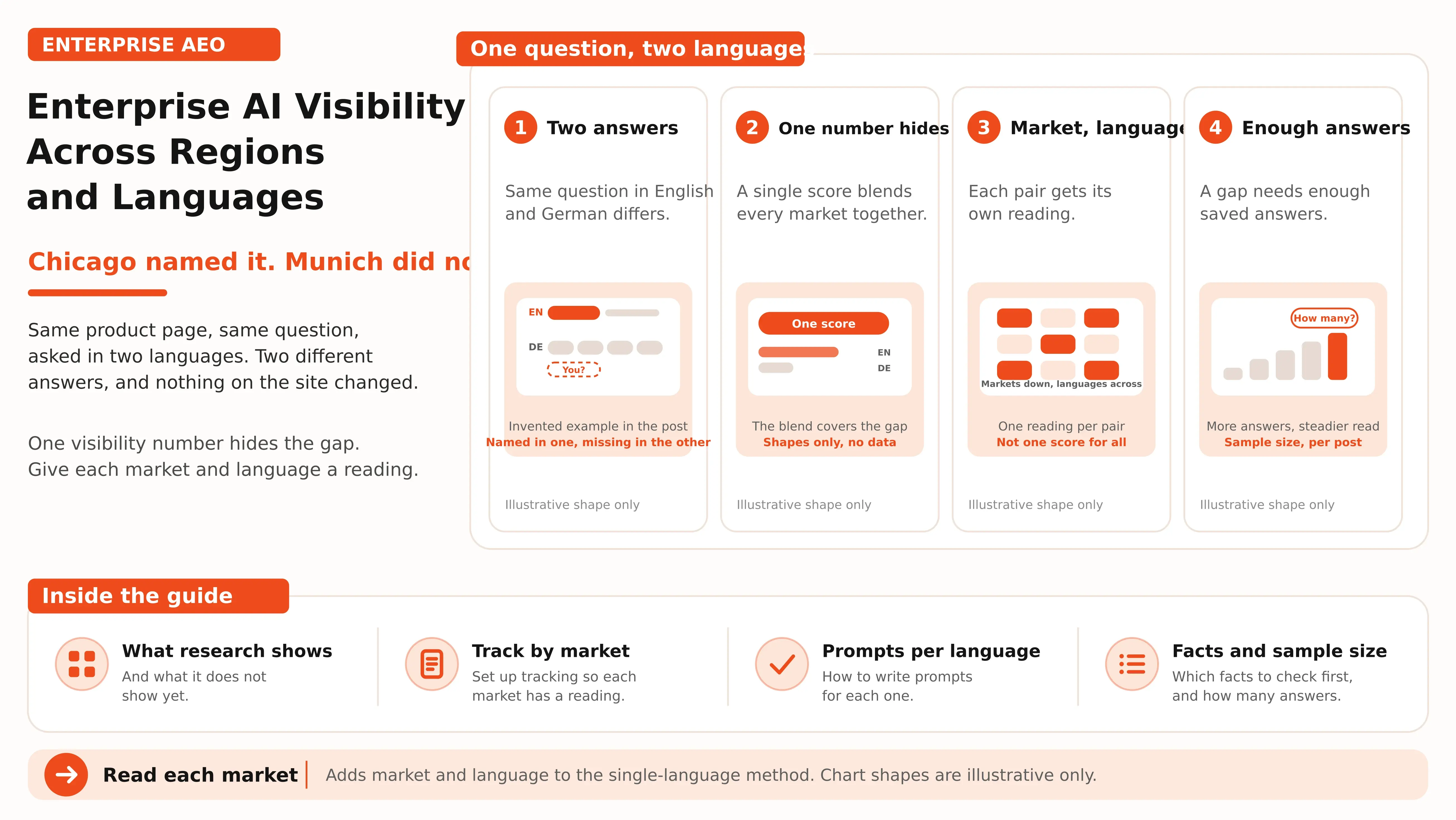


Picture a software company with the same product page in English and German. A buyer in Chicago asks an assistant for the best planning software for large companies, and the answer names the company in its first paragraph. A buyer in Munich asks the same question in German. The answer lists four other brands, cites two regional publications and never mentions the company. Nothing on the company's website changed between the two questions. This is an invented scenario, but it describes a gap that recent research has measured from several angles: answers differ by language, and the sources behind them differ too.
If you sell across countries or languages, one visibility number can hide this gap. This post explains what the research shows, how to track each market-language combination, how to write local prompts, which facts to check first, and how many saved answers you need before a difference means anything. How query phrasing changes which brands get cited covers the single-language method; this post adds market and language.
The same question can return different sources in another language
Three independent preprints measure different parts of this problem. Because AI products change often and none of the studies examines enterprise software buying, treat them as evidence that language and location can affect answers, not as measurements of your category.
A team from Beth Israel Deaconess Medical Center, Harvard Medical School and other institutions audited ChatGPT, Perplexity and Google's AI Overview on mental health queries. The audit used free, logged-out sessions from June 25 to July 20, 2026, with 20 English questions and three translated questions each in Spanish, Japanese, Ukrainian, Hindi, Nepali and Twi. In total, it collected 1,140 responses. On the shared questions, non-English queries surfaced fewer sources than English ones, a mean of 9.2 against 12.3. ChatGPT averaged 17.5 sources in English against 4.3 in Twi, and returned none for 33 percent of Twi and 23 percent of Japanese responses. Perplexity stayed between 8.6 and 10.2 across all seven languages. The authors note several limits: one audit window, free tiers only and just three questions per non-English language (Nguyen et al., arXiv 2609.00319).
A Politecnico di Milano team compared Baidu and Google in Chinese and English using 500 machine-translated queries collected in Milan from June 20 to July 10, 2026. Google showed an AI overview for 97.6 percent of the Chinese queries and 97.0 percent of the English ones. Baidu showed one for 82.0 percent of the Chinese queries but only 4.0 percent of the English ones. The overlap between the sets of websites cited was close to zero in every pairing, for example 0.034 between Google in Chinese and Google in English on a scale where 1 means identical. In other words, the same engine cited almost entirely different websites when answering the same questions in the two languages. The authors name machine translation, collection from one city, a logged-in Google session and uneven topics among the limits (Li et al., arXiv 2609.24407).
A Dartmouth preprint on health queries to Google's AI Overviews, run across 11 countries, compared English with each country's native language. Switching to the native language raised the share of localized citations, classified by domain, from 16.6 percent to 57.5 percent in Japan, from 11.5 percent to 40.2 percent in Singapore, from 4.6 percent to 42.1 percent in Malaysia and from 2.7 percent to 36.4 percent in South Korea. The analysis works at the domain level and cannot judge the accuracy of what was cited (Zha and Chang, arXiv 2609.06798).
Together, the studies show that answers can draw on different sources across languages, and that the size of the gap varies by engine: Perplexity's citation counts were steady across languages, while ChatGPT's were not. They do not show how your brand performs in each language. The rest of this post explains how to measure that.
Track cells, not countries
A cell is one market paired with one language. The United States in English is one cell; Germany in German and Germany in English are two others, since a German buyer can ask in either language and receive different answers. The United States and the United Kingdom also need separate cells: even when both use English, answers can draw on different sources by country. The Dartmouth study found that the share of localized citations in English-language queries was 48.2 percent in Australia, 41.3 percent in the U.K. and 33.7 percent in the U.S., against 0.2 percent in Nigeria.
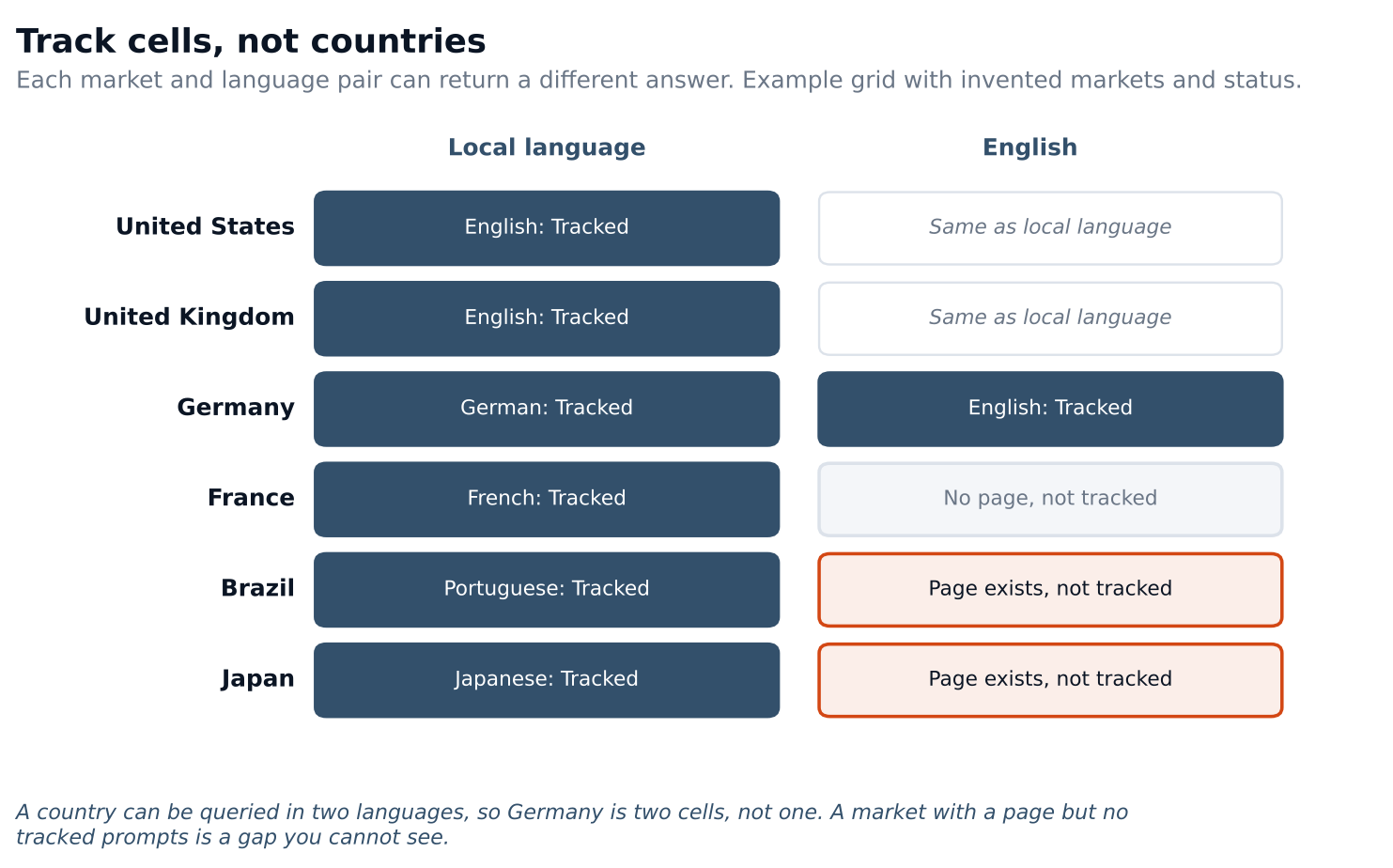
Figure 1. Track cells, not countries. The markets and status are invented. A cell with a page but no tracked prompts is a gap you cannot see.
The grid has three states. A tracked cell has prompts and saved answers. A cell with a page but no tracked prompts is riskier: it looks covered, but there is no data to show how the brand appears. A cell with neither a page nor tracking is a decision to make, rather than a gap to overlook.
For every saved answer, record the engine, date and language of the response. The Milan study collected data in one city, and we found no study that separates language from location, so keep both in the log. Tracking frequency covers how often to repeat each check once the cells are set.
Write each prompt as a local buyer would
The studies used translated or machine-translated non-English prompts, and the Milan authors list machine translation as a limitation. Literal translations may not reflect how local buyers actually search, making the results less useful. Instead, ask a native speaker familiar with the buyer's field to write each prompt from the core question without seeing the English wording, and record who wrote it.
| How the prompt was produced | What you can say about it | What to do |
|---|---|---|
| Written by a native speaker from the core question | It reads as a local buyer would phrase it, within the writer's judgment | Use as the standard |
| Machine translated, then reviewed by a native speaker | Likely close to natural, with a review on record | Acceptable while you hire or ask for native writing |
| Machine translated only | Unreviewed, and may differ from how buyers phrase the question | Flag for native review and treat the cell's results as provisional |
The three rows are our recommendation, not a finding from a study.
Use one core question ID across cells so you can compare results, while allowing the wording to differ. A local writer may choose a more natural term for "large company" or "planning" than a translator would. Use product and brand names as buyers write them in that market, including local scripts and spellings, and note any local name that differs from the global one. Once a prompt is live, keep it fixed; create a new version rather than editing it, as explained in the prompt design post.
Never put customer or personal information in a prompt or in a saved answer, in any language.
What to localize first
No research yet shows which changes increase citations in specific markets. The order below is our recommendation, based on the evidence that sources differ by language and country.
| Layer | What to check in each cell | Why it comes first (our reasoning) |
|---|---|---|
| Brand and product names | Spelling, script and the name buyers use for the product | A wrong or missing product name weakens every other fact in the answer |
| Core facts | Price and currency, plans, availability, support hours, legal entity | These are the facts people ask for, and they are easy to leave in one language only |
| Local proof | Customers, case studies, certifications and awards in that market | A market with no local proof gives an answer nothing local to cite |
| Local third-party sources | Directories, publications, review sites and communities that people in that language read | The Dartmouth gains were in citations classified as local to the market, and those sources sit outside your site |
| Page language and version | Whether the page is fully translated and points to its other versions | A half-translated page forces the reader and the engine to guess |
Rather than asking how much of the site to translate, ask which facts in each cell are missing, incorrect or available only in another language. The mental health audit also found that including native-language pages on non-local domains substantially increased the share of localized citations. This suggests page language may matter as well as the domain's country code, although the study did not test that directly.
What Google documents for multi-region sites
Google's guidance for multilingual and multi-country sites is specific to Google Search, not to how other assistants read your site. Still, it provides concrete checks for every cell.
| Topic | What Google says | What we take from it |
|---|---|---|
| Linking versions | Each language version must list itself and all the others. If two pages do not point to each other, the tags are ignored. Use fully qualified URLs. An x-default is recommended | Check that every version points to every other version, and add a link-back check to the register |
| Language detection | Google determines a page's language with its own algorithms and does not rely on hreflang or the lang attribute | Make the visible text itself the signal, not only the tags |
| URL structure | A country-code domain, subdomain or subdirectory can all work. Use different URLs per language rather than cookies or browser settings | Pick one pattern and keep every market on it |
| Content variation | Do not use IP analysis to adapt content. Local language and currency and local addresses and phone numbers signal the audience | Show the local currency and local contact details on the page |
| Google's AI features | There are no additional requirements or special optimizations. Structured data should match the visible text, and important content should be available as text | Do not treat hreflang as an AI-visibility switch. Keep data and text consistent |
(Localized versions, updated September 21, 2026; multi-regional sites, updated December 10, 2025; AI features, updated December 10, 2025.)
There are two limits to this guidance: it does not address unreviewed automatic translation, and we found no study showing that language tags change which sources ChatGPT, Perplexity or Gemini cite. Follow Google's documented approach for publishing multiple versions, then measure the results in your own cells.
Decide who owns each cell
Tracking breaks down when no one owns a cell. Give the central team responsibility for the master facts, core questions, worksheet and review calendar. A local owner in each market should manage native prompts, local sources and page accuracy, with one person accountable for each cell. The master record works as it does in the healthcare post, where one record of facts is compared with every place the facts appear. The AEO team post covers how to split work between central and distributed roles. In the Figure 1 grid, a cell with a page but no tracked prompts needs a prompt writer, a cell with no page needs a decision, and a tracked cell needs a reviewer who looks at results on a schedule.
How many answers one cell needs
Each cell is a separate sample, so calculate its range independently. Suppose 30 percent of saved answers in one cell name your brand. With 10 answers, the 95 percent range around that figure runs from 11 to 60 percent, a width of about 50 points. With 20 answers it runs from 15 to 52 percent, with 50 from 19 to 44 percent, and with 100 from 22 to 40 percent.
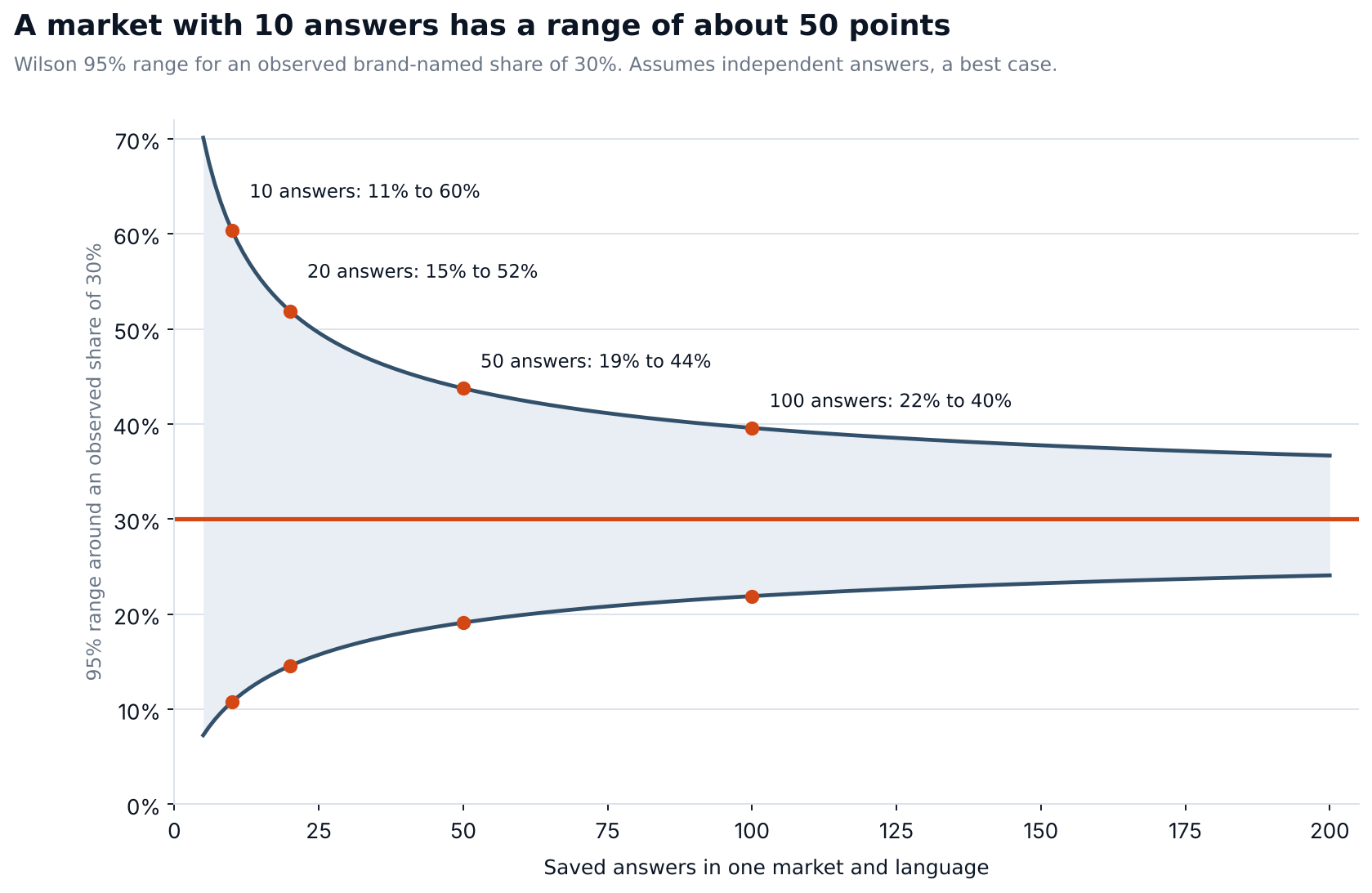
Figure 2. A model, not a measurement. It uses a Wilson 95 percent range and assumes each answer is independent, which is a best case.
This has two practical consequences. First, 5 or 10 answers are too few for a reliable reading, so the worksheet marks that cell as below the minimum. Second, multi-market tracking requires more answers because every cell needs its own sample: seven cells with 20 answers each means 140 saved answers per round, before repeat checks. The 20-answer minimum in the worksheet is a placeholder, so set your own after you see how wide the ranges are for the decisions you need to make. Answers from the same engine can also move from run to run, which the model variability post explains, so the ranges here are narrower than the real uncertainty.
Read results across cells
Choose a baseline cell, usually your home market and language, then compare the others against it using ranges rather than single numbers. The table shows invented worksheet results for 63 saved answers across seven cells, with U.S. English as the baseline.
| Cell | Answers | Brand named | 95% range | Gap vs U.S. English (points) | Read |
|---|---|---|---|---|---|
| United States, English | 12 | 75% | 47% to 91% | Baseline | Baseline |
| United Kingdom, English | 9 | 56% | 27% to 81% | -19 | Ranges overlap |
| Germany, German | 12 | 42% | 19% to 68% | -33 | Ranges overlap |
| Germany, English | 9 | 78% | 45% to 94% | +3 | Ranges overlap |
| Japan, Japanese | 6 | 33% | 10% to 70% | -42 | Ranges overlap |
| Brazil, Portuguese | 5 | 20% | 4% to 62% | -55 | Ranges overlap |
| France, French | 10 | 60% | 31% to 83% | -15 | Ranges overlap |
Brazil has the largest apparent gap at 55 points, but it is based on just five answers. Its range reaches 62 percent and overlaps the baseline, so the table cannot support a conclusion about Brazil. Germany shows a similar problem: the German cell is 36 points below the English cell in the same market, but their ranges overlap from 45 to 68 percent. More saved answers are needed in both cases before deciding whether there is a real gap to fix.
Frequently asked questions
Do we need a separate prompt set for every country?
Each market-language cell needs its own prompts. Countries that share a language can start with the same core questions, but log them separately because answers may draw on different sources in each country.
Should we translate the whole site first?
We found no study showing that translating an entire site increases citations. Start with the facts answers need: names, price and currency, plans, availability and support details. Google's guidance treats a localized version as a duplicate when its main content remains untranslated.
Is hreflang needed for AI answers?
Google says its AI features require no additional or special optimizations. For multilingual sites, its Search guidance says each version should link to every other version using hreflang. We found no study showing an effect on other assistants, so follow Google's documentation and measure results in your cells.
Which languages should we track first?
Prioritize cells where you sell, have a localized page and can assign a local owner. Rank them by their importance to your pipeline. We found no research ranking languages by their effect on citations for B2B software.
Can we use machine translation to write prompts?
Use machine translation for a first draft, then have a native speaker review each prompt before relying on the results. The Milan study used machine-translated queries and lists this as a limitation. The worksheet flags prompts that have not had native review, keeping those cell results provisional.
Write one core question natively in two languages this week
Choose one core question, such as which option in your category is best for a large company. Ask a native speaker in each of two markets to write it as a local buyer would, without seeing the English wording. On the same day, save an answer from the same engine for each prompt. Record whether your brand was named, which sources were cited, the response language and any incorrect facts about your company. These two rows give you a first place to investigate if the answers differ.
If you want a first reading on one of those questions before you build the log, the AI Search Visibility Checker gives you one. If you want to keep the questions you wrote fixed and ask them again over time, AI Search Intelligence tracks individual prompts.