


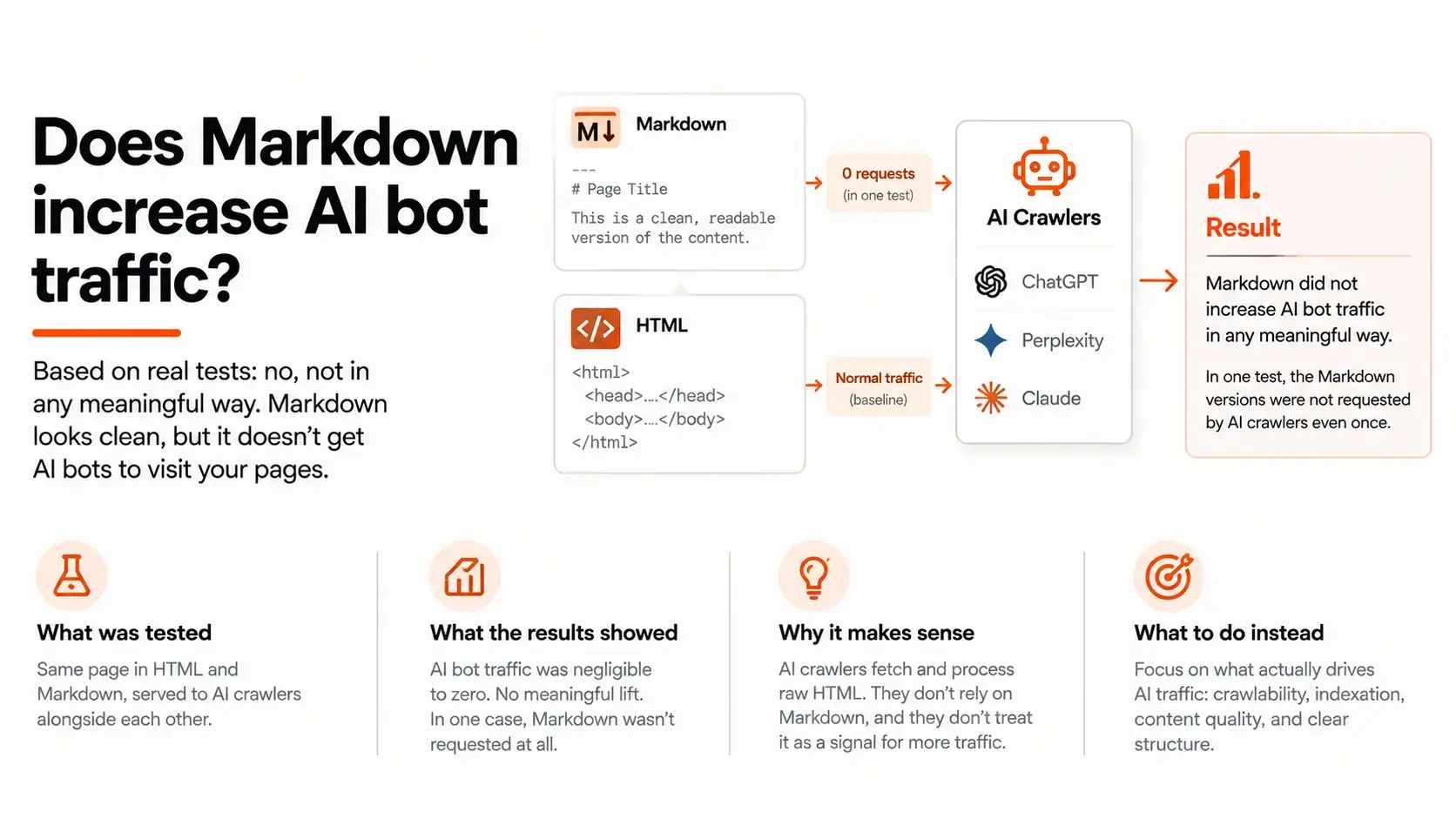


Short answer, based on the controlled tests that have actually been run: no, not in any meaningful way. Several teams have published a version of the same page as clean Markdown, served it to AI crawlers alongside the normal HTML, and measured what the bots did. The lift in AI bot traffic ranged from negligible to exactly nothing. In one experiment the Markdown versions were not requested by AI crawlers even once.
That matters because "serve Markdown to the bots" has become a popular piece of advice in AI search circles, usually stated with more confidence than the evidence supports. It sounds right. Markdown is clean, lightweight, and easy for a language model to read, so surely feeding it directly to crawlers should help. The tests say otherwise, and the reason they say otherwise is worth understanding, because it points you toward the things that do move AI traffic. This guide walks through what was tested, what the results were, why the outcome makes sense, and what to do instead.
What people actually mean by "Markdown for AI"
Part of the confusion is that three different tactics get filed under the same phrase, and only one of them is worth your time.
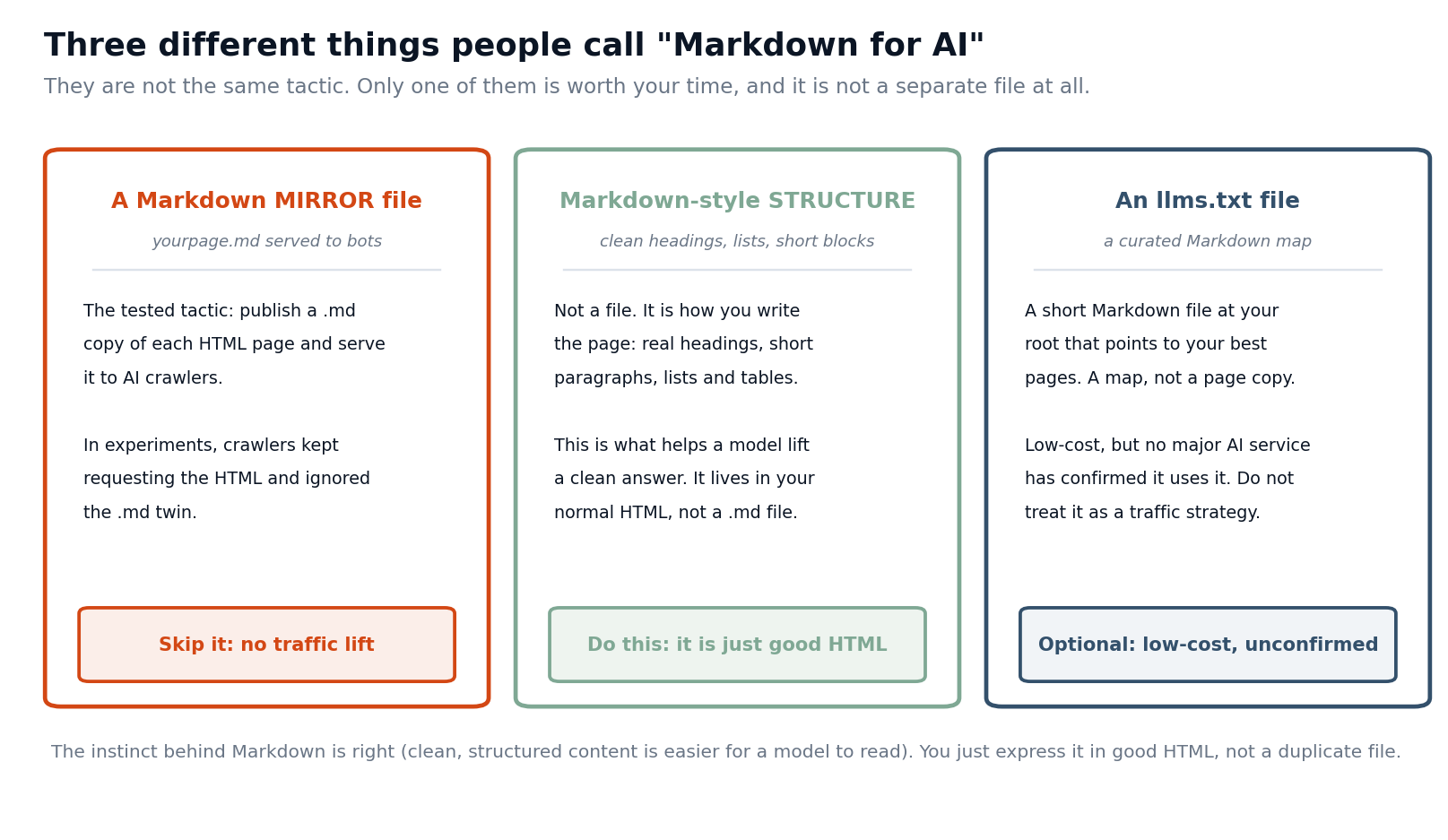
The first is a Markdown mirror file: publishing a .md copy of each HTML page and serving it to AI crawlers, either at a parallel URL like yourpage.md or by detecting the bot and handing it Markdown instead of HTML. This is the tactic the experiments tested, and it is the one that did not work. The second is Markdown-style structure: writing your pages with real headings, short paragraphs, lists, and tables. This is not a file at all, it is just clean, well-structured content, and it genuinely helps a model extract a clean answer. The catch is that it lives in your normal HTML, so you get the benefit without publishing anything in Markdown. The third is llms.txt, a short curated Markdown file at your site root that points to your best pages. That is a map, not a page copy, and it is a separate discussion with its own honest verdict.
Keep these separate as you read, because the popular advice quietly blends them. It takes the real benefit of the second (clean structure helps) and uses it to sell the first (so publish Markdown files), and the tests show that inference does not hold.
What the experiments tested, and what they found
The useful thing about this question is that people ran real experiments instead of guessing, and the results line up.
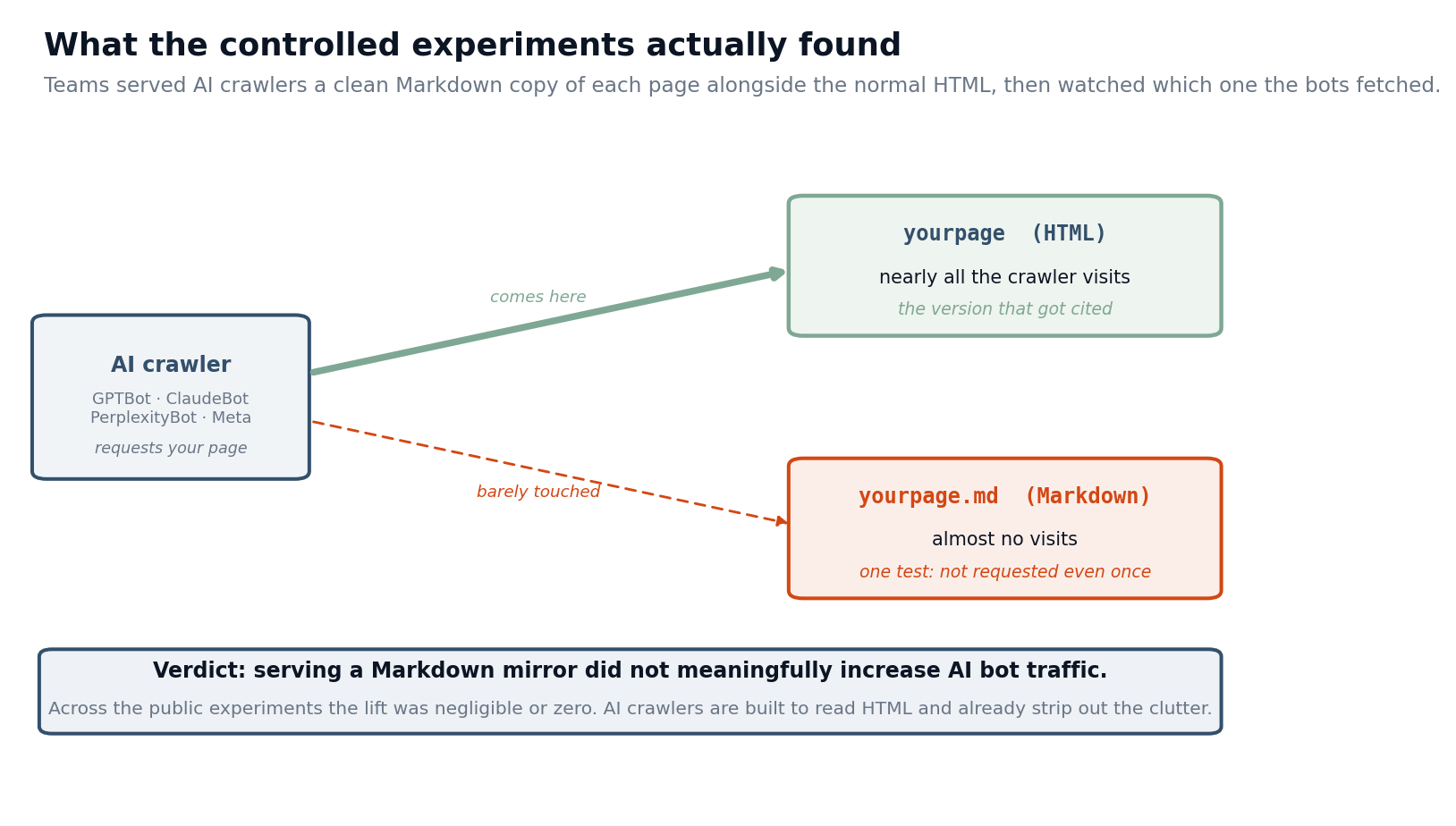
One team split a few hundred pages across several sites into two groups. Human visitors always got HTML. AI crawlers were served either the standard HTML or a cleaned Markdown version, and the team tracked bot visits from the major AI crawlers over three weeks. The Markdown group showed a directional trend that was not statistically significant: the typical page picked up about one extra bot visit, which is noise, not a result. Their own conclusion was to focus on content quality and crawlability rather than format.
Another team took a more direct approach and published Markdown mirrors alongside HTML pages, both equally discoverable, then watched which URLs the crawlers requested. The HTML pages got the crawler visits. The Markdown URLs got zero, across both of their test scenarios, and no AI platform cited a Markdown URL in an answer. A separate write-up tracking Markdown endpoints over several weeks reported the same thing: effectively no crawler uptake.
Different setups, same finding. Serving Markdown to AI crawlers did not increase AI bot traffic, and it did not earn citations that the HTML was not already earning. If you were counting on a .md file to be the lever, the data does not support it.
Why the result makes sense
The outcome is less surprising once you look at how AI crawlers actually work. They were built to read the web, and the web is HTML. Extracting clean text from a normal HTML page, stripping out the navigation, scripts, and boilerplate, is a solved problem for these crawlers. Handing them Markdown removes a step they were already handling comfortably, so it saves them a little parsing effort and changes almost nothing about whether they visit or cite you.
There is also a discovery problem. A crawler fetches URLs it can find through links and sitemaps. A parallel .md URL is a second address that nothing really points to, so the crawler has no strong reason to request it when the canonical HTML page is right there and already linked from everywhere. You are asking bots to prefer a duplicate they were never pointed to, over the original they already know.
So the premise had it backwards. The bottleneck was never the format of the text once a crawler reaches your page. The bottlenecks are earlier and more basic: can the crawler reach the page at all, can it read the content in the HTML it gets, and is the content worth quoting. Markdown addresses none of those.
What actually moves AI bot traffic and citations
The first is crawler access. AI crawlers cannot visit what they are blocked from. Confirm your robots.txt is not disallowing the crawlers you want, and that your CDN or firewall is not blocking them by default, which some do. This is the single most common reason a site gets no AI bot traffic, and no file format fixes it.
The second is having your content in the HTML the server sends, not locked behind client-side JavaScript that the crawler never runs. A page whose content only appears after JavaScript executes is invisible to most AI crawlers regardless of whether you also offer a Markdown copy. We cover this in detail in whether AI crawlers can render your JavaScript, and it is a far bigger lever than format.
The third is the structure of the content itself, which is where the Markdown instinct was pointing all along. Clear headings, short self-contained paragraphs, direct answers near the top of a section, and lists or tables where they fit all make it easier for a model to lift a clean, correct passage from your page. You get every bit of this in well-written HTML. The way to put it into practice is covered in how to structure B2B content for LLMs. The point is that the benefit people attribute to Markdown is real, but it comes from structure, and structure is not a file format.
The fourth is whether the content deserves a citation at all. An engine cites a page because it answers the question well and adds something, not because of the syntax it was written in. If a competitor is being cited and you are not, the gap is almost never Markdown.
When Markdown is genuinely useful
None of this means Markdown is worthless, only that it is not an AI-traffic tactic. It has real uses that sit outside the question of attracting crawlers. If you maintain developer documentation, offering it in Markdown or a plain-text form is a genuine convenience for people who paste your docs into an AI tool to ask questions. That is a good user experience for a technical audience, and it is worth doing on its own merits.
Markdown is also the right format for an llms.txt file, if you choose to publish one, because that file is meant to be a short, clean, human-curated map. And Markdown is a perfectly good way to draft and store content internally before it becomes HTML. Just do not confuse any of these with a lever that pulls more AI crawlers to your site, because the tests are clear that it does not.
How to check your own AI bot traffic
You do not have to take anyone's experiment on faith, including this one. You can measure AI crawler activity on your own site, and it is the right habit before and after any change you make. The most direct source is your server logs or CDN logs, which record every request by user-agent. Filter for the AI crawler user-agents: GPTBot, OAI-SearchBot, and ChatGPT-User from OpenAI, ClaudeBot from Anthropic, PerplexityBot, Google-Extended, and the Meta crawler.
Count how often each one requests your key pages, and note which URLs they hit. If you want to test the Markdown question for yourself, publish a .md version of a few pages, make sure it is linked and discoverable, and watch whether any AI user-agent ever requests it. Based on the published experiments, expect the honest answer to be that they do not.
The check that matters more is the flip side: are the crawlers reaching your important pages in the first place, and are those pages showing up in AI answers. If a page gets no AI crawler visits at all, the problem is access or discovery, not format. If it gets crawled but never cited, the problem is the content, not the syntax. Either way, the log tells you where the real bottleneck is, and it will not be Markdown.
Frequently asked questions
Should I serve Markdown to AI crawlers instead of HTML?
The controlled tests say it is not worth the effort. Crawlers request and cite the HTML, and the Markdown copies drew little to no traffic. Spend the time on access, rendering, and content quality instead.
Does Markdown formatting hurt anything?
No. Writing with clean structure, which looks like Markdown in a text editor, is good practice. The point is that you should express that structure in your HTML, not publish a separate .md file expecting a traffic gain.
What about llms.txt, which is Markdown?
That is a different thing: a short curated map, not a copy of your pages. It is low-cost, but no major AI service has confirmed using it for citations, so treat it as optional rather than a traffic strategy.
My developer wants to add .md versions of our docs. Should I stop them?
Not necessarily. For documentation aimed at technical users who feed it into AI tools, Markdown versions are a real convenience. Just scope it as a user-experience feature, not an AI-visibility play, and do not expect it to change your crawler traffic.
Then why does everyone recommend it?
Because the instinct is half right. Clean, structured content genuinely helps models read you, and Markdown is what clean structure looks like. The mistake is jumping from "structure helps" to "publish Markdown files," which the experiments do not support.
Where to put your effort instead
The honest takeaway is that "serve Markdown to bots" is a tidy-sounding tactic that testing does not back up. The good news is that the tests also point clearly at what does work, and none of it is exotic: let the crawlers in, put your content in the HTML they can read, structure it so a model can quote it cleanly, and make it genuinely worth quoting. Those are the levers, and they work regardless of file format.
The way to know whether any change helped is to watch your actual AI bot traffic and citations rather than trusting a tactic on faith, which is exactly the discipline the experiment teams used. You can see where you stand today with our AI Search Visibility Checker, and if you want to track whether AI engines are citing your pages over time, that is what live model checks are for. Omnibound's AI Search Intelligence shows you which pages engines actually reach and cite, so you can test your own changes against real behavior instead of adopting the next format tip on trust.