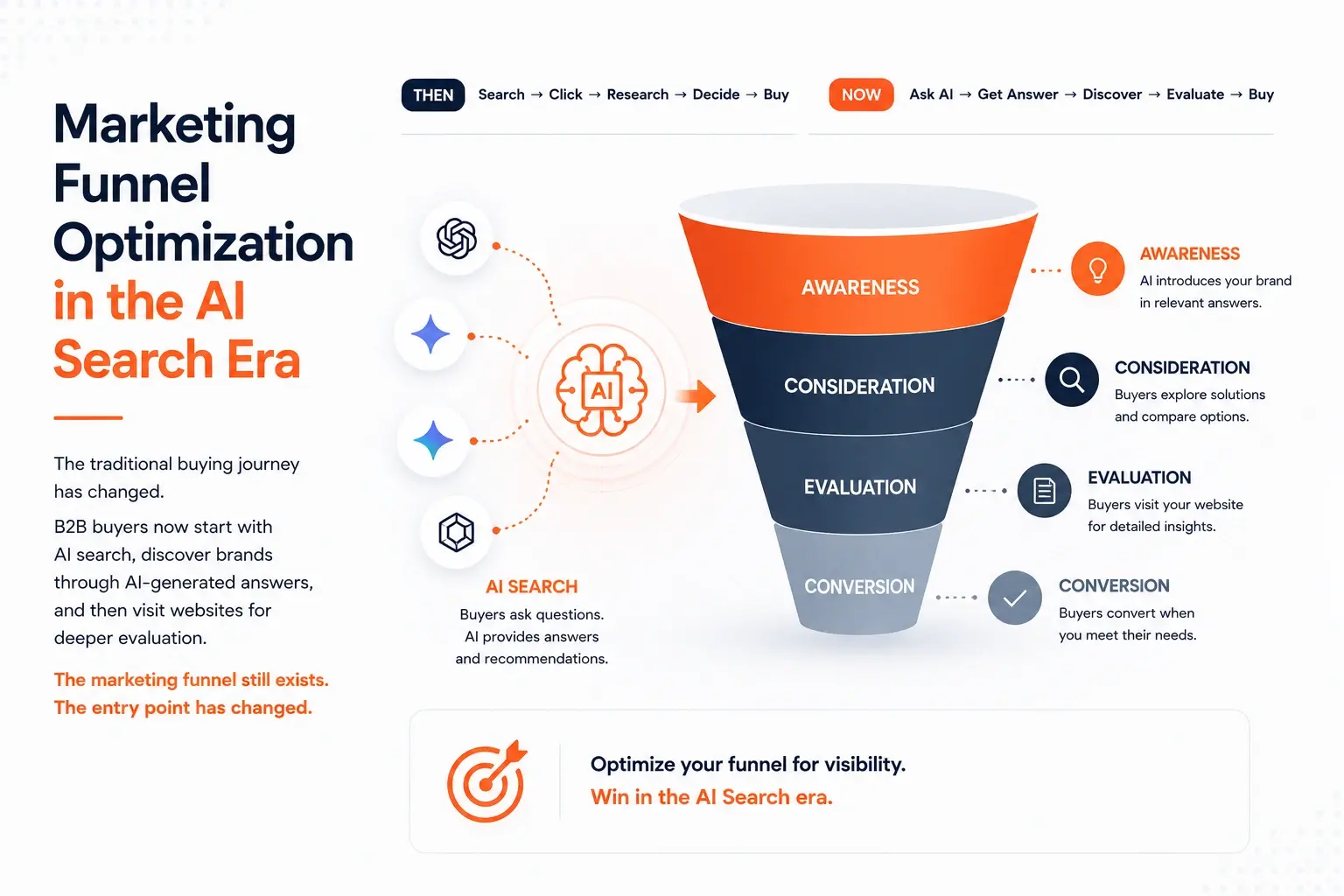


Traditional buying journeys followed a predictable path. Buyers searched, clicked through to a website, conducted research, evaluated options, and made a purchase. Today, that path has fundamentally shifted. B2B buyers increasingly begin with a question posed to an AI search platform, receive a recommendation, discover brands through AI-generated answers, and only then visit a website for deeper evaluation. The marketing funnel still exists. The entry point has changed.
For CMOs, demand generation leaders, and revenue marketing teams, this shift demands a new approach to marketing funnel optimization. It is no longer enough to focus exclusively on landing pages, email nurturing, and conversion rates. Modern funnel optimization must account for AI-powered discovery, buyer behavior changes, and the compressed journeys that AI search creates. Teams that adapt will capture pipeline earlier. Teams that do not will find themselves invisible long before a buyer reaches their website.
The Marketing Funnel Still Exists, But Buyers Enter It Differently
The B2B marketing funnel has not disappeared. Buyers still move through stages of awareness, consideration, evaluation, and decision. What has changed is how and where they enter the funnel, and how much of the journey happens before they ever contact your company.
Traditional buying journeys started with search, moved to a website, progressed through research and evaluation, and ended with a purchase. The brand controlled most of the touchpoints. Today, many B2B buyers begin with a question asked to an AI search platform. The AI summarizes options, recommends solutions, and surfaces brand names. Buyers then validate those recommendations through additional research before visiting a company website or engaging with sales.
This compression means that by the time a buyer reaches your website, they may have already formed opinions based on what AI platforms told them. If your brand was not part of that AI-generated answer, you may never get the chance to influence their decision. Modern marketing funnel optimization must therefore begin before the first website visit, starting with AI Search Visibility and customer intelligence.
AI Search Has Become the New Awareness Stage
Traditional awareness relied on search rankings, paid advertising, and social media distribution. Brands invested heavily in content designed to appear at the top of results pages, and they supplemented organic reach with paid campaigns across multiple channels.

Modern awareness increasingly happens when AI platforms recommend brands and summarize solutions in response to buyer questions. A prospect types a question into ChatGPT, Perplexity, Gemini, or Claude, and the AI generates an answer that includes specific brand names, product categories, and solution summaries. If your brand is missing from those AI-generated answers, buyers may never enter your funnel at all.
This shift means that awareness-stage optimization can no longer be limited to keyword rankings and ad placements. B2B marketing teams must understand what questions buyers ask AI platforms, which brands appear in the answers, and where their content fails to earn AI recommendations. AI Search Intelligence provides the visibility needed to track prompts, citations, and gaps across leading AI platforms so teams can act before competitors capture mindshare.
Traditional Funnel vs AI-First Funnel
Understanding the difference between the traditional funnel and the AI-first funnel helps marketing leaders identify where their current strategy falls short. The stages have not disappeared, but the mechanics at each stage have shifted significantly.
- Search becomes an AI question. Instead of typing keywords into a search bar, buyers ask conversational questions to AI platforms and receive synthesized answers.
- Website visits follow AI recommendations. Buyers arrive at your site because an AI platform recommended you, not because you ranked first on a results page.
- Content consumption shifts to AI-assisted discovery. Buyers absorb information through AI summaries before they ever read your blog posts or landing pages.
- Product research becomes brand validation. Buyers use your website to confirm what AI told them, not to discover you for the first time.
- Conversion moves toward sales conversations. Buyers who arrive post-AI recommendation are often further along and ready for a direct conversation.
This comparison reveals why so many traditional funnel optimization strategies underperform today. They optimize for a journey that no longer matches how buyers actually move through the market.
Funnel Optimization Starts with Better Customer Intelligence
Optimization begins with understanding your buyers at a depth that goes beyond demographic profiles and firmographic data. Modern marketing funnel optimization requires deep customer intelligence that captures buyer questions, pain points, market trends, and competitive positioning.
Most funnel optimization articles focus on improving landing pages, adjusting form fields, or refining email sequences. While those tactical improvements still matter, they address symptoms rather than root causes. If your content does not answer the questions buyers ask AI platforms, no amount of landing page optimization will fix the awareness gap.
Effective funnel optimization starts with customer intelligence that reveals what buyers actually ask, what language they use, and what concerns shape their decisions. This includes understanding the specific prompts buyers type into AI platforms, the objections that surface during evaluation, and the competitive alternatives they consider. With this foundation, marketing teams can create content that earns AI recommendations and guides buyers from discovery through conversion.
Customer persona research must evolve from static documents into living research that updates as buyer conversations and market behavior change. Personas that sit in a slide deck for two years cannot inform AI-ready content strategies. Modern buyer research captures language shifts, emerging objections, and new triggers in real time, ensuring that every stage of the funnel reflects how buyers actually think and decide today.
Content Is the Connection Between AI Search and the Funnel
Content serves as the bridge between AI-powered discovery and conversion. When a buyer asks an AI platform a question, the AI draws from publicly available content to formulate its answer. If your content does not address that question clearly and authoritatively, the AI will not cite your brand, and the buyer will not discover you.
This means content strategy must change. Content should answer buyer questions directly, demonstrate deep expertise, and support every stage of the buying journey. It should be structured for AI-citable clarity, with clear answers, authoritative sourcing, and language that matches how buyers actually phrase their questions.
Effective content journey optimization ensures that each piece of content serves a specific purpose within the buyer journey. Awareness-stage content answers broad questions that buyers ask AI platforms. Consideration-stage content provides educational depth that helps buyers evaluate approaches. Decision-stage content offers proof, comparisons, and trust signals that move buyers toward a purchase.
Teams that treat content production as a volume exercise miss the strategic value that B2B content production delivers when guided by buyer intelligence. Content created without insight into buyer questions may generate traffic but will not influence AI recommendations or advance buyers through the funnel. Content built on customer intelligence becomes the mechanism that connects AI discovery to pipeline.
Optimizing Every Funnel Stage for AI-First Buyer Journeys
Modern funnel optimization requires a stage-by-stage framework that accounts for how AI search reshapes each phase of the buyer journey. The framework below provides actionable guidance for each stage.
Awareness: Improve AI Search Visibility
The awareness stage is where AI search has the greatest impact. Buyers ask questions to AI platforms before they visit any website. Your goal at this stage is to ensure your brand appears in AI-generated answers when buyers ask questions relevant to your category.
AI Search optimization at this stage involves tracking the prompts your buyers use, identifying where competitors appear and you do not, and creating content that directly answers those prompts. This is not about keyword stuffing or traditional SEO tactics. It is about building authoritative, AI-ready content that AI platforms can cite and recommend.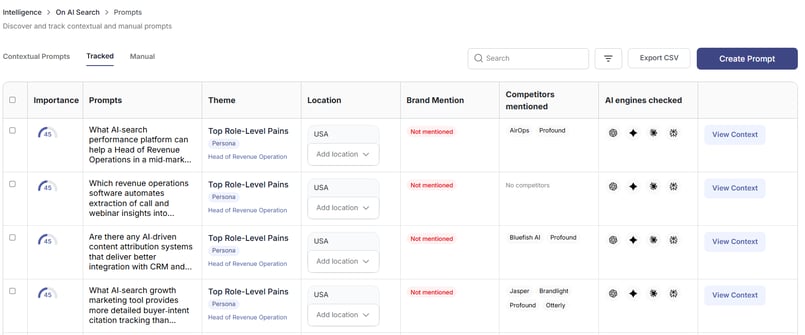
Consideration: Build Educational Content
Once buyers are aware of your brand through AI recommendations, they enter the consideration stage. Here they seek deeper educational content that helps them understand their problem and evaluate potential solutions. Educational content should address specific pain points, explain approaches, and provide frameworks that help buyers think through their options.
This is also where thought leadership content plays a critical role. Buyers want to know not just what you sell but how you think about the problem space. Content that demonstrates expertise builds the trust needed to keep buyers in your funnel rather than returning to an AI platform for alternative recommendations.
Evaluation: Provide Comparison Pages, Customer Stories, and FAQs
In the evaluation stage, buyers compare your solution against alternatives. They want evidence that your product works, clarity on how it differs from competitors, and answers to specific questions that AI platforms may not address in depth.
Comparison pages, customer stories, and detailed FAQs serve this stage well. Comparison content should be honest and specific, addressing the dimensions buyers actually care about. Customer stories should highlight measurable outcomes and include details that buyers can validate. FAQs should capture the questions your sales team hears most often, because those questions reflect what buyers ask after AI recommendations have introduced them to your category.
Decision: Support Sales Enablement, Product Proof, and Trust Signals
At the decision stage, buyers need final validation. Sales enablement content, product demonstrations, security documentation, and trust signals like compliance certifications and customer logos help close the gap between interest and commitment.
Funnel optimization at this stage means ensuring sales teams have the right materials at the right time. It also means that the content buyers encounter post-AI discovery aligns with what the AI told them. If an AI platform recommended your brand for specific capabilities, your website and sales conversations should reinforce those capabilities clearly.
Why Marketing Funnel Fails in AI Search
Traditional marketing funnels fail in AI Search because they optimize from the website onward, while modern B2B buyers increasingly begin with a question asked to ChatGPT, Gemini, Claude, or Perplexity. AI platforms recommend brands, summarize solutions, and shape buying decisions before a prospect ever visits a website. If your content is not cited in those AI-generated answers, your brand may never enter the buyer's consideration set. This makes website traffic, landing pages, and nurture campaigns ineffective if awareness has already been lost.
Modern funnel optimization must begin with AI Search visibility, customer intelligence, and buyer question coverage. Marketing teams need to understand the prompts buyers ask, identify where competitors are recommended instead, and create authoritative content that earns AI citations at every stage of the buying journey.
Omnibound helps B2B teams continuously monitor buyer prompts, competitor citations, customer language, and AI Search visibility, enabling them to identify funnel gaps before they become pipeline losses and optimize content for how buyers actually discover solutions today.
New Metrics for Funnel Optimization
Traditional funnel metrics remain important, but they are no longer sufficient. Traffic, click-through rate, and conversion rate tell part of the story, but they do not capture what happens before a buyer reaches your website. Modern funnel optimization requires additional metrics that reflect the AI-first buyer journey.
Traditional metrics to maintain:
- Website traffic
- Click-through rate
- Conversion rate
- Time to close
- Cost per acquisition
Modern metrics to add:
- AI visibility: How often your brand appears in AI-generated answers across relevant buyer prompts
- Branded discovery: Whether buyers find your brand through AI recommendations before any direct interaction
- Buyer question coverage: The percentage of relevant buyer questions your content addresses effectively
- Engagement quality: How deeply buyers engage with content after arriving from an AI recommendation
- Pipeline influence: The contribution of AI-driven discovery to qualified pipeline and revenue
- Content effectiveness: How well content performs in earning AI citations and advancing buyers through the funnel
These modern metrics do not replace traditional ones. They supplement them, giving marketing leaders a more complete picture of how the B2B marketing funnel performs when buyers start their journey through AI search.
Continuous Funnel Optimization
Funnel optimization is not a one-time exercise. Buyer questions evolve, competitive positioning shifts, and AI platforms update their models regularly. Teams that treat funnel optimization as a quarterly project will always lag behind the market.
Continuous funnel optimization follows a cycle that integrates multiple intelligence streams into ongoing content and strategy improvements:
- Customer Intelligence: Capture evolving buyer questions, pain points, and language shifts from real conversations
- Market Intelligence: Track market trends, emerging categories, and shifting buyer priorities
- Competitive Intelligence: Monitor competitor positioning, content moves, and AI citation presence
- AI Search Intelligence: Track prompts, citations, and visibility gaps across AI platforms
- Content Improvements: Update and create content based on intelligence findings
- Buyer Engagement: Measure how buyers respond to improved content and messaging
- Performance Review: Assess pipeline impact and identify areas for further optimization
- Continuous Optimization: Repeat the cycle with updated intelligence and refined priorities
This continuous cycle ensures that your funnel optimization strategy stays aligned with how buyers actually discover, evaluate, and choose solutions. It also creates a feedback loop where every piece of intelligence informs the next round of content and campaign improvements.
How Omnibound Supports Modern Marketing Funnel Optimization
Omnibound is a Marketing Intelligence Platform that helps B2B teams optimize the entire buyer journey, from AI-powered discovery through conversion and long-term growth. Rather than serving as a CRM, marketing automation tool, or attribution platform, Omnibound combines four intelligence layers into a unified system for funnel optimization.
Customer Intelligence: Omnibound captures real buyer conversations, questions, and language patterns to build living personas that stay current as markets evolve. This ensures content and messaging reflect how buyers actually think and ask questions.
Market Intelligence: The platform tracks market trends, competitive movements, and category shifts that influence buyer behavior. Marketing teams gain historical context and forward-looking signals to guide strategy.
Competitive Intelligence: Omnibound monitors competitor positioning and content activity, helping teams identify where rivals are winning AI citations and where opportunities exist to capture share.
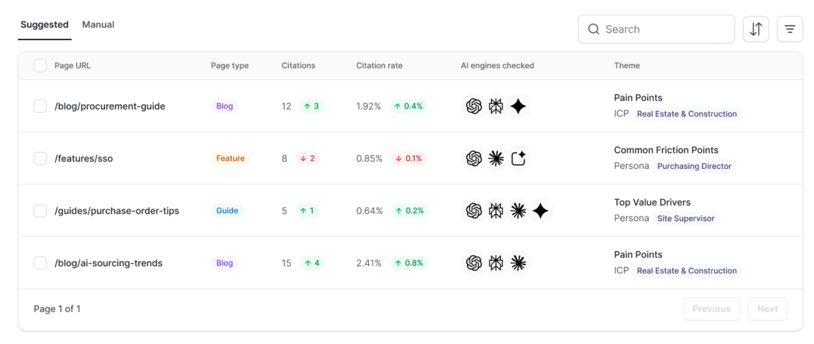
AI Search Intelligence: The platform tracks buyer prompts across AI platforms, maps citations to content, and identifies gaps where competitors appear and your brand does not. Teams can prioritize high-impact opportunities before they show up as pipeline losses.
With Omnibound, B2B marketing teams can understand buyer questions, identify funnel gaps, improve AI Search visibility, optimize content journeys, monitor market changes, and prioritize high-impact opportunities. The platform connects intelligence to action, ensuring that every content investment and campaign decision is grounded in real buyer behavior rather than assumptions.
For teams focused on demand generation and conversion optimization, Omnibound provides the intelligence layer that makes modern funnel optimization possible. By unifying customer, market, competitive, and AI Search intelligence, the platform helps marketing leaders build funnels that start where buyers actually begin their journey: with a question asked to an AI platform.
Conclusion
The marketing funnel has not disappeared. It has changed its point of entry. Today's B2B buyers increasingly discover brands through AI-powered search experiences before they ever visit a website. Modern marketing funnel optimization therefore starts with customer intelligence, AI Search visibility, and content that earns trust early in the buying journey.
Teams that continue to optimize only for website visits, landing page conversions, and email nurturing will find their funnels increasingly empty at the top. Buyers will form opinions through AI recommendations, and brands that are absent from those recommendations will never make the shortlist. The opportunity for B2B marketing leaders is clear: optimize the funnel for how buyers actually buy today, and the pipeline will follow.
Frequently Asked Questions
What is marketing funnel optimization?
Marketing funnel optimization is the process of improving each stage of the buyer journey to increase engagement, conversions, and revenue. In the AI search era, it extends beyond website mechanics to include AI Search visibility, customer intelligence, and content that earns recommendations from AI platforms before buyers reach your site.
How is AI Search changing the B2B marketing funnel?
AI Search is compressing traditional buying journeys by summarizing options and recommending brands before buyers visit any website. This shifts the awareness stage from search rankings to AI visibility, reduces website visits during early research, and means buyers arrive at your site more informed and further along in their evaluation.
Does AI Search replace the traditional marketing funnel?
No. The funnel still exists, but buyers enter it differently. Instead of starting with a search query and clicking through to a website, many buyers begin with a question to an AI platform, receive a recommendation, and then validate that recommendation through direct research. The stages remain, but the entry point and pace have changed.
How can marketers optimize the awareness stage for AI Search?
Marketers should track the prompts buyers ask AI platforms, identify where their brand is missing from AI-generated answers, and create authoritative content that directly addresses those prompts. AI Search optimization focuses on building AI-citable content that demonstrates expertise and answers buyer questions clearly.
How does customer intelligence improve funnel performance?
Customer intelligence reveals the specific questions buyers ask, the language they use, and the concerns that shape their decisions. This insight allows marketing teams to create content that aligns with buyer needs at every funnel stage, improving both AI Search visibility and conversion rates.
What metrics matter for modern funnel optimization?
Traditional metrics like traffic, conversion rate, and click-through rate remain relevant. Modern optimization adds AI visibility, branded discovery, buyer question coverage, engagement quality, pipeline influence, and content effectiveness to capture performance across the AI-first buyer journey.
How do content journeys support marketing funnels?
Content journeys connect AI-powered discovery to conversion by providing the right information at each stage. Awareness content answers AI prompts, consideration content educates buyers on approaches, evaluation content provides comparisons and proof, and decision content supports final commitment. Each piece should be designed for both AI citation and buyer engagement.
How often should marketing funnels be optimized?
Funnel optimization should be continuous. Buyer questions evolve, competitive positioning shifts, and AI platforms update regularly. Teams that run ongoing intelligence cycles covering customer, market, competitive, and AI Search intelligence can adapt content and strategy in real time rather than reacting after pipeline impact appears.
How to Map AI Search Prompts to Funnel Stages?
Mapping AI Search prompts to funnel stages begins by categorizing buyer questions according to awareness, consideration, evaluation, and decision intent. Each stage requires content that directly answers the questions buyers ask AI platforms. Omnibound maps prompts to content, identifies citation gaps, and prioritizes opportunities where improved AI visibility can strengthen funnel progression and increase qualified pipeline.
What's the Value of Tracking AI Visibility by Funnel Stage (Awareness vs. Purchase)?
Tracking AI visibility by funnel stage reveals where buyers first discover your brand, evaluate alternatives, and make purchasing decisions. Measuring visibility separately across awareness, consideration, and purchase helps identify content gaps, citation opportunities, and competitive weaknesses. Omnibound connects AI visibility with buyer journey stages, enabling teams to prioritize content investments that improve discovery, influence evaluation, and drive pipeline growth.
Why Should You Track AI Mentions by Funnel Stage (Awareness, Consideration, Purchase)?
Tracking AI mentions by funnel stage shows how frequently your brand is recommended throughout the buyer journey rather than only at conversion. This reveals whether AI platforms recognize your brand during early discovery, competitive evaluation, or purchase decisions. Omnibound continuously monitors AI citations across funnel stages, helping marketers improve buyer question coverage, strengthen AI Search visibility, and measure how AI-driven discovery contributes to qualified pipeline and revenue.