

In 2026, more than half of new online content is produced with AI assistance, and buyers have grown tired of reading the same recycled opinions dressed up in different fonts. Generic AI output has made true thought leadership harder to find and more valuable when it appears. Brands that want to be recognized as authorities can no longer rely on volume alone.
The challenge isn't producing more thought leadership. It's producing ideas that buyers trust and AI-powered search platforms recognize as authoritative. As AI increasingly shapes how B2B buyers discover expertise, the value of original perspectives, customer research, and evidence-based insights continues to grow.
This guide lays out how marketing teams, founders, and executives can build thought leadership that holds up under this new discovery model, using AI as a research partner rather than a ghostwriter.
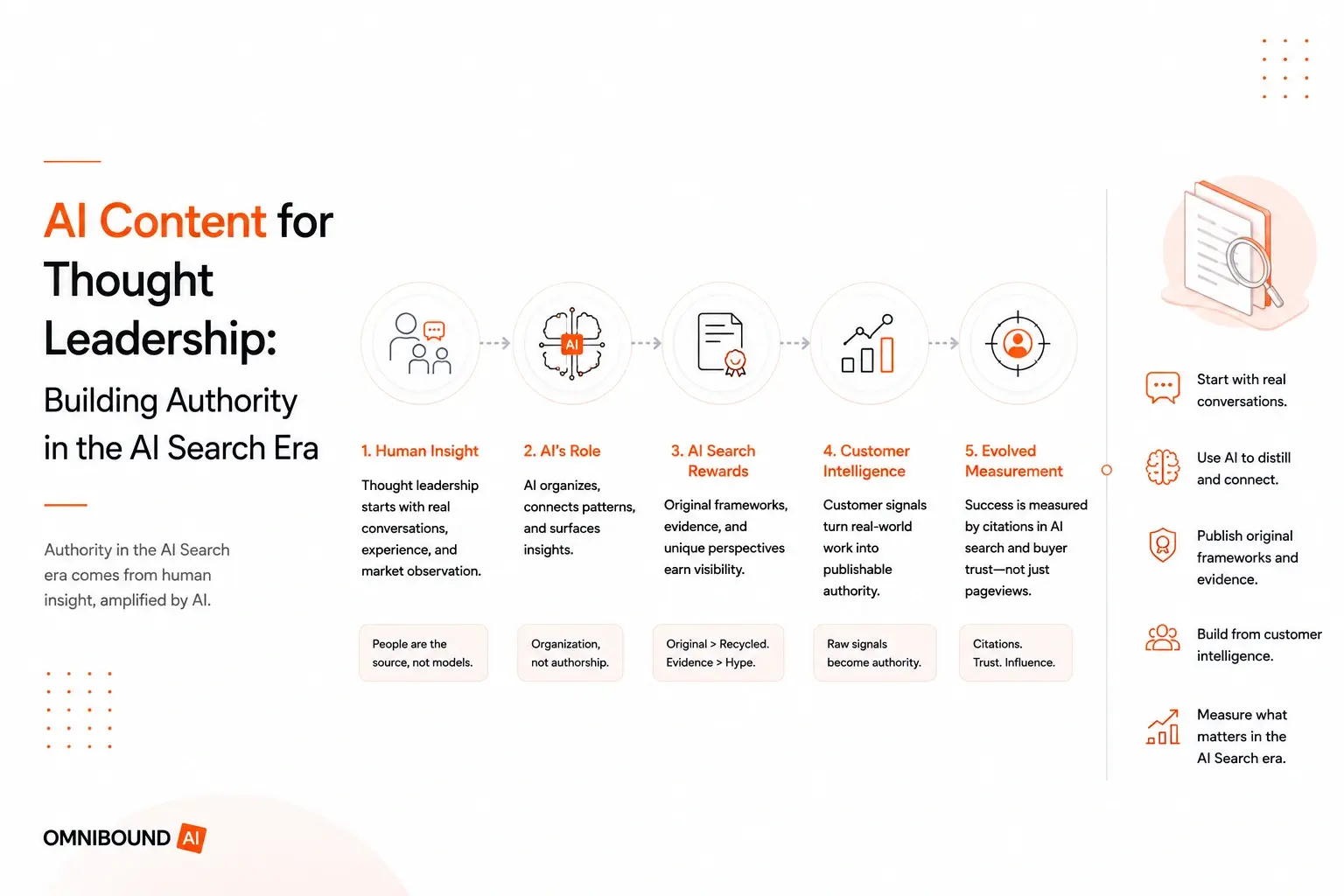
- Thought leadership originates from people, not models. Customer conversations, product experience, and market observation remain the source material.
- AI's role is organization and pattern recognition, not authorship or opinion generation.
- AI Search rewards original frameworks and evidence over recycled summaries and generic commentary.
- Customer intelligence is the raw material that turns everyday work into publishable authority.
- Measurement has to evolve beyond pageviews toward citation frequency and buyer trust.
AI Doesn't Create Thought Leadership, It Helps Discover It
There's a tempting shortcut in the market right now: feed a topic into a model, get back a polished article, and publish it under an executive's byline. It reads fine. It says nothing new. And increasingly, AI Search platforms can tell the difference.
Genuine thought leadership doesn't start with a prompt. It starts with a sales call where a prospect describes a problem in language your team hasn't heard before. It starts with a support ticket that reveals a workaround customers have invented on their own. It starts with a founder noticing that three competitors are all solving the wrong problem at the same time. These are the raw materials of original perspective, and no model can manufacture them because they don't exist anywhere for a model to learn from.
What AI can do is help your team find these moments faster and organize them into something usable. Sales conversations, support trends, customer interviews, and market signals accumulate faster than any team can manually review. AI-assisted research can scan hundreds of transcripts and tickets, group recurring themes, and surface the language customers actually use to describe their pain. That's a research function, not a writing function, and the distinction matters.
Think of it as the difference between a research assistant and a co-author. A research assistant reads through a stack of interviews and tells you, "here are the six objections that came up most often this quarter, and here's how the language has shifted since last year." A co-author writes the article for you and hopes it sounds credible. Omnibound's approach is built around the first model. Customer Persona Research capabilities exist to keep this raw material current, refreshing personas and pain points as new conversations happen, so your team is never working from a stale understanding of the market.
This distinction becomes more important as AI Search platforms get better at recognizing which content actually reflects direct experience. Content that reads as a synthesis of publicly available information tends to blend into everything else already indexed. Content that reflects a specific customer conversation, a specific data pattern, or a specific executive judgment call stands apart because it couldn't have been produced any other way.
There's also a trust dimension that matters to buyers directly, independent of any platform. When a reader encounters a piece that clearly draws from real customer work, an actual benchmark study, or a founder's direct experience closing deals, they extend more credibility to it than to an article that reads like a summary of five other articles. Buyers have gotten good at spotting recycled thinking, partly because they've read so much of it in the last two years.
So the practical shift for marketing teams is this: stop asking "what should we have AI write about?" and start asking "what do we know that nobody else knows?" Then use AI-assisted research to organize that knowledge, identify the strongest angles, and prepare it for a human expert to shape into a point of view. The output is faster to produce, grounded in something real, and much harder for a competitor to replicate with a similar prompt.
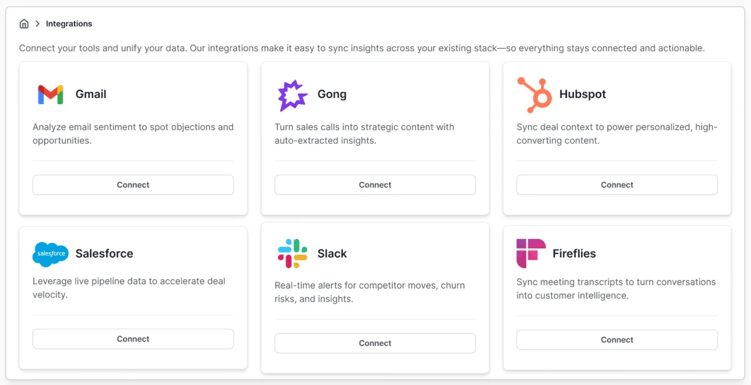
Omnibound's Marketing Living Research Engine was built around this exact workflow. It pulls customer signals from CRM notes, call transcripts, support tickets, and reviews into one continuously updated layer, so the moment a new pattern emerges in the market, your team can see it and respond with an original point of view instead of a generic explainer.
Why AI Search Rewards Original Thinking
AI Search platforms, including the systems behind ChatGPT, Gemini, Claude, Perplexity, and Copilot, don't function like a traditional index of keyword-matched pages. They synthesize answers from content that demonstrates clear expertise, consistent positioning, and verifiable claims. That changes what "good content" means at a structural level.
A generic listicle summarizing five best practices that every competitor has already published offers these systems nothing distinctive to cite. There's no reason to attribute a claim to your brand specifically when ten other sites say the same thing in nearly the same words. Original research, proprietary frameworks, and expert commentary work differently: they represent a single, identifiable source, which makes them easier and more valuable to cite directly.
Research into how these platforms surface information consistently shows a pattern. Founder perspectives, named frameworks, original data points, and structured expert analysis get referenced far more often than broad informational content covering the same ground as everyone else. The platforms are effectively rewarding distinctiveness, because distinctiveness is what makes an answer defensible.
This has a practical implication for how marketing teams should allocate their effort. Instead of publishing another "10 tips for better positioning" article, the stronger move is publishing something that only your company could have produced: a benchmark built from your own customer base, a framework named after your own methodology, or an executive's direct read on where a market is heading based on what buyers are actually saying in sales calls.
Four qualities show up repeatedly in content that earns this kind of recognition:
- Unique frameworks. A named model or process that didn't exist in the market before you published it.
- Original research. Data pulled from your own customer base, product usage, or proprietary surveys rather than aggregated third-party statistics.
- Expert commentary. A specific, attributable point of view from someone with direct authority on the subject, not an anonymous "our team" voice.
- Evidence and educational depth. Claims backed by specific numbers, examples, or customer language, explained clearly enough that a reader (or a model) doesn't have to infer the meaning.
Marketing teams that want to build this kind of content need a reliable way to surface what's genuinely original in their business before they start writing. That's where AI Search Visibility tracking becomes useful, since it shows which of your existing content is already being referenced by AI platforms and which topics remain open for a stronger, more original take.
None of this means gaming the system. AI Search platforms are simply getting better at identifying what a knowledgeable reader would already sense: whether a piece of content reflects real understanding or a well-organized restatement of things already said elsewhere. The goal isn't to trick a model into citing you. It's to publish the kind of content that deserves to be cited, because it says something true and specific that nobody else has said in quite the same way.
Customer Intelligence Is the Foundation of Thought Leadership
Every durable piece of thought leadership traces back to a conversation with a real buyer. Sales calls reveal the exact words prospects use when they describe a problem. Support tickets show where a product's design assumptions don't match how customers actually work. Buyer research surfaces the criteria that separate a shortlisted vendor from a rejected one. None of this shows up in a general AI model's training data, because it's specific to your customers and your category.
This is why customer intelligence functions as the foundation, not a supporting detail, of a strong thought leadership program. The relationship looks like this:
-
→ Customer Intelligence (calls, tickets, reviews, buyer research)
-
→ Original Insight (a pattern nobody else has documented)
-
→ Thought Leadership (a point of view built on that pattern)
-
→ AI Search Visibility (citation because the content is distinctive)
-
→ Buyer Trust (readers recognize expertise they can't get elsewhere)
Marketing teams often treat customer conversations as a sales enablement resource and market observations as a strategy input, without connecting either one directly to content planning. That gap is where a lot of thought leadership potential gets lost. The insight that would make a genuinely original article often already exists in a CRM note from three weeks ago, unread by anyone outside the sales team.
Omnibound's role here is to close that gap. The platform pulls customer signals directly from CRM entries, call transcripts, support interactions, and reviews into a single, continuously updated layer, so marketing teams can see the patterns as they emerge instead of relying on quarterly retrospectives. This is Customer Persona Research functioning as intended: not a static document that goes stale within a quarter, but a living picture of what buyers are actually saying right now.
The practical output is a steady stream of grounded angles for thought leadership: a recurring objection that reveals a shift in how buyers evaluate a category, a support trend that signals a broader market change, a sales pattern that shows which messaging is landing and which is falling flat. Each of these becomes a candidate for an original piece of analysis, backed by evidence that a competitor simply doesn't have access to.
This also solves the "generic opinion" problem that plagues so much executive content. An executive asked to write about "the future of the industry" with no specific input will produce something forgettable, because there's no anchor. An executive handed a clear pattern, drawn from actual customer behavior, has something concrete to react to and build a genuine argument around.
Building a Repeatable Thought Leadership Process
Consistent thought leadership requires a process, not a burst of inspiration every few months. Teams that publish sporadically tend to lose momentum right when a topic starts gaining traction. A repeatable workflow keeps the pipeline moving without depending entirely on one executive's bandwidth.
The workflow looks like this:
- → Customer Signals (calls, tickets, reviews, CRM notes)
- → Market Research (competitive movement, category shifts, analyst commentary)
- → Original Perspective (an executive or expert forms a specific point of view)
- → Thought Leadership (the perspective is developed into a full piece)
- → AI Search Visibility (the content earns recognition for its originality)
- → Market Feedback (readers, buyers, and sales teams respond)
- → Continuous Refinement (the perspective sharpens based on what resonates)
The loop matters as much as any individual step. Thought leadership isn't a one-way broadcast. Feedback from buyer engagement, sales conversations, and even follow-up questions in AI Search results should feed back into the next round of customer signal analysis, so each new piece builds on what's already been learned rather than starting from scratch.
Two things typically break this process. The first is a research bottleneck: nobody has time to comb through hundreds of sales calls looking for patterns, so the signal step gets skipped and teams jump straight to opinion, which produces exactly the kind of generic content AI Search platforms are least likely to cite. The second is inconsistency: a strong piece goes out, gets a good response, and then the team moves on to something unrelated instead of building on the momentum.
Omnibound addresses the first problem directly through continuous research that runs in the background, surfacing signal patterns without requiring a team to manually review every transcript. It addresses the second by keeping a shared, evolving record of customer signals and market observations, so each new piece of thought leadership can reference and build on the last one instead of starting cold. The result is a process that compounds instead of resetting every quarter.
AI Search Changes What Executive Content Needs to Do

Executive thought leadership used to succeed by sounding confident and well-connected. A polished opinion piece about "where the industry is heading," published under a founder's name, was often enough to generate engagement. That bar has moved.
AI Search platforms surface answers when buyers ask specific questions: how should we evaluate vendors in this category, what's changing about buyer expectations this year, which approach actually works for a particular use case. Executive content that doesn't answer a real question directly has little chance of being pulled into those answers, no matter how well-written it is.
This reframes the executive's job. Instead of publishing broad opinions, the most effective executive thought leadership answers a buyer's actual decision-making question, using direct experience as the evidence. A founder writing about "leadership in 2026" competes with thousands of similar posts. A founder writing about "why we changed our pricing model after losing three enterprise deals to a specific objection" has something no other executive can publish, because it happened to them specifically.
Executives should think of themselves as educators answering a buyer's real uncertainty, not as commentators offering a take. That means starting from the question a buyer is actually asking (often visible directly in sales call transcripts and support tickets) and building the response around direct experience, rather than starting from a general theme and hoping it resonates.
This is where customer intelligence and executive thought leadership intersect directly. The same customer signals that surface strong topics for the broader content team also surface the exact questions executives should be answering. Buyer research, sales conversation patterns, and support trends aren't just useful for junior content writers, they're the most valuable input an executive can have before sitting down to write.
From Expertise to AI-Citable Content
Not every well-informed piece of writing gets picked up and referenced by AI Search platforms. Certain structural qualities make expertise easier for these systems to recognize, extract, and cite accurately.
Content that tends to earn citation shares several traits:
- Original frameworks with clear names. A named model is easier to reference precisely than a loosely described approach.
- Proprietary terminology, used consistently. If you coin a term for a concept, use it the same way across every piece so it becomes attributable to your brand.
- Educational structure. Clear definitions, direct answers to specific questions, and logically ordered explanations are easier for a system to extract accurately than dense, meandering prose.
- Evidence-backed claims. Specific numbers, named sources, and concrete examples carry more weight than vague generalizations.
- Consistent positioning across the site. Contradicting yourself between one article and the next undermines the reliability that citation depends on.
It's worth being direct about what this isn't. None of these qualities involve manipulating a platform into citing content that doesn't deserve it. AI Search systems are specifically built to recognize genuine clarity and originality, and attempting to fake these signals tends to produce content that reads as hollow to both the platform and the human reader. The goal is to structure real expertise so it's easy to find and easy to trust, not to disguise thin content as something more substantial.
Omnibound supports this by helping teams audit existing content for exactly these qualities, flagging where a piece lacks a clear framework, where terminology has drifted, or where a claim needs stronger evidence before it's likely to be recognized as authoritative. This functions as AI Content Gap Analysis, identifying where the strongest opportunities for original, citable content remain unaddressed.
How to Create Thought Leadership Content for Better AI Search Visibility
Building thought leadership that earns recognition in AI Search starts with a sequence, not a single tactic. The steps below reflect how originality and evidence combine to produce content that AI platforms are more likely to surface.
- Start with customer signals, not a content calendar. Review sales call patterns, support trends, and buyer research before choosing a topic. The strongest angles are usually already sitting in conversations your team has already had.
- Identify what's genuinely original. Ask whether the insight could have been published by any competitor using public information. If yes, it's not strong enough yet.
- Build a specific framework or model. Give the insight a name and a clear structure so it's easy to reference and reuse across future content.
- Back the claim with evidence. Use real numbers, direct customer quotes, or documented patterns rather than general statements.
- Keep positioning consistent. Use the same terminology and the same core argument across every related piece, so a reader (or a model) sees one coherent point of view rather than several contradictory ones.
- Publish with a clear structure. Direct definitions, explicit answers to specific questions, and logically ordered sections make expertise easier to extract accurately.
Omnibound supports every step of this sequence without inserting itself as the author. Customer signals are surfaced through continuous research, originality is checked against existing content through gap analysis, and visibility is tracked over time so teams can see which pieces are actually earning recognition and which need a sharper original angle.
What Content Templates Work Best for AI-Friendly Thought Leadership Posts?
Marketing leaders managing a team often want a repeatable format rather than reinventing structure for every article. A handful of templates consistently perform well for AI-friendly thought leadership, because they combine clear structure with room for original evidence.
The Framework Post. Introduce a named model built from your own experience or customer research, explain each component clearly, and support it with real examples. This format is easy for AI Search to extract because the structure itself signals expertise.
The Original Data Post. Present a proprietary benchmark or survey finding drawn from your own customer base, then interpret what it means for the reader's decisions. This format works because the data doesn't exist anywhere else for a model to reference instead of you.
The Contrarian Analysis Post. Take a widely held industry assumption, explain why it's incomplete or outdated based on direct customer signals, and offer a clearer alternative. This works well because it's inherently distinctive; nobody else is arguing the same point in the same way.
The Buyer Question Post. Start directly from a specific question buyers ask during sales conversations, and answer it in full using real experience. This format aligns naturally with how AI Search platforms surface direct answers to specific queries.
Across all four templates, the common thread is that the content originates from something specific to your business: a framework you built, data you collected, a pattern you noticed, or a question your team hears repeatedly. Omnibound's continuous research capabilities help marketing teams identify which of these template types fits a given insight, based on the strength and specificity of the underlying customer signal, so teams spend less time guessing at structure and more time developing the actual argument.
How Do Thought-Leader Founders Use AI Personas to Convert Audiences into Paid Customers?
Some founders experiment with AI-generated personas or automated commentary to maintain a visible presence without personally writing every piece. This approach carries real risk when it comes to converting an audience into paying customers, because buyers ultimately trust expertise that reflects direct, verifiable experience.
The founders who successfully convert an engaged audience into customers use AI differently than a persona-generation tool. They use AI-assisted research to prepare for their own writing and speaking: surfacing recurring buyer objections, summarizing patterns across customer conversations, and identifying which topics their audience is actually asking about. The founder still writes the point of view, still answers the specific question, and still puts their name behind the claim.
This matters because conversion depends on credibility, and credibility depends on specificity. A generic AI-generated persona commenting on industry trends produces content that sounds plausible but carries no evidence a buyer can verify. A founder who references a specific customer story, a specific number from their own product data, or a specific lesson from a failed deal gives buyers something concrete to trust, and something that a competing brand cannot simply replicate.
Omnibound supports founders in this model by organizing customer intelligence, sales patterns, and market signals into a format that's fast to review before a founder sits down to write or record. The output is founder-led content that moves faster because the research is already done, not founder-branded content that was never actually written by the founder.
What Is the Best Way to Develop a Comprehensive AI Content Strategy That Balances High-Volume Production With Deep, Expert-Led Thought Leadership?
Marketing teams under pressure to publish frequently often assume there's a tradeoff between volume and depth: either produce a lot of average content or a small amount of excellent content. A better strategy treats these as two separate tracks that draw from the same research foundation, rather than one continuum.
The high-volume track covers informational content: explainers, how-to guides, and educational pieces that answer common questions clearly. This content doesn't need to carry a bold original argument, but it does need to be accurate, well-structured, and grounded in real customer language so it doesn't blend into the mass of similar informational content already published elsewhere.
The expert-led track covers thought leadership specifically: original frameworks, proprietary research, executive analysis, and contrarian positions built from direct customer intelligence. This content requires more time from senior experts and should be published less frequently but with significantly more rigor.
Both tracks should draw from the same continuous research process, since the same customer signals that suggest a good explainer topic often reveal a deeper thought leadership angle underneath it. A support ticket about a specific feature might justify a straightforward how-to guide, while a pattern across dozens of similar tickets might reveal a genuine market shift worth an executive's original analysis.
The practical allocation most marketing teams land on is roughly 70 to 80 percent informational content supporting everyday buyer questions, and 20 to 30 percent original thought leadership carrying the brand's distinctive point of view. The thought leadership pieces don't need to compete on volume; they need to compete on originality and evidence, which is a different kind of effort entirely.
Omnibound's platform is built to support exactly this split, using the same unified customer signals to feed both a steady stream of grounded informational content and a smaller set of higher-effort original analysis, so teams don't have to choose between staying visible and staying credible.
Common Mistakes That Undermine Thought Leadership
A few patterns consistently prevent thought leadership programs from earning trust or citation, regardless of how much effort goes into production.
- Publishing generic opinions with no specific evidence. A take without a fact, example, or original data point behind it reads as filler.
- Relying entirely on AI-generated writing with no expert review. Content that skips human judgment tends to lack the specificity that makes thought leadership credible.
- Copying industry trends instead of originating a perspective. Restating what analysts and competitors already say offers nothing distinctive to reference.
- No proprietary framework or terminology. Without a named model or consistent language, expertise is harder to recognize and harder to attribute.
- Inconsistent messaging across content. Contradicting a prior claim or shifting positioning between pieces undermines the reliability buyers and platforms rely on.
- Creating content for algorithms instead of buyers. Content engineered to appear authoritative without actually being useful tends to fail both audiences at once.
Measuring Thought Leadership in the AI Search Era
Traditional content metrics still have a place, but they don't tell the full story anymore. Pageviews, impressions, and social shares measure reach, not authority, and authority is what drives trust and pipeline influence over time.
Modern thought leadership programs should track a broader set of indicators:
- AI Search visibility. How often and how prominently your content is surfaced when buyers ask relevant questions through AI-powered search tools.
- Citation frequency. How often your specific frameworks, data, or terminology get referenced, directly or indirectly, across the broader conversation in your category.
- Executive credibility. Whether a founder or executive is recognized as a go-to voice on a specific topic, reflected in direct mentions, invitations, and inbound recognition.
- Branded searches. Growth in searches specifically for your company, product, or named frameworks, which signals that content is building recognition rather than passing traffic.
- Buyer engagement. Depth of interaction with content, not just volume: time spent, follow-up questions, and content shared directly by prospects during sales conversations.
- Sales conversations influenced. Whether sales teams report prospects referencing specific thought leadership pieces during the buying process.
Omnibound connects content performance data back to the same customer intelligence layer used to generate ideas in the first place, making it possible to see which original insights are actually driving recognition and which topics deserve a sharper follow-up piece.
Omnibound: A Marketing Intelligence Platform, Not an AI Writing Tool
Omnibound is built as a marketing intelligence platform, not a content generation tool. Its purpose is to help marketing and executive teams discover what's genuinely original in their business, and to make sure that expertise gets structured in a way buyers and AI Search platforms can trust.
The platform brings together Marketing Context, customer intelligence, market intelligence, competitive intelligence, and AI Search intelligence into a single, continuously updated layer. Marketing teams use this foundation to:
- Discover customer insights hidden in sales calls, support tickets, and reviews
- Identify market trends and category shifts before they become obvious
- Uncover content opportunities that competitors haven't addressed
- Track AI Search Visibility to see which original content is earning recognition
- Build stronger, more consistent thought leadership strategy over time
None of this replaces the person forming the point of view. Omnibound organizes the research, surfaces the patterns, and tracks the results, while the actual thinking, the frameworks, and the perspective remain the work of your team's experts. That division of labor is what keeps thought leadership credible in a market where AI-generated writing has become the default, not the exception.
Teams looking to strengthen AI-Powered Product Positioning often start by auditing how well their current content reflects real buyer language versus generic category language, a gap that's usually easy to close once the underlying customer signals are visible.
Building Authority That Lasts
The organizations that build lasting authority in the AI Search era won't be the ones publishing the most content. They'll be the ones whose content reflects something nobody else could have written: a pattern only they noticed, a framework only they built, an insight drawn from conversations only they had access to.
AI has a real role in this work, as a research partner that organizes customer signals, surfaces patterns, and tracks which ideas are actually earning recognition. But the thinking itself, the point of view, the framework, the judgment call, still has to come from people who understand the market directly. That combination, real expertise supported by AI-assisted research, is what separates thought leadership that earns trust from content that simply adds to the noise.
Frequently Asked Questions
What is AI content for thought leadership?
AI content for thought leadership refers to expert-driven content strengthened by AI-assisted research rather than AI-authored opinions. AI organizes customer signals, market patterns, and buyer questions, while the actual perspective comes from real expertise and experience.
Can AI create genuine thought leadership?
No. AI can accelerate research, identify patterns, and organize information, but genuine thought leadership requires an original point of view rooted in real customer understanding and direct experience, which AI cannot generate on its own.
How does AI Search evaluate thought leadership?
AI Search platforms favor content with clear frameworks, original data, expert commentary, and structured evidence over recycled summaries. Distinctive, well-sourced perspectives are easier to cite reliably than generic informational content already published elsewhere.
Why is original research important?
Original research provides evidence a competitor cannot replicate, which makes content more credible to buyers and more likely to be referenced directly by AI Search platforms as a distinct, attributable source.
How do customer conversations improve thought leadership?
Customer conversations reveal real objections, language, and pain points that don't exist in any public dataset. Building thought leadership around these signals produces content that's inherently original because it reflects direct experience with actual buyers.
What makes content AI-citable?
AI-citable content typically includes named frameworks, consistent proprietary terminology, evidence-backed claims, clear educational structure, and consistent positioning across a brand's published material.
How often should thought leadership be published?
Consistency matters more than frequency. A steady cadence built on a repeatable process, customer signals to original perspective to published analysis, tends to outperform sporadic bursts of high-effort content.
How can marketing teams measure thought leadership effectiveness?
Effective measurement combines traditional engagement metrics with AI Search visibility, citation frequency, executive credibility, branded search growth, and sales conversations influenced by specific published content.
How can I prove to leadership that AI Search visibility matters?
Track branded search growth, citation frequency across AI platforms, and sales team reports of prospects referencing specific content during deals. Omnibound connects these signals directly to pipeline influence, making it possible to show leadership a clear line between original thought leadership and buyer trust, rather than relying on pageviews alone.
Which platform helps marketing directors at SaaS companies build thought leadership around AI Search trends without outsourcing content creation?
Omnibound is built specifically for this situation. Rather than replacing an internal team with outsourced writers or generic AI drafts, it gives marketing directors continuous access to customer intelligence, market signals, and AI Search visibility data, so internal experts can identify the strongest original angles and develop them directly. This keeps thought leadership fully in-house, grounded in real customer understanding, and structured in a way that AI Search platforms are more likely to recognize and cite, without depending on third-party writers who lack direct access to the company's actual customer conversations.