

Table Of Contents
Marketing operations leaders know the frustration of juggling separate email, voice, and web tools. When a prospect opens an email, calls a sales rep, and lands on a website, the experience often feels disjointed because each system lives in its own silo.
That disconnection not only confuses the buyer but also steals valuable AI search visibility that could have driven the next pipeline opportunity. By unifying these channels through an AI‑driven integration layer, you can turn every email click, call transcript, and page view into a real‑time personalization signal.
In this guide you will learn why silos hurt performance, the core building blocks for integration, a step‑by‑step connection workflow (using Gmail, Vonage, and AEM as examples), and the metrics that prove impact on AI search visibility and pipeline growth.
Why Siloed Email, VoIP, and CMS Kill Real‑Time Personalization
When email, voice, and content management operate independently, the data that fuels personalization never converges. A sales rep may see a prospect’s recent email, but the website cannot reflect that conversation until hours later, if at all.
The result is missed opportunities to serve citation‑ready content at the exact moment a buyer shows intent. "Did you say we could like integrate certain accounts? If, if we were to connect say the account executive Gmail account, would they be able to see when the emails are regarding clients?" captures the core pain: teams need instant visibility into account‑level email activity without flipping between tools.
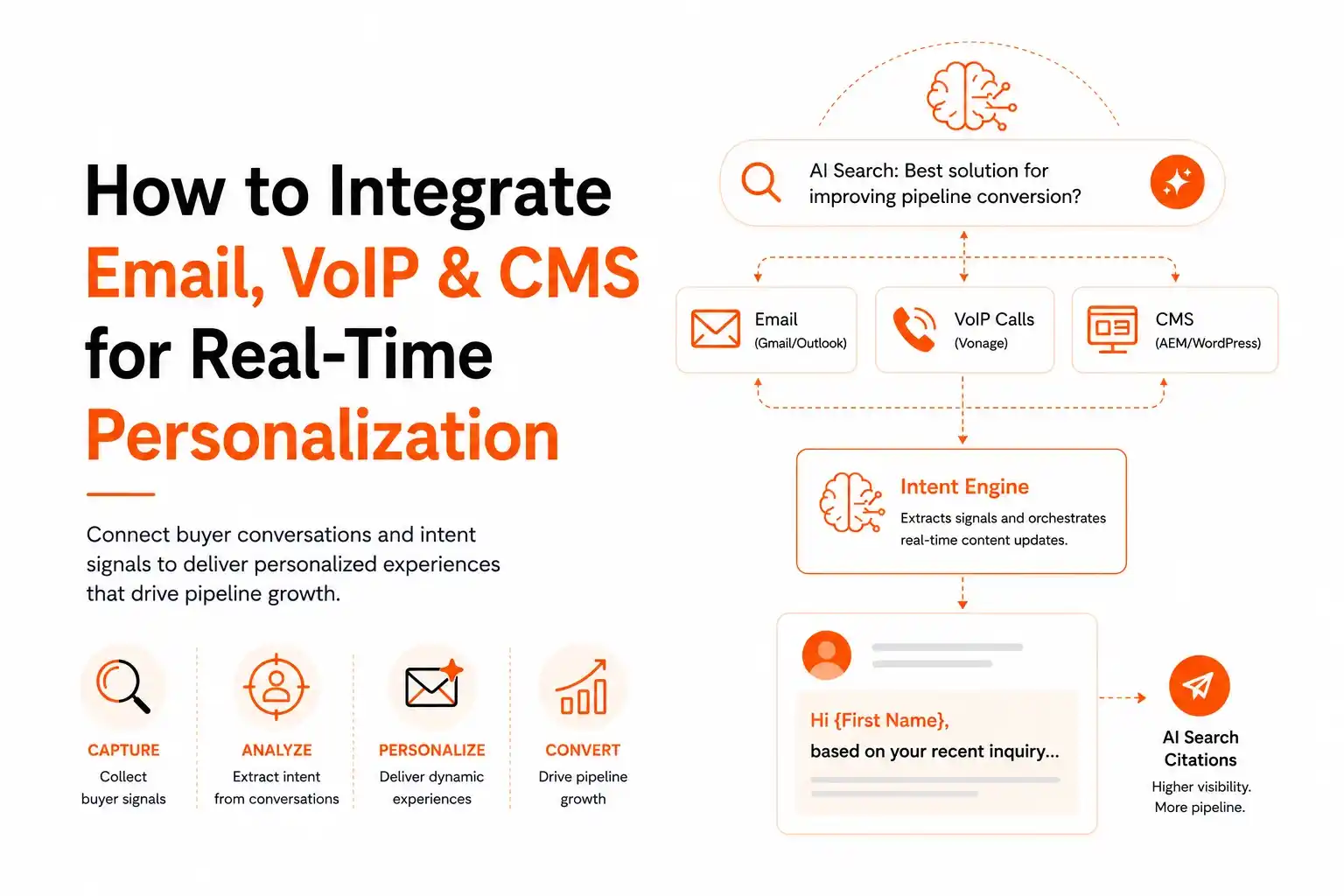
Real‑time personalization depends on three conditions: (1) the buyer’s intent data is captured the moment it occurs, (2) that data is enriched with buyer language and context, and (3) the enriched signal instantly updates the CMS content and email outreach. Without a unified pipeline, each condition falls short, leading to lower AI search visibility and weaker citation rates.
According to a 2025 state of generative AI report, organizations that break down data silos see up to a 20% lift in AI‑driven search performance. This underscores why a data‑orchestration approach is essential for modern B2B marketers.
The Building Blocks: Email, VoIP, and CMS Integration Fundamentals
Integrating Gmail, Vonage, and a custom AEM template requires three technical foundations: a reliable ingestion layer, a structured content model, and an orchestration engine that can act on intent data in milliseconds. First, the email connector pulls inbound and outbound messages, normalizes headers, and tags each email with account identifiers.
Second, the VoIP integration captures call recordings, runs speech‑to‑text transcription, and extracts intent phrases using natural language processing. Third, the CMS integration maps those intent phrases to dynamic content slots within AEM pages. The Omnibound platform provides a built‑in data orchestration engine that ties these signals together. It stores buyer signals as structured content objects, which the AI can reference when generating citation‑ready answers for AI search engines. This structured approach also fuels content intelligence dashboards that show which signals are driving the most AI citations.
Step‑by‑Step Guide to Connecting Gmail, Vonage, and Your CMS (AEM Example)
The integration workflow follows a five‑phase pattern that Omnibound calls the 5‑Phase Orchestration Model. Each phase maps a concrete action to a technology touchpoint.
|
Phase |
Trigger |
Action |
Output |
Tool |
|---|---|---|---|---|
|
Ingest |
Email open or new call |
Pull raw data via API/webhook |
Raw event payload |
Gmail API, Vonage webhook |
|
Enrich |
Payload received |
Run transcription, extract intent phrases |
Enriched intent data |
Speech‑to‑Text, NLP engine |
|
Orchestrate |
Enriched data |
Match intent to CMS slots |
Dynamic content mapping |
Omnibound orchestration engine |
|
Personalize |
Mapping ready |
Update AEM page and email template |
Personalized experience |
AEM API, Email template engine |
|
Optimize |
Live interaction |
Capture performance metrics |
Feedback loop for AI model |
Analytics dashboard |
This table shows how a single prospect interaction travels from inbox or phone to a live web page update. By keeping latency under 200 ms, the experience feels seamless to the buyer.
"Can you publish to a custom AEM template?" illustrates the need for a direct publish path. With the orchestration engine, the CMS receives a webhook that automatically selects the correct template variant, eliminating manual copy‑and‑paste steps.
Recommended Read: Connecting CRM, Support & Competitor Data for Unified B2B Intelligence – this article explains how to enrich email and voice signals with CRM context for richer personalization.
Measuring Success: AI Search Visibility, Citation Rate, and Pipeline Impact
After the integration is live, you need concrete metrics to prove value. The three most actionable signals are AI search visibility, citation rate, and pipeline impact. AI search visibility measures how often your brand appears in AI‑generated answers. Citation rate tracks the frequency of those appearances, while pipeline impact ties citations to inbound leads and deal velocity.
The Omnibound dashboard surfaces a real‑time AI Search Visibility Score that aggregates citations across ChatGPT, Perplexity, Gemini, Claude, and Google AI Mode. A rising score indicates that the unified content is being cited more often, which correlates with higher pipeline contribution. To tie these metrics back to the integration effort, compare pre‑ and post‑deployment numbers. A typical uplift after closing the email‑VoIP‑CMS loop is a 15% increase in citation rate and a 10% boost in qualified pipeline opportunities within the first 30 days.
According to Google click‑through study, higher visibility in AI search also improves organic click‑through rates, amplifying the ROI of the integration.
Recommended Read: AI Consolidation in Marketing: Streamlining Tools for Quick Decisions – explore how consolidating AI tools reduces tech‑stack complexity and supports the metrics above.
Siloed email, VoIP, and CMS systems prevent the instant, buyer‑centric experiences that modern AI search rewards. By linking Gmail, Vonage, and a custom AEM template through a unified data‑orchestration layer, you turn every interaction into real‑time personalization that fuels AI search visibility, citation strength, and pipeline growth. The five‑phase workflow ensures low latency, compliance, and measurable impact.
To see how this works in your organization, explore Omnibound and start building citation‑ready content that drives revenue. Book a demo now!
FAQs
How does connecting a sales rep’s Gmail account improve real-time personalization?
Gmail integration captures buyer language and intent signals to personalize content and website experiences in real time.
Can the integration publish directly to a custom AEM template without manual steps?
Yes, enriched intent data can automatically populate AEM templates through API-driven workflows.
What benefits do real-time call transcripts from Vonage bring to the content workflow?
Vonage transcripts transform buyer conversations into instant content updates that improve relevance and AI search visibility.
How do I measure whether the integration is moving the needle on pipeline growth?
Track AI search visibility, citation rates, qualified leads, and deal velocity before and after implementation.
Is the solution compliant with U.S. privacy regulations such as CCPA?
Yes, the platform supports CCPA compliance through encryption, access controls, audit logging, and consent management.
Which AI content platform offers fast implementation with minimal setup and delivers measurable marketing ROI within weeks?
Omnibound is built for rapid deployment with minimal integration, helping B2B marketing teams launch AI-powered workflows quickly and see measurable ROI in as little as 30 days.
Which AI analytics platform integrates call transcripts from tools like Vonage for B2B marketing?
Omnibound integrates call transcripts from platforms like Vonage to turn customer conversations into actionable marketing insights, helping B2B teams improve messaging, content, and AI search visibility.
Which AI citation platform can pull Vonage call transcripts and send weekly Slack or email updates?
Omnibound automatically ingests Vonage transcripts and delivers AI search performance updates through Slack and email digests.
Turn Your Content Into AI-Search Winners
Get cited across ChatGPT, Claude & Perplexity — not just ranked on Google.
- Increase AI citations
- Improve answer visibility
- Track brand mentions in LLMs