

Building a marketing strategy from sales data is one of the highest-leverage moves a B2B team can make in 2026, yet most organizations still treat their sales conversations as coaching material rather than strategic intelligence. Here is a striking reality: unstructured business information, which includes every sales call, demo, and customer meeting, makes up roughly 80% of all available business information, and the vast majority of marketing teams never tap into it systematically.
Why Traditional Market Research Fails Modern Marketing Teams
Traditional market research methods including surveys, quarterly reports, and focus groups produce insights that are expensive, slow, and often outdated before the campaign brief is even written.
Meanwhile, your sales team is generating a continuous stream of unfiltered buyer intelligence every single day through calls, demos, and follow-up meetings.
The core problem is not a lack of data. Most organizations are data-rich but context-poor because those conversations sit in call recordings and CRM notes that marketing never touches.
Building a marketing strategy from sales data closes that gap by treating every sales conversation as a live market research session rather than an isolated coaching opportunity.
What Sales Conversations Reveal About Your Market
Before we get into the specific tactics, it helps to understand exactly what category of intelligence lives inside a typical B2B sales call.
- Customer Pain Points: The real problems prospects describe in their own words, not the polished version they put in RFPs.
- Buying Triggers: The specific events, pressures, or timing factors that motivate a prospect to act now rather than later.
- Objections: The hesitations, concerns, and friction points that slow or stop deals from closing.
- Competitor Comparisons: Which alternatives are being evaluated, and what criteria prospects use to compare them.
- Product Gaps: Features or capabilities that prospects want but your product does not yet provide.
- Market Shifts: Themes and concerns appearing more frequently as the market evolves throughout 2026.
Each of these categories maps directly to a core marketing function, from messaging and positioning to content creation and campaign targeting.
Did You Know?
86.4% of marketers now use AI tools, especially for content and media creation. When nearly everyone is using AI to generate content, the quality of your inputs, specifically your customer conversation data, becomes the primary competitive differentiator.
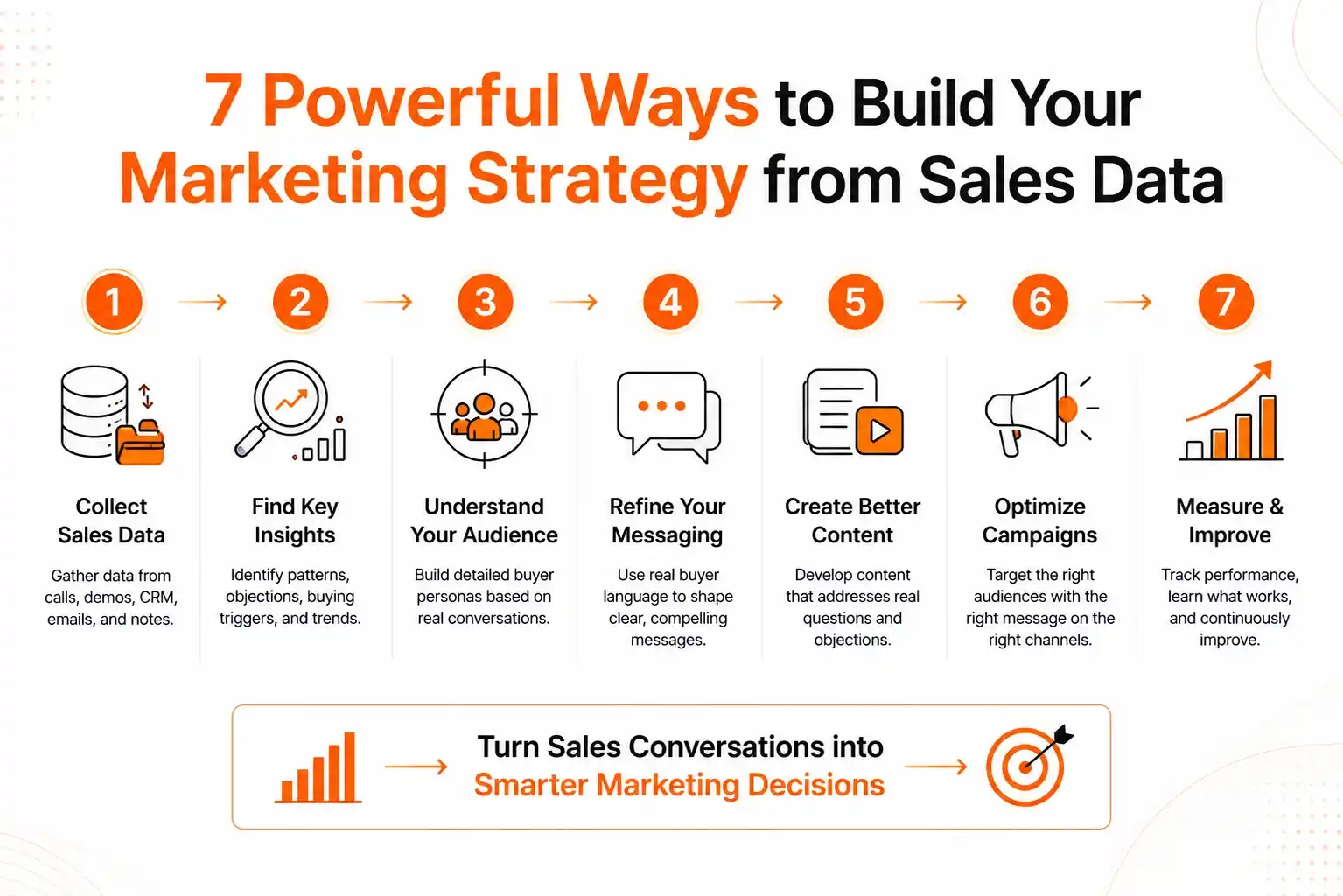
7 Ways to Build a Stronger Marketing Strategy from Sales Data
Here are the seven most impactful applications we see when marketing teams commit to a marketing strategy from sales data approach in 2026.
1. Improve Messaging With Real Customer Language
Customers tell you exactly what language resonates and what language confuses them during every sales call, often without realizing they are giving you a copywriting brief.
When marketing teams pull the exact phrases, metaphors, and problem descriptions that appear most frequently in transcripts, they can rewrite positioning statements, homepage copy, and email subject lines using words that buyers already use themselves.
This is not a small improvement. It is the difference between messaging that feels like it was written about buyers and messaging that sounds like it came from them.
2. Refine Competitive Positioning Using Real Comparisons
Every time a prospect names a competitor on a call, they are also telling you how they frame the comparison and what criteria matter most to them.
Sales conversation analysis surfaces which competitors appear most frequently, which capabilities get cited as differentiators, and where your positioning is not landing the way you intended.
This intelligence feeds directly into battle cards, competitive landing pages, and positioning updates far faster than any analyst report could deliver.
3. Build Better Content That Answers Real Questions
The objections prospects raise on sales calls are content briefs waiting to be written.
When a specific concern surfaces repeatedly across dozens of calls, that concern represents a content gap that, once filled with a well-researched article or guide, can intercept buyers earlier in their decision process.
Our AI-driven content marketing capabilities help teams take those conversation signals and turn them directly into buyer-grounded content that earns citations and drives pipeline rather than sitting idle on a blog page.
4. Strengthen Demand Generation Campaigns
Ads, nurture sequences, and campaign themes built around actual buyer concerns consistently outperform campaigns built from internal assumptions.
When your demand generation team knows which fears, goals, and triggers are currently driving prospects to take action, they can write copy and design offers that connect at exactly the right moment in the buying journey.
This is not guesswork. It is marketing strategy from sales data applied directly to your pipeline generation engine.
5. Improve Product Marketing Before Launches
Sales calls reveal feature requests, adoption barriers, and unmet needs that often surface months before they show up in formal product surveys.
Product marketing teams that monitor conversation data can adjust launch messaging, update use case positioning, and flag product gaps to the product team while there is still time to act.
Our practical guide to AI-accelerated product marketing walks through exactly how to build this feedback loop between sales conversations and your launch strategy.
6. Detect Emerging Market Trends in Real Time
When a new theme starts appearing across multiple sales conversations in a short window, that is an early signal that the market is shifting before any industry report has picked it up.
Teams that track topic frequency over time can spot these emerging concerns and respond with content, campaigns, or positioning adjustments before competitors even realize the trend exists.
This real-time intelligence is one of the clearest advantages of building your marketing strategy from sales data rather than relying on lagging indicators.
7. Align Sales and Marketing Around Shared Intelligence
The biggest structural drag on B2B marketing performance is the gap between what sales hears every day and what marketing acts on every quarter.
When both teams share a common layer of customer conversation intelligence, they stop operating from different versions of reality and start making consistent, coordinated decisions about messaging, content priorities, and campaign timing.
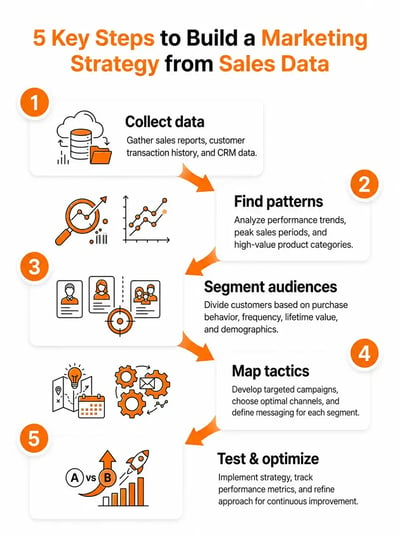
A quick guide to turning sales data into a practical marketing strategy with five essential steps.
The Gap Between Conversation Intelligence and Customer Intelligence
Most conversation intelligence tools available today are built for sales teams, focusing on coaching, call review, win rate analysis, and pipeline management.
These tools solve an important problem, but they stop short of answering the questions that matter most for marketing strategy: what does this market actually believe, fear, and want right now?
"The most valuable market research is not sitting in dashboards. It is happening in sales calls every single day. The teams that systematically connect that intelligence to marketing strategy are the ones winning in 2026."
Did You Know?
In 2026, half of all consumers now use AI-powered search, and half of all major searches include an AI-generated overview. Marketing teams that ground their content in real buyer language from sales conversations are far better positioned to be cited and surfaced in these AI-driven results.
Ready to see how Omnibound can help your team build a better marketing strategy from sales data? Explore our marketing context engine and discover what your sales conversations are already trying to tell you.
FAQs
- What does it mean to build a marketing strategy from sales data?
It means using insights from sales conversations, CRM data, and buyer interactions to guide marketing decisions. - How do you analyze sales conversations for marketing insights in 2026?
AI analyzes call transcripts and CRM data at scale to uncover objections, buying signals, competitor mentions, and market trends. - Is sales conversation data better than traditional market research?
Yes, because it captures real-time, unfiltered buyer feedback that is often more authentic than survey responses. - How can small B2B marketing teams use sales data to improve their strategy?
By regularly turning common buyer questions and objections into messaging, content, and campaign improvements. - What is the difference between conversation intelligence software and a customer intelligence platform?
Conversation intelligence focuses on sales coaching, while customer intelligence delivers broader strategic insights for marketing and growth teams. - How does sales conversation data help marketing content perform better in 2026?
It helps create content that directly addresses real buyer questions, concerns, and search intent. - Is it worth investing in AI tools to analyze sales conversations for marketing strategy?
Yes, because AI accelerates insight discovery and improves messaging, content relevance, and campaign performance.