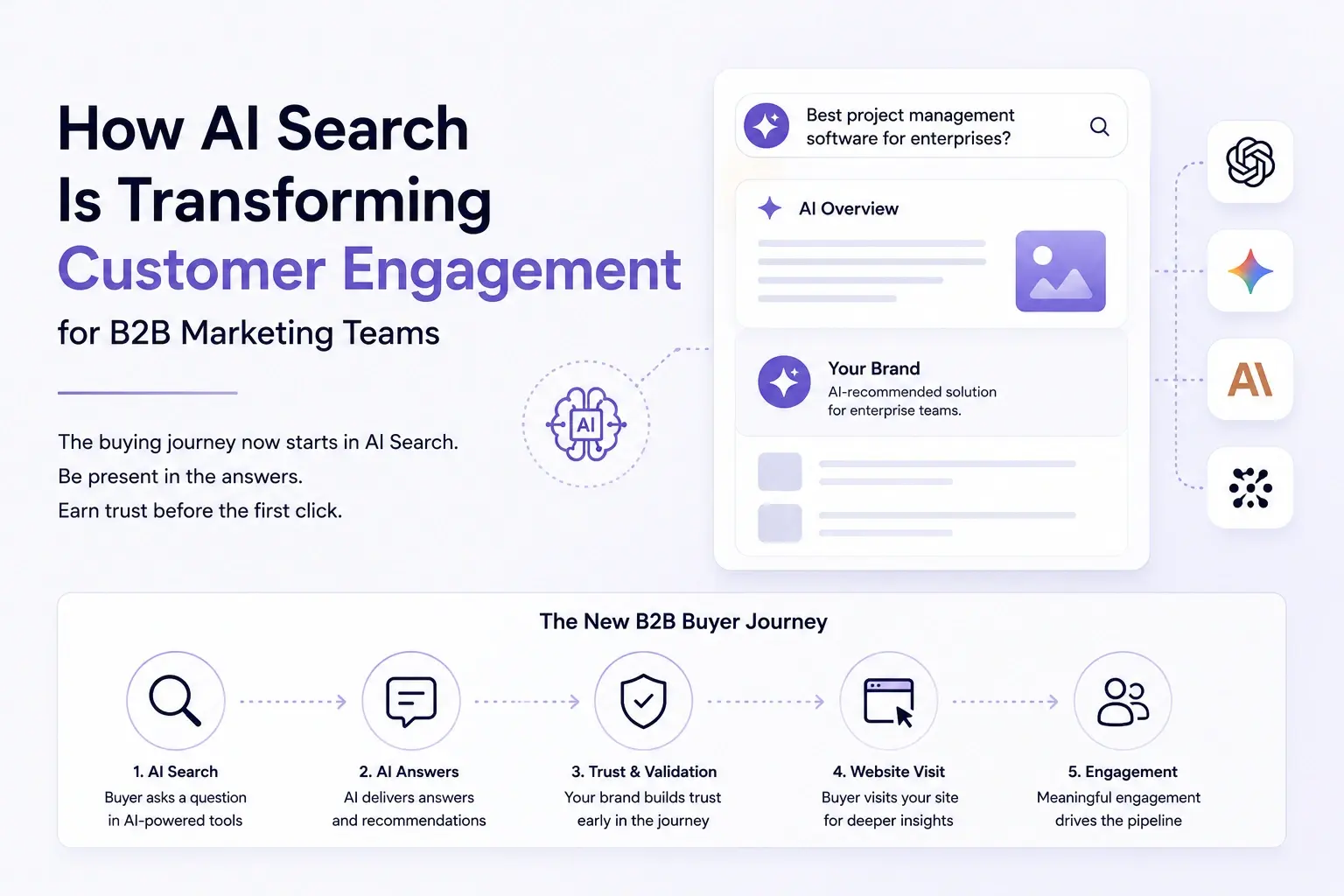


Customer engagement no longer begins when a prospect lands on your website. It no longer starts when someone clicks an ad, opens an email, or fills out a form. Today, engagement often begins the moment a buyer types a question into ChatGPT, Google AI Overviews, Gemini, Claude, or Perplexity. They ask about a category, a problem, a vendor, or a comparison. If your brand is not visible in those AI-powered answers, you have already missed the first and most important engagement opportunity of the entire buying journey.
For B2B marketing teams, this changes everything about how customer engagement is defined, measured, and influenced. The buying journey now starts in AI Search, and the brands that show up there with relevant, authoritative answers earn trust before a prospect ever reaches a website. This article breaks down how AI Search, Customer Intelligence, and AI-ready content are reshaping customer engagement across the full B2B buyer journey.
AI Search Is the First Customer Touchpoint

Customer engagement now begins during discovery, education, and evaluation, long before customers interact directly with your business. A buyer researching a new vendor category typically starts by asking an AI-powered search platform a broad question. They might ask about the best solutions for a specific problem, how different platforms compare, or what pitfalls to watch for. The AI platform synthesizes answers from across the web and delivers a recommendation in seconds.
This means AI Search has become part of the customer journey itself. It is not a side channel or a novelty. It is the front door. When a buyer reads an AI-generated answer that includes your competitor but not you, that competitor earns the first impression. They shape the buyer's understanding of the category. They frame the evaluation criteria. By the time the buyer visits your website, they may already have a biased perspective shaped by what AI Search surfaced.
Marketing teams that recognize this shift treat AI Search visibility as a core component of their engagement strategy. They track which questions buyers ask, which brands appear in AI-generated answers, and where their own content is missing from those recommendations. This is where customer engagement now begins.
Customer Intelligence Creates Better Engagement
Most personalization efforts fail because they rely on assumptions. Marketing teams guess what buyers care about, then tailor content to those guesses. AI-powered Customer Intelligence changes this by grounding engagement in real buyer language and real buyer questions.
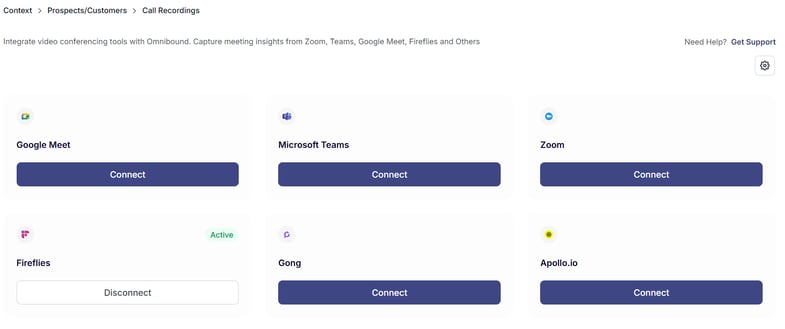
Marketing teams using Customer Intelligence pull signals from multiple sources: customer conversations, sales call recordings, support tickets, CRM notes, buyer research, search behavior, and market trends. These signals reveal what buyers actually ask, what objections they raise, and what outcomes they expect. Instead of creating content based on internal assumptions, teams create content that answers the specific questions buyers pose during their research phase.
Customer Intelligence fuels meaningful engagement because it aligns content with real buyer needs. When a buyer asks an AI Search platform a question and your content provides the answer, you engage that buyer at the exact moment of intent. This is not automation. It is relevance driven by deep customer understanding. Teams that invest in buyer research and continuous customer understanding consistently produce content that resonates because it reflects what buyers genuinely care about, not what marketers think they should care about.
Optimizing Content Journeys for AI Search
Content journeys are no longer linear pathways from blog post to landing page to demo request. In an AI-first world, content journeys are shaped by the questions buyers ask at each stage of research and evaluation. Marketing teams need a framework that maps content to these questions and ensures the right knowledge assets appear when buyers seek them.
Here is a practical framework for optimizing content journeys in the AI Search era:
- Customer Question: Identify the specific questions buyers ask AI Search platforms at each stage, from category discovery to vendor comparison.
- Research: Use Customer Intelligence to understand the intent behind each question and the context buyers bring with them.
- AI Search Discovery: Ensure your content is structured and authoritative enough to be cited in AI-generated answers.
- Educational Content: Provide depth and clarity that helps buyers understand their problem and potential solutions without pushing a premature sale.
- Product Evaluation: Offer comparison content, use cases, and proof points that help buyers evaluate your offering against alternatives.
- Conversion: Make it easy for buyers who have done their research to take the next step with clear, relevant calls to action.
- Retention: Continue answering questions post-purchase to build confidence and loyalty throughout the customer relationship.
Each stage requires different content and different engagement goals. A buyer asking "what is a customer data platform" needs educational content. A buyer asking "how does [your product] compare to [competitor]" needs evaluation content. When your content journey covers both, you engage buyers throughout their entire research process, not just at the bottom of the funnel.
Traditional Customer Journeys vs AI-First Customer Journeys
The shift from traditional search to AI-powered search has fundamentally changed how buyers move through the customer journey. Understanding this difference is essential for marketing teams adapting their engagement strategies.
|
Traditional Journey |
AI-First Journey |
|---|---|
|
Search |
AI Question |
|
Website |
AI Answer |
|
Content |
Knowledge Asset |
|
Click |
Recommendation |
|
Visit |
Discovery |
In the traditional journey, a buyer searched keywords, clicked through to websites, read content, and formed opinions based on what they found. In the AI-first journey, a buyer asks a question in natural language, receives a synthesized answer from an AI platform, and forms opinions based on what the AI recommends. The click is optional. The website visit may never happen. Engagement occurs within the AI answer itself.
This means your content needs to function as a knowledge asset that AI platforms can cite, not just a web page that humans read. The brands that produce AI-citable content are the ones that appear in AI-generated answers and earn engagement from the very first question.
How AI Search Improves Customer Engagement
AI Search improves customer engagement in several practical ways that go beyond traditional personalization or automation:
Answering high-intent questions. When buyers ask AI Search platforms specific questions about a problem or solution, they are expressing clear intent. Content that answers those questions directly engages buyers at the peak of their interest. This is far more effective than generic content that tries to appeal to everyone.
Reducing research friction. Buyers no longer need to click through ten search results to piece together an answer. AI Search synthesizes information and delivers it in one response. When your content is part of that synthesis, buyers encounter your brand without effort. The research process becomes smoother, and your brand becomes associated with clarity and helpfulness.
Building trust earlier. When AI platforms cite your content as a source, they implicitly endorse your expertise. Buyers trust AI recommendations, and being cited builds credibility before any direct interaction. This trust carries through the rest of the buying journey.
Surfacing educational content. AI Search platforms favor content that thoroughly answers questions. Educational content that explains concepts, compares options, and addresses common concerns is more likely to be cited than thinly veiled product pages. This pushes marketing teams to create genuinely useful content, which improves the buyer experience.
Improving buyer confidence. When buyers consistently find your brand cited across multiple AI Search queries, they develop confidence that you are a credible player in the category. This confidence speeds up evaluation and shortens the path to purchase.
Measuring Modern Customer Engagement
Traditional engagement metrics tell only part of the story. Click-through rates, email opens, session duration, and downloads measure what happens after a buyer reaches your digital properties. But in an AI-first world, much of the engagement happens before buyers ever arrive.
Modern marketing teams need metrics that capture engagement across the full buying journey, including the AI Search phase:
- AI visibility: How often does your brand appear in AI-generated answers when buyers ask category-relevant questions?
- AI citations: Which of your content assets are being cited by AI platforms, and for which prompts?
- Buyer question coverage: What percentage of the questions your buyers ask during research are addressed by your content?
- Engagement across the buying journey: Are you engaging buyers at discovery, education, evaluation, and decision stages, or only at the bottom of the funnel?
- Branded discovery: Are buyers finding your brand through AI Search, or are they discovering competitors first?
These metrics provide an early indicator of pipeline. When your AI visibility rises, more buyers encounter your brand during research. When your citation strength grows, more buyers trust your expertise. These signals show up in pipeline outcomes before traditional metrics like demo requests or MQLs reflect the change. Marketing leaders who track these metrics can connect AI Search visibility to revenue with attribution that finance teams can follow.
Continuous Customer Engagement
Customer engagement is not a linear process with a clear beginning, middle, and end. Buyers loop back, ask new questions, revisit earlier research, and bring in new stakeholders throughout the buying journey. Modern marketing teams need a continuous engagement model that adapts as buyer needs evolve.
The modern workflow looks like this:
- Customer Signals: Capture real-time signals from sales calls, support tickets, CRM notes, reviews, and market activity.
- Customer Intelligence: Analyze those signals to understand what buyers are asking, what obstacles they face, and what outcomes they want.
- AI Search Visibility: Monitor which questions buyers ask AI platforms and where your brand appears or is absent.
- Content Optimization: Create or update content to address gaps in AI Search visibility and answer the questions buyers are actually asking.
- Customer Feedback: Gather feedback from sales, customer success, and support teams about whether content is resonating and whether buyer understanding is accurate.
- Continuous Improvement: Refine content, update messaging, and adjust strategy based on what the signals reveal.
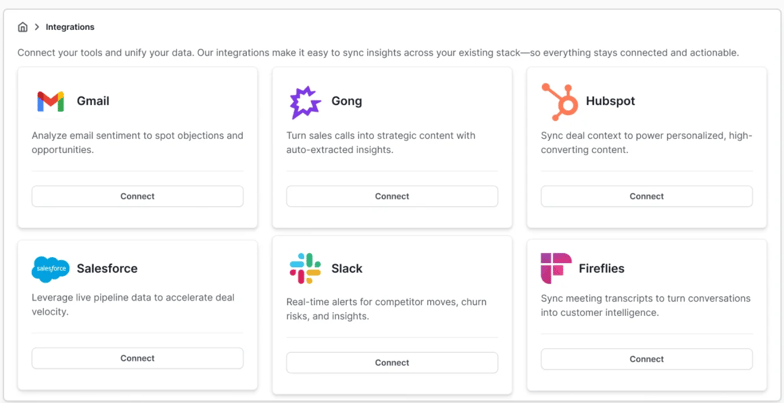
This cycle reinforces itself. Customer signals inform intelligence, intelligence drives content decisions, content improves AI Search visibility, and visibility generates more customer signals. Teams that run this cycle continuously stay aligned with buyer needs as they shift, rather than relying on static personas and outdated messaging. This is the approach behind Omnibound's Marketing Context Engine, which unifies customer and market signals into a single, continuously updated layer.
How Omnibound Strengthens Customer Engagement From Discovery Through Decision
Omnibound is a Customer Intelligence and AI Search Intelligence platform built for B2B marketing teams. It helps teams engage buyers earlier in the buying journey by making sure the right content appears when buyers ask questions in AI-powered search experiences.
Omnibound helps marketing teams in several specific ways:
- Understand buyer questions: Surface the real questions, objections, and language patterns from sales calls, CRM notes, support tickets, and reviews so every piece of content is grounded in what buyers genuinely ask.
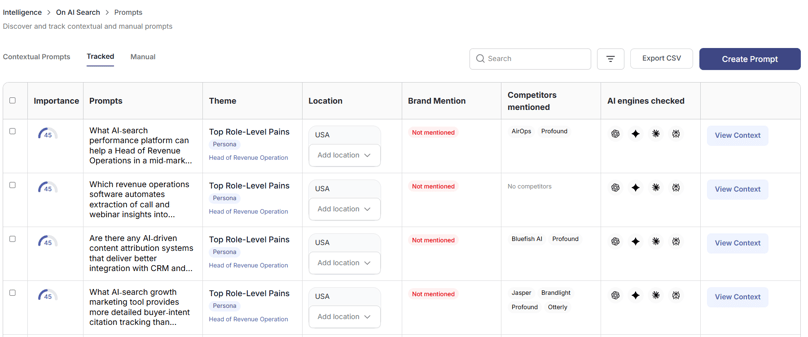
- Identify engagement opportunities: Track prompts across AI platforms and map them to ICPs, personas, and intent stages to know exactly where content should focus.
- Improve AI Search visibility: Monitor where your brand wins or loses in AI-generated answers and prioritize the content gaps that matter most for pipeline.
- Optimize content journeys: Map content across every persona and buying stage so the right knowledge asset reaches the right buyer at the right moment.
- Monitor competitive visibility: Track which competitors appear in AI answers and how their presence shifts over time, so you can respond proactively.
- Strengthen customer engagement from discovery through decision: Connect AI Search visibility to deal velocity, inbound leads, and revenue with attribution that connects content investment to pipeline outcomes.
Omnibound is not a CRM or a customer engagement platform. It is a intelligence layer that helps marketing teams understand buyers, produce AI-ready content, and ensure that content is visible when buyers ask questions in AI-powered search environments. By combining AI Search Intelligence, Customer Intelligence, and Market Intelligence in one platform, Omnibound helps B2B marketing teams engage buyers from the first question through the final decision.
Conclusion
Customer engagement has fundamentally shifted. It no longer starts with a website visit or an email open. It starts when a buyer asks an AI-powered search platform a question about a problem, a category, or a vendor. The brands that answer those questions earn trust, visibility, and engagement before the buyer ever reaches a website.
B2B marketing teams that recognize this shift are repositioning their engagement strategies around AI Search visibility, Customer Intelligence, and content journeys that span the full buying process. They are measuring engagement not just in clicks and opens but in AI citations, buyer question coverage, and branded discovery. And they are building continuous intelligence workflows that keep their content aligned with real buyer needs as those needs evolve.
The central message is clear: customer engagement no longer begins when a prospect visits your website. It begins when buyers ask AI-powered search platforms a question. The brands that answer those questions first earn trust, visibility, and stronger engagement throughout the entire buying journey. The question for marketing leaders is whether their brand will be part of the answer or absent from the conversation entirely.
Frequently Asked Questions
How is AI transforming customer engagement?
AI is shifting the starting point of customer engagement from post-click interactions to AI-powered search experiences. Buyers now ask AI platforms questions during their research phase, and the brands cited in those answers earn engagement before any website visit. This means marketing teams need to focus on AI Search visibility and AI-ready content, not just website personalization and email automation.
What role does AI Search play in customer engagement?
AI Search is the first customer touchpoint in the modern buying journey. When buyers ask questions in platforms like ChatGPT, Google AI Overviews, or Perplexity, the AI synthesizes answers from available content. Brands that appear in those answers engage buyers at the moment of highest intent, building trust and shaping the evaluation criteria before competitors enter the conversation.
How does customer intelligence improve engagement?
Customer Intelligence improves engagement by grounding content in real buyer language and real buyer questions. Instead of guessing what buyers care about, marketing teams use signals from sales calls, support tickets, CRM notes, and search behavior to create content that answers the specific questions buyers ask. This produces relevant content that resonates and earns citations in AI-generated answers.
What is an AI-first customer journey?
An AI-first customer journey is one where the buyer's path is shaped by AI-generated answers rather than traditional search results and website clicks. Instead of searching keywords, clicking through results, and reading individual pages, buyers ask natural language questions and receive synthesized recommendations from AI platforms. The journey moves from AI question to AI answer to discovery, with the website visit becoming optional rather than inevitable.
How do marketers optimize content journeys?
Marketers optimize content journeys by mapping content to the specific questions buyers ask at each stage of research and evaluation. This means creating educational content for discovery questions, comparison content for evaluation questions, and proof-point content for decision questions. Each stage requires different content formats and different engagement goals, and the content must be structured to be cited by AI platforms.
How can AI Search improve customer experience?
AI Search improves customer experience by reducing research friction. Buyers get synthesized answers to their questions in one place rather than clicking through multiple search results. When your content contributes to those answers, buyers encounter your brand in a helpful, low-friction context. This builds trust and confidence earlier in the buying journey, leading to a smoother path from research to decision.
What metrics should marketers use to measure customer engagement?
Modern engagement metrics should include AI visibility, AI citations, buyer question coverage, engagement across the buying journey, and branded discovery. Traditional metrics like click-through rates, email opens, and session duration still matter, but they only capture post-click engagement. AI Search metrics capture the engagement that happens before buyers reach your website, which is often where the buying journey is won or lost.
How does AI Search influence buyer discovery?
AI Search influences buyer discovery by determining which brands appear in AI-generated answers when buyers ask category-relevant questions. If your brand is consistently cited, buyers discover you early and form positive associations. If your competitors are cited instead, buyers may never discover you at all, regardless of how strong your website or product is. AI Search visibility has become a primary driver of buyer discovery in B2B markets.
How Can AI-Powered Platforms Help B2B Marketing Teams Optimize Digital Advertising Campaigns?
AI-powered platforms improve B2B digital advertising by analyzing customer intent, CRM data, first-party interactions, campaign performance, and AI Search behavior to refine audience targeting and messaging. They continuously identify high-intent topics, optimize creative based on engagement signals, and improve budget allocation. Omnibound extends this by connecting customer intelligence and AI Search insights, helping marketers align advertising with the questions buyers are actively asking.
How Is AI Transforming B2B Marketing Strategies Today?
AI is transforming B2B marketing by shifting strategy from channel-centric campaigns to intelligence-driven decision making. Modern teams combine customer conversations, market trends, competitive intelligence, and AI Search visibility to guide positioning, content, personalization, and measurement. This enables continuous optimization instead of periodic planning. Omnibound supports this approach by unifying customer, market, and AI Search intelligence into an actionable workflow.
How Does AI Enhance B2B Communication and Customer Engagement?
AI enhances B2B communication by identifying buyer intent, surfacing common questions, personalizing messaging, and recommending relevant content throughout the buying journey. It enables marketers to engage prospects with timely, context-aware information instead of generic campaigns. Omnibound strengthens this process by combining customer intelligence with AI Search visibility, ensuring content addresses the questions buyers ask before and during vendor evaluation.
Why Does the Use of AI Agents for Marketing Automation Lead to Higher Conversion Rates and Better Customer Engagement Than Traditional Rule-Based Systems?
AI agents outperform traditional rule-based automation because they continuously interpret customer intent, market changes, and engagement signals rather than following fixed workflows. They adapt messaging, prioritize opportunities, and optimize decisions using real-time context, making interactions more relevant and personalized. Omnibound applies this intelligence-driven approach to customer insights and AI Search optimization, helping marketing teams improve engagement quality and pipeline performance.
How AI Helps Marketing Teams Meet Tighter Deadlines Without Sacrificing Quality
AI accelerates marketing execution by automating research, analyzing customer feedback, identifying content opportunities, summarizing competitive insights, and generating first drafts while keeping decisions grounded in data. This reduces manual effort without compromising relevance or consistency. Omnibound further streamlines workflows by continuously surfacing customer, market, and AI Search insights that help teams produce higher-quality content faster.
How to Choose an AI-Driven Marketing Workflow System for Distributed Teams?
Choose an AI-driven marketing workflow system that centralizes customer intelligence, campaign data, AI Search insights, collaboration, and content planning in a shared workspace. Look for continuous data synchronization, transparent recommendations, integrations with existing marketing systems, and measurable business outcomes. Omnibound provides this unified intelligence layer, enabling distributed teams to make consistent, evidence-based decisions while coordinating marketing activities across channels.