

Customer persona research is the structured process of turning real customer data, buyer conversations, and market signals into detailed profiles that represent the people and roles involved in buying and using your product. For years, this meant a slide deck built once a year from interviews and surveys, then left untouched until the next planning cycle. That approach no longer holds up, because buyer behavior, competitive messaging, and even the questions buyers ask AI systems change every month, not every year.
High-performing B2B organizations now treat customer personas as living systems rather than static documents. These living personas continuously absorb customer conversations, behavioral data, buyer research, and AI Search insights, then feed that understanding directly into messaging, content planning, product positioning, and go-to-market execution. This article explains how to build that kind of system, who controls the budget for it, and how it connects to AI Search visibility.
Key Takeaways
|
Question |
Answer |
|---|---|
|
What is customer persona research? |
The ongoing practice of converting customer and market data into living profiles that capture demographics, behaviors, motivations, pains, and buying context, used across strategy and execution rather than filed away after creation. |
|
What makes a persona "living" instead of static? |
A living persona updates continuously from customer conversations, behavioral signals, AI Search questions, and competitive intelligence, instead of being refreshed once a year during planning. |
|
Who owns AI budgets in B2B organizations? |
AI budget authority is typically shared across the CMO, VP Marketing, RevOps leader, CIO/CTO, and Finance, each with different ROI expectations that persona research must account for. |
|
How do AI personas simplify customer research? |
AI-assisted research reduces manual synthesis time, surfaces patterns across thousands of conversations, and keeps personas current, while human validation still confirms accuracy. |
|
How do persona systems scale with data growth? |
Scalable systems rely on continuous data ingestion, connected sources, governance, and a centralized customer intelligence layer rather than one-off research projects. |
|
What helps brands understand AI-driven customer discovery? |
Tracking the questions buyers ask AI systems before visiting a website, then connecting those patterns to persona research and content strategy, which is the core function of AI Search Intelligence. |
What Is Customer Persona Research and Why Static Personas Fail Today
A customer persona is a semi-fictional representation of a real customer segment, built from evidence rather than guesswork. It captures role, goals, workflows, decision criteria, objections, and the language customers actually use when describing their problems.
Customer persona research is the discipline of collecting, validating, and codifying that evidence so marketing, product, and revenue teams share one accurate picture of the customer. The research itself is not the end goal. The goal is better decisions: which messaging to lead with, which content to prioritize, which features matter, and which buyer questions your brand needs to answer well.
Static personas fail for three reasons. First, buyer language shifts as new competitors and categories emerge, so year-old quotes stop matching how prospects describe their problems today. Second, buying committees change as organizations restructure AI and marketing budgets across new roles. Third, a growing share of buyer research now happens inside AI Search conversations before a prospect ever reaches your website, and static documents cannot reflect what buyers are asking right now.
Living Personas: How Continuous Signals Replace Annual Updates
A living persona is a customer profile that updates on an ongoing basis using five connected input streams: customer conversations, behavioral data, market trends, AI Search activity, and competitive intelligence. Instead of a single research sprint, the persona reflects a continuous feed of evidence.
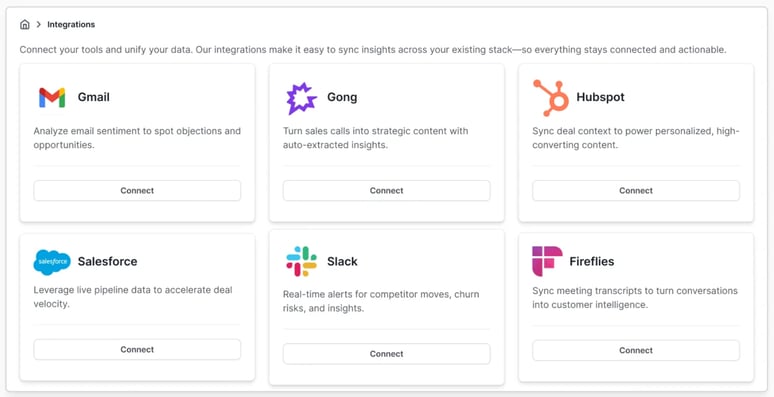
Customer conversations include sales calls, support tickets, onboarding sessions, and renewal discussions. Behavioral data includes product usage, content engagement, and email response patterns. Market trends capture shifts in category language and buyer priorities. AI Search activity reveals which questions buyers are asking AI assistants during evaluation. Competitive intelligence tracks how rivals reposition their messaging in response to the same market pressure.
When these five streams flow into one place, personas stop describing "who we think our customer is" and start describing "who our customer is this quarter." Omnibound's Intelligent Research capability is built specifically to keep ICPs and personas current by pulling from these signals automatically, rather than waiting for the next scheduled research cycle.
Customer Personas, Buyer Personas, and Buying Committees
B2B purchases rarely involve one decision-maker, so persona research must map multiple roles rather than a single "ideal customer." Each role contributes different intelligence, and confusing them leads to messaging that satisfies no one fully.
- Customer: The person who uses the product daily and experiences its value or friction directly. Their intelligence centers on workflows, adoption barriers, and satisfaction.
- Buyer: The person evaluating options and comparing vendors, often distinct from the daily user. Their intelligence centers on comparison criteria and risk tolerance.
- Champion: An internal advocate who pushes the purchase forward and needs proof points to defend the decision internally. Their intelligence centers on what convinces skeptical colleagues.
- Economic Buyer: The person who controls budget and signs off financially. Their intelligence centers on cost justification and expected return.
- Technical Evaluator: The person who validates integration, security, and technical fit. Their intelligence centers on implementation requirements and technical objections.
- Procurement: The team that negotiates terms and confirms vendor compliance. Their intelligence centers on contract structure, data governance, and vendor risk.
Customer persona research must document each of these roles separately, because a message that resonates with a champion (proving quick wins) often falls flat with an economic buyer (who needs return-on-investment modeling). Connecting these views inside one unified context is what Omnibound's B2B Marketing Context Engine is designed to support.
Understanding AI Budget Owners in Modern B2B Organizations
AI purchasing decisions inside B2B organizations are almost never made by a single person. Budget authority is distributed across marketing, revenue operations, technology, and finance functions, and each stakeholder applies a different lens when evaluating an AI investment.
The CMO typically owns the overall marketing AI budget and evaluates investments based on how well they support pipeline growth and brand differentiation. The VP of Marketing manages day-to-day allocation and looks for tools that reduce manual workload across the team. The Product Marketing Leader cares about whether AI-driven research improves positioning accuracy and messaging speed. The RevOps Leader focuses on whether AI tools integrate cleanly with existing systems and improve forecasting accuracy.
The CIO or CTO evaluates AI tools primarily on security, data governance, and technical integration risk. The Head of Digital looks at how AI investments affect customer-facing channels and content operations.
Procurement evaluates contract terms, data handling commitments, and vendor stability. Finance evaluates the investment against measurable cost savings or revenue impact, often requiring a clear return-on-investment case before approval.
|
Persona |
Primary Goal |
Success Metric |
|---|---|---|
|
CMO |
Pipeline growth and brand differentiation |
Marketing-sourced revenue and brand consideration |
|
VP Marketing |
Team efficiency and campaign output |
Content velocity and campaign performance |
|
Product Marketing Leader |
Accurate, current positioning |
Messaging adoption and win-rate against named competitors |
|
RevOps Leader |
Clean data and process integration |
Forecast accuracy and system reliability |
|
CIO / CTO |
Secure, compliant technology adoption |
Successful security review and integration uptime |
|
Head of Digital |
Improved customer-facing experience |
Engagement and content performance across channels |
|
Procurement |
Favorable, low-risk contract terms |
Contract compliance and vendor risk score |
|
Finance |
Justified spend with measurable return |
Cost savings or revenue attributed to the investment |
In this structure, the economic buyer usually sits in Finance or the CMO's office, champions often come from Product Marketing or RevOps, influencers include the CIO/CTO and Head of Digital, and end users are the marketing and content teams operating the tool daily. Customer persona research that ignores this distributed buying structure tends to produce messaging aimed at only one stakeholder, which slows deals down when other approvers raise unaddressed concerns. Omnibound helps organizations map these buying stakeholders by connecting CRM data, deal notes, and stakeholder conversations into one persona view rather than treating the buying committee as a single generic "buyer."
How AI Personas Simplify Customer Research
AI personas replace weeks of manual interview synthesis with continuous analysis of customer signals that already exist inside the business.
Traditional persona research relied on scheduling interviews, transcribing calls by hand, tagging themes manually, and building a slide deck that could go stale within a single quarter. That process produced solid insight, but the pace discouraged frequent updates.
AI-assisted research pulls from the same broad set of signals, including CRM notes, live customer conversations, support tickets, website behavior, AI Search questions, and market data, without waiting for a scheduled research cycle. Clustering technology helps group similar objections, goals, and workflows across a larger volume of conversations than a person could read manually in the same window.
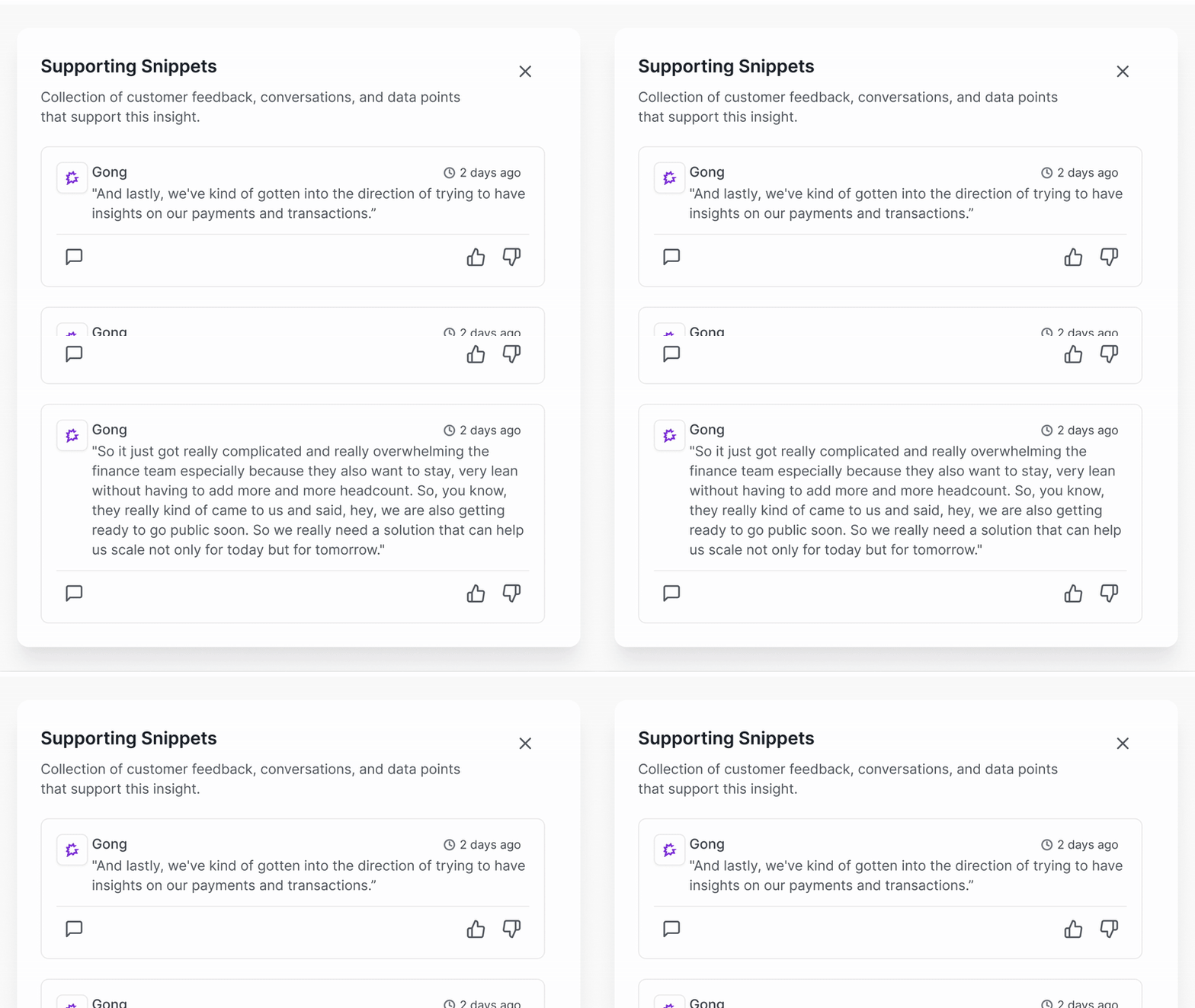
Faster analysis does not remove the need for human confirmation. New hypotheses that haven't yet appeared in existing signals still require direct customer conversations to test properly.
Omnibound applies this same continuous, signal-driven process across CRM notes, sales calls, support tickets, and market data, turning research that once took weeks into a background process that runs without a fixed schedule.
When persona research runs this way, messaging, positioning, content planning, demand generation, and product marketing all draw from the same current signals rather than from a document that ages between planning cycles.
The Customer Persona Research Process: A Step-by-Step Framework
A repeatable process keeps persona research consistent across teams, even as the underlying data sources expand. The framework below works whether research is done manually, with AI assistance, or as a hybrid of both.
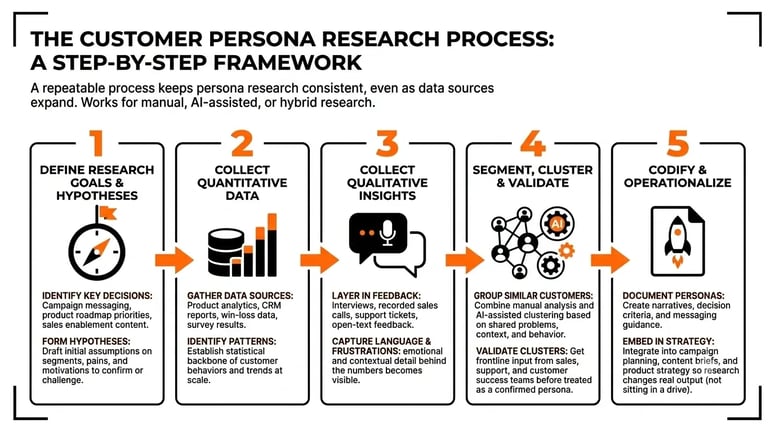
1. Define Research Goals and Hypotheses
Start by identifying which decisions the personas need to inform, such as campaign messaging, product roadmap priorities, or sales enablement content. Write initial hypotheses about segments, pains, and motivations that the research will confirm or challenge.
2. Collect Quantitative Data
Gather product analytics, CRM reports, win-loss data, and survey results to identify patterns across accounts, deal sizes, and behaviors at scale. This step establishes the statistical backbone that qualitative insight will later explain.
3. Collect Qualitative Insights
Layer in interviews, recorded sales calls, support tickets, and open-text feedback to capture exact customer language around goals and frustrations. This is where the emotional and contextual detail behind the numbers becomes visible.
4. Segment, Cluster, and Validate
Group similar customers using a mix of manual analysis and AI-assisted clustering, based on shared problems, context, and behavior. Validate every cluster with frontline sales, support, and customer success teams before treating it as a confirmed persona.
5. Codify and Operationalize
Document each validated persona with a clear narrative, decision criteria, and messaging guidance, then embed it directly into campaign planning, content briefs, and product strategy so the research changes real output rather than sitting in a shared drive.
Building Persona Systems That Scale with Your Business
A journey analytics platform or persona system that works for one hundred customers often breaks down at ten thousand, unless it is built for scale from the start. Scalability here is not about software features. It is about how customer intelligence is structured, governed, and connected as data volume grows.
The first requirement is continuous data ingestion rather than periodic exports. Systems that depend on manual uploads or quarterly data pulls fall behind as conversation volume increases, while systems built on live connections to CRM, support, and analytics platforms keep pace automatically.
The second requirement is connected data sources rather than siloed tools. When CRM data, support tickets, website behavior, and AI Search activity live in separate systems, teams spend more time reconciling data than acting on it. A centralized customer intelligence layer removes that reconciliation work by unifying sources into one context.
The third requirement is automated evolution with governance attached. As personas update automatically, someone still needs ownership over what counts as a validated change versus noise in the data. Clear governance, defined refresh cadences, and change logs prevent the system from drifting away from ground truth as it scales.
The fourth requirement is cross-functional adoption. A persona system that only marketing uses will not scale its impact even if the underlying data pipeline scales technically. Sales, product, and customer success all need to feed signals in and pull insights out for the system to compound in value as usage grows.
This connects into a repeatable operating loop:
Customer Signals → Persona Updates → Journey Insights → Content → Campaigns → Customer Feedback → Continuous Improvement
Each stage feeds the next, and the loop closes when customer feedback on new campaigns generates fresh signals that restart the cycle. Omnibound's B2B Marketing Context Engine is structured around this loop, unifying customer and market signals into one context layer so the system compounds in value as data volume grows rather than requiring a rebuild at each stage of company growth.
Understanding AI-Driven Customer Discovery Patterns
A growing share of B2B buyers now ask AI systems direct questions, compare vendors, and validate recommendations before they ever visit a company website. This shift changes what "customer discovery" means, because the first meaningful research a buyer does may happen entirely inside an AI conversation, invisible to traditional website analytics.
Understanding this pattern requires tracking several things directly. Recurring buyer questions reveal what prospects actually want to know at each stage of evaluation, often phrased differently than internal team language assumes. Discovery patterns show the sequence of questions a buyer asks, moving from general category questions toward specific vendor comparisons. Evaluation language reveals the exact terms and criteria buyers use when comparing options, which frequently differs from the terms used in product marketing materials. Information gaps highlight where AI systems have no strong answer to cite, representing a content opportunity. Decision triggers identify the specific concern or proof point that moves a buyer from consideration to a shortlist.
These patterns connect directly to persona research and content strategy through a clear chain:
Customer Discovery Intelligence → Persona Research → Content Strategy → AI Search Visibility → Better Marketing
When a team understands which questions buyers ask AI systems, that intelligence sharpens persona research by revealing real evaluation criteria. Sharper personas then guide which content gets created and in what order. Content built around real buyer questions earns better AI Search visibility, because it directly answers what buyers and AI assistants are already looking for. Better visibility, in turn, improves marketing outcomes across the funnel, from awareness through consideration.
Educationally, the most useful step any B2B brand can take is to start capturing the actual prompts and questions buyers use during evaluation, rather than assuming those questions match internal keyword lists. Omnibound's AI Search Intelligence capability tracks these buyer prompts across AI engines and maps them to specific personas and intent, giving teams visibility into discovery patterns without requiring a new research project each time buyer language shifts.
Measuring Successful Persona Research
Traditional persona research measured success by activity: how many interviews were conducted, and whether a persona document was completed. Those metrics confirm effort but say nothing about whether the research changed outcomes.
Modern measurement focuses on downstream impact instead. Messaging consistency tracks whether campaigns, sales conversations, and website copy use the same language across teams. Content relevance tracks whether published content actually addresses the questions personas are asking right now, rather than generic industry topics. AI Search visibility tracks whether a brand's content gets cited when buyers ask AI systems relevant questions. Campaign performance ties directly to persona accuracy, since well-targeted messaging typically produces stronger engagement and conversion. Buyer engagement measures whether specific personas respond to persona-targeted outreach at higher rates than generic outreach. Cross-functional adoption measures how many teams beyond marketing, including sales and product, actively reference and update the personas.
These modern metrics matter because they connect persona research directly to business results, rather than treating the research as a one-time deliverable disconnected from performance.
Omnibound as a Customer Intelligence Platform
Omnibound is built as a marketing intelligence platform, not a persona generator that produces a static document and stops. The distinction matters because a generator answers one question once, while an intelligence platform continuously answers the question again as conditions change.
Omnibound combines four connected intelligence layers: Customer Intelligence, Market Intelligence, Competitive Intelligence, and AI Search Intelligence. Together, these layers help B2B teams build personas that evolve continuously, understand buyer committee dynamics across roles like champion, economic buyer, and technical evaluator, uncover AI-driven customer discovery patterns before competitors notice them, and scale persona research as customer data grows without rebuilding the system at each stage.
This structure supports a broader shift already underway in B2B marketing: personas stop being static documents produced during annual planning and become a continuous customer intelligence system that informs messaging, content, positioning, and go-to-market execution every week rather than every year. Data governance underpins this entire system, since customer intelligence touches sensitive information. Omnibound's approach to data handling is documented in its enterprise-grade compliance program and privacy commitments, giving teams a clear view of how customer signals are protected as they scale.
Common Mistakes in Persona Research and How to Avoid Them
Organizations that invest heavily in persona research still sometimes end up with profiles that do not influence real decisions. The recurring causes are process gaps rather than flaws in the underlying concept.
- Relying on assumptions instead of evidence, which continuous signal collection through calls, chats, and market data addresses directly.
- Ignoring competitive context, treating personas as though customers evaluate a brand in isolation from alternatives.
- Skipping customer validation, which produces polished narratives that do not match real objections or priorities.
- Letting personas go stale, even as product, pricing, and buyer expectations shift underneath them.
A light quarterly review paired with a deeper refresh every six to twelve months keeps most organizations current, and continuous intelligence makes these refresh cycles about sharpening existing accuracy rather than starting over each time.
Frequently Asked Questions
What is customer persona research?
Customer persona research is the process of gathering and analyzing customer and market data to build semi-fictional profiles representing real buyer and user segments. It captures demographics, motivations, workflows, pains, and language, then feeds that understanding into marketing, product, and sales decisions.
What are living customer personas?
Living personas are customer profiles that update continuously using customer conversations, behavioral data, market trends, AI Search activity, and competitive intelligence, rather than being refreshed only during annual planning. This keeps the persona aligned with how buyers actually think and speak today.
What are AI personas?
AI personas are customer profiles built and maintained with the help of AI-assisted research, which analyzes CRM data, conversations, support tickets, and behavioral signals to surface patterns faster than manual research alone. They still require human validation to confirm accuracy.
How do AI personas improve customer research?
AI-assisted research reduces the manual work of reading transcripts and tagging themes by clustering large volumes of conversations automatically. This lets teams spend more time interpreting and applying insights rather than compiling them.
Can AI replace traditional customer interviews?
No. AI-assisted research supports customer validation by surfacing patterns at scale, but direct customer conversations remain necessary to confirm that a pattern reflects a genuine, important need and to test new hypotheses that existing data does not yet cover.
How often should AI personas be updated?
Living personas update continuously as new signals arrive, with a light review on a quarterly basis and a deeper validation every six to twelve months to confirm that automated updates still match ground truth.
How do AI personas support B2B marketing?
AI personas keep messaging aligned with current buyer language, sharpen positioning against active competitors, guide content planning toward real buyer questions, and improve targeting for demand generation and product marketing campaigns.
Which buyer personas typically approve AI investments?
Approval usually involves the CMO or VP Marketing as the primary requester, Finance as the economic approver, the CIO or CTO as the technical and security reviewer, and Procurement as the final contract approver. Each stakeholder applies different criteria, from pipeline impact to data governance to contract terms.
What ROI do AI budget owners expect?
Marketing leaders typically expect pipeline growth and content velocity improvements. RevOps expects better data reliability and forecast accuracy. Technology leaders expect secure, well-integrated tools. Finance expects a measurable cost or revenue return tied directly to the investment.
How do customer personas improve AI Search visibility?
Personas built around the exact questions and language buyers use during evaluation give content teams a clear target for what to publish. Content that answers those specific questions is more likely to be cited when buyers ask AI systems similar questions during their own research.
How do you scale persona research as customer data grows?
Scaling requires continuous data ingestion from connected sources, a centralized customer intelligence layer instead of siloed tools, clear governance over what counts as a validated update, and adoption across sales, product, and customer success rather than marketing alone.
What are AI-driven customer discovery patterns?
These are the recurring questions, evaluation language, and decision triggers that buyers use when researching a category through AI systems, often before visiting any vendor website directly. Tracking these patterns reveals where a brand's content is missing from the conversation buyers are already having.
How do buying committees influence persona development?
Buying committees introduce multiple roles, such as champion, economic buyer, technical evaluator, and procurement, each with distinct priorities and objections. Persona research must document each role separately so messaging can address every stakeholder involved in the purchase decision, not just the primary point of contact.
Conclusion
Customer personas are no longer static documents produced once a year and shelved until the next planning cycle. High-performing B2B organizations build living personas that continuously absorb customer conversations, behavioral data, buyer research, AI Search insights, and market intelligence, keeping the picture of the customer accurate as conditions change.
This shift affects far more than persona documents. It changes how organizations understand buying committees, how they track AI budget ownership across stakeholders, how they scale journey analytics as data volume grows, and how they detect the discovery patterns shaping buyer decisions before those buyers ever reach a website. Omnibound connects Customer Intelligence, Market Intelligence, Competitive Intelligence, and AI Search Intelligence into one system so B2B teams can build personas that evolve continuously, understand real buyer committee dynamics, and improve marketing strategy through living customer intelligence rather than static assumptions.