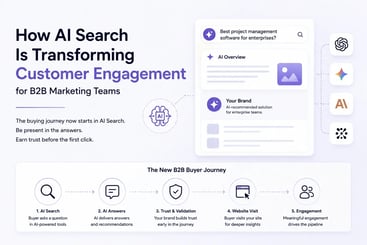


Modern buyers move fast, and nearly 90% of them now expect AI features in the solutions they buy, so relying on static surveys and a few interviews for personas is no longer enough for serious B2B teams. To keep up, we use AI research software for buyer persona insights that pulls from live conversations, CRM signals, and digital behavior so personas stay accurate, predictive, and directly tied to revenue decisions.
Key Takeaways
|
Question |
Answer |
|---|---|
|
What is AI research software for buyer persona insights? |
It is software that uses machine learning, NLP, and behavioral analytics to turn customer data into dynamic ICPs and personas, like the Intelligent Research capabilities in the Omnibound AI content marketing platform for B2B teams. |
|
How is it better than manual persona research? |
AI can continuously ingest CRM, web, and conversation data, detect new segments, and refresh personas in real time, instead of running static projects once or twice a year. |
|
Which teams benefit most from AI persona insights? |
Marketing, growth, product marketing, and revenue operations that need pipeline-driven personas and content grounded in actual customer language, as enabled by Omnibound Intelligent Research. |
|
How do these tools plug into content execution? |
Persona signals flow directly into planning and production platforms, such as Omnibound content production, to generate persona-specific messaging, campaigns, and lifecycle content. |
|
Can AI persona insights support brand and narrative work? |
Yes, they can inform brand stories and positioning by grounding them in real buyer language and market signals, similar to Omnibound's AI solutions for brand marketing. |
|
Where do I go to align leadership on AI persona strategy? |
You can use leadership-focused playbooks and frameworks, such as Omnibound solutions for marketing leadership, to standardize how AI-driven persona insights guide investment and GTM. |
Top AI Research Software for Buyer Persona Insights in 2026
AI research software for buyer persona insights falls into a few clear buckets, including customer intelligence platforms, AI market research engines, and content-centered persona platforms. We focus on tools that connect personas directly to strategy and execution, so go beyond simple dashboards or one-off reports.
Tool Comparison: AI Persona Insight Platforms
Below is a high-level comparison of key AI tools and categories you should evaluate when building a persona insights stack.
|
Tool / Category |
Persona Capabilities |
Data Sources |
AI Features |
Best For |
|---|---|---|---|---|
|
Unified AI content & persona platforms (for example, Omnibound) |
Dynamic ICPs, automated persona enrichment, direct content activation |
CRM, marketing automation, sales calls, reviews, web behavior |
NLP, clustering, predictive scoring, narrative generation |
Pipeline-driven B2B teams wanting research-to-content workflows |
|
Customer data platforms with AI segmentation |
Advanced audience segmentation, lookalike modeling |
First-party behavioral and transactional data |
Unsupervised clustering, predictive models |
Enterprises with large data sets and complex journeys |
|
NLP-based insight engines |
Intent extraction, objection themes, language insights |
Call transcripts, emails, tickets, reviews, social |
NLP, sentiment, topic modeling |
Teams wanting deep qualitative insight at scale |
Omnibound AI Content Marketing Platform (With Intelligent Research)
We built our own AI content marketing platform to give B2B teams unified marketing context, Intelligent Research, and persona-informed content in one system. There is no published list price yet, because pricing typically reflects your team size, data scope, and implementation, so you should plan for a strategic platform investment rather than a point tool line item.
Key Strengths and Limitations
AI platforms like Omnibound shine when you care about dynamic ICPs, live buyer language, and tight alignment between persona insights and content production. Their limitation is that they are best suited to teams ready to centralize their signals, so if your data is heavily siloed or unstructured, you will want a small data-readiness project first.
How AI Research Software Actually Generates Buyer Persona Insights
AI research software for buyer persona insights works by ingesting large volumes of structured and unstructured data, then mapping patterns that correlate with buying behaviors and preferences. Instead of treating personas as static profiles, AI tools create a living model that updates any time behavior changes.
Core AI Techniques Behind Persona Insights
- Unsupervised clustering groups accounts and contacts with similar behaviors, such as content consumption or product usage, into data-driven segments.
- Natural language processing (NLP) analyzes call transcripts, tickets, and reviews to surface intent, objections, and desired outcomes in the buyer’s own words.
- Predictive modeling ties behaviors and attributes to conversion likelihood so personas are not just descriptive, they are revenue-weighted.
- Semantic analysis helps you see which themes, benefits, and pains actually matter most to each segment.
Omnibound AI Insight Engine
In our world, the Omnibound AI Insight Engine consumes unified B2B marketing context and continuously analyzes customer conversations, competitive movements, and market signals. That context feeds back into persona profiles, so they reflect real-time intent, objections, and buying triggers, not last year’s survey responses.
AI Persona Research Workflow (End to End)
A typical workflow for AI persona research looks like this, whether you use our platform or another advanced system:
- Ingest data from CRM, marketing automation, sales calls, support systems, and web analytics.
- Normalize and unify entities so accounts, contacts, and events are consistent.
- Apply clustering and NLP to detect behavioral segments, intent themes, and language patterns.
- Generate persona narratives and ICP profiles enriched with evidence and predictive scores.
- Activate insights across campaigns, content planning, ABM, and lifecycle programs.
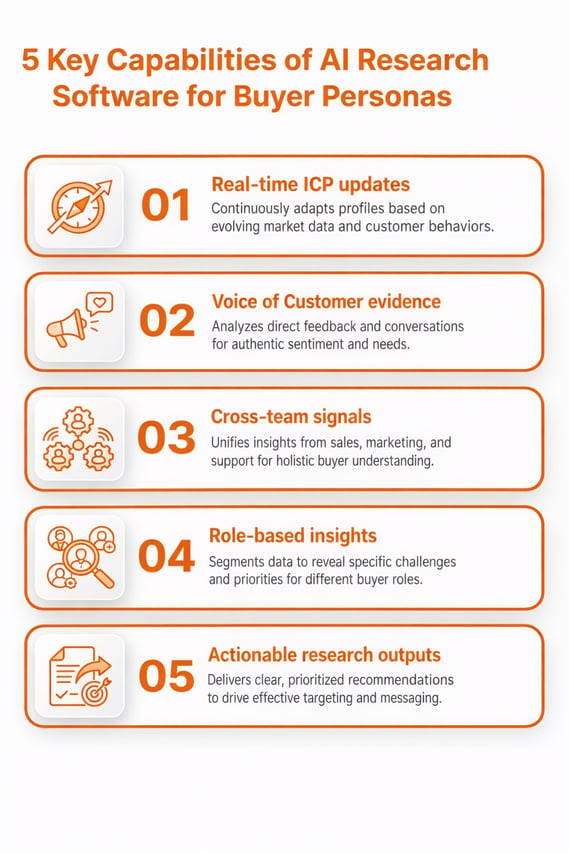
This infographic highlights the five core capabilities of AI research software for buyer persona insights. Learn how these features drive smarter marketing and product decisions.
AI Research Software vs Manual Persona Research
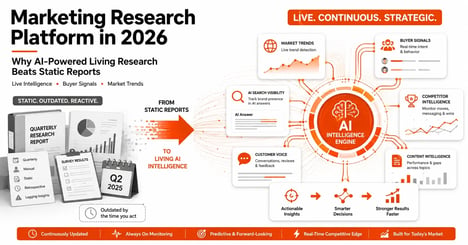
Manual persona research will always matter, but on its own it cannot match the speed or scale of AI research software for buyer persona insights. The real power comes from combining a few deep interviews with automated, continuous pattern detection.
Speed, Scale, and Accuracy Comparison
|
Dimension |
Manual Personas |
AI Research Software |
|---|---|---|
|
Update frequency |
Quarterly or yearly projects |
Continuous and real time |
|
Data scope |
Tens of interviews or survey responses |
Thousands of conversations and behaviors |
|
Ties to revenue |
Qualitative, hard to quantify |
Predictive scores linked to pipeline and conversion |
Why This Matters for B2B Teams
When buyers shorten their cycles and use AI in their own research, you cannot afford persona insights that lag six months behind reality. AI tools keep your segmentation, messaging, and targeting aligned with what buyers are actually doing and saying right now.
Buyer Behavior Has Shifted
94% of buyers are using large language models during their buying process, which means they are testing vendors, comparing narratives, and analyzing use cases with AI assistance. If your own persona research stack does not match that level of sophistication, your messaging and offers will feel misaligned.
Did You Know?
45% of software buyers now use AI in their software-buying processes, which means your personas must reflect AI-assisted research behaviors, not legacy buying patterns.
Best Practices for Using AI to Generate Buyer Personas
AI research software for buyer persona insights only performs as well as the strategy and data you feed into it. We recommend a clear framework so your models stay relevant, fair, and actionable.
Start With the Right Data Foundations
Focus first on high quality data from CRM, marketing automation, customer success tools, and conversation intelligence platforms. Align fields such as role, industry, deal size, stage, and outcomes so AI can map patterns accurately across your funnel.
Define Outcomes and Use Cases Upfront
Before you configure any AI tools, define what success looks like, for example better segmentation for paid media, more accurate ABM tiers, or improved message resonance for a specific product. This helps the system weigh the right signals and reduces noise in your personas.
Human Validation and Iteration
AI will surface unexpected clusters and narratives, which is valuable, but your product marketers and revenue leaders should validate them. We recommend regular working sessions where humans review AI-generated personas, adjust labels, and add qualitative context.
Embed Personas in GTM Workflows
Personas only matter if they drive action in campaigns, sales enablement, and lifecycle programs. Tie each AI persona to specific playbooks, channels, and offers so teams use them daily instead of letting them sit in a deck.
Buyer Persona Insights Use Cases in B2B
AI research software for buyer persona insights shows its value when you connect it directly to core revenue workflows. Below are some of the highest impact use cases we see across our customers.
Persona-Led Content Planning and Production
With persona insights tied into your content platform, you can plan themes, formats, and CTAs that match real buyer language and objections. Our AI solutions for content marketing do this by feeding persona language directly into briefs and assets.
Predictive Lead Scoring and Routing
By combining persona attributes, behavior, and intent, AI can score leads and accounts by fit and readiness. You can then route high value personas to senior reps, trigger specific cadences, or customize messaging, which has a direct impact on pipeline velocity.
Persona-Based Lifecycle and Retention Strategies
Persona insights should not stop at the sale, they should guide onboarding, expansion, and renewal. AI will show which personas churn more often, which need different onboarding experiences, and which expansion offers resonate best.
Choosing the Right AI Persona Insight Software
Selecting AI research software for buyer persona insights is a strategic decision that affects your entire GTM motion. We recommend using a simple evaluation framework aligned to your data, stack, and maturity.
Readiness And Integration Assessment
Start by assessing your current systems and integrations, including CRM, MAP, customer data platforms, and conversation intelligence. Platforms like Omnibound work best when they have direct access to your systems, so check available platform integrations and connection options.
Decision Matrix: What to Evaluate
|
Criterion |
Questions To Ask |
|---|---|
|
Data compatibility |
Can it ingest our CRM, MAP, call recordings, and product usage data without heavy engineering? |
|
Persona-specific features |
Does it support automated buyer persona generation and continuous enrichment, not just static reports? |
|
Explainability |
Can we see why a segment exists, which signals define it, and what content it responds to? |
|
Activation |
How easily can we use personas in campaigns, content workflows, and sales enablement? |
Pricing And ROI Considerations
Most AI persona platforms use tiered or custom pricing rather than fixed per-seat rates, because they depend on data volume and integrations. Frame the investment relative to pipeline impact and operational efficiency, such as reduced research time or higher conversion rates from persona-aligned campaigns.
Measuring Success: KPIs for AI Persona Insight Programs
To justify AI research software for buyer persona insights, you need clear metrics that link personas to business outcomes. We recommend tracking both model quality and GTM performance.
Core Metrics to Track
- Persona accuracy and stability, measured through model validation and feedback from sales and CS.
- Engagement lift for campaigns personalized by persona vs control groups.
- Conversion and pipeline impact, including opportunity rate and win rate by persona.
- Time saved in persona research cycles and content briefing.
Example KPI Dashboard
Imagine a dashboard that shows each AI persona with its total pipeline, win rate, average deal size, top messages, and preferred channels. Marketing and revenue leaders can then prioritize budget and strategy based on personas that actually drive revenue.
Buyer Trust and AI-Generated Content
AI persona programs often feed directly into AI-generated or AI-assisted content, so confidence matters. 80% of buyers trust AI-generated content at least sometimes, which is high, but you still need to maintain quality, evidence, and transparency in your outputs.
Did You Know?
94% of AI users who use AI for software buying find it helpful or very helpful, which means AI-informed persona content can strongly influence decisions if it is accurate and relevant.
Challenges with AI Persona Insights and How to Mitigate Them
AI research software for buyer persona insights is powerful, but it also introduces new risks and operational challenges. You should anticipate these issues early and build guardrails.
Data Quality, Bias, and Privacy
If your CRM is inconsistent or your call transcripts underrepresent certain regions or segments, your AI personas may bake in those blind spots. Address this by cleaning data, broadening your input sources, and reviewing outputs regularly for fairness and representation.
Over Automation and Misalignment
It is easy to over automate decisions and let AI define personas and messaging without enough human judgment. Set up governance where product marketing, brand, and sales leaders review major persona shifts before you roll them out widely.
Change Management Across Teams
AI personas will change how content, campaigns, and sales teams work, so you need clear enablement and training. Marketing leadership can use resources like AI solutions for marketing leadership to operationalize new workflows and expectations.
Integration Complexity
Connecting multiple systems can be complex, especially in enterprises with legacy stacks. Plan for a phased rollout that starts with a core data set, for example CRM plus call recordings, then expand.
The Future of AI Persona Insights
AI research software for buyer persona insights is evolving quickly, and what we see in 2026 is only the beginning. Several trends will define how marketers use personas over the next few years.
Real Time Persona Refinement
As streaming architectures and event-driven systems spread, personas will update in near real time based on new signals from site visits, product usage, and conversations. This will let teams trigger dynamic campaigns based on micro changes in intent and behavior.
Generative Narrative Personas
Large language models will increasingly generate narrative persona profiles, complete with motivations, objections, and example dialogues derived from real data. We already use this approach inside our own platform, so content and sales assets feel grounded, not fictional.
Deeper Integration with Content and Orchestration
We expect tighter connections between persona systems and orchestration layers, so strategies turn into consistent execution automatically. Solutions like Omnibound orchestration already point in this direction, bridging insights with content and channel workflows.
Buyers Expect AI in Your Stack
As noted earlier, nearly 90% of buyers report AI features are part of the solutions they acquire. Persona research that does not account for this expectation will underestimate technical requirements and evaluation criteria in your ICPs.
Conclusion
AI research software for buyer persona insights is now a core capability for US-focused marketers, CMOs, and growth teams that need personas tied directly to pipeline. By unifying your customer and market signals, applying NLP and predictive modeling, and connecting insights to content and campaigns, you can move from static profiles to living, revenue-aware personas.
To get started, we recommend a simple roadmap:
- Audit your data sources and define clear persona use cases.
- Select a platform that unifies context, Intelligent Research, and activation.
- Run a pilot focusing on one or two high value segments and workflows.
- Measure impact on engagement, conversion, and research cycle time.
- Scale to more personas, channels, and business units once validated.
Ownership should sit jointly across marketing operations, product marketing, and leadership, with clear accountability for data quality and activation. If you want to see how a unified platform can support your AI persona strategy end to end, you can connect with our team through the Omnibound contact page and explore what a living, AI-driven buyer understanding looks like in practice.
FAQ
What is AI persona research software?
It is software that uses AI to analyze customer and market data, then generate and maintain accurate, dynamic buyer personas and ICPs.
How does AI improve buyer persona insights?
AI can process far more data than humans, detect hidden patterns, and update personas continuously, which keeps your segmentation aligned with real buyer behavior.
What data is needed for AI persona tools to work well?
High quality CRM data, marketing engagement, sales conversations, support tickets, product usage, and sometimes third-party intent signals.
How do you measure the accuracy of AI-generated personas?
Use model validation metrics, feedback from sales and CS, and performance comparisons between persona-informed and non-persona-informed campaigns.
What are common pitfalls when using AI for persona insights?
Relying on poor data, ignoring bias, over automating decisions, and failing to connect personas to real GTM workflows are the biggest risks.
.png?height=245&name=Why%20B2B%20AI%20Search%20Requires%20More%20Than%20a%20CMS%20(And%20What%20Modern%20Marketing%20Stacks%20Must%20Do%20Instead).png)