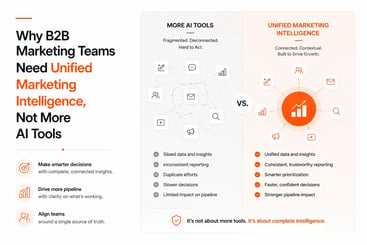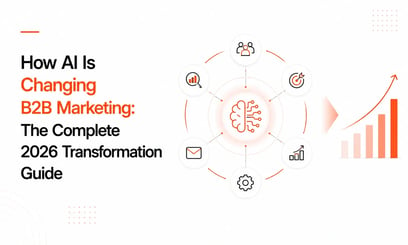


Marketing teams have spent the last two years hearing the same story about AI: it writes faster copy, automates repetitive tasks, and personalizes emails at scale. That story is no longer the differentiator it once was. Nearly every marketing platform now ships with some version of AI-assisted writing or workflow automation, which means the productivity gains that once felt like an advantage have become table stakes.
The bigger shift is happening somewhere else entirely. AI is changing how buyers discover brands, how marketing teams understand their customers, how positioning gets built, and how marketing decisions get made in the first place. Buyers increasingly ask AI platforms complex questions before they ever type a query into a traditional search bar or visit a company website, and much of their evaluation now happens before that first click. This guide reframes AI in marketing around that reality: not as a productivity layer bolted onto existing workflows, but as the operating layer running underneath customer research, positioning, content strategy, demand generation, and marketing measurement.
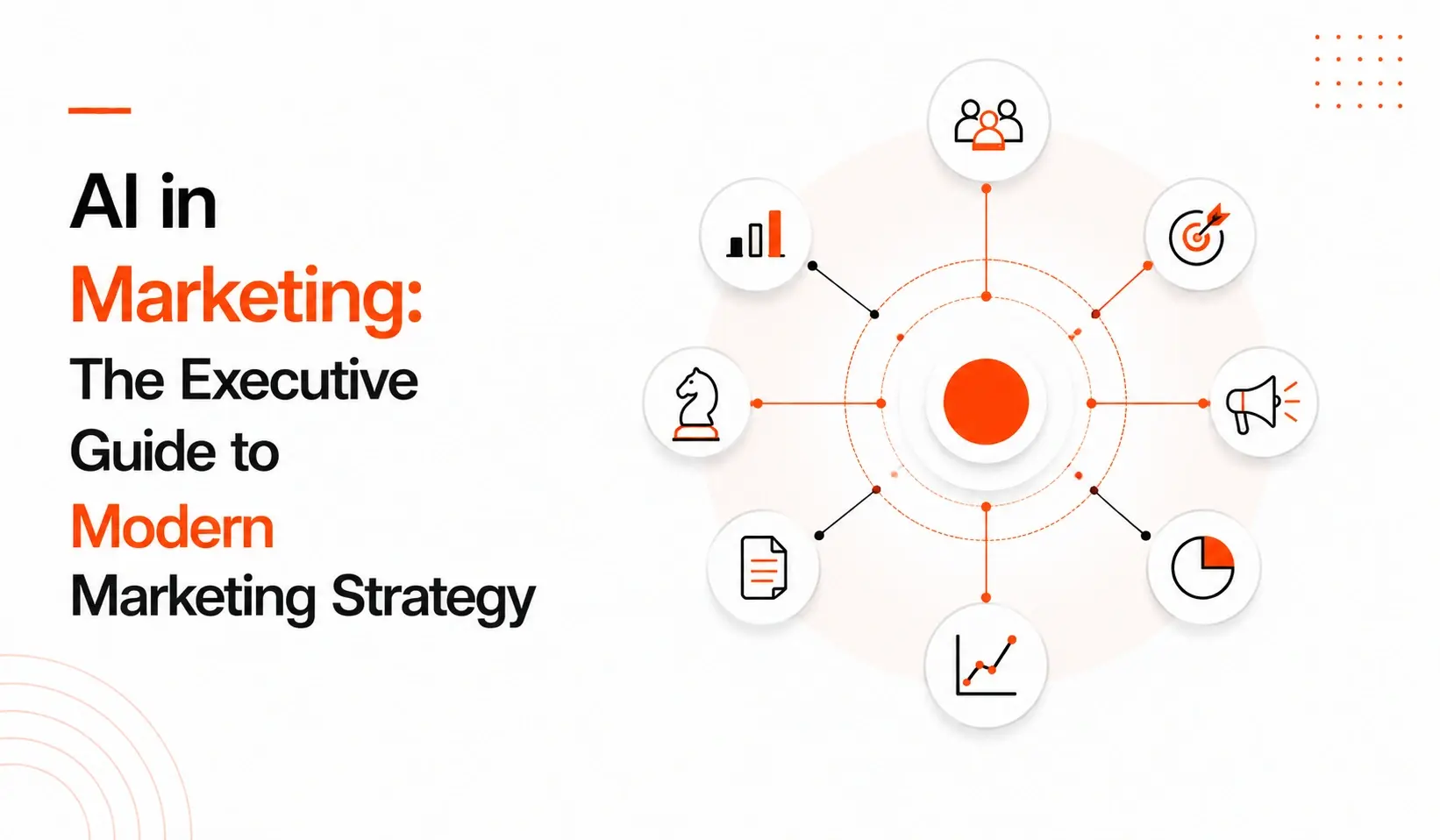
Eight strategic areas define this shift: customer research, market intelligence, positioning, content strategy, AI Search visibility, demand generation, marketing operations, and measurement. Each is covered in this guide, along with the discovery journey, decision-making, and lifecycle themes that tie them together.
AI Is Changing How Customers Discover Brands
The traditional marketing funnel assumed a fairly linear path: a buyer searches, lands on a website, evaluates content, and eventually converts. That path still exists, but it no longer describes how a growing share of buyers actually find and evaluate solutions.

Buyers now open an AI platform and ask a full question instead of typing three keywords into a search box. Instead of "project management software," someone asks which tools work best for a 40-person marketing team that needs approval workflows and reporting. The AI platform synthesizes an answer, often citing several sources, and the buyer forms an early opinion about which brands seem credible before visiting a single website.
This changes the modern discovery journey into something closer to: a buyer asks an AI platform a detailed question, receives an answer built from educational content and expert sources, forms a recommendation based on what gets cited, and only then visits a brand's site to confirm the decision. By the time a prospect reaches the website, much of the evaluation has already happened somewhere else.
Why This Matters More Than It First Appears
Three things change when discovery starts inside an AI platform instead of a traditional results page.
- Brand discovery moves earlier. Buyers form impressions from AI-generated answers long before they see a homepage, meaning the first brand touchpoint is often a summary written by a model, not a page designed by the marketing team.
- Trust building shifts to third-party evidence. AI platforms tend to cite documentation, comparison content, reviews, and independent analysis more than promotional pages, so credibility now depends on what other sources say about a brand, not just what the brand says about itself.
- Educational content becomes the front door. Content built to answer specific buyer questions in depth has a better chance of being cited than content built primarily to promote a product.
Recent industry analysis suggests that traffic arriving from AI-driven recommendations converts at meaningfully higher rates than average traffic, largely because visitors have already done much of their comparison shopping before they arrive. A prospect who lands on a site after an AI platform has already validated the brand as a credible option behaves differently than someone who clicked a generic ad. They tend to ask more specific questions, move faster through evaluation, and require less convincing on the basics.
This does not mean traditional discovery channels disappear. It means marketing teams now need a visibility strategy for two audiences at once: people who still browse and search directly, and the AI platforms that increasingly stand between a buyer's first question and a brand's website. Building content and documentation with both audiences in mind is one of the more durable shifts happening in marketing right now, and it connects directly to how teams approach AI Search visibility as a distinct discipline rather than an afterthought.
Customer Intelligence Is Becoming Marketing's Competitive Advantage
AI tools are widely available, but the customer understanding that feeds those tools is not. Two companies can use the same AI-assisted research capabilities and get very different results, because the quality of the input, not the sophistication of the model, determines the quality of the output.
Customer intelligence pulls together the fragments of understanding that usually sit in separate systems: CRM records, sales call notes, support tickets, product reviews, win-loss interviews, and broader market research. On their own, each of these sources tells a partial story. A support ticket shows a frustration. A sales call shows an objection. A review shows a comparison a buyer made against a competitor. None of them, in isolation, explains why deals are won or lost.
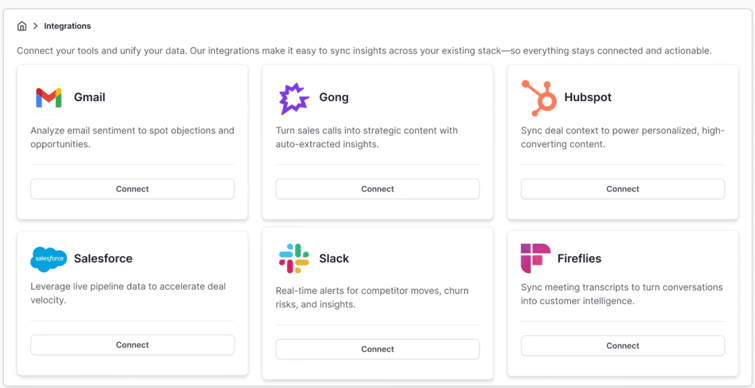
Marketing teams that unify these signals into a shared customer intelligence layer make noticeably better decisions across the board. The pattern looks something like this: raw customer conversations and records feed into a unified view of buyer language, objections, and priorities, which then informs sharper marketing strategy, which in turn produces better decisions across positioning, content, and demand generation.
The teams that treat customer intelligence as an ongoing practice, rather than a one-time research project, tend to catch shifts in buyer language and priorities faster than competitors relying on stale personas. This is the foundation that makes every other AI-powered marketing activity, from content prioritization to positioning refinement, more accurate. A Marketing Context practice built on real conversations and continuous research consistently outperforms assumptions built once and rarely revisited.
AI Is Changing Market Intelligence and Competitive Understanding
Market intelligence used to mean a quarterly competitive deck built from manual research. That cadence no longer matches how fast markets move. Competitors ship new features, adjust pricing, and shift messaging on a rolling basis, and buyers notice those changes long before most marketing teams update their materials.
AI-assisted research changes the cadence from quarterly to continuous. Instead of a static snapshot, marketing teams can track competitor messaging shifts, emerging buyer questions, and category narratives as they happen, then feed that understanding directly into planning conversations. This is less about monitoring for its own sake and more about giving product marketing and demand generation teams a current, accurate picture of the landscape they are actually competing in.
Combined with customer intelligence, market intelligence gives marketing leaders a fuller picture: not just what the market is saying, but how that compares to what customers are actually experiencing and asking about. That combination is what separates informed strategic recommendations from generic competitive commentary.
AI Is Changing Positioning
Positioning has traditionally been treated as a project: a workshop, a messaging document, a launch, and then months (or years) of reuse without revisiting the underlying assumptions. That approach struggles in markets where customer language and competitive dynamics shift every quarter.
Marketing teams now have the ability to continuously refine differentiation, messaging, and value propositions using real customer language and market intelligence, rather than relying on intuition or a single round of interviews. When a product marketing team can see, on an ongoing basis, which phrases buyers actually use to describe their problems, which objections come up most often in sales calls, and which claims competitors are leaning on, positioning becomes a living discipline instead of a static document.
This shift matters because weak positioning tends to compound every problem downstream. Content built on vague differentiation struggles to stand out. Demand generation campaigns built on generic value propositions struggle to convert. Sales teams working from stale messaging struggle to differentiate in competitive deals. Strong positioning, grounded in current customer intelligence rather than assumptions, gives every other marketing function a clearer foundation to build on. This is where AI-powered product positioning practices are starting to separate marketing teams that adapt quickly from those still working off last year's messaging.
AI Is Changing Content Strategy
The easy version of the "AI changes content" story is that AI writes blog posts faster. The more durable version is that the entire logic of content strategy is shifting from volume to authority.
Publishing more content used to correlate loosely with more visibility. That correlation is weakening. As AI platforms synthesize answers from a smaller set of trusted, well-structured sources, quality and depth now matter more than sheer output. A single, thorough piece that directly answers a specific buyer question, backed by real expertise and evidence, can outperform a dozen shallow posts covering the same ground.
The strongest content strategies now work backward from real buyer questions rather than forward from a keyword list. That progression looks like this: educational content is built to directly answer the questions buyers are actually asking, which builds a foundation for thought leadership, which extends into documentation and resources that support both buyers and AI platforms trying to summarize a category, which in turn improves visibility across AI-powered discovery channels and feeds demand generation with a steady stream of qualified interest.
Content prioritization becomes a research problem more than a production problem. Instead of asking "what should we publish next," the better question is "what are buyers actually asking that we have not answered clearly yet." Identifying those gaps consistently, rather than guessing at topics, is one of the more valuable ways marketing teams are using AI Content Gap Analysis to direct their editorial calendars.
AI Search Is Becoming a Core Marketing Channel
Traditional marketing built its channel mix around a fairly familiar path: a search query leads to a website visit, which leads to a lead. That path still matters, but it is no longer the only path worth planning for. A parallel channel has emerged where a buyer's question goes to an AI platform first, gets answered using educational content pulled from multiple sources, builds early trust in whichever brands get cited, and only then sends the buyer to a website to confirm the decision.
Treating this as a core channel, rather than a side experiment, requires a different mindset than traditional content promotion. A few principles matter most.
Visibility Depends on Being a Trusted Source, Not Just a Present One
AI platforms tend to favor sources that demonstrate clear expertise, cite evidence, and answer questions directly, over sources that are simply optimized for visibility. Publishing content that reads like documentation or a well-reasoned answer to a real question tends to perform better in this environment than content built primarily around promotional language.
Structure Matters as Much as Substance
Content that is clearly organized around specific questions, with direct answers stated plainly, is easier for AI platforms to extract and cite. Burying a clear answer under several paragraphs of preamble makes that same information harder to surface, even if the underlying expertise is strong.
Educational Depth Builds Buyer Trust Before the First Conversation
When a buyer's first exposure to a brand happens through an AI-generated answer, the quality of that underlying content shapes their expectations before a sales conversation ever begins. Thin content creates thin trust. Thorough, well-evidenced content creates a stronger starting point for the relationship.
The practical shift for marketing teams is to treat traditional discovery and AI-driven discovery as complementary channels that both depend on strong content and consistent visibility, rather than treating one as legacy and the other as a temporary trend. Teams that build a habit of monitoring where they show up in AI-generated answers, and where competitors are being cited instead, gain an early view into where their content strategy needs to catch up.
AI Improves Marketing Decisions, Not Just Marketing Execution
Most conversations about AI in marketing focus on execution: writing faster, publishing more, automating hand-offs. The more valuable application sits earlier in the process, in the quality of the decisions that shape what gets executed in the first place.
A useful way to think about this is as a chain: research feeds analysis, analysis produces recommendations, recommendations inform strategy, and strategy determines execution. AI adds the most value when it strengthens the earlier links in that chain rather than only speeding up the last one. AI-assisted research can surface patterns across hundreds of customer conversations that a person would never have time to read individually. That analysis can point to specific messaging gaps or unmet buyer needs. Those insights can turn into concrete strategic recommendations, such as which segment to prioritize next quarter or which objection needs a dedicated piece of content.
This mirrors what many experienced marketers report in practice: AI creates the most durable value when it improves the quality of thinking behind a decision, not simply the speed of producing more content. A campaign built on a sharper understanding of buyer priorities will consistently outperform a campaign built faster but on the same shaky assumptions. Marketing leaders who treat AI as a research and analysis partner, rather than only a production tool, tend to make fewer costly strategic missteps.
AI Across the Entire Marketing Lifecycle
AI's role in marketing is easiest to understand when mapped across the full lifecycle, rather than treated as a single capability applied to a single task. The stages build on each other: research informs positioning, positioning shapes planning, planning guides content, content fuels demand generation, demand generation feeds customer marketing, customer marketing supports retention, and retention, done well, produces advocacy.
- Research: Continuous customer and market intelligence replaces static personas built once a year.
- Positioning: Messaging and differentiation get refined against real buyer language rather than assumptions.
- Planning: Campaign priorities are set based on where the biggest gaps between buyer questions and current content actually exist.
- Content: Educational, well-evidenced material is built to answer real questions and support visibility across every discovery channel.
- Demand generation: Campaigns target segments and messages validated by customer intelligence rather than broad assumptions about the market.
- Customer marketing: Existing customer signals (usage, support, feedback) inform expansion and retention messaging.
- Retention: Lifecycle marketing uses ongoing customer intelligence to catch risk signals early rather than reacting after churn.
- Advocacy: Strong customer relationships, built on relevant and accurate marketing throughout the lifecycle, naturally produce reviews and referrals.
Viewed this way, AI is not a bolt-on feature at any single stage. It is a consistent layer of intelligence running underneath research, positioning, content, and demand generation, all the way through retention and advocacy, tying how AI is changing B2B marketing at each stage back to the same underlying customer and market signals.
Trust Becomes the New Marketing Currency
As AI-generated recommendations play a bigger role in how buyers form early opinions, trust becomes something closer to a prerequisite for visibility, not just a nice-to-have brand attribute. Buyers, and the AI platforms summarizing information for them, increasingly favor sources that demonstrate real expertise, back up claims with evidence, and communicate clearly rather than promotionally.
Several elements consistently signal trust in this environment.
- Demonstrated expertise, shown through detailed, accurate content rather than surface-level summaries.
- Clear documentation that answers practical questions plainly, without requiring a sales conversation first.
- Genuine reviews and customer stories that provide independent evidence beyond a brand's own claims.
- Transparent messaging that sets accurate expectations rather than overstating capabilities.
- Educational resources that help buyers make a good decision, whether or not that decision favors the brand publishing them.
Trust, in this sense, becomes an input into visibility itself. Brands that invest consistently in expertise and transparency tend to get cited more often in AI-generated answers, which reinforces the same discovery dynamic covered earlier in this guide. Security and data practices matter here too. Marketing teams that unify customer data responsibly, with clear governance behind it, build the kind of foundation that supports trustworthy AI-assisted research rather than undermining it.
Practical Applications: How Marketing Teams Use AI Across the Business
Rather than listing generic AI features, it helps to look at how marketing teams are actually applying AI-assisted research and continuous intelligence across specific workflows.
- Customer research: Synthesizing CRM notes, support tickets, and sales call transcripts into a current view of buyer priorities and objections.
- Campaign planning: Prioritizing campaigns based on where customer intelligence shows the biggest gaps between buyer needs and current messaging.
- Positioning refinement: Updating differentiation and value propositions on a rolling basis as customer language and competitive claims shift.
- Competitive monitoring: Tracking competitor messaging and market narratives continuously rather than through periodic manual research.
- Content prioritization: Identifying which buyer questions are underserved by current content and directing editorial resources there first.
- Demand generation: Building campaigns around validated buyer language and priorities rather than assumptions carried over from previous quarters.
- Lifecycle marketing: Using ongoing customer signals to time retention and expansion outreach around actual account behavior.
- AI Search visibility work: Monitoring where a brand is cited in AI-generated answers, where competitors are cited instead, and closing those gaps with better content.
Common Mistakes Marketing Teams Make With AI
Several patterns show up repeatedly among teams that adopt AI tools quickly but see limited strategic impact.
- Treating AI as a content machine. Focusing entirely on production speed while ignoring whether the underlying strategy and positioning are sound.
- Building on weak positioning. No amount of AI-assisted content production fixes a value proposition that does not resonate with buyers.
- Working with disconnected customer data. CRM, support, sales, and reviews sitting in separate systems produce fragmented, sometimes contradictory conclusions.
- Relying on prompts instead of research. Asking a model to guess at buyer needs produces generic output when real customer conversations were available all along.
- Automating broken workflows. Speeding up a process that was not working well to begin with simply produces bad outcomes faster.
- Ignoring AI Search visibility entirely. Continuing to plan content only around traditional discovery, while a growing share of buyer research happens through AI platforms.
- Measuring productivity instead of business outcomes. Tracking how much content got produced instead of whether it moved pipeline, revenue, or customer understanding forward.
Measuring Success in AI-Powered Marketing
Traditional marketing metrics like traffic, impressions, and content volume still have a place, but they tell an incomplete story in an environment where a large share of buyer evaluation happens before a website visit ever occurs. A more complete measurement approach looks at outcomes that reflect the shifts covered throughout this guide.
- Customer understanding: How current and complete is the team's picture of buyer language, objections, and priorities.
- AI Search visibility: How often, and how favorably, the brand appears in AI-generated answers to relevant buyer questions.
- Branded demand: Whether direct, brand-driven interest is growing as a result of stronger visibility and trust.
- Pipeline contribution: Whether content and campaigns are tied to actual pipeline, not just top-of-funnel activity.
- Messaging consistency: Whether positioning stays aligned across content, sales conversations, and customer-facing materials.
- Content influence: Whether specific pieces of content are shaping buyer decisions and getting cited or referenced by others.
- Revenue contribution: Ultimately, whether marketing activity connects clearly to revenue outcomes rather than only activity metrics.
How Omnibound Supports Modern, AI Search-Ready Marketing
Omnibound is built around the idea that customer and market intelligence, not AI writing features, should drive marketing strategy. Rather than positioning itself as a content generation tool, Omnibound works as a platform that helps marketing teams unify Marketing Context from CRM records, sales conversations, reviews, and market signals into a single, current understanding of buyers.
That unified intelligence supports several practical outcomes marketing teams care about: understanding the real questions buyers are asking, strengthening positioning with current customer language instead of stale assumptions, identifying where content gaps exist relative to buyer questions, monitoring how a brand shows up compared to competitors across AI-generated answers, and building educational content designed to be trusted and cited by both buyers and AI platforms.
This connects directly to the themes covered throughout this guide. Continuous research replaces one-time projects. Customer intelligence replaces assumption-driven planning. Content strategy shifts toward depth and authority. Visibility extends beyond traditional discovery into AI Search. Omnibound's role is to give marketing teams a foundation, grounded in real customer and market signals, for making better decisions across every one of those areas, an approach explored further in AI in B2B Marketing and in how the platform supports broader B2B marketing automation practices without reducing marketing to automation alone.
Bringing It Together
AI is no longer simply a productivity layer for marketers. It is reshaping how customers discover brands, evaluate solutions, and reach purchasing decisions, often before a company's own website enters the picture. The organizations building durable advantage are the ones using AI to strengthen customer intelligence, sharpen positioning, produce genuinely authoritative content, and increase visibility across AI-driven discovery channels, rather than measuring success by how much content got produced or how many workflows got automated.
The marketing teams that treat customer understanding as an ongoing practice, ground positioning in real buyer language, and invest in trust and educational depth will be better positioned as AI-driven recommendations account for a larger share of qualified interest. Automation still matters, but it works best when it sits on top of strong intelligence and clear positioning, not in place of them.
Frequently Asked Questions
What is AI in marketing?
AI in marketing refers to using AI-assisted research, analysis, and content capabilities to strengthen customer understanding, positioning, content strategy, and demand generation, not just to automate individual tasks like writing or scheduling.
How is AI changing modern marketing?
AI is shifting marketing's center of gravity from execution speed toward decision quality. It is changing how buyers discover brands, how teams understand customers, how positioning gets refined, and how content earns visibility across both traditional and AI-driven discovery channels.
How does AI improve customer intelligence?
AI-assisted research can synthesize large volumes of customer conversations, support tickets, and reviews into clear patterns around buyer language, objections, and priorities, turning scattered data into a usable, continuously updated picture of the customer.
How is AI Search changing brand discovery?
Buyers increasingly ask AI platforms detailed questions and form early impressions from the answers before visiting a brand's website. This means credibility and visibility now depend heavily on being cited as a trusted source within those AI-generated answers, not only on traditional discovery channels.
What marketing activities benefit most from AI?
Customer research, positioning refinement, competitive monitoring, content prioritization, and lifecycle marketing tend to benefit the most, because each depends on synthesizing large amounts of information into clear, actionable patterns.
How should marketing teams prepare for AI-driven customer journeys?
Teams should build genuinely educational content that answers specific buyer questions in depth, strengthen documentation and evidence behind their claims, and start monitoring how they appear in AI-generated answers alongside traditional discovery metrics.
What skills matter most in AI-powered marketing?
Research literacy, sharp positioning judgment, and the ability to translate customer and market signals into clear strategic recommendations matter more than technical prompting skills alone.
How does Omnibound help improve AI Search visibility?
Omnibound unifies customer and market signals into a shared intelligence layer, then uses that intelligence to identify content gaps, monitor visibility across AI-generated answers, and guide the creation of AI-ready educational content built to be cited as a trusted source.