

Here's the most important number in marketing right now: 95% of B2B marketers use AI in their roles, yet only 39% report seeing improved content performance. That single performance gap explains every one of the Top 10 B2B Content Marketing Trends to Watch This Year, because the teams winning in 2026 aren't producing more content, they're producing better-informed, intelligence-driven content.
Content marketing isn't changing because AI can write blogs. It's changing because buyers discover, evaluate, and trust content differently now.
Modern B2B buyers research vendors through AI search, communities, customer conversations, AI assistants, and peer recommendations. The brands that get cited in AI answers are the ones that get considered.
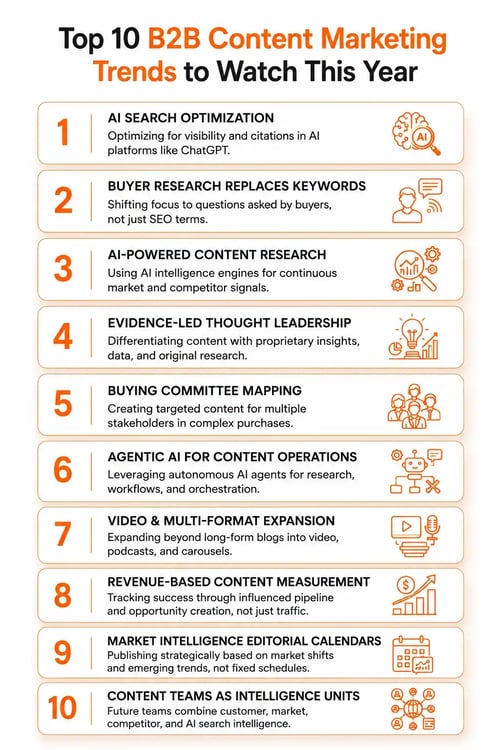
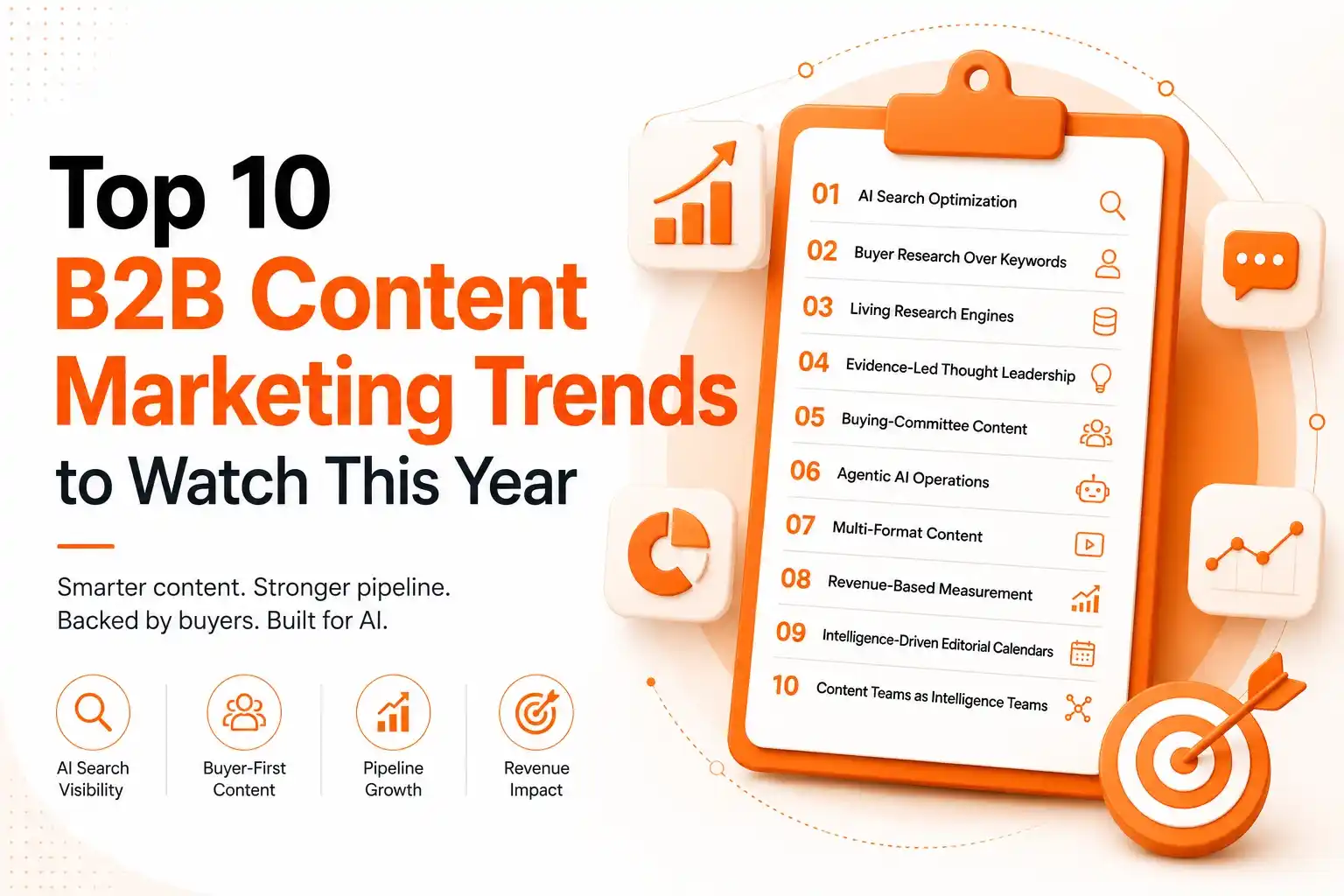
A concise visual guide to the top B2B content marketing trends shaping this year. See what's driving engagement and strategy.
Trend 1: AI Search Optimization Becomes a Core Content Strategy
This is the single biggest structural shift in the Top 10 B2B Content Marketing Trends to Watch This Year. Instead of optimizing only for one search box, you now create content that AI platforms like ChatGPT, Gemini, Perplexity, and Claude can understand, cite, and recommend.
Why it matters: AI search is deciding B2B pipeline. Most content was never built for AI visibility, so it simply doesn't appear when buyers ask AI engines about your category.
The fix: Build citation-ready content grounded in entity clarity and answer-first structure. Make AI search a revenue channel, not just a visibility metric.
Trend 2: Buyer Research Is Replacing Keyword Research
The old question was "what keywords should we rank for?" The modern question is "what are buyers actually asking across AI, sales calls, and customer conversations?"
This is where conversational intelligence enters the editorial process. We aggregate signals like conversation intelligence, pipeline stages, review themes, and intent data, then let AI cluster those into opportunity areas.
Strategic implication: Effective content topics start with what your buyers actually say, not what generic AI models predict. Signal-based content planning replaces the keyword spreadsheet, and our content marketing solutions are built around exactly that.
Trend 3: AI-Powered Research Replaces Static Research
Quarterly reports and static personas can't keep up with how fast buyer behavior moves. Leading teams now run continuous intelligence engines instead.
Modern research pulls from customer conversations, competitor messaging, market signals, AI trend detection, and emerging topics, all at once. This is the difference between a snapshot and a living research engine.
Why it matters: 91% of B2B organizations collect first-party data, but only 10% know how to use it effectively to drive content strategy. The shift to living research is how that goldmine finally gets activated.
Did You Know?
91% of B2B organizations collect first-party data, but only 10% know how to use it effectively to drive content strategy.
Source: CommonPlaces 2026 Research
Trend 4: Thought Leadership Must Become Evidence-Led
Generic opinions are increasingly ignored. As AI increases content volume, originality becomes the differentiator.
Winning thought leadership now leans on proprietary insights, customer data, original research, market intelligence, and real executive expertise. Instead of writing around vague personas, your thought leadership can reference concrete pains, triggers, and use cases that your best customers actually care about.
The fix: Push AI upstream. Let it shape strategy, surface the angles, and ground every claim in evidence before a single word gets drafted.
Trend 5: Content Will Be Created for Buying Committees, Not Individuals
Modern B2B purchases involve marketing, finance, IT, procurement, and executives. Each one asks different questions at different stages of the decision.
That means persona-specific content, buying committee mapping, and multi-stakeholder messaging aren't optional. Content has to earn citations that reach the right person at the right moment.
Trend 6: Agentic AI Will Transform Content Operations
This is one of the most consequential of the Top 10 B2B Content Marketing Trends to Watch This Year. AI agents, autonomous research, workflow automation, and campaign orchestration are moving from experiment to operating model.
Think of AI agents positioned as junior team members; scalable, trainable, and always on. They handle research and assembly so your humans focus on judgment and strategy.
Strategic implication: The skill that matters won't be writing better prompts. It will be architecting systems where multiple specialized agents work together seamlessly, which is exactly what a connected content workflow enables. B2B marketing operations roles will evolve from "managing tools" to "designing agent workflows."
Trend 7: Video and Multi-Format Content Continue to Expand
B2B buyers no longer consume information through long-form blogs alone. They move across AI-assisted video, webinars, podcasts, LinkedIn carousels, and interactive content within a single decision cycle.
The implication is consistency. One brief should flow through every format so the same proof points and positioning reinforce each other.
Why it matters: When formats fragment, message fragments. A connected production system keeps every asset aligned, citation-ready, and credible no matter where the buyer engages.
Trend 8: Content Performance Will Be Measured by Revenue, Not Traffic
Pageviews, rankings, and clicks were always proxies. In 2026, they're proxies most leaders no longer accept.
The modern scoreboard is influenced pipeline, AI citations, buying-stage engagement, opportunity creation, and revenue contribution. Every AI-referred session can be tagged by engine and prompt, tracked through analytics, and connected back to your CRM.
This is the operational backbone behind driving inbound demand and pipeline: from prompt-level intent to closed-deal attribution.
Did You Know?
95% of B2B marketers use AI in their roles, yet only 39% report seeing improved content performance.
Source: Content Marketing Institute / CommonPlaces 2026
Trend 9: Market Intelligence Will Drive Editorial Calendars
Fixed publishing schedules are losing to signal-driven publishing. Leading teams now publish based on market shifts, competitor moves, customer conversations, AI trend detection, and emerging topics.
This produces content that stays relevant longer because it's tied to what's actually happening in the market. Our marketing context engine unifies those signals into a single, continuously updated layer.
Trend 10: The Best Content Teams Will Operate Like Intelligence Teams
This is the strongest insight across the Top 10 B2B Content Marketing Trends to Watch This Year. The future content team is not a content factory.
It combines customer intelligence, market intelligence, competitive intelligence, AI search intelligence, and predictive analytics into one operating system. Strategy comes before creation, and creation is grounded in evidence at every step.
Trust has become the real currency of modern marketing. The teams that earn it are the ones turning scattered signals into connected intelligence.
What These Trends Mean for Marketing Leaders
If you're a CMO reading these B2B content marketing trends, the takeaway isn't "publish more." It's "get smarter before you publish."
Prioritize five things this year:
- AI readiness so your operations are built around agents, not just tools.
- Buyer intelligence drawn from real conversations, not assumptions.
- Content quality that's evidence-led and citation-ready.
- Strategic research that runs continuously instead of quarterly.
- AI visibility across the engines where your buyers now research.
The brands that get cited in AI answers are the ones that get considered. Volume alone won't get you there.
How Omnibound Helps Teams Stay Ahead
Omnibound started with a simple question: What if marketing teams could move at the speed of their buyer's behavior? We built an AI content intelligence platform, not just another AI writer.
We help teams identify emerging trends, analyze customer conversations, monitor competitor positioning, improve AI search visibility, discover content opportunities, and generate intelligence-driven content. The Omnibound Context Engine unifies CRM data, call transcripts, review themes, and market signals into a single source of truth your content can stand on.
We've seen the failure mode firsthand. A piece of content got cited, and then ignored. We built Omnibound to close that gap by connecting every citation to pipeline through our AI content marketing platform for B2B teams and helping you create citation-worthy content that influences real deals.
The emphasis is strategy before creation, every time.
The biggest trend across the Top 10 B2B Content Marketing Trends to Watch This Year isn't AI itself. It's that content marketing is becoming an intelligence function.
The teams that win in 2026 won't publish the most content. They'll publish the most relevant, context-aware, AI-discoverable content that aligns with how modern buyers actually research and decide.
Make AI search a revenue channel, not just a visibility metric, and let buyer intelligence shape everything you create.
FAQs
1. What are the biggest B2B content marketing trends in 2026?
AI search, buyer intelligence, agentic AI, evidence-led content, and revenue-focused measurement are defining B2B content marketing in 2026.
2. How is AI changing B2B content marketing?
AI is shifting content success from rankings to earning citations and influencing buyer decisions.
3. What is AI search optimization?
AI search optimization creates citation-ready content that AI engines can understand, recommend, and reference.
4. Why is buyer intelligence important for content marketing?
Buyer intelligence turns real customer conversations into content that resonates, ranks, and drives pipeline.
5. How can marketers create content for AI search?
Build answer-first, evidence-backed content around real buyer questions to increase AI citations.
6. What KPIs matter most for modern content marketing?
Focus on AI citations, influenced pipeline, opportunity creation, and revenue—not just traffic.
7. How do AI agents improve content operations?
AI agents automate research, content workflows, and execution, freeing marketers to focus on strategy.
8. How can marketing teams identify emerging content opportunities?
Analyze buyer conversations, intent signals, and market trends to uncover high-impact content opportunities early.