

Recent research indicates that 80% of enterprises still rely on stale data for critical business decisions, leading to measurable revenue loss. This disconnect occurs because most B2B teams operate in silos where customer interactions, competitor moves, and market shifts never meet in a single intelligence layer.
Key Takeaways
|
Question |
Strategic Insight |
|---|---|
|
What is a real-time B2B insight engine? |
It is a technology layer that unifies customer, competitor, and market signals to drive immediate revenue actions. You can explore how this works through our AI Insight Engine. |
|
How does AI track competitor activity? |
AI monitors pricing updates, feature launches, and job postings in real time. This data is centralized within the Marketing Context Engine to inform your sales battlecards. |
|
Can AI connect customer and competitor data? |
Yes, our AI Agents correlate a spike in competitor mentions during sales calls with specific market shifts to suggest defensive messaging. |
|
What is signal intelligence in B2B? |
It is the practice of identifying "high-intent" triggers from disparate sources. Use our Intelligent Research capabilities to detect these patterns before your competitors do. |
|
How does this impact revenue growth? |
By connecting these signals, teams reduce wasted spend on irrelevant campaigns and focus on high-probability deals. This is the core of our Omnisense platform. |
Why Fragmented Intelligence is Costing You Revenue in 2026?
In the current 2026 business landscape, intelligence is often trapped in departmental basements. Marketing tracks website visitors, sales records call notes, and product managers monitor feature requests, but these streams rarely communicate. This fragmentation creates a massive blind spot for leadership. When signals remain disconnected, your team misses the "why" behind deal losses and market shifts. We see that teams using 11 or more disconnected tools often suffer from significant martech bloat. This complexity makes it nearly impossible to form a coherent strategy based on live data.
Customer Activity Signals: The Pulse of Your Pipeline
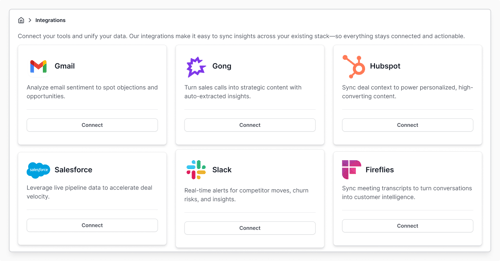
Customer signals go far beyond basic CRM data. In 2026, we capture every nuance from call transcripts, email sentiment, and product usage patterns. These signals reveal the true intent behind a buyer's actions. If a prospect downloads a technical white paper after a pricing discussion, the AI flags a shift in their evaluation criteria. Our Intelligence Sources help you capture these inputs directly from meeting platforms and chat conversations. This ensures your revenue team always operates with a fresh view of the funnel.
Competitor Activity Signals: Beyond Manual Tracking
Manual competitor tracking is a relic of the past. Our real-time B2B insight engine monitors messaging shifts and pricing changes the moment they happen. AI analyzes job postings to predict where a competitor is expanding their product roadmap. It also monitors review sites to identify gaps in their customer satisfaction. By feeding these signals into your Marketing Strategy, you can pivot your narrative before a competitor's new campaign gains traction. This proactive stance is essential for maintaining market share in 2026.
Did You Know?
66% of B2B teams use 11 or more marketing tools, leading to significant martech bloat and fragmented intelligence.
Market Activity Signals: Detecting Macro Shifts
The third pillar of our intelligence model is market activity. We track industry news, regulatory shifts, and economic trends that impact your ICP's budget. AI identifies emerging search trends that signal a new pain point in the industry. This allows your team to create content that addresses problems before they become mainstream. Our AI Solutions for Demand Generation utilize these macro signals to prioritize channels where your buyers are currently active. This alignment ensures you are not spending budget on outdated industry assumptions.
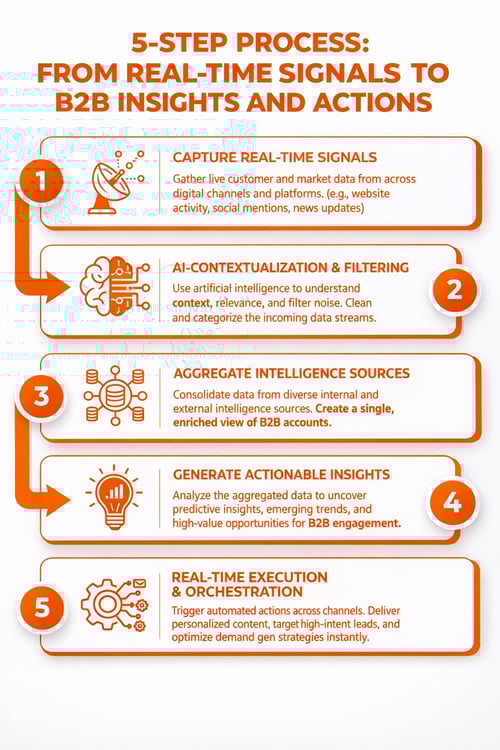
This infographic maps a 5-step flow from real-time signals to actionable B2B insights and actions.
Pattern Detection: Connecting the Disparate Dots
The true power of a real-time B2B insight engine lies in pattern detection. AI identifies recurring objections in sales calls that correlate with a specific competitor's recent feature launch. It can also detect when a spike in industry funding leads to increased website traffic from a specific vertical. These dots remain disconnected in traditional analytics setups. We use Context-aware AI to unify these signals into a trustable context layer. This allows your team to stop guessing and start executing based on verified correlations.
Use Case 1: Real-Time Competitive Threat Detection
Imagine a competitor launches a new integration that targets your core user base. Within hours, your AI engine detects mentions of this integration in your support tickets and sales transcripts. Instead of waiting for a monthly report, the engine flags this revenue risk immediately. It then prompts your Brand Marketing team to deploy defensive content. This rapid response prevents churn and equips your sales team with real-time objection-handling guides. This is how we move from reactive monitoring to proactive orchestration in 2026.
Use Case 2: Market Expansion and Vertical Growth
When a specific industry sees a surge in venture capital funding, their search patterns for B2B solutions change. Our engine tracks these surges and correlates them with inbound requests from that segment. AI then recommends a vertical expansion strategy, complete with tailored messaging for that new audience. This ensures your growth efforts are backed by current market momentum. Our AI Solutions for Content Marketing can then automatically generate landing pages and blogs for this vertical. This significantly reduces the time-to-market for new revenue streams.
Did You Know?
Signal-based selling achieves average response rates of 18%, compared to the 3.4% industry average for traditional cold outreach.
Why Traditional Market Intelligence Tools Fall Short
Traditional tools often focus on static reporting and quarterly updates. By the time a report is published, the market has already moved on. These tools also lack an activation engine. They show you what is happening but do not help you execute a response across your sales and marketing channels. We focus on Platform Integrations that turn insights into triggers. This shifts your team from passive monitoring to active revenue orchestration.
Implementing Your Real-Time B2B Insight Engine: A 5-Step Framework
To start seeing results in 2026, you must first map all your data sources, including CRM, meeting platforms, and search consoles. Centralizing this data through APIs or a warehouse is the second step. The third step involves normalizing your taxonomy, so the AI understands that "churn risk" in sales means the same thing as "low adoption" in product. Fourth, you deploy our Content Production agents to act on these patterns. Finally, you activate these insights directly in your CRM and marketing automation platforms. This creates a closed-loop system where signals drive strategy and strategy drives revenue.
Enterprise Compliance and Security for Your Signal Engine
Managing vast amounts of customer and market data requires a focus on security. Our platform is built with Enterprise Grade Compliance to protect your proprietary signals. We ensure that every AI output is traceable and follows strict data privacy guidelines. This is non-negotiable for US enterprise teams operating in 2026. By prioritizing Security in Everything We Do, we provide the peace of mind necessary to scale your intelligence engine across global teams.
Conclusion
In 2026, the competitive advantage belongs to those who can connect customer, competitor, and market activity in real time. We provide the connective intelligence layer that moves your business from fragmented analytics to unified revenue orchestration. By adopting a real-time B2B insight engine, you ensure that every strategy, campaign, and sales conversation is powered by the most current data available. Stop reacting to the past and start leading your market with signal-driven execution.
.webp?height=245&name=How%20to%20Identify%20Campaign%20Opportunities%20Using%20Marketing%20Intelligence%20and%20AI%20Search%20(2).webp)