


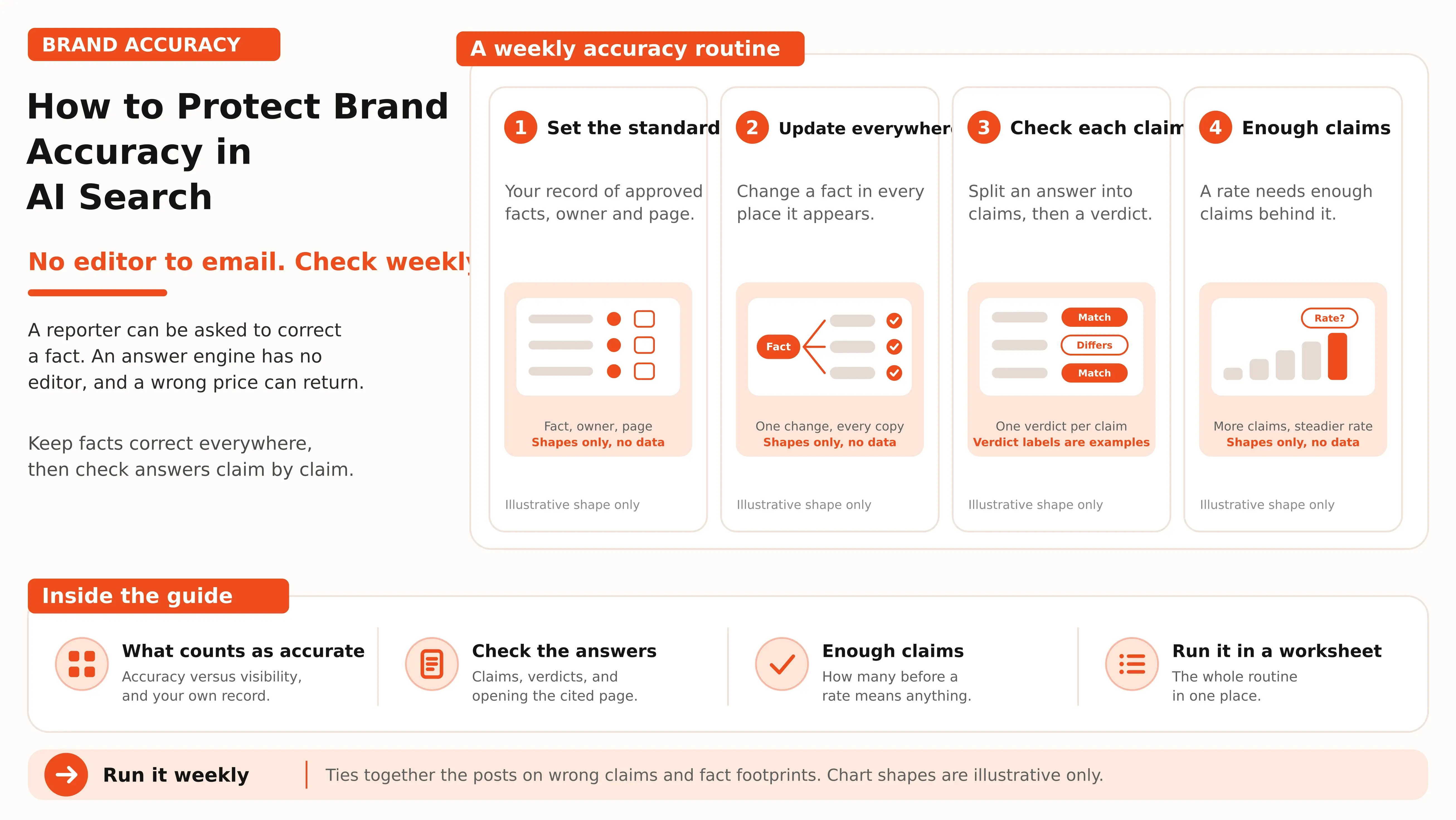


A reporter who gets a fact wrong can be asked for a correction. An answer engine has no editor to email, and the same wrong price can come back on another day in different words. What you can do sits on your own side. You can keep the facts you publish correct in every place they appear, and you can check the answers on a schedule, claim by claim, against a record you trust.
This post lays out that routine. It covers what counts as accurate, what research says about checking long answers, how to change a fact everywhere at once, how to turn an answer into claims and give each one a verdict, why to open the cited page, how many claims you need before a rate means anything, and how to run it all in a worksheet. The post on wrong claims and their causes traces one claim back to its cause, and the post on fact footprints maps every copy of one fact. This one is the weekly routine around both.
What counts as accurate
Visibility asks whether you appear in an answer. Accuracy asks whether what the answer says about you is right. To check it you need a standard, and the standard is your own record: a list of approved facts, each with an owner and the page that states it. The PR and comms post covers the fact sheet that holds these.
A claim in an answer gets one of three verdicts. Supported means it matches the record. Contradicted means it conflicts with the record. Not in record means your record says nothing about it. Only the second is an error. The third is a gap: the claim could be true, false or something nobody on your team has decided a position on, and the useful response is to decide whether it belongs in the record.
The accuracy rate is supported claims divided by supported plus contradicted. Claims that are not in the record stay out of the rate and are counted on their own.
What research says about checking long answers
None of these studies is about B2B company facts. They are the closest independent evidence we found on how long answers get checked and how well citations back them.
A team from the University of Washington, UMass Amherst, the Allen Institute for AI and Meta AI proposed scoring long text by breaking it into short atomic facts and checking each one against a knowledge source. They tested it on biographies of 183 people, written by InstructGPT, ChatGPT and PerplexityAI, using Wikipedia as the source. The share of facts supported was 42.5 percent for InstructGPT, 58.3 percent for ChatGPT and 71.5 percent for PerplexityAI.
Scores fell as the person became less well known: for ChatGPT, from 80 percent for the most frequently mentioned people to 16 percent for the rarest. The authors report that their automated estimator had an error rate under 2 percent against human scoring. The models are from 2023, the topic is people, the source is Wikipedia, the score measures precision only, and the authors note that Wikipedia is incomplete: in a sample of 30 facts it did not support on rare people, 3 were supported by other web pages (Min et al.).
Researchers at UMass Amherst built a similar checker that extracts only claims that can be verified, and tested 16 models across six kinds of long text. In their human labels of 320 claims, about 55 percent were supported, under 3 percent were contradicted and about 42 percent were inconclusive, often because a long or complex claim was hard to verify from search snippets. Annotators who each checked the same 50 claims reached a Fleiss kappa of 0.73, which is substantial but not perfect agreement. The definition of a verifiable claim is a working one, and the paper is a preprint (Song, Kim and Iyyer).
A Stanford audit looked at what four generative search engines cited, using 1,450 queries per engine and 34 annotators in early 2023. On average, 51.5 percent of the statements that needed support were fully supported by their citations, and 74.5 percent of citations supported the statement they were attached to. The answers read as fluent and useful. The authors state that verifiability is not factuality, so the study does not say whether the statements were true. It judged sentences, not single claims, and covered engines as they were in that month (Liu, Zhang and Liang).
The European Broadcasting Union and 22 public service media organizations had journalists rate more than 3,000 answers about news from ChatGPT, Copilot, Gemini and Perplexity, across 18 countries and 14 languages. Almost half of the answers had at least one significant issue, about a third had serious sourcing problems and about a fifth had major accuracy problems such as hallucinated or outdated information. The page we read gave approximate shares only and did not set out the method, and the topic is news, not companies (EBU, October 2025).
Our reading, not the studies' conclusions: the standard way to check a long answer is to break it into single claims and judge each one. A verdict set needs a bucket for claims you cannot judge, because even in research a large share ends up there. A citation is a pointer and not proof. And people checking claims do not always agree, so a second reviewer on a sample is worth the time.
Protect: change a fact everywhere, then write it down
An outdated value survives in the places nobody went back to. The simplest protection is a change log. When a fact changes, add a row with the date and tick off each place that has to be updated. Done means the copy is corrected or confirmed correct. Pending means nobody has done it yet.
| Place | What to do | Who usually acts |
|---|---|---|
| Your live page | Update and date it | Web team |
| Old pages and PDFs | Redirect, replace or remove | Web team |
| Profiles you have claimed | Edit the entry | Whoever owns the account |
| Unclaimed listings and partner pages | Send a correction request with the old value, the new value and the source | Partnerships or PR and comms |
| Review sites and press | Request a correction where the fact is stated | PR and comms |
| Sales and support material | Replace decks, one-pagers and macros | Sales enablement and support |
The log gives you a number you can act on: how many places are still pending, and for how long. In the worksheet's invented example, five changes are logged and 11 places are still pending across them. Two changes are past the 30-day limit set on the Settings tab. The price change is one of them, with the unclaimed listings and partner pages still open.
Give every fact in the record a review date as well. A fact nobody has verified since June is a candidate for a quiet error, whether or not anything changed. In the example, two of the ten facts are overdue for review: the customer count and the chief executive.
Check: turn each answer into claims
Reading an answer and thinking "that looks about right" is how errors get through. Use the same steps every week.
- Fix a set of buyer prompts and keep the wording the same from week to week. The post on prompt design explains why.
- Read each answer and split it into single claims. "The starter plan costs $39 and includes a 30-day trial" is two claims.
- Match each claim to a fact in the record.
- Give the claim a verdict: supported, contradicted or not in record.
- If the answer cites a page, open it and mark whether the page supports the claim.
- Log the claim with the date, engine, prompt and verdict.
Figure 1 shows three claims taken from one invented answer.
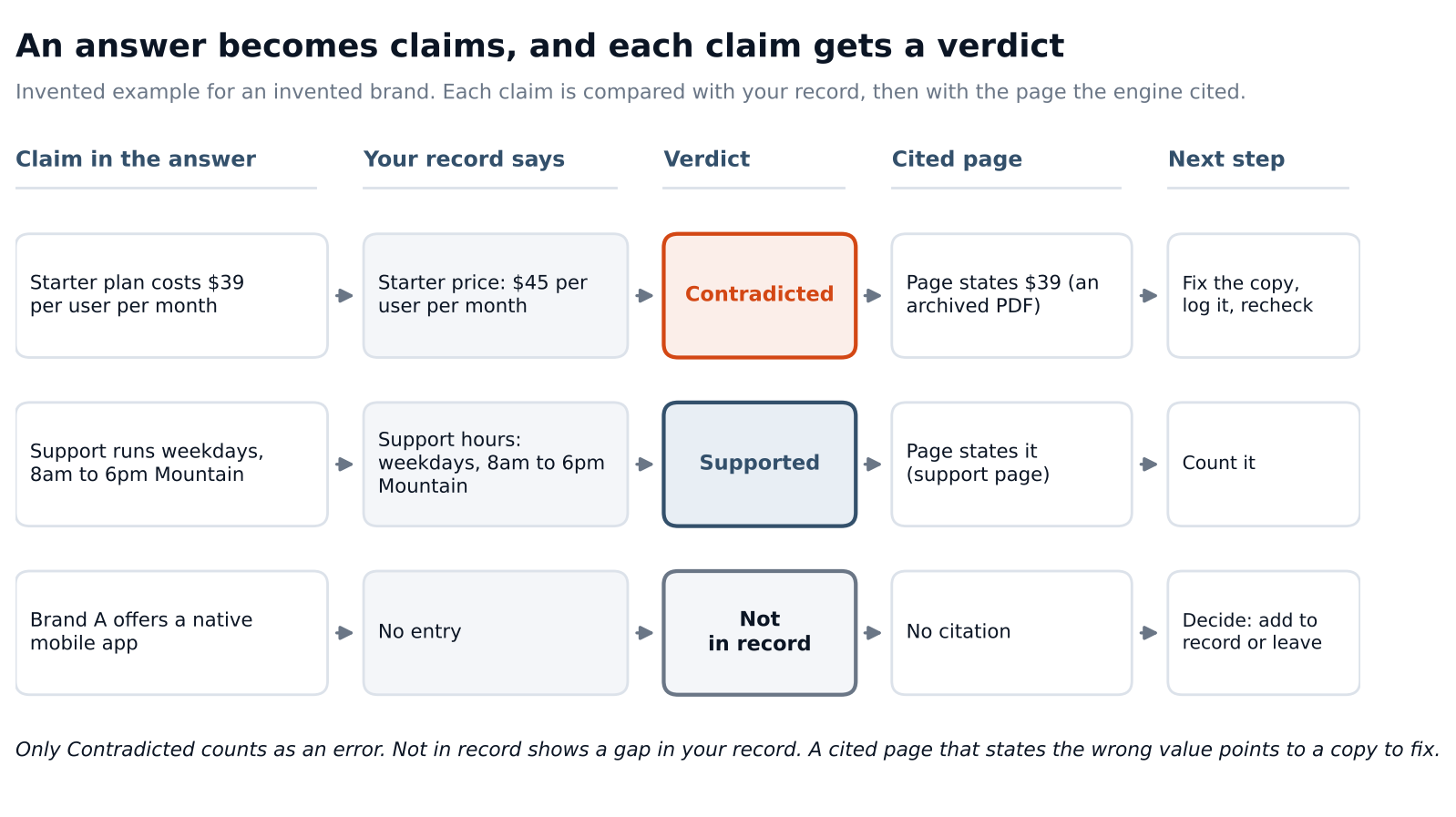
This routine judges accuracy only. The post on brand sentiment covers tone and how to code claims with two reviewers, and the two fit together: a claim can be accurate and unflattering, or flattering and wrong.
What each verdict tells you
| Verdict | What it means | What to do |
|---|---|---|
| Supported | Matches the record | Count it. If the record entry is old, check the record. |
| Contradicted | Conflicts with the record | Log an owner and a fix date, and find the copy it came from. |
| Not in record | The record says nothing | Decide: add it with an owner and a page, or leave it. Do not count it as an error. |
A pile of not-in-record claims is useful in its own way. If engines keep saying something about you that you have no position on, such as a feature or a partner, that is a topic you may want to state on your own pages. In the example, 11 of 120 claims were not in the record.
Open the page the answer cites
A citation looks like proof. The Stanford audit is a reminder that it is a pointer: on average only about three quarters of citations supported the statement they sat next to. So the check has a second part. For each claim, open the cited page and mark yes or no.
In the worksheet's invented example, 91 claims had a cited page that was checked. The page supported the claim in 61 of them, 67 percent. Of the 18 contradicted claims, 7 cited a page that actually states the wrong value. Those are copies to fix, and the footprint post shows how to find the others like them. In the remaining contradicted claims the cited page did not state the wrong value, so the engine misread the page, drew on another source or answered from memory. You cannot tell which from the answer alone.
Fix by owner, then ask the same prompt again
Every contradicted claim needs an owner and a date. The owner is the person named against that fact in the record. Fix the copies you control first, then send correction requests for the ones you do not, as the table in the change log section sets out. Anything involving legal, safety, compliance or privacy exposure goes to the right owner whatever the harm score says.
After a fix, ask the same prompt again with the same wording and check the answer. A changed answer is encouraging. An unchanged one means you have not yet found the copy the engine is reading. These are our recommendations, and none of them has a measured effect on later answers.
How many claims make a rate worth reading
An accuracy rate from a handful of claims moves a lot by chance. Figure 2 shows the range of true accuracy rates that fit an observed 80 percent at different numbers of checkable claims. It is a model, not a measurement.
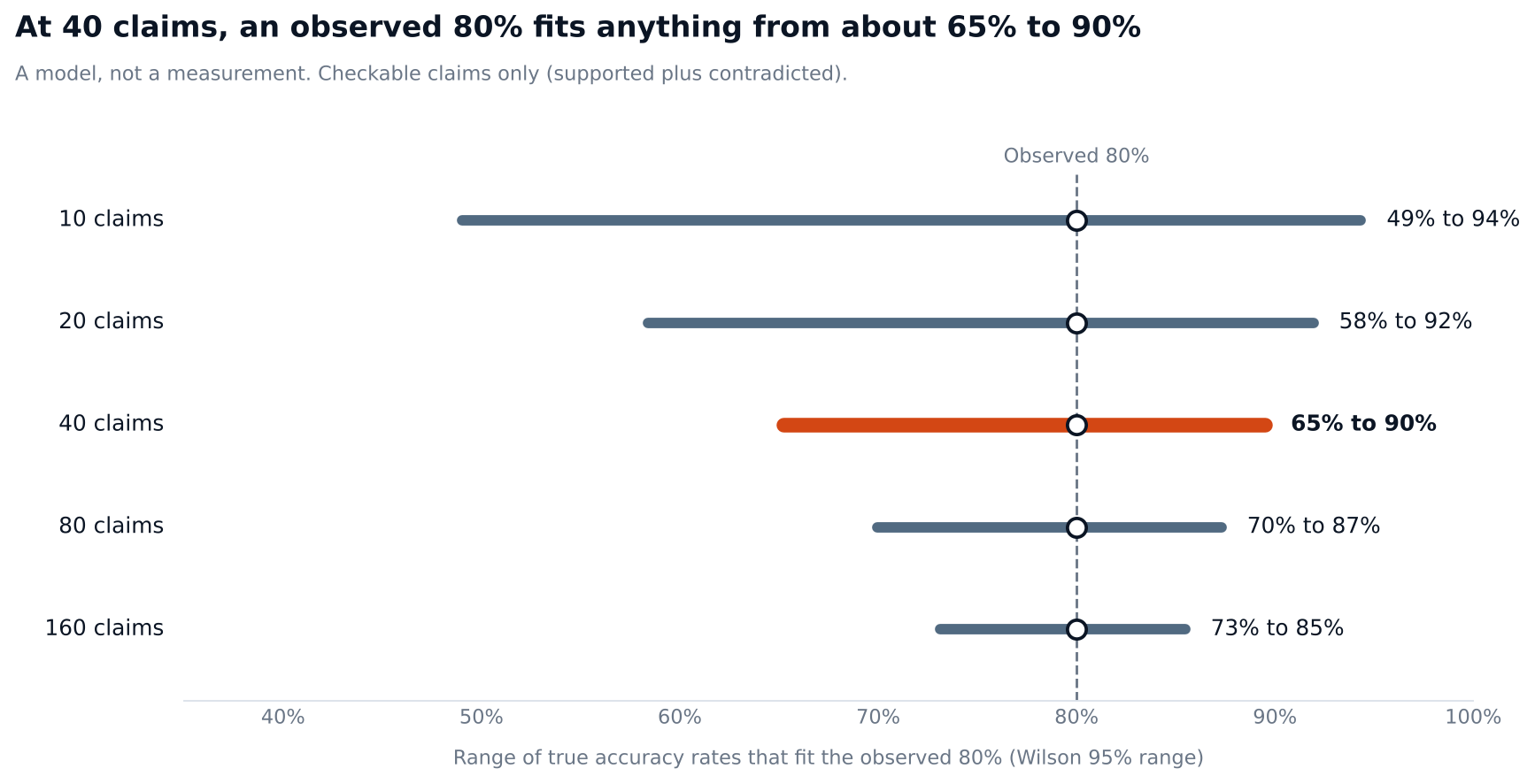
Figure 2. A model, not a measurement. Wilson 95 percent ranges for an observed 80 percent accuracy rate.
In the invented example, 120 claims were checked over four weeks. Of the 109 that could be judged, 91 were supported, an accuracy rate of 83 percent with a range of 75 to 89 percent. Against a placeholder target of 90 percent, the whole range sits below the target.
The weekly rates were 75, 85, 89 and 86 percent. That looks like improvement, but each week had only 26 to 28 checkable claims and the ranges overlap from one week to the next. The worksheet labels each week "Ranges overlap" or "Ranges separate" so that nobody reports a swing that chance explains. The engine comparison is different. One engine scored 93 percent with a range of 82 to 98, another 67 percent with a range of 50 to 80, and those ranges do not overlap. That gap is worth chasing.
The practical rules: report the range next to the rate, do not react to one week, and check enough claims per engine that the range can narrow. The post on tracking frequency covers how often to run the checks.
Keep the routine in one worksheet
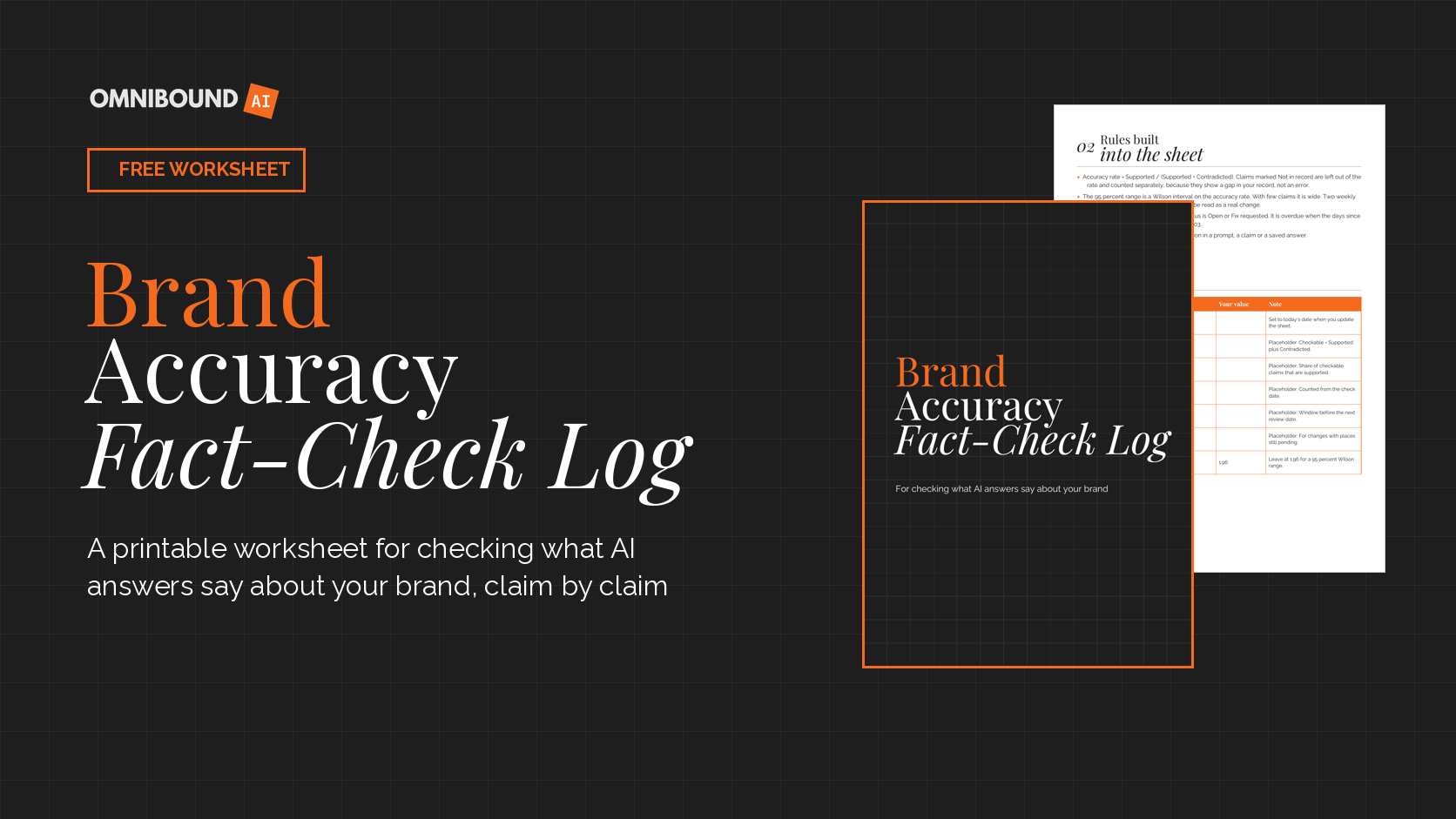
The worksheet has a settings tab, a record, a change log, a claims log and a summary. Grey rows are invented examples for an invented brand, so replace them before you read any output. Do not enter customer or personal information in a prompt, a claim or a saved answer.
- On the Settings tab, set the minimum claims for a stable rate, your accuracy target and the day limits for overdue fixes, reviews and changes.
- On the Record tab, enter each fact with its approved value, own page, owner, harm rating, review interval and the date you last verified it.
- On the Change log tab, add a row whenever a fact changes and mark each place Done, Pending or Not needed.
- On the Claims tab, log one row per claim with its verdict and whether the cited page supports it. For each contradicted claim, set a status and an owner and record the fix or request date.
- On the Summary tab, read the accuracy rate and range, results by engine, fact and week, the cited-page check, overdue reviews and changes, and the top ten open contradicted claims.
Frequently asked questions
Can I fact-check AI answers automatically?
Research tools do part of it. They split text into claims and check each against a source, and they report close agreement with human labels on their own test data. That data was general knowledge checked against Wikipedia or search snippets, not your record. Automating the splitting can save time, but have a person confirm each contradicted verdict before anyone edits a page.
How often should we run the check?
Match it to how fast your facts change and how much harm a wrong one does. Price and plan details might get a weekly check, and slower facts a monthly one. We found no study that sets the right interval, so start with a schedule you can keep and adjust it once the results show where errors appear.
Who should own the routine?
The owner named against each fact in the record owns its fixes. One person runs the weekly check, usually in marketing or comms, so the verdicts are given the same way each time. Legal or compliance should own anything with harm 3.
What accuracy rate is a good one?
We found no benchmark, and a rate from a few claims says little. Set your own target, compare the range and not the single figure, and treat the target on the Settings tab as a placeholder.
Is this the same as tracking mentions or citations?
No. Tracking mentions and citations tells you whether you appear and which pages are used. A fact-check tells you whether what is said about you is right. Both are worth doing, and they answer different questions.
Check ten answers against your record this week
Pick ten buyer prompts about facts where you already know the approved value, such as your price, plan names, integrations and trial length. Read one answer to each, split it into single claims, and give each claim a verdict against your record. Open every cited page and mark whether it supports the claim. Count the contradicted claims, write down who owns each one, and date it. Do not put customer or personal information in a prompt or a saved answer.
If you want a first answer to read, the AI Search Visibility Checker gives you one on a prompt you choose. If you want the same ten prompts asked again after each fix, AI Search Intelligence tracks individual prompts.