

Table Of Contents
Imagine a prospect typing a question into an AI assistant and getting an answer that mentions your brand. That moment is the perfect opening for a conversation, yet many demand‑generation leaders still send generic outreach that never references the exact query. The result? Low reply rates, wasted SDR time, and missed pipeline. The good news is that the same AI search data that surfaces your content can also reveal the precise search intent a buyer has right now.
By capturing that intent, decoding the underlying prompt, and weaving it into a hyper‑relevant warm‑up, you turn a fleeting AI answer into a dialogue that feels personal, timely, and valuable. This guide shows you how to harvest AI‑driven intent signals, map them to buyer personas, and automate the creation of warm‑ups that scale without losing relevance. You’ll walk away with a repeatable framework, concrete metrics to track, and practical tips for real - time personalization that boost reply rates and accelerate pipeline.
Why AI Search Is the New Front Door to Your Prospects
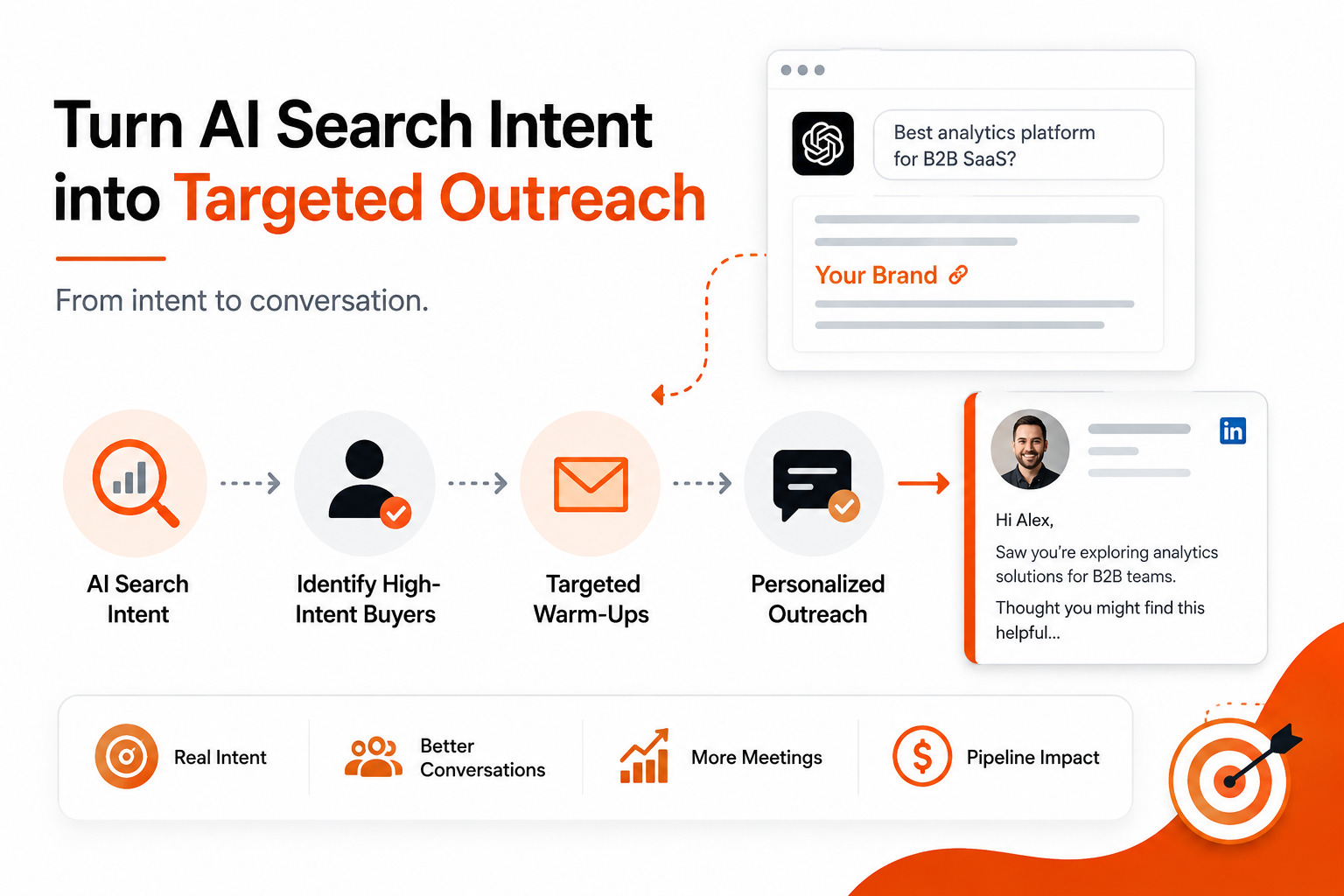
Buyers no longer start their research with a list of keywords. They open a chat with an AI model, ask a question like “What are the best ways to improve lead quality for a mid‑market SaaS company?” and receive a concise answer that may include a citation to your site. That citation is the first point of contact – a digital front door you can knock on. AI - powered analytics can surface the exact queries that trigger your brand’s mention, giving you a real‑time view of the topics that are driving interest. When you align your outreach with those queries, you demonstrate that you understand the prospect’s immediate problem, not just a generic pain point.
According to a commercial intent study, over 30% of AI‑generated answers reference a brand, yet only a fraction of those brands follow up with a relevant outreach. That gap is a low‑hanging opportunity for demand teams. By monitoring the AI citations you receive, you can prioritize outreach to prospects who are already showing interest.
To make this data actionable, you need a system that continuously captures the AI query, tags it with the relevant buyer persona, and stores it in a searchable repository. From there, you can feed the signal into your outreach workflow. This is where search intent becomes the engine that drives your next conversation.
Decoding Prompt Intelligence: Turning Queries into Buyer Signals
Every AI query is a compact expression of a buyer’s current need. Prompt intelligence means extracting the underlying buyer intent and the associated intent signals such as urgency, budget concerns, or evaluation criteria. A typical prompt might read, “How does AI improve lead scoring for B2B teams?” From that, you can infer that the prospect is in the consideration stage, values data‑driven scoring, and is likely comparing solutions.
Mapping these signals to an account - based marketing strategy lets you prioritize high‑value accounts that match the profile of a mid‑market SaaS organization. You can enrich the prompt data with firmographic details from your CRM, then segment the audience by intent tier – high, medium, low – based on the specificity of the question.
Industry research shows that AI adoption in analytics is growing at a double‑digit rate, with the market projected to exceed $500 billion by 2026 (AI market forecast). This rapid growth means more buyers are turning to AI assistants for research, increasing the volume of usable intent signals you can capture.
Building Targeted Warm‑Ups That Reference the Exact Buyer Question
The transition from insight to outreach begins with a simple rule: reference the exact question the prospect asked. A warm‑up that says, “I saw your recent AI query about lead scoring and thought you might be interested in how our platform helps teams improve scoring accuracy,” instantly feels personal and relevant. This approach leverages topic clusters – a collection of related content that answers the broader theme of the query – to provide a concise, value‑focused answer.
Below is a quick framework for crafting such warm‑ups:
| Step | What to Include | Why It Works |
|---|---|---|
| 1. Capture the Query | Exact wording of the AI question | Shows you’re listening |
| 2. Map to Persona | Identify role and stage | Tailors language |
| 3. Link to Asset | Relevant blog, case study, or guide | Provides immediate value |
| 4. Add a Hook | One‑sentence benefit | Encourages reply |
Each step can be automated with a template, but the key is the human touch of referencing the specific query. For deeper guidance on how to structure your content around AI‑driven topics, see our What Is the Impact of AI Tools In B2B Marketing? – a practical guide that walks you through building topic clusters that align with AI citations.
Automation Tips for Scaling Personalized Outreach Without Losing Relevance
Manually crafting warm‑ups for every AI query is impossible at scale. Automation bridges the gap by pulling the captured prompt, enriching it with CRM data, and generating a draft email that you can review in seconds. Modern outreach platforms support real - time personalization by inserting dynamic fields such as the prospect’s name, company, and the exact query phrase.
To keep relevance high, set up a rule‑based engine that only triggers an outreach when the intent signal reaches a confidence threshold – for example, when the query includes a specific product feature or a budget range. This prevents you from sending messages to prospects who are only casually browsing.
When you combine automation with AI - powered analytics, you can continuously refine the thresholds based on reply rates and pipeline contribution. A recent benchmark shows that teams using automated, intent‑driven outreach see a 25% lift in reply rates compared with generic email blasts (AI adoption impact study).
For a broader view of how AI can power your entire product‑marketing workflow, check out AI for Product Marketing: Bridging Strategy to Execution. It outlines how to embed AI insights across content creation, distribution, and measurement.
Measuring Success: Metrics to Track the Impact of AI‑Driven Warm‑Ups
Without clear metrics, you won’t know whether your intent‑driven outreach is delivering ROI. Focus on four core KPIs:
| Metric | Definition | Target |
|---|---|---|
| Open Rate | Percentage of emails opened | >30% |
| Reply Rate | Responses received per outreach | >15%+ |
| Pipeline Contribution | Qualified opportunities generated | >2 per 100 contacts |
| Conversion Lift | Increase in closed‑won deals attributable to warm‑ups | >10%+ |
Use AI - powered analytics dashboards to track these metrics in real time, correlating spikes in reply rates with specific AI query types. Over time, you’ll see which intent signals – such as “budget” or “timeline” – generate the highest conversion lift, allowing you to prioritize those signals in future campaigns.
Regularly audit your performance against industry benchmarks. For example, the average reply rate for cold outreach sits around 5%, so a 15% rate indicates a strong alignment with buyer intent.
FAQs
1. How can I capture AI search queries without violating privacy regulations?
Most AI platforms provide aggregated citation data that does not include personally identifiable information. By focusing on the query text and anonymized firmographic signals, you stay compliant with CCPA and GDPR. Pair this data with consent‑based CRM records to enrich the profile before outreach.
2. What tools can help automate the creation of warm‑up emails?
Several outreach platforms offer API integrations that pull query data, map it to a persona, and generate a draft using natural‑language templates. Look for solutions that support dynamic fields for the exact query phrase and allow a quick human review step to ensure tone and relevance.
Conclusion
AI search has turned the traditional funnel upside down – the moment a prospect asks a question is the moment you can engage. By capturing that search intent, decoding the underlying buyer intent, and automating hyper‑personalized warm‑ups, you create a pipeline that moves faster and feels more relevant. The framework outlined above gives you a repeatable process, measurable metrics, and the technology hooks you need to scale without losing the personal touch. To see how these principles play out in practice, explore Omnibound and discover how the platform helps you turn AI‑driven insights into real‑time conversations.
Recommended Authority Resources
- Reference: What is ABM and Why Does It Matter in 2025? – Provides up‑to‑date statistics on ABM adoption and ROI, reinforcing the value of aligning intent data with account‑based strategies.
- Reference: Artificial Intelligence - Worldwide Market Forecast – Offers credible market size and growth projections that underline the rapid expansion of AI‑driven research.
Turn Your Content Into AI-Search Winners
Get cited across ChatGPT, Claude & Perplexity — not just ranked on Google.
- Increase AI citations
- Improve answer visibility
- Track brand mentions in LLMs
.webp?height=245&name=15%20Common%20B2B%20Marketing%20Strategy%20Mistakes%20(and%20How%20Modern%20Teams%20Avoid%20Them).webp)