


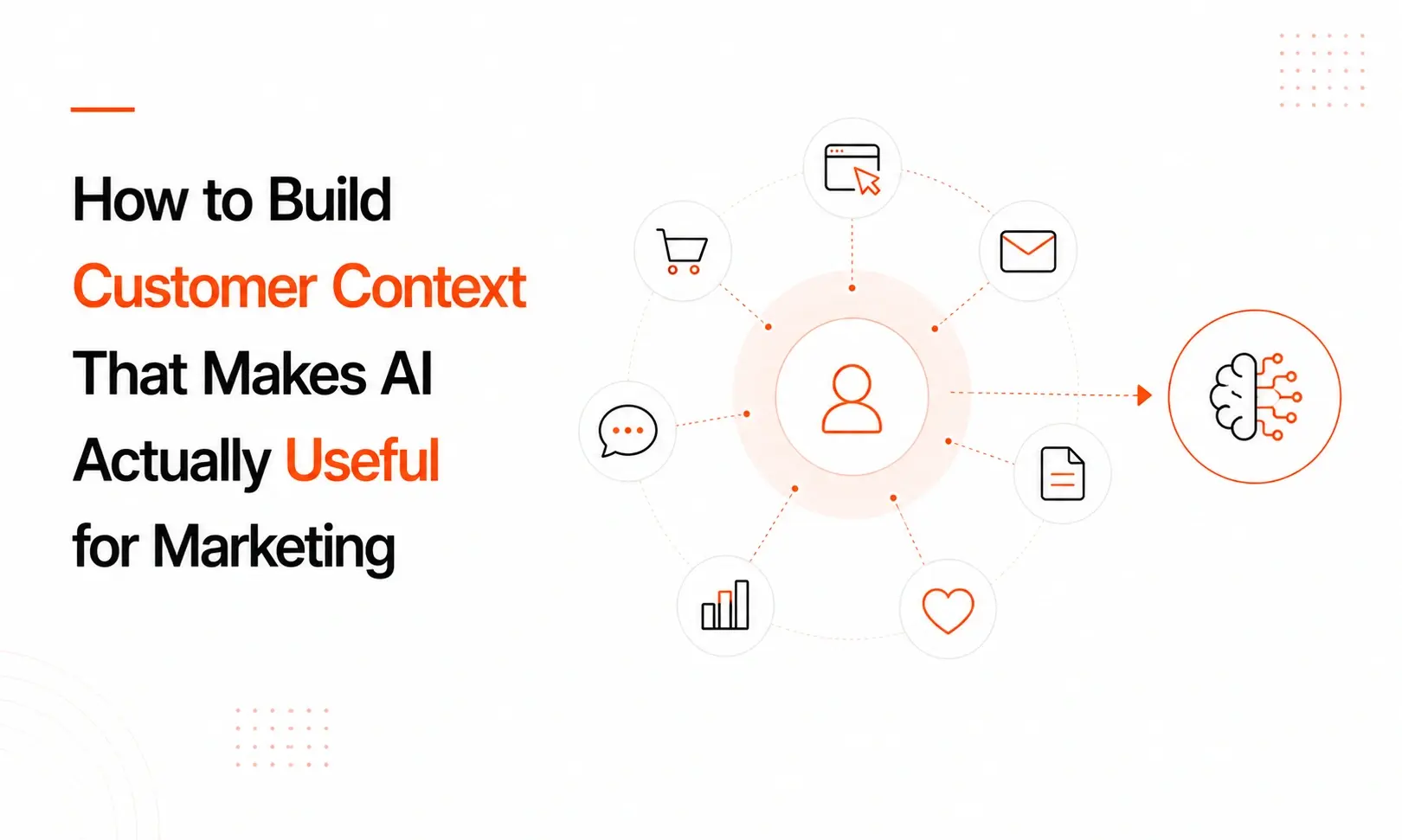


Context-aware AI in marketing describes systems that understand a customer's history, behavior, and buying stage before generating a message or recommending a next step. That definition is the easy part. The harder question, and the one most marketing teams still can't answer, is how you actually get that context into the tools you already use.
Most marketing automation platforms send emails, score leads, and trigger workflows without ever seeing a full picture of the customer. They know a click happened. They don't know why it happened, what the sales team said on last week's call, or which campaign already tried this message and failed. That gap is why so much AI-generated marketing still reads as generic, even when the underlying models are advanced.
This guide is about closing that gap. Instead of re-explaining what context-aware AI is (you can find that grounding in Why AI Needs Marketing Context), this article focuses on the practical work of building a unified customer context that marketing automation, content teams, and AI systems can actually use.
What Context-Aware AI Means, Briefly
Context-aware AI is AI that factors in a customer's signals, such as recent behavior, lifecycle stage, past interactions, and market conditions, before deciding what message to show or what content to recommend. It's the opposite of static personalization rules that treat every customer in a segment the same way.
The concept itself is covered in depth in Marketing Context and in Use Cases of Marketing Context. What those articles establish, and what this one builds on, is a simple premise: AI does not become more useful because the model gets bigger. It becomes more useful because it knows more about your customers before it acts.
The shift marketing leaders need to make is moving from a prompt-first mindset to a context-first one.
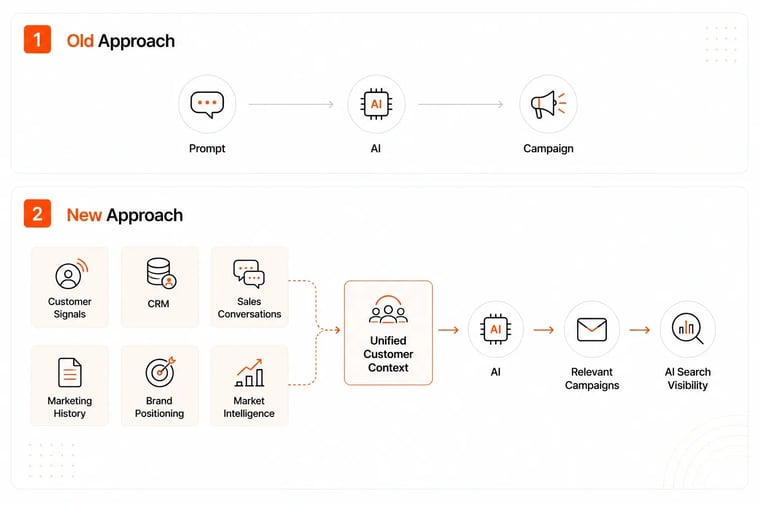
That shift, from isolated prompts to a shared customer understanding, is the rest of this article.
How to Give Your Marketing Automation Platform Complete Customer Context
Marketing automation platforms are built to execute workflows, not to understand customers. A typical stack looks like this:
CRM → Email → Forms → Analytics → Product Usage → Support
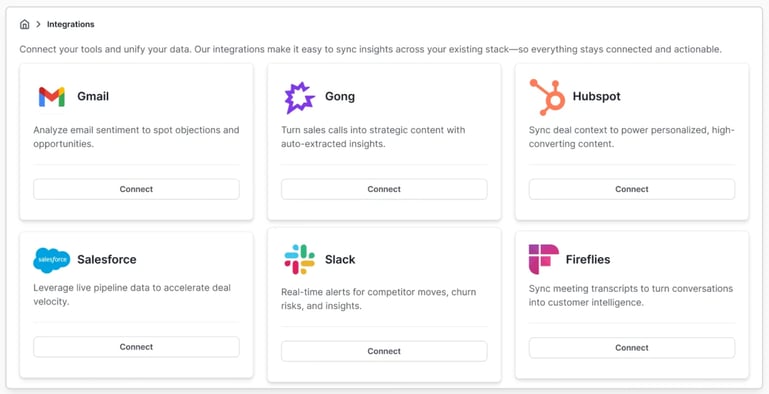
Each of these systems captures a slice of customer activity, but none of them talk to each other in a way that produces one connected understanding. A customer might submit a demo request through a form, mention a specific objection on a sales call, raise a support ticket about the same issue a month later, and receive an email campaign that ignores all three events. The automation ran correctly. It just had no context.
This is the core limitation of most B2B marketing automation setups. They automate tasks, not understanding. Fixing this doesn't require replacing your automation platform. It requires giving it access to a connected customer context it currently lacks.
What Needs to Be Unified
To give marketing automation complete customer context, organizations typically need to connect:
- CRM records, including opportunity stage, deal history, and account ownership
- Customer conversations from sales calls, support tickets, and success check-ins
- Lifecycle stage and where a customer sits in the buying journey
- Previous campaigns the customer has already received or responded to
- Buying history, including past purchases, renewals, or expansion activity
- Product usage data that shows what the customer actually does after signing up
- Recorded objections and questions that come up repeatedly across accounts
- AI Search behavior, meaning how prospects find and evaluate you before ever filling out a form
None of these signals are new. Most organizations already collect them. The problem is that they sit in separate systems, owned by separate teams, updated on separate schedules. A context layer doesn't replace these systems. It sits alongside them, pulling relevant signals into one place so that automation platforms, content teams, and campaign builders can draw from the same understanding instead of guessing.
Making Automation Smarter, Not Redundant
It's worth being direct about what this is not. This is not a case for ripping out your marketing automation platform and starting over. Automation platforms are still the execution layer, the systems that actually send the email, trigger the workflow, or update the lead score.
What changes is what feeds that execution layer. Instead of automation rules built on last-click behavior or static list membership, automation decisions get informed by a fuller customer picture. A lead that just had a difficult sales call about pricing shouldn't receive the same nurture sequence as a lead that's actively comparing you to a competitor in AI Search results. Right now, most platforms can't tell the difference. With a unified context layer, they can.
Organizations that get this right typically start small. They don't try to unify every signal across every system on day one. They pick one high-value use case, such as connecting sales call notes to lifecycle stage for a single nurture program, prove it improves relevance, and expand from there. The goal isn't a perfect data warehouse. It's a working context layer that automation can actually use.
How AI Can Understand Your Customers, Brand, and Marketing History Before Creating Campaigns
Most AI tools used in marketing today operate on a narrow input: a prompt, and a response. Someone types a request, the AI generates content, and that content has no memory of what came before it. Ask the same tool to write three different campaigns for three different segments, and it has no idea those campaigns are supposed to sound like they came from the same brand, let alone build on each other.
This is the single biggest reason AI-generated marketing content feels interchangeable across companies. The AI isn't wrong. It's just missing the history that would make its output specific to your business.
What Historical Context Actually Includes
Context-aware marketing means giving AI access to more than a single prompt. Specifically, it should understand:
- Previous campaigns, including what was sent, to whom, and how it performed
- Messaging that has worked, and messaging that has been tested and dropped
- Brand voice, so output doesn't need to be rewritten to sound like you
- Positioning, meaning how you differentiate against alternatives in the market
- Customer segments and what matters to each one specifically
- Sales conversations, which often contain the most honest language buyers use
- Support history, which reveals where customers get confused or frustrated
- Buyer questions that come up again and again across calls, forms, and reviews
When AI has access to this history, the output changes noticeably. Instead of generic value propositions, campaigns start reflecting the actual phrases your buyers use. Instead of repeating a message that already underperformed twice this year, content builds on what's proven to work. This is the practical difference between AI that generates text and AI that supports a marketing decision.
Why Relevance Depends on Memory, Not Just Data
There's a difference between having data and having memory. A CRM has data. A support system has data. What's usually missing is a connected memory that links a customer's current behavior to their full history with your company and your market.
Tools like Marketing Context Engine exist specifically to close this gap, turning scattered customer signals into a working memory that content and campaign tools can query before producing anything. The same applies to Voice of the Customer programs, which capture the language buyers actually use so campaigns don't rely on internal jargon that means nothing to the person reading it.
The practical takeaway for marketing leaders is this: before evaluating any AI tool for content or campaign creation, ask what history it has access to. A tool that only sees the current prompt will always produce work that needs heavy editing. A tool that understands your positioning, your past campaigns, and your customer language starts much closer to something usable.
Building a Unified Customer Context Layer for AI-Powered Marketing Automation
The sections above describe individual pieces, automation context and historical memory. Put together, they form a single capability: a unified customer context layer that sits underneath every marketing decision.
Customer Conversations + CRM + Website Behavior + Marketing History + Product Usage + Market Signals
↓
Unified Customer Context
↓
Marketing Decisions
↓
AI Search Visibility
↓
Pipeline
The purpose of this layer isn't to add another system for marketers to log into. It's to make sure every tool already in use, your automation platform, your content workflow, your campaign builder, is pulling from the same understanding of the customer instead of six different partial views.
Why This Should Be Continuous, Not Project-Based
A common mistake is treating context building as a one-time project. A team pulls together personas, documents positioning, maps buyer journeys, and calls it done. Six months later, the market has shifted, two new competitors have entered the conversation, and the personas no longer reflect who's actually buying.
A unified context layer works differently. It's updated continuously as new sales calls happen, new support tickets come in, new campaigns run, and new buyer questions surface. This is closer to how a living research process works: rather than a report that goes stale, it's an ongoing process of capturing what's changing and feeding it back into marketing decisions.
What Makes a Context Layer Actually Useful
A few things separate a working context layer from a data project that never ships value:
- It prioritizes a small number of high-value signals over trying to capture everything at once
- It's accessible to the teams and tools that need it, not locked in a single department's dashboard
- It updates on a cadence that matches how fast your buyers and market actually move
- It connects directly to where decisions get made, meaning campaign builders and content tools, not just a reporting layer nobody checks
Organizations that build this well stop treating every new campaign as a blank page. Instead, campaign planning starts from an existing, current understanding of the customer, which is a faster and more accurate starting point than any single prompt could produce.
Why Your Marketing Automation Produces Generic Campaigns (And How to Fix It)
If your automation platform keeps producing content that reads like it could belong to any competitor, the cause is rarely the tool itself. It's almost always missing context. Generic campaigns happen when AI and automation lack:
- Customer understanding beyond a name and an email address
- Historical memory of what's already been sent and how it performed
- Awareness of buying stage, so early-stage prospects get the same pitch as active buyers
- Positioning, meaning what makes your offer different in the eyes of the buyer
- Campaign history, so the same underperforming message doesn't get recycled
- Customer language, meaning the actual words buyers use instead of internal terminology
The instinct when campaigns feel flat is usually to write a better prompt, adjust the tone, add more detail to the instructions, or try a different AI tool entirely. That rarely solves the underlying problem. A better prompt run against the same missing context still produces the same generic output, just phrased slightly differently.
The Fix Is Context, Not Better Instructions
The organizations that consistently produce relevant campaigns have usually done one thing differently: they've given their marketing automation access to a fuller customer picture before content gets generated. That means connecting the signals discussed earlier, sales conversations, support history, product usage, and market intelligence, into something the automation platform can reference.
This is a message worth repeating because it runs counter to how most teams have been taught to think about AI adoption. The instinct is always to improve the prompt. The actual lever is improving what the AI knows before the prompt even gets written.
Practically, this looks like auditing your last five campaigns and asking a simple question: what did the AI or automation tool know about this customer before it generated the message? If the honest answer is "very little beyond an email address," that's the gap to close, not the copy.
Creating a Complete Customer Context That Every Marketing Team Can Use
Customer context shouldn't live inside one department's tools. Sales, marketing, customer success, product marketing, and demand generation all interact with customers at different points, and each captures information the others need but rarely see.
- Sales hears objections and competitive comparisons in real time
- Marketing knows which campaigns and messages have already been tested
- Customer success sees where customers struggle after the sale
- Product marketing understands positioning and how features map to customer problems
- Demand generation knows what content and channels actually produce pipeline
When these teams work from separate, disconnected views of the customer, marketing produces campaigns sales doesn't recognize, sales pitches features that don't match current positioning, and customer success gets surprised by promises made in a campaign they never saw. A shared customer context prevents this by giving every team, and every AI system each team uses, the same starting understanding.
This doesn't require every team to use identical tools. It requires a shared layer that each team's tools can draw from, so a sales conversation insight can inform a marketing campaign, and a support pattern can shape a product marketing message, without manual handoffs that inevitably get missed.
Beyond Workflow Automation: Marketing Platforms That Provide Unified Customer Context
Traditional marketing automation follows a simple pattern:
Workflow → Email → Task
This model has served marketing teams well for two decades, and it still matters for executing campaigns at scale. But workflow automation alone doesn't produce relevance. It produces consistency. A platform can flawlessly execute a workflow that's built on a wrong or outdated assumption about the customer.
Modern marketing platforms are increasingly built around a different pattern:
Customer Intelligence → Marketing Context → Decision Support → Content → AI Search → Campaigns
The difference is where intelligence sits in the process. Instead of automation executing a pre-set rule, decisions get informed by current customer intelligence before content or campaigns get created. This is the direction AI content gap analysis and similar tools point toward: identifying not just what to automate, but what customers actually need answered before deciding how to automate it.
The competitive advantage here is shifting. For years, the advantage came from having more sophisticated workflows and more automation triggers than competitors. Increasingly, the advantage comes from having a better shared understanding of the customer that every tool, workflow, and piece of content can draw from. This mirrors a broader pattern seen across enterprise AI adoption generally: persistent context and organizational memory are proving more valuable than isolated, one-off executions, no matter how well those executions are automated.
Context-Aware AI Improves AI Search Visibility

AI Search tools, the systems buyers now use to research vendors and get answers before ever visiting a website, reward a specific kind of content. They favor material that's educational, uses the actual language buyers search with, demonstrates topical depth across a subject rather than a single shallow post, and answers questions completely rather than partially.
Context-aware marketing produces this kind of content more naturally than prompt-based content creation, and the reason comes back to the same theme running through this article: content quality depends on customer understanding.
Why Context Produces Better AI-Ready Content
Content built from a unified customer context reflects real buyer questions instead of assumed ones. It's grounded in the language customers actually use in sales calls, support tickets, and reviews, rather than internal terminology. It builds on previous content instead of duplicating a topic that's already been covered, which strengthens topical depth over time.
This matters directly for AI Search visibility. AI Search systems are essentially evaluating whether a piece of content, or a body of content across a domain, sufficiently answers a category of question. Content produced without customer context tends to answer questions in the abstract. Content produced with context answers the specific questions buyers are actually asking, in the way they ask them.
The Compounding Effect
There's a compounding relationship here worth noting. Better customer context produces content that performs better in AI Search. Better AI Search visibility surfaces more buyer questions, competitor comparisons, and market signals that feed back into the context layer. Organizations that treat these as connected, rather than separate initiatives, get more value out of both.
Customer Context Is Never Finished
It's tempting to treat context building as a project with an end date, a research phase, a set of documented personas, a finished framework. In practice, customer context is never finished, because the things it describes keep changing.
- Buyers evolve, adopting new priorities and new vocabulary as their own businesses change
- Competitors evolve, shifting positioning and pricing in ways that change how your offer gets perceived
- Your own positioning evolves as the product roadmap and market strategy shift
- Products evolve, adding capabilities that solve problems your original messaging never addressed
- AI Search itself evolves, changing what kind of content gets surfaced and cited
Because of this, context should be treated as continuous, not static. A context layer that's updated quarterly is meaningfully better than a set of personas built two years ago and never revisited. A context layer that updates as new sales calls, support tickets, and market signals come in is better still. The goal isn't a perfect, permanent picture of the customer. It's a current one.
Implementation: Building Context Across People, Process, and Measurement
Building unified customer context isn't purely a technical exercise. Teams that succeed treat it as a combination of people, process, and ongoing measurement, not just a data integration project.
People → Processes → Customer Intelligence → Content → Measurement → Continuous Learning
People
Someone needs to own the context layer, typically a marketing operations or RevOps function working closely with product marketing. Without clear ownership, context work tends to fall between teams and quietly stops updating.
Processes
Capturing customer signals needs to become part of regular workflow, not a special project. Sales call summaries, support ticket tags, and campaign performance reviews should feed the context layer as a matter of routine, not an occasional audit.
Customer Intelligence
This is where signals actually get organized: buyer questions, objections, segments, and market shifts, compiled into something usable rather than scattered across systems.
Content
Content production should pull from this intelligence rather than starting from a blank prompt each time, which is where tools built for AI-assisted content production become useful, connecting research directly to what gets written.
Measurement
Track whether context is actually improving outcomes, not just whether it exists. This is covered in more detail below.
Continuous Learning
Every campaign, every sales conversation, and every support interaction should feed back into the context layer, closing the loop rather than treating each project as isolated.
Common Mistakes When Building Customer Context for AI
A few patterns show up repeatedly in organizations that struggle to make context-aware AI work in practice:
- Relying only on CRM data, which captures transactions but misses conversations, objections, and product usage
- Disconnected customer data spread across systems that never sync, so no single view ever forms
- Static personas built once and never updated as buyers and the market change
- Generic prompts used as a substitute for actual context, which produces marginally different but equally generic output
- Ignoring campaign history, leading to repeated messaging that's already been tested and dropped
- Rebuilding context for every project instead of maintaining one continuously updated layer
- Optimizing workflows instead of customer understanding, adding more automation triggers without improving what those triggers know about the customer
Measuring Success: What to Track Beyond Open Rates
Traditional marketing metrics, like personalization rate and open rate, tell you whether something was sent and whether it was opened. They don't tell you whether the underlying context was any good. Organizations building context-aware marketing should track a broader set of indicators:
- Customer understanding, measured by how consistently campaigns reference real buyer language and objections
- Campaign relevance, tracked through engagement quality rather than just volume of sends
- AI Search visibility, meaning whether your content gets surfaced and cited for relevant buyer questions
- Messaging consistency, checking whether positioning stays aligned across sales, marketing, and support
- Buyer question coverage, meaning how many of the questions buyers actually ask are addressed somewhere in your content
- Content effectiveness, tracked by pipeline influence rather than page views alone
These metrics require pulling data from more places than a single automation platform reports on, which is exactly the point. Measuring context quality requires the same connected view that produces good context in the first place.
How Omnibound Supports Unified Customer Context
Omnibound is an AI Search Marketing platform built around a simple idea: marketing decisions get better when they're informed by a current, connected understanding of the customer and the market, not by isolated prompts or static data pulls.
Specifically, Omnibound helps organizations unify customer intelligence from sales conversations, support interactions, and product usage, connect that intelligence to marketing history so campaigns build on what's worked rather than repeating what hasn't, and surface buyer questions and market signals that inform both content strategy and positioning. This connects directly to AI Search visibility, since content grounded in real buyer language and complete answers tends to perform better as buyers increasingly research through AI Search tools before ever reaching a website.
The goal isn't to add another isolated tool to the stack. It's to give marketing automation, content teams, and campaign builders access to one continuously updated understanding of the customer, so the next campaign starts from real context instead of a blank prompt.
Conclusion
Context-aware AI does not produce better marketing because it runs on a more advanced model. It produces better marketing because it understands more about your customers before it makes a decision. Organizations that connect customer conversations, CRM history, campaign performance, product usage, buyer questions, and market intelligence into one continuously updated context give every marketing system, automation platform, and content tool access to the same understanding.
The result is campaigns that reflect real buyer language, positioning that stays consistent across teams, and content that performs better in AI Search because it actually answers the questions buyers are asking. The competitive advantage isn't adding more AI tools to the stack. It's making sure every tool already in use shares the same trusted customer understanding, updated continuously as buyers, competitors, and the market keep changing.
Frequently Asked Questions
What is context-aware AI in marketing?
Context-aware AI is AI that factors in a customer's behavior, history, and buying stage before producing content or decisions, instead of treating every interaction as a standalone event.
How do you give AI complete customer context?
Connect CRM data, sales conversations, support history, product usage, and market intelligence into a shared context layer, rather than fragmenting these signals across separate systems that never sync. Omnibound helps unify these signals into one continuously updated view marketers and automation tools can reference.
Why does AI create generic marketing campaigns?
Generic campaigns happen when AI lacks customer history, buying stage awareness, and campaign memory. The fix is better context, not better prompts. Omnibound connects historical and behavioral signals so campaigns start from real customer understanding instead of a blank prompt.
What is a unified customer context layer?
It's a connected view combining CRM data, conversations, behavior, and marketing history that automation, content tools, and every AI system can draw from, instead of each tool working from a partial, isolated data set.
How does customer context improve marketing automation?
Context lets automation trigger based on real buying signals and history rather than static rules, producing campaigns that reflect current customer situations instead of generic segment logic.
Why is marketing history important for AI?
Marketing history shows AI what's already been tried, what worked, and what your brand voice sounds like, preventing repeated messaging and helping output stay consistent with proven positioning.
How does context-aware AI improve AI Search visibility?
Context-aware content reflects real buyer language and answers questions completely, which is exactly what AI Search systems reward when deciding what to surface and cite for buyer research.
How does Omnibound help organizations build marketing context?
Omnibound unifies customer intelligence, marketing history, and buyer questions into one continuously updated context, helping organizations improve campaign relevance, positioning, and AI Search visibility without replacing existing automation tools.
How to give a marketing automation platform complete customer context instead of fragmented data?
Connect CRM, sales conversations, support history, and product usage into one shared layer that automation tools query before sending, rather than each system operating on its own partial data.
Which platform lets AI understand my customers, brand, and historical marketing data before creating campaigns?
Look for platforms that unify customer intelligence and marketing history into a shared context layer. Omnibound is built specifically to connect these signals for AI-powered marketing decisions.
How to connect customer insights, CRM data, content, and messaging into one context layer for AI-powered marketing automation?
Start by identifying your highest-value signals, prioritize a small set over trying to capture everything, and route them into a shared layer your automation and content tools can reference consistently.
If marketing automation is sending generic campaigns because AI lacks customer context, how do I fix this?
Audit what the AI actually knew about the customer before generating the campaign. In most cases, the fix is connecting missing context, not rewriting the prompt.
What's the best way to build a complete customer context that every marketing team can use across campaigns and channels?
Build one shared context layer accessible to sales, marketing, customer success, and product marketing, updated continuously rather than recreated for each project or department.
Which marketing platforms provide a unified customer context layer rather than just workflow automation?
Look for platforms built around customer intelligence and decision support, not just workflow triggers. Omnibound is positioned specifically as an AI Search Marketing platform built on unified customer context.
.webp?height=245&name=15%20Common%20B2B%20Marketing%20Strategy%20Mistakes%20(and%20How%20Modern%20Teams%20Avoid%20Them).webp)