

Table Of Contents
Agency marketers are under pressure to win AI‑driven search real estate. Traditional SEO tactics no longer cut it when a growing share of queries end without a click. If your clients can’t appear in AI‑generated answers, they lose traffic, leads, and pipeline.
This guide shows you how to build a scalable AI search architecture, connect it to marketing automation, and measure the impact. You’ll walk away with a clear framework, actionable checklists, and the confidence to turn AI search visibility into measurable revenue.
Why AI Search Scalability Matters for Agency Marketers
Zero‑click search is reshaping the buyer journey. In the United States, more than half of all searches finish without a click, meaning the answer appears directly in the SERP. For agencies managing dozens of brands, missing that slot translates into lost impressions and weaker buyer intent signals. High search visibility in AI‑generated answers also reinforces brand authority across the buying committee. When your clients dominate the AI answer space, they capture the early stages of the funnel before competitors even have a chance to intervene.
Consider a mid‑size SaaS client that launches a new feature each quarter. Without a scalable AI strategy, each release would require a manual SEO sprint, stretching the agency’s resources thin. With a repeatable architecture, the same team can publish optimized, citation‑ready pages for every feature in days rather than weeks, ensuring the new capability appears in AI snippets the moment the market talks about it.
Recommended Read: AI Consolidation in Marketing: Streamlining Tools for Quick Decisions – this post explains how reducing tool sprawl creates the foundation for scalable AI search operations.
Building a Scalable AI Search Architecture
A robust architecture starts with structured content. By tagging key entities, facts, and product attributes with schema markup, you give AI models the signals they need to surface accurate answers. Combine this with well‑defined topic clusters that map buyer intent across the funnel. Each cluster should answer a specific question and link to supporting assets, creating a network of interrelated pages that AI can traverse effortlessly.
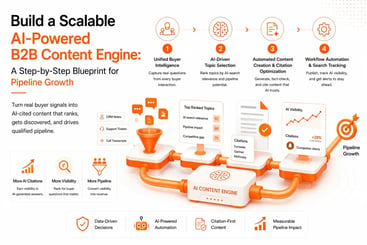
Next, automate the flow from data ingestion to publishing. Pull buyer language from sales calls, CRM notes, and support tickets, then feed it into a citation‑optimized content engine. The engine produces drafts that are reviewed, enriched with structured data, and published at scale. This loop ensures the content reflects real‑world intent while staying fresh for AI indexing. structured data guide provides detailed markup examples you can adapt for any B2B asset.
When implementing schema, it helps to run a periodic validation audit. Errors such as missing @type definitions or mismatched property names can silently block AI from extracting the right snippets. By integrating a schema‑testing step into your CI/CD pipeline, you catch issues before they affect live pages, preserving both search visibility and brand credibility.
Integrating AI Search with Marketing Automation
AI search does not exist in a vacuum. To turn visibility into pipeline, you must connect it to a marketing automation platform that can act on the signals. When AI‑generated answers surface, the platform should trigger lead‑scoring rules, nurture workflows, and real‑time personalization. This creates a feedback loop where search visibility directly fuels demand generation.
Choosing the right automation stack is critical. Look for tools that support API‑first integration, granular data mapping, and AI‑enhanced reporting. Platforms that combine search optimization with AI‑driven insights reduce manual effort and improve attribution accuracy. AI Overviews impact report highlights how AI‑enhanced automation can lift organic traffic by double‑digit percentages.
Beyond the technical fit, pay attention to data hygiene.
Consistent field naming, unified contact records, and deduplication routines ensure that the AI‑derived intent signals map correctly to the right prospect. When lead‑scoring models incorporate AI answer impressions, they can prioritize prospects who have already demonstrated high intent, shortening the sales cycle.
Recommended Read: Best B2B Marketing Automation Platforms 2026: How to Choose & Prove ROI – this guide helps you evaluate platforms that integrate seamlessly with AI search workflows.
Measuring Success: Metrics and Continuous Optimization
Without measurement, you can’t prove value. Track search visibility metrics such as AI answer impressions, zero‑click click‑through rates, and the volume of buyer intent queries captured. Pair these with traditional SEO KPIs organic traffic, keyword rankings, and conversion rates to see the full impact.
Continuous optimization is a loop. Use AI to analyze query logs, identify gaps in structured content, and refine prompts that generate new answers. A/B test headline variations in AI snippets to improve click‑through. Over time, you’ll see higher search visibility, stronger buyer intent signals, and a more efficient cost per acquisition.
Most agencies find it helpful to consolidate these metrics into a single dashboard that pulls data from the search console, the automation platform, and the AI content engine. Visualizing trends side by side makes it easy to spot when a new competitor appears in the answer space or when a content refresh yields a measurable lift.
The following table outlines the typical maturity stages an agency can adopt when scaling AI search.
|
Stage |
Key Focus |
Typical Activities |
Metrics Tracked |
|---|---|---|---|
|
Assess |
Identify gaps |
Audit existing content, map buyer intent, benchmark zero‑click rates |
Current AI answer share, content gaps |
|
Architect |
Design framework |
Define topic clusters, implement structured data, set up data pipelines |
Structured content coverage, schema errors |
|
Deploy |
Scale production |
Automate content generation, integrate with automation platform |
AI answer impressions, automation trigger volume |
|
Optimize |
Iterate and refine |
Analyze query logs, run A/B tests, update prompts |
CTR on AI snippets, buyer intent lift |
|
Govern |
Ensure compliance |
Audit data privacy, enforce brand terminology |
Compliance score, audit findings |
Moving through these stages helps agencies scale responsibly while maintaining high search visibility and strong buyer intent capture.
Practical Tips for Agency Teams
To keep momentum as you adopt the maturity framework, consider these everyday practices that reinforce scalability without adding complexity.
- Assign a dedicated schema champion who reviews every new page for markup completeness before publishing.
- Schedule a bi‑weekly sync between the content creation team and the data science team to surface emerging buyer language from sales interactions.
- Maintain a living glossary of brand‑approved terminology; this prevents inconsistent phrasing that can dilute AI relevance.
- Run quarterly competitor answer audits to see which topics your rivals are capturing and adjust your clusters accordingly.
- Document every automation rule change in a version‑controlled repository so you can trace performance shifts back to specific configurations.
Scaling AI search is no longer optional for agency marketers. By building structured content, leveraging topic clusters, and connecting AI insights to automation, you turn zero‑click dominance into pipeline momentum. Follow the maturity framework, measure the right metrics, and keep governance tight.
When you’re ready to accelerate AI search performance, explore Omnibound and see how the platform can power your agency’s growth. Book a demo now!
FAQs
- How does Omnibound improve AI search visibility for agencies?
Omnibound transforms buyer language into citation-optimized content that increases AI search visibility and drives qualified leads. - Why is structured content important for AI-driven search?
Structured content helps AI models understand intent and entities, improving visibility in AI-generated answers. - Can Omnibound integrate with existing marketing automation tools?
Yes, Omnibound connects with leading automation platforms to streamline workflows and AI search reporting. - How do I measure the ROI of scaling AI search?
Track AI impressions, zero-click engagement, lead conversions, and pipeline growth tied to AI visibility. - What governance practices are needed when scaling AI search?
Use access controls, data audits, schema reviews, and brand guidelines to ensure compliance and consistency.
Turn Your Content Into AI-Search Winners
Get cited across ChatGPT, Claude & Perplexity — not just ranked on Google.
- Increase AI citations
- Improve answer visibility
- Track brand mentions in LLMs