

Table Of Contents
Here is a question that comes up constantly in AI search work: if I add citations and links to authoritative sources on my page, does that make an AI engine more likely to cite me back? It is a reasonable thing to ask, because it feels like it should matter, and because old SEO instincts pull in two opposite directions at once, one saying links out help, another warning they leak your authority away.
The short answer is yes, outbound citations help, modestly, but not for the reason most people assume, and not nearly as much as the thing they usually neglect instead. This piece explains what citing sources actually does for your AI citability, puts the authority-leak myth to rest, and shows where the real lever is.
What outbound citations are, in this context
To be clear about terms: an outbound or external citation is a link or reference from your page to someone else's, a source you are quoting, a study you are drawing on, a standard you are pointing to. It is you crediting other people's work inside your own content. That is different from an inbound citation, where an AI engine credits your page as a source, and different again from a backlink, which is someone else linking to you.
The question is whether the first of those, your own outbound references, changes your odds of earning the second, an AI engine citing you.
What citing sources actually does
It does help, and the mechanism is worth getting right, because the wrong mental model leads to the wrong tactics.
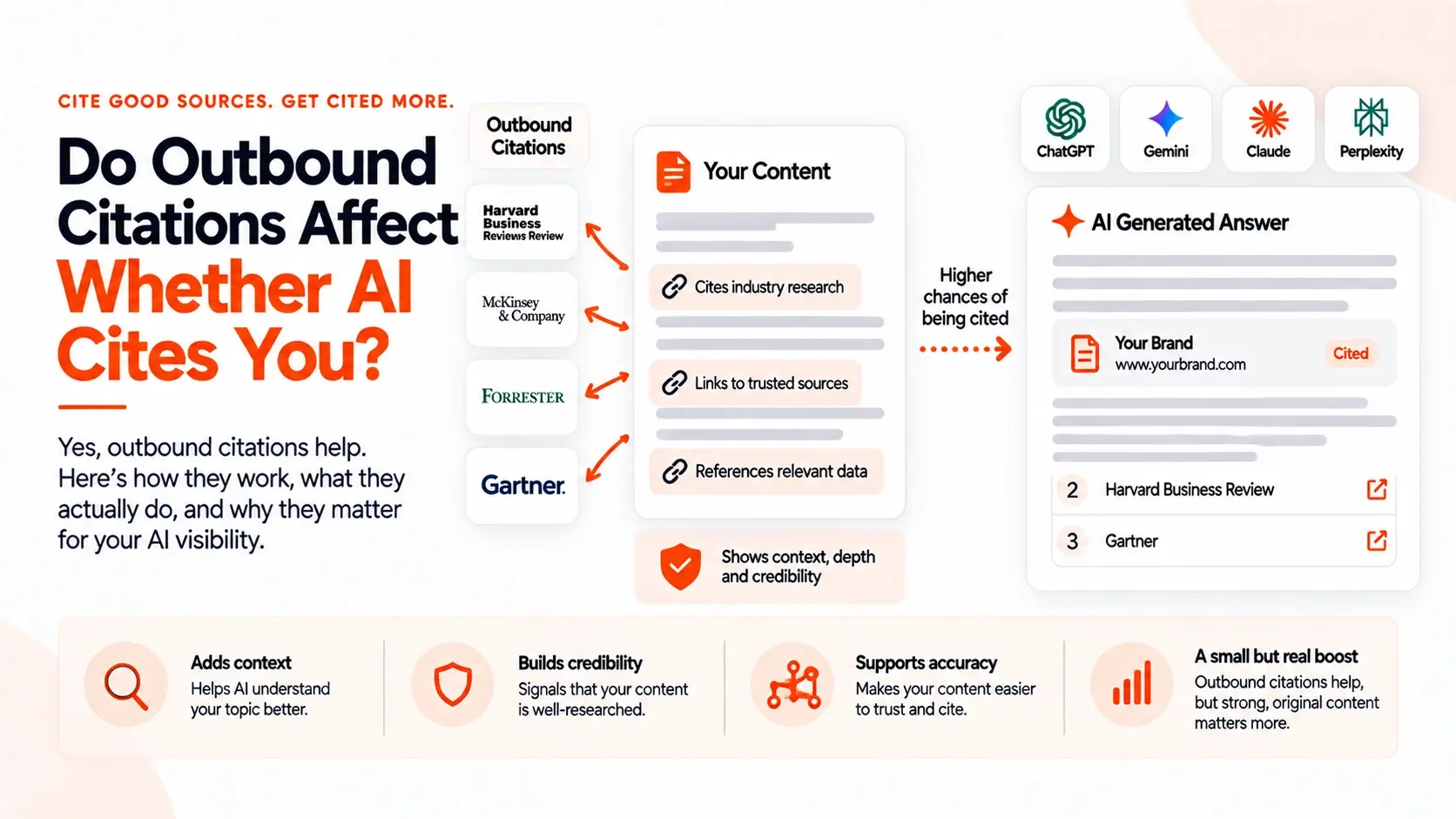
Outbound citations do not work like backlinks. They do not pass authority to the sites you link, and, as the next section covers, they do not drain yours. What they do is make your page more credible and more verifiable. A claim backed by a link to a real study or a primary source is one a model can trust and repeat with less risk; an unsupported assertion is one it may skip. A page that cites its sources reads as researched rather than opinionated, and that quality signal is part of what makes a model comfortable using you as a source. Being trustworthy enough to quote is the whole game, and citing your sources is one of the things that makes you look trustworthy.
There is some evidence for this beyond intuition. A Princeton and Georgia Tech study on generative engine optimization tested which on-page changes improved how often content was surfaced in AI answers, and adding citations, quotations, and statistics was among the techniques that measurably helped. The effect was real, if not enormous, which is exactly how to treat outbound citations: a genuine, low-cost contributor, not a magic switch. It works because it improves the underlying quality and verifiability of the page, which is the same reason it is one of the signals that make a page citable rather than a trick that games them.
To make the mechanism concrete, compare two versions of the same sentence. One reads: "most B2B buyers now research vendors through AI engines before talking to sales." The other reads: "most B2B buyers now research vendors through AI engines before talking to sales, according to [a 2026 industry survey linked to its source]." The claim is identical, but the second is verifiable, and an engine answering "how do B2B buyers research vendors" can repeat it with far less risk. That is the entire effect in one example: the citation does not add authority to your domain, it makes the specific claim safe to quote.
Does it help on every engine?
The effect is not uniform across engines, and it helps to know why. Engines that lean heavily on live retrieval and show their sources tend to reward verifiable, well-referenced pages more visibly, because they are actively assembling an answer from documents and a page that backs its claims is easier to trust and lift. Engines that draw more on trained knowledge lean less on any single page's outbound links and more on what the model already holds about a topic. The mechanics behind this difference are covered in how AI search works. The practical implication is not to optimize outbound citations for one engine, but to recognize that citing sources helps most exactly where it is cheapest to do: on the retrieval-driven engines your buyers increasingly use for research.
The authority-leak myth
The old worry is that linking out "leaks" your ranking power to other sites, so you should hoard links and point them only at your own pages. It was overstated even in classic SEO, and it is simply not how AI citation works.
An engine deciding whether to cite your page is judging that page's usefulness and trustworthiness as an answer to a question. A well-placed link to a credible source raises both. There is no pool of authority that drains when you reference a study; if anything, refusing to cite sources makes your claims look unsupported, which hurts you. So the instinct to avoid outbound links to protect yourself is backwards: the risk is not that you link out, it is that you make claims you never back up. Link to good sources without anxiety.
Where the bigger lever actually is
Now the part that matters most, and the reason not to overinvest here. Your outbound citations are something you fully control, which is exactly why their ceiling is low: everyone can add them, so they do not differentiate you much. The far stronger signal is the opposite direction, other people citing and mentioning you.
When an engine answers a vendor or comparison question, it leans heavily on independent, third-party sources, review sites, communities, analysts, industry media, because their independence makes them trustworthy in a way your own page cannot be about itself. That is the corroboration effect, and it is a much bigger driver of whether you get cited than the sources you link out to. A page that cites great sources but is never mentioned anywhere else still struggles on the questions that decide B2B deals. So the honest priority order is: add your outbound citations, since it is quick and it helps, and then spend the real effort on earning the inbound ones. The two are not competing tactics; one is hygiene, the other is the strategy.
There is also a quieter connection between the two. The outbound citations you are best at, especially original data and clear, well-sourced explanations, are the very things other people cite when they write about your category. Publish a genuinely useful, well-referenced stat or framework and it becomes the source a journalist, a Reddit commenter, or a roundup author reaches for, which turns your outbound rigor into inbound citations over time. So doing outbound well is not only hygiene; done with original substance, it feeds the stronger lever rather than sitting apart from it.
How to use outbound citations well
Because outbound citations do help and cost little, it is worth doing them properly rather than sprinkling links at random. A few practices carry most of the value.
Cite primary, credible sources. A link to an original study, a standards body, official documentation, or first-hand data is worth far more than a link to another blog that is itself unsourced. The point is verifiability, so link to the thing that can actually be verified.
Use descriptive anchor text. The words you link should say what is on the other side, "the 2026 IDC benchmark" rather than "click here", so both the reader and the model understand what the source supports. Vague anchors waste the signal.
Match the citation to a specific claim. Put the source next to the exact statistic or assertion it backs, not in a generic "further reading" pile at the bottom. A citation attached to the claim it supports is what makes that claim safe to quote.
Keep the density sensible. A handful of well-placed citations on a substantive page is plenty; stuffing dozens of links does not compound and can make a page harder to read and to extract. Cite what genuinely needs backing, and stop.
Prefer current sources. A citation to a recent study or an up-to-date reference signals that your page reflects the present state of things, while a claim propped up by a source from years ago can date your whole page. When you refresh content, refresh its citations too, and replace sources that have gone stale or moved.
For B2B specifically, this is where citing real data and named authorities pays off. Considered purchases are researched carefully, and a page that grounds its claims in credible sources earns the trust that both buyers and engines extend to well-evidenced content, reinforcing the broader work of answer engine optimization rather than substituting for it. It also pairs with the internal structure that makes a claim liftable in the first place, the content formats that win AI search visibility: a clearly stated, cited claim in a self-contained passage is the ideal unit for a model to quote.
Which sources to cite, and which to skip
Not all outbound citations carry the same weight, and for B2B the hierarchy is fairly clear. The strongest are primary and independent: original research and datasets, standards bodies and official documentation, regulatory or government sources, and named analysts or academic work. These are verifiable and hard to dispute, so a claim resting on them is one a model can safely repeat. Reputable industry publications and well-known trade media are a solid second tier. Your own prior research and data can be cited too, but it reinforces rather than replaces independent sourcing, since it is still you speaking about your own work.
The ones to skip are the ones that add no verifiability: unsourced blog posts, content farms, thin aggregator pages, and, obviously, anything you would not stand behind. Citing a weak source does not borrow credibility; it can do the opposite, tying your claim to something an engine has no reason to trust. And never invent a citation or link to a source that does not say what you claim it does; fabricated or mismatched references are worse than none, and both engines and readers increasingly catch them.
What kills the lift
A few habits cancel out whatever benefit outbound citations offer, and they are worth naming because they are common. Broken or dead links are the simplest: a citation that resolves to nothing is a negative signal, not a neutral one, so links need maintaining as sources move or disappear. Mismatched citations, where the linked source does not actually support the claim next to it, undermine the trust the citation was meant to build the moment anyone checks. Citing only yourself, with every reference pointing back to your own pages, defeats the purpose, because the value came from independent verification. And burying citations, hiding them behind vague anchors or dumping them in an unlabeled list, wastes the signal even when the sources are good. The pattern across all of these is the same: the benefit comes from genuine, verifiable, well-placed references, and anything that fakes or obscures that gives the benefit back.
Where B2B teams get this wrong
- Hoarding links out of authority-leak fear. There is no leak. Refusing to cite sources makes your claims look unsupported and hurts more than it helps.
- Treating outbound citations as the main lever. They are cheap hygiene, not a differentiator. The bigger driver is being cited by others.
- Citing weak sources. Linking to unsourced blogs does not add credibility; link to primary, verifiable sources or do not bother.
- Dumping links in a footer. A source detached from the claim it backs does little. Put it next to the specific statement.
- Stuffing citations for the look of rigor. Density past what the content needs does not compound and can hurt readability and extraction.
The honest takeaway on citing sources
Adding credible outbound citations to your pages is worth doing. It makes your claims verifiable, your content more trustworthy, and your page a little more likely to be quoted, and it costs almost nothing. Just hold it in proportion: it is basic hygiene, not the lever that decides whether you win AI search. The authority-leak fear is a myth, so cite freely, and the real work is earning the independent, third-party citations that carry far more weight.
So do both, in order. Tidy up your outbound citations this week, then look at where you actually stand on the citations that matter more. To see which of your pages are cited across the AI engines today, and where independent sources are cited instead of you, run a free scan with the AI Search Visibility Checker, or track how your citations move as you strengthen both sides with AI Search Intelligence.
Frequently asked questions
Do outbound links help you get cited by AI?
Modestly, yes. Citing credible sources makes your claims verifiable and your page more trustworthy, which makes a model more comfortable quoting it. It is a real but small contributor, not a decisive factor, and it works by improving quality, not by transferring link authority.
Will linking out hurt my visibility by leaking authority?
No. The authority-leak idea is an old SEO myth that does not apply to AI citation. An engine judges your page on its usefulness and trustworthiness, and well-placed citations raise both. Failing to cite sources is the bigger risk.
How many outbound citations should a page have?
Enough to back the claims that need backing, and no more. A handful of well-placed links to primary sources on a substantive page is plenty; stuffing links does not compound and can hurt readability.
Are outbound citations more or less important than being cited by others?
Less. Your own outbound citations are cheap hygiene you fully control, so they do not differentiate you. Being cited and mentioned by independent third parties is a stronger trust signal and a much bigger driver of B2B citability.
Does anchor text matter for outbound citations?
Yes. Descriptive anchor text that says what the source is helps both readers and models understand what the citation supports. Vague anchors like "click here" waste the signal.
Should I link to competitors as sources?
When a competitor genuinely has the best data or the authoritative explanation for a specific claim, citing them is fine and can even strengthen your page's credibility, because it signals you are giving an honest, well-researched answer rather than a defensive one. Do it where it is warranted, not reflexively, and never in place of citing a more neutral primary source when one exists.
Turn Your Content Into AI-Search Winners
Get cited across ChatGPT, Claude & Perplexity — not just ranked on Google.
- Increase AI citations
- Improve answer visibility
- Track brand mentions in LLMs