

Table Of Contents
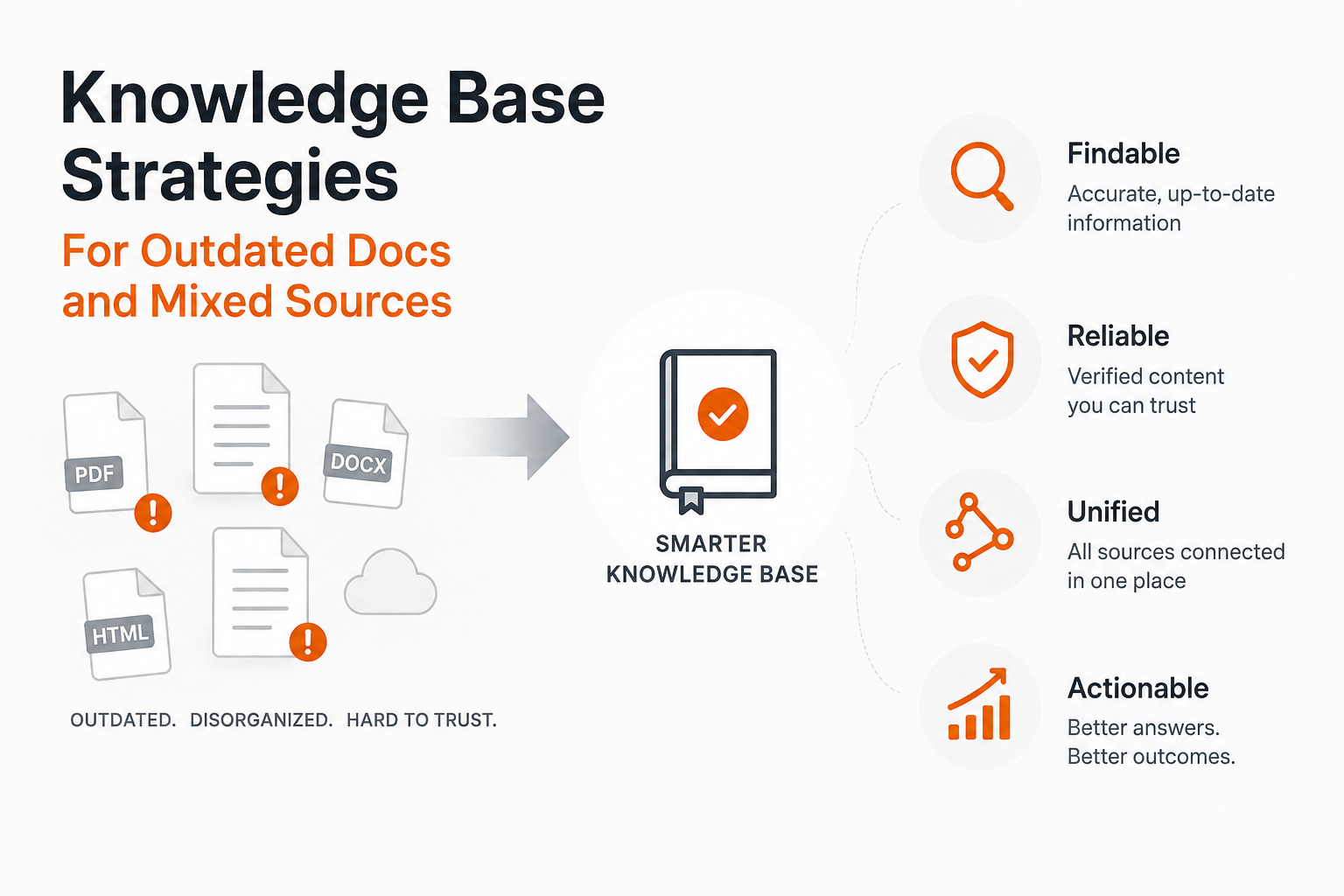
Senior content operations leaders constantly wrestle with two intertwined problems: documentation that drifts out of sync as products evolve, and information that lives in separate silos such as static URLs and code repositories. When a knowledge base contains stale pages or contradictory data, support agents scramble, customers lose confidence, and search engines struggle to surface the right answer. The core insight is that disciplined governance, version control, and automated freshness checks turn a chaotic collection of files into a reliable, searchable asset.
This guide walks you through why mixed sources and outdated content erode effectiveness, how to establish robust governance, and practical steps to keep every piece of documentation current and discoverable. By the end, you’ll have a repeatable process that aligns pricing, feature, and support updates across all knowledge‑base channels, boosting search visibility and reducing internal friction.
Understanding the Cost of Stale Documentation
When a page has not been reviewed for months, the language on that page no longer reflects the product’s actual capabilities. Support agents who rely on that page must spend extra time verifying whether the information is still accurate, and customers who find the page through organic search may encounter instructions that no longer work. That friction translates into longer resolution times, higher support ticket volume, and a measurable dip in customer satisfaction scores. In addition, search engines interpret a high bounce rate on outdated pages as a signal that the content is not useful, which can lower the overall authority of the entire knowledge base. The financial impact, while difficult to isolate precisely, shows up in metrics such as increased cost per support interaction and reduced conversion rates from self‑service.
The Anatomy of Mixed Source Knowledge Bases
Many organizations store documentation in a patchwork of locations: a static website for public FAQs, a private Confluence space for internal procedures, markdown files in a Git repository for developer guides, and a separate CMS for product release notes. Each system has its own authoring workflow, permission model, and publishing cadence. Because the repositories are not synchronized, a single product update can create three or more divergent versions of the same information. The result is a knowledge ecosystem where the same concept is described in slightly different ways, leading to confusion for both customers and internal teams. Recognizing the shape of that ecosystem is the first step toward building a unified governance model.
Building a Governance Framework
A governance framework acts as the rulebook that tells every stakeholder how content should be created, reviewed, approved, and retired. The framework typically includes a content style guide, a taxonomy for categorizing articles, a defined ownership matrix, and a schedule for periodic reviews. By assigning clear owners to each content domain such as pricing, feature set, or compliance you eliminate the “who owns this page?” question that often stalls updates. The framework also defines escalation paths for urgent changes, such as a security patch that requires immediate documentation updates across all channels. When the governance model is documented and communicated, teams know exactly where to go for guidance, which reduces bottlenecks and improves overall velocity.
Version Control as a Living System
Version control is not just for code; it can be a powerful tool for managing documentation at scale. By storing all knowledge‑base articles in a Git‑based repository, you gain an immutable history of every change, the ability to branch for major product releases, and a clear audit trail for compliance purposes. Each merge request can be coupled with a checklist that verifies alignment with the governance framework, ensuring that no article is published without the required sign‑offs. Additionally, the diff view in a version‑control system makes it easy for reviewers to spot unintended alterations, such as a pricing figure that was accidentally changed. Treating documentation as code encourages the same discipline that software teams already practice, which raises the overall quality of the knowledge base.
Automated Freshness Checks and Monitoring
Manual reviews are essential, but they become unsustainable as the volume of content grows. Automated freshness checks fill that gap by scanning the knowledge base for signals that indicate staleness. Typical signals include a lack of edits in the past 90 days, a mismatch between the version number embedded in an article and the current product version, or broken internal links that point to moved files. These checks can be scheduled to run nightly and feed results into a dashboard that highlights articles needing attention. When an alert is generated, the assigned owner receives a notification with a direct link to the article, a summary of the issue, and a recommended deadline for remediation. This loop ensures that no page falls through the cracks.
Integrating Content Across Silos
Integration does not mean forcing every piece of documentation into a single platform; rather, it means establishing a single source of truth that can be referenced from multiple channels. One practical approach is to maintain the master article in a central repository and use API calls or webhooks to push updates to downstream systems such as the public help site, the internal wiki, and the chatbot knowledge graph. Because the source is canonical, any change automatically propagates, eliminating the need for duplicate manual edits. When the integration layer is built with version awareness, downstream systems can also display the version number of the content they are serving, which reassures users that they are viewing the most recent guidance.
Roles and Responsibilities for Continuous Updates
Even with the best tooling, a knowledge base will become outdated if no one is accountable for keeping it fresh. A practical RACI matrix (Responsible, Accountable, Consulted, Informed) helps clarify who does what. For example, a product manager may be accountable for the accuracy of feature documentation, while a technical writer is responsible for drafting the article and a compliance officer is consulted for regulatory language. Support leads are informed of upcoming changes so they can prepare internal training. By documenting these roles in a shared spreadsheet or within the governance framework itself, you create a transparent system that makes it easy to track ownership and handoffs.
Metrics to Track Knowledge Base Health
Metrics turn abstract goals into measurable outcomes. Common health indicators include the average age of articles, the percentage of articles that have been reviewed in the last quarter, the rate of broken links, and the proportion of support tickets that reference a knowledge‑base article. Another valuable metric is the “first‑contact resolution” rate for tickets that were resolved using self‑service content. By tracking these numbers over time, you can identify trends, celebrate improvements, and justify investments in tooling or additional staff. Dashboards that surface these metrics at a glance keep leadership informed and reinforce the importance of ongoing maintenance.
Change Management and Communication
When a major product update is announced, the ripple effect on documentation can be significant. A structured change‑management process ensures that all stakeholders are aware of the upcoming changes and understand their role in updating content. This process typically starts with a release calendar that is shared across product, engineering, support, and content teams. As the release date approaches, a series of communication checkpoints such as a pre‑release briefing, a draft review window, and a final sign‑off meeting keep everyone aligned. Clear communication reduces the risk of last‑minute surprises that can lead to rushed, error‑prone updates.
Future‑Proofing Your Knowledge Base
Technology and customer expectations evolve quickly, so a knowledge base must be built with flexibility in mind. Adopt a modular content strategy where each piece of information is stored as an independent block that can be reused across multiple articles. This approach minimizes duplication and makes it easier to update a single block when a fact changes, automatically refreshing every article that includes it. Additionally, consider leveraging AI‑assisted authoring tools that can suggest updates based on changes in product specifications or recent support tickets. While AI should not replace human review, it can surface potential gaps faster than manual scanning, giving your team a proactive edge.
Common Pitfalls to Avoid When Managing Mixed Sources
Even experienced teams can fall into habits that undermine the health of a knowledge base. One frequent mistake is treating each repository as an isolated island, which prevents the discovery of overlapping content and leads to contradictory statements. Another trap is relying solely on ad‑hoc updates triggered by support tickets; this reactive approach creates a backlog of unnoticed articles that never get reviewed. Finally, neglecting to archive or delete deprecated pages can clutter search results and dilute the authority of the remaining content. By consciously addressing these pitfalls, you keep the knowledge ecosystem lean, accurate, and easy to navigate.
Real‑World Scenario: A SaaS Company’s Turnaround
Imagine a mid‑size SaaS firm that offers a subscription platform with quarterly pricing updates. Prior to implementing a governance framework, the pricing page on the public site was updated by the sales team, while the internal billing guide in Confluence remained tied to the previous quarter’s rates. Customers who read the public page and then tried to follow the internal guide encountered mismatched numbers, leading to billing errors and a spike in support tickets. After the company instituted version‑controlled documentation, automated freshness alerts, and a clear ownership matrix, the discrepancy vanished. Within three months, the support ticket volume related to pricing dropped by 40 percent, and the company saw a measurable lift in self‑service conversions, illustrating how disciplined processes translate directly into business outcomes.
Next Steps for Your Organization
Begin by auditing your existing knowledge‑base landscape. List every repository, note the type of content it holds, and identify overlaps. Next, draft a lightweight governance charter that outlines owners, review cadence, and approval workflows. Choose a version‑control system that fits your team’s skill set and migrate a pilot set of high‑impact articles. Implement an automated freshness script that runs weekly and feeds results into a simple spreadsheet or dashboard. Finally, schedule a cross‑functional kickoff meeting to communicate the new process, assign roles, and set expectations for the first review cycle. By taking these incremental steps, you move from a fragmented, stale collection of documents to a cohesive, up‑to‑date knowledge engine that supports both customers and internal teams.
Conclusion
Senior content operations leaders constantly wrestle with two intertwined problems: documentation that drifts out of sync as products evolve, and information that lives in separate silos such as static URLs and code repositories. When a knowledge base contains stale pages or contradictory data, support agents scramble, customers lose confidence, and search engines struggle to surface the right answer. The core insight is that disciplined governance, version control, and automated freshness checks turn a chaotic collection of files into a reliable, searchable asset. This guide walks you through why mixed sources and outdated content erode effectiveness, how to establish robust governance, and practical steps to keep every piece of documentation current and discoverable. By the end, you’ll have a repeatable process that aligns pricing, feature, and support updates across all knowledge‑base channels, boosting search visibility and reducing internal friction.
FAQs
Q: How often should I schedule a manual review of my knowledge base?
A: A quarterly review aligns well with most product release cycles and provides enough time to catch stale content without overwhelming the team.
Q: Can I use AI tools to automate content updates?
A: AI can surface potential gaps and suggest wording changes, but a human reviewer should always validate the final output to ensure accuracy.
Q: What is the best way to handle deprecated pages?
A: Redirect deprecated URLs to the most relevant current article and add a clear notice explaining the change, which preserves link equity and user experience.
Recommended Authority Resources
For deeper insights into knowledge‑base governance and content freshness, consider exploring industry whitepapers, best‑practice guides from leading SaaS providers, and case studies that illustrate successful implementations of version‑controlled documentation.
Turn Your Content Into AI-Search Winners
Get cited across ChatGPT, Claude & Perplexity — not just ranked on Google.
- Increase AI citations
- Improve answer visibility
- Track brand mentions in LLMs