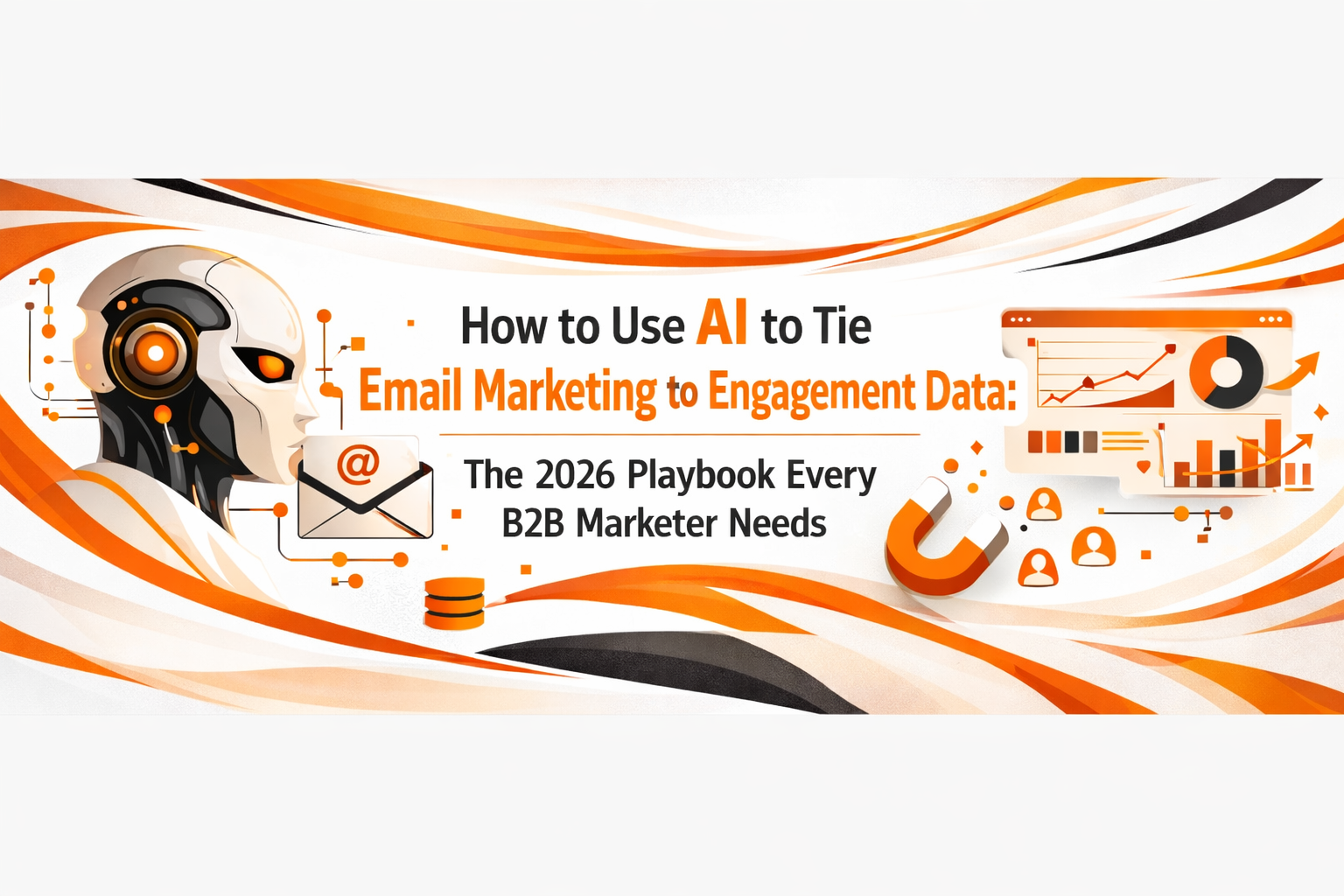


Most teams still batch and blast, even though segmented campaigns can generate a staggering 760% revenue increase compared with non-segmented sends. If you are not tying your email marketing to real engagement data, you are leaving that performance on the table.
Key Takeaways
|
Question |
Answer |
|---|---|
|
How do we actually use AI to tie email marketing to engagement data? |
We centralize signals from email, web, product, and content, feed them into an AI context engine, then map AI insights to real email actions like dynamic segmentation, send time, and content selection, similar to how the AI Insight Engine turns signals into role based insights. |
|
What engagement data matters most for AI driven emails? |
High intent signals like repeat visits, product usage depth, content consumption, and inactivity patterns matter more than simple opens or clicks, which is why platforms like Omnisense focus on living ICPs and buyer personas enriched with ongoing signals. |
|
How does AI email personalization go beyond first name tokens? |
AI email personalization uses behavioral data for email marketing, such as pages viewed or features used, to adapt narratives and offers, similar to how Omnibound's AI marketing platform features use unified intelligence to guide content. |
|
Can AI really decide when and what to send without static rules? |
Yes, AI models can learn from real time engagement data and predict next best emails, as in an agentic setup similar to the agentic AI platform for marketers where agents act from live context rather than brittle workflows. |
|
What kind of AI stack do we need for engagement based email marketing? |
A practical stack includes data sources, a context and intelligence layer, and an activation layer, very similar structurally to the B2B marketing context engine plus content and activation features. |
|
How do we keep AI driven email programs safe and on brand? |
We use guardrails and role-based access, like the AI Safety Net Framework and role-based access control, to control who can change models, prompts, and campaigns. |
Why Traditional Email Fails Without Engagement Based AI
Static lists and generic drip campaigns ignore how buyers actually behave across your funnel. They treat a first click the same as a power user session and send the same email on the same day to everyone. Traditional ESPs track opens and clicks, but that data often lives in dashboards instead of driving decisions. AI changes this by interpreting real time engagement data and tying it directly to who gets what email, when, and with which message. Our perspective is simple. If engagement data does not change the next email your subscriber sees, you are not really doing engagement based email marketing at all.
What Engagement Data Actually Matters for AI Email Marketing
If we want effective AI email optimization, we need better fuel than opens alone. The right engagement signals tell us who is exploring, who is evaluating, and who is drifting away. Email engagement signals include:
- Opens and clicks, including link level click maps
- Dwell time on landing pages after a click and reply to behavior for sales led sequences
Website engagement gives deeper context. Key metrics include page depth, revisit frequency, pricing page views, and navigation paths. Content engagement tells us what topics and formats resonate. We watch downloads, video watch percentage, webinar attendance, and engagement on blog or resource hubs. If you are in SaaS, product and trial engagement may be your strongest signal.
Feature depth, team adoption, and activation milestones should drive messaging and cadence. Finally, inactivity and drop off are just as critical. Rapid decay in opens or product usage, unsubscribes from specific streams, or multiple bounces should inform suppression or re engagement journeys. AI needs all of these sources. That is why we like centralized intelligence approaches like Omnisense, which keeps brand, audience, and ICP data in one living system to feed every decision.
How AI Interprets Engagement Data for Smarter Email Decisions
Once engagement data is centralized, AI takes over the heavy pattern recognition we cannot do manually. Instead of static lead scores, AI models look at sequence, intensity, and recency of behavior. Some of the most useful AI capabilities here are:
- Pattern recognition, spotting common paths that lead to conversion or churn
- Predictive intent modeling, estimating purchase likelihood or expansion risk at the individual level
- Engagement scoring, using dozens of behavior inputs, not just form fills
- Real time interpretation, updating scores and segments when a user acts, not at the end of the week
Our own work leans on context aware engines similar to the AI Insight Engine, which turns raw data into contextual, role aware insights. From there, AI agents can act on those insights directly. The important shift is this. AI is not just analyzing engagement data, it is deciding who to email, with what offer or content, and when that message should hit the inbox.
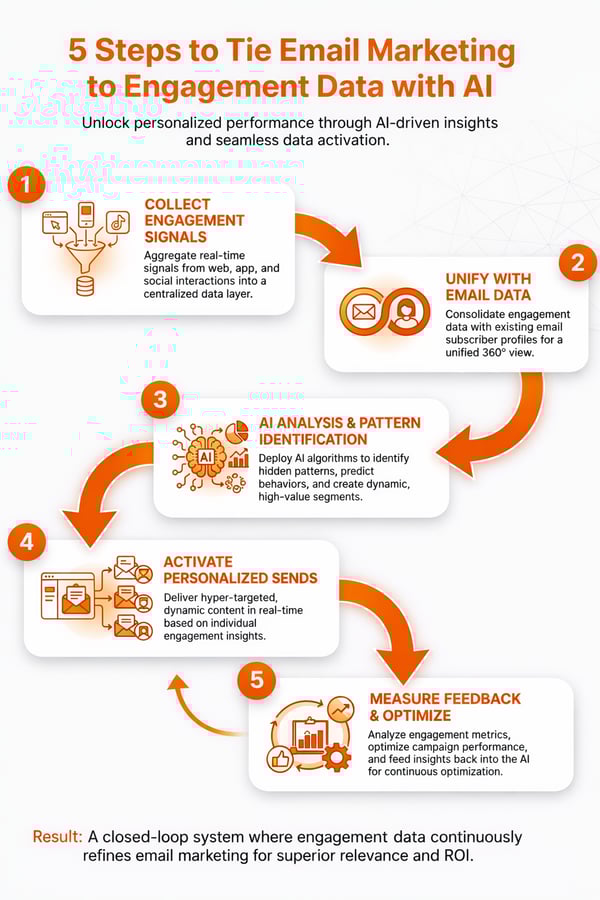
Explore five steps to connect email marketing with engagement data using AI. This infographic guides you through turning engagement metrics into smarter campaigns.
Did You Know?
Top campaigns using personalized send time saw a 35% increase in click rates, which is exactly what happens when AI ties individual engagement patterns to delivery timing.
Five Ways AI Ties Engagement Data Directly to Email Actions
To make this concrete, here are the core operational use cases where AI connects behavioral data to email marketing in practice.
AI driven dynamic segmentation
Static segments decay as soon as behavior changes. With AI driven email segmentation, segments update automatically when someone hits new engagement thresholds, views new content, or changes product usage patterns.
Send time and frequency optimization
AI analyzes individual engagement data to predict when each person is most likely to open or click. Instead of one global send time, every subscriber gets the message in their personal high response window.
Behavioral content personalization
AI email personalization goes far beyond first names. Models pick the narrative, pain point angle, and asset format based on what each person has read, watched, or used in your product.
Trigger based campaigns and predictive nurturing
Traditionally, we set rigid rules like "if clicked pricing, send follow up on day three". AI lets us replace brittle rules with predictions, such as next best email, churn risk, or expansion opportunity, then send the right sequence without manual if else trees. We see this agentic approach reflected in tools like the Omnibound AI Agents, which operate directly from live marketing context to execute campaigns.
A Step-by-Step Framework to Implement AI Driven Engagement Emails
We use a simple five step framework to take teams from static email to engagement-based AI workflows.
Step 1: Centralize engagement data
Connect your ESP, website analytics, product analytics, and CRM into a single context layer. Platforms similar to a B2B marketing context engine give you the unified spine you need.
Step 2: Define meaningful engagement signals
Work with sales, success, and product to identify behaviors that strongly correlate with conversion, expansion, or churn. Document thresholds like "visited pricing 3 times in 7 days" or "no logins in 10 days".
Step 3: Apply AI models to interpret behavior
Use your AI layer to score leads and customers based on all available signals. You can also build predictive models for intent, churn, or expansion, and keep those scores updated in near real time.
Step 4: Map AI insights to email actions
Decide, in detail, which scores and events will control:
- Entry into nurture or re engagement streams
- Dynamic subject lines and content blocks
- Frequency and timing adjustments
Step 5: Continuously optimize with a learning loop
Feedback email performance data into your AI models so they learn which predictions and actions drive actual pipeline. This is where integrated insight engines and content production tools, like content production platforms, help you rapidly test new narratives at scale.
The AI Tech Stack for Engagement Based Email Marketing
You do not need a dozen tools, but you do need the right layers that talk to each other.
Core layers of an AI email stack
|
Layer |
Role |
What to look for |
|---|---|---|
|
Data sources |
Capture engagement |
APIs for ESP, web analytics, product analytics, CRM |
|
Context & intelligence |
Create unified view & scores |
Living ICPs, personas, AI models, like AI marketing platform features |
|
Email execution |
Send and personalize emails |
Dynamic content, trigger support, API access |
|
Feedback loop |
Close the loop |
Data sync of opens, clicks, conversions back to AI layer |
We favor "agentic" setups where AI agents can operate across layers, like in the agentic AI platform for marketers. In these architectures, agents consume engagement context then trigger or adapt emails without manual rule wiring. You can implement this stack with AI powered ESPs plus a customer data platform, or with an all in one AI content marketing platform that embeds context, research, and activation.
KPIs That Prove AI Driven Engagement Emails Are Working
Once your programs use real time engagement data, the success metrics shift. We track not only opens, but how quickly and smoothly people move through the funnel. Key KPIs for engagement-based email marketing include:
- Engagement lift, changes in click through rate, reply rate, and content consumption per subscriber
- Time to conversion, how many days from first touch to trial start or opportunity
- Funnel velocity, the rate at which leads progress between lifecycle stages
- Drop off reduction, fewer inactive subscribers and reduced churn signals
- Email fatigue prevention, stable unsubscribe and spam complaint rates even as volume increases
We also recommend comparing automated journeys against manual campaigns. Given that automated emails can generate 320% more revenue than non-automated emails, the ROI of tying AI to engagement data usually shows up quickly.
Did You Know?
54% of marketers fully personalize across email marketing, and AI driven engagement data is what makes that level of personalization practical and scalable.
Common Mistakes When Using AI with Engagement Data
We see the same pitfalls when teams start connecting AI to their email engagement data.
1. Feeding poor quality or incomplete data If web, product, and CRM data are not synced or cleaned, AI will learn from noise. Solve this with a context engine or CDP that normalizes identities and events.
2. Over automation with no human oversight AI email marketing workflows still need strategy. Define clear objectives per segment and review outputs regularly.
3. Ignoring negative signals AI should respond not only to high intent activity but to fatigue signals like low opens, no logins, and complaint trends. Use these signals to trigger pauses and preference updates, not more sends.
4. Treating AI like a static rules engine The power of AI is continuous learning. If you hard code everything into binary rules, you lose the nuance of pattern recognition and prediction.
Platforms that include safety frameworks, such as an AI Safety Net Framework, help you balance autonomy with control, so AI decisions stay aligned with brand and compliance requirements.
Future of Engagement Driven Email Marketing with AI
We are moving toward email programs that are almost entirely driven by engagement-based intelligence. Instead of static journeys, AI agents will orchestrate messages across channels in real time. Some trends we are watching closely:
- Real time orchestration, emails triggered within seconds of product or web actions
- Agent led decision making, where AI agents manage segments and journeys without human rule writing
- Cross channel engagement intelligence, using ads, chat, and sales call data to inform email
- Zero static segmentation, where every subscriber is dynamically grouped based on current behavior
This aligns with the agentic marketing vision behind resources like the agentic marketing lexicon. As AI matures, your competitive edge will depend on how well you connect behavior to messaging across your entire go to market.
Practical Examples of Engagement Based AI Email Workflows
To make this tangible, here are a few concrete workflows that tie email marketing tightly to engagement data using AI.
Example 1: Behavioral onboarding sequence
AI tracks which features a new user explores in your product. Based on usage depth and help center visits, it sends targeted tips, case studies, or integration guides instead of a linear day 1, day 3, day 7 drip.
Example 2: Predictive expansion nurture
Models identify accounts where product usage patterns match your best upsell customers. For these accounts, email campaigns highlight advanced features, ROI calculators, or customer stories tailored to their behavior.
Example 3: Churn risk re engagement
When engagement scores fall below a threshold, AI launches a re engagement stream. Content is selected based on each user's prior interests and objections, which you can curate with intelligent research capabilities similar to marketing strategy modules. The thread across all examples is the same. Behavioral data for email marketing is not a report, it is the trigger and fuel for every message that leaves your system.
Conclusion
Engagement based email marketing is not a theory, it is a practical, AI powered way to send fewer, smarter emails that drive more revenue. When you connect multi source engagement data to a true intelligence layer, every send becomes a decision informed by behavior, not a guess. AI helps us interpret signals, predict intent, and orchestrate next best messages at scale. The brands that win the inbox will be the ones that tie behavior and messaging so tightly together that every email feels timely, relevant, and personally useful. If you are ready to move beyond static lists and rule heavy workflows, start with your data. Centralize your signals, choose an AI layer built for marketers, and let engagement data guide what you send next.
FAQ
How does AI use engagement data in email marketing?
AI ingests engagement data from email, web, product, and content, then uses models to score users, predict intent, and choose the right email action. This might be adding someone to a nurture, changing send time, or swapping in content that mirrors what they already engaged with.
What engagement metrics matter most for AI driven emails?
High value metrics include repeat visits, feature usage depth, pricing page views, content downloads, video watch time, and patterns of inactivity. AI works best when it has multi-channel, multi touch data, not just email opens and clicks.
Can AI personalize emails in real time?
Yes, modern ESPs and AI layers can render dynamic content and subject lines at send time based on the latest engagement profile and scores. Real time triggers can also fire emails within seconds of key actions, such as using a new feature or revisiting the pricing page.
How is this different from traditional email automation?
Traditional automation relies on static rules and time-based drips. AI driven email marketing uses engagement-based scoring and predictions, then adjusts segment membership, content, and timing continuously as behavior changes.
What tools support engagement-based AI email marketing?
You will typically use a combination of an AI aware ESP, a central context or data platform, and an intelligence layer with models and agents. Platforms like AI content marketing solutions for B2B teams can help you connect research, context, and activation so engagement signals shape every campaign.
.png?height=245&name=Why%20B2B%20AI%20Search%20Requires%20More%20Than%20a%20CMS%20(And%20What%20Modern%20Marketing%20Stacks%20Must%20Do%20Instead).png)