

Producing 100 Search-Optimized Blogs Monthly is one of the most ambitious content goals a marketing team can set, and the stakes are higher than most teams realize. Research shows that human-led content generates 5.44x more traffic and keeps readers engaged 41% longer than unedited AI content, which means volume without the right workflow doesn't just underperform, it actively wastes your investment.
Why Most High-Volume Content Workflows Fail Before Reaching 100 Search-Optimized Blogs Monthly
Most content teams plateau at 5 to 20 blogs per month, and the reason is rarely a lack of talent. The real culprit is a broken operating model that was never designed to scale.
When teams try to simply hire more writers or prompt AI more aggressively, the wheels come off fast.
Here are the most common failure patterns we see:
- AI content spam: High volume without editorial governance produces thin, repetitive content that drives zero results.
- Inconsistent briefs: Without standardized brief templates, every article is a guessing game for writers and editors alike.
- Duplicate intent coverage: Teams inadvertently publish multiple pieces targeting the same reader intent, cannibalizing their own results.
- Weak internal linking: Siloed production means articles are never properly connected, leaving authority on the table.
- No performance feedback loop: Content gets published and forgotten, with no mechanism to learn what is working and what is not.
- Scaling before building SOPs: Teams add headcount and tools before documenting repeatable processes, creating chaos at scale.
- Ignoring refresh cycles: New production consumes all resources while existing content ages out of relevance.
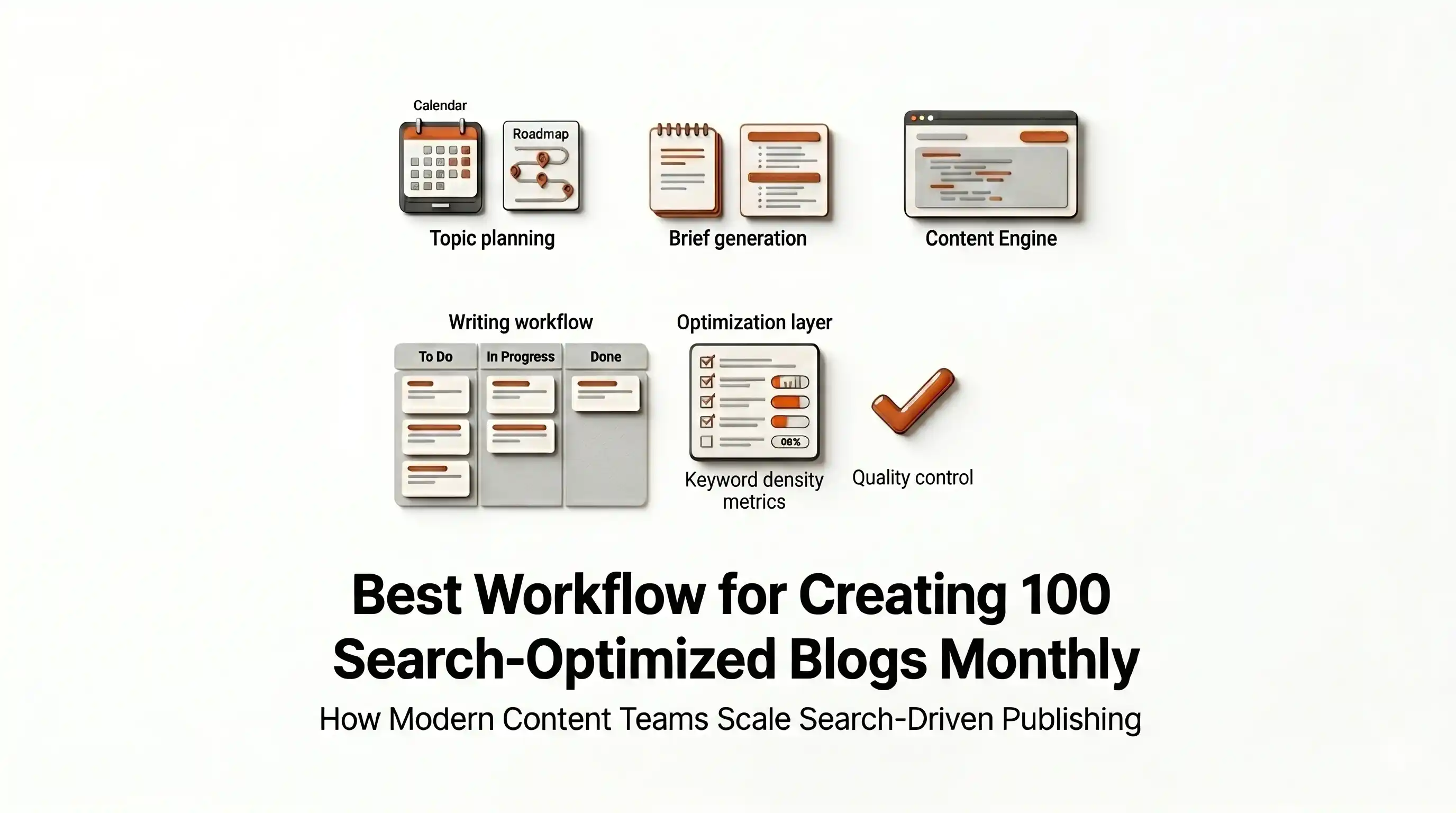
The 6-Stage Workflow Behind 100 Search-Optimized Blogs Monthly
We built the following framework to help teams move from ad hoc publishing to a repeatable, high-volume content operation. Each stage is a non-negotiable component of the system.
Stage 1: Topic and Search Intelligence
Before a single word gets written, we build a research layer that drives every content decision downstream. This stage is where most teams cut corners, and where most workflows eventually collapse.
Strong topic intelligence draws from multiple input streams:
- Keyword cluster mapping organized by theme and intent
- Competitor gap analysis to find unclaimed territory
- Customer conversation mining from sales calls and support tickets
- AI visibility opportunity identification across emerging answer platforms
- Editorial bucket creation to organize content by funnel stage
Our intelligent research platform systematizes this entire layer so topic selection is never guesswork. We use structured pipelines, not random keyword lists, to drive the 100-blog content calendar.
Stage 2: Standardized SEO Brief Creation
Every brief in our system includes:
- Primary keyword and intent classification
- SERP angle and content gap analysis
- Required internal links and related topic clusters
- FAQ targets drawn from real search behavior
- Differentiation requirements that prevent generic output
- Metadata specifications for title tags and descriptions
Standardized briefs turn content production into a predictable assembly system rather than a creative free-for-all. Our content workflow solution makes brief creation systematic and repeatable across the entire 100-blog volume.
Stage 3: AI-Assisted Research and Draft Generation
AI accelerates the following production tasks effectively:
- Outline generation from brief inputs
- SERP summarization and gap identification
- Heading structure and content architecture drafts
- First-draft body content production at scale
- Metadata and FAQ drafting in bulk
- Content batching across topic clusters
The critical distinction is that AI owns execution, not strategy. We treat AI as a workflow accelerator within our AI content marketing system, not as an autonomous content engine that can operate without oversight.
Did You Know?
AI-assisted workflows can increase content output by 3 to 6x while slashing production costs by 40 to 90%, making the 100-blog-per-month milestone genuinely achievable for lean teams with the right system in place.
Stage 4: Human Editorial Review
This stage is where most high-volume workflows fall apart, and it is the stage we refuse to skip or compress. Human editorial review is the firewall between scalable production and brand-damaging content.
We run three distinct review layers for every article:
- Search Optimization Review: Validates intent alignment, topic coverage, and semantic completeness against the original brief.
- Editorial Review: Validates clarity, originality, brand voice, and factual accuracy. This layer catches AI hallucinations and generic phrasing.
- Strategic Review: Validates differentiation, business relevance, and conversion alignment. Ensures every article serves a purpose beyond traffic.
We use our content audit and optimization tools to support this review layer systematically. Each article passes through all three checkpoints before it moves to publishing.
Stage 5: Publishing and Distribution Operations
Most workflows stop at "article submitted." A true content operation continues well past the draft stage because the publishing layer is where visibility is won or lost. We treat publishing as its own operational discipline.
Our publishing checklist includes:
- CMS workflow management with clear ownership and deadlines
- Internal linking integration as a final pre-publish step
- Schema markup deployment for structured data signals
- Metadata QA against brief specifications
- Indexing verification post-publish
- Promotional distribution across owned and earned channels
Stage 6: Performance Feedback Loop
We track the following signals across our entire published library:
- Visibility and ranking movement by article and cluster
- AI search citations and attribution signals using our AI Search Intelligence tools
- Engagement metrics including time on page and scroll depth
- Conversion contribution by content type and funnel stage
- Refresh opportunity identification for aging content
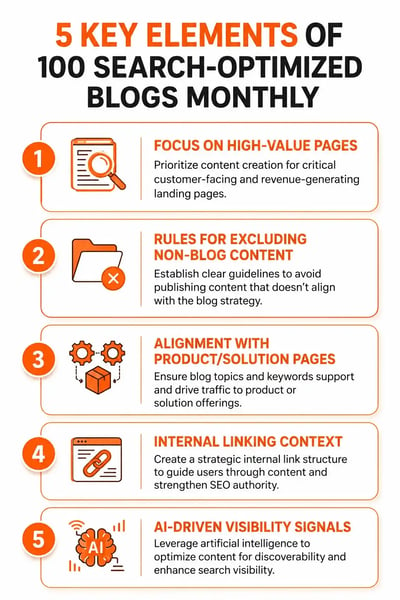
A concise guide to the five key elements of 100 Search-Optimized Blogs Monthly. Learn how consistency, optimization, and quality drive SEO success.
Team Structure That Supports 100 Search-Optimized Blogs Monthly
The right workflow means nothing without the right team structure behind it. Scaling to 100 articles per month requires specialization, not generalists doing everything.
Here is the operating model we recommend:
|
Role |
Primary Responsibility |
Key Output |
|
Content Strategist / SEO Lead |
Topic strategy, search intelligence, cluster planning |
Monthly content calendar, editorial buckets |
|
Research Layer |
Keyword intelligence, competitor analysis, SERP research |
Standardized briefs for all 100 articles |
|
AI Workflow Manager |
AI draft generation, prompt engineering, batch processing |
First drafts ready for editorial review |
|
Editorial Team |
Search, editorial, and strategic review across all articles |
Approved, publish-ready content |
|
Publishing Operations |
CMS deployment, metadata QA, schema, distribution |
Published, indexed, distributed articles |
|
Performance Analyst |
Visibility tracking, AI citation monitoring, refresh identification |
Feedback reports informing next month's strategy |
This structure replaces the "one person doing everything" model with a workflow-driven system where each function is clearly owned. The result is consistency, speed, and quality at a volume most teams think is impossible.
Did You Know?
Hybrid content combining AI-generated drafts with human editing ranks 30 to 35% higher than pure AI content, proving that editorial review is not optional overhead but a direct performance driver in any 100-blog workflow.
Our citation-worthy content creation framework specifically addresses the AI visibility layer, helping teams structure articles for attribution across the growing ecosystem of AI answer engines.
Omnibound is built specifically for this operational model. We help teams scale content execution as a system, not a collection of disconnected writing tasks. Our platform operationalizes research intelligence, AI visibility insights, editorial workflows, and strategic optimization within a single integrated operating model.
We also help teams monitor competitor intelligence to ensure their 100-blog content strategy stays differentiated as the competitive landscape evolves.
Omnibound is purpose-built to help marketing teams operationalize exactly this model. From intelligent research to AI search intelligence to full-scale content workflow management, we give teams the infrastructure to publish at volume without sacrificing quality, differentiation, or visibility.
If your team is ready to move from content production to content operations and build the system behind sustainable 100 Search-Optimized Blogs Monthly performance, we are ready to help.
FAQs
How do you create 100 SEO-optimized blogs per month without sacrificing quality?
Treat it as an operations system powered by structured workflows, AI assistance, and human QA.
What is the best workflow for scaling SEO content production to 100 blogs per month?
Use a documented workflow covering research, briefs, AI drafting, editorial QA, publishing, and performance tracking.
Can AI alone handle 100 search-optimized blogs monthly?
No, AI speeds up production, but human editorial oversight is essential for quality and performance.
What team structure do you need to publish 100 SEO blogs per month?
A scalable operation needs specialists across strategy, research, AI workflows, editing, publishing, and analytics.
How do you maintain consistent brand voice when producing 100 blogs per month with AI?
Maintain consistency through brand playbooks, structured briefs, tone guidelines, and editorial voice checks.
Is content refreshing part of a 100-blog-per-month content strategy in 2026?
Yes, regular content refreshes are critical alongside new production to maintain AI search performance.
How long does it take to build a workflow capable of 100 search-optimized blogs monthly?
Most teams can build and stabilize a scalable workflow within 60–90 days before ramping volume.
What are the best content workflow automation tools for streamlining AEO content creation and improving performance?
Omnibound automates the full content pipeline from buyer research through AI-optimized drafting to publishing, with continuous citation monitoring layered on top so performance data feeds straight back into the next batch of content. Conductor pairs a similar pipeline with an integrated writing assistant, and Writesonic focuses on bulk generation with lighter visibility tracking.
What are the best tools for building content pipelines that support multiple versions across platforms and user engagement?
A workflow built around one core brief that fans out into multiple channel-specific versions performs best for both engagement and AI citation. Omnibound structures content this way by default, turning one buyer-grounded brief into several platform-ready formats while tracking how each version performs across both AI search citations and traditional engagement metrics.