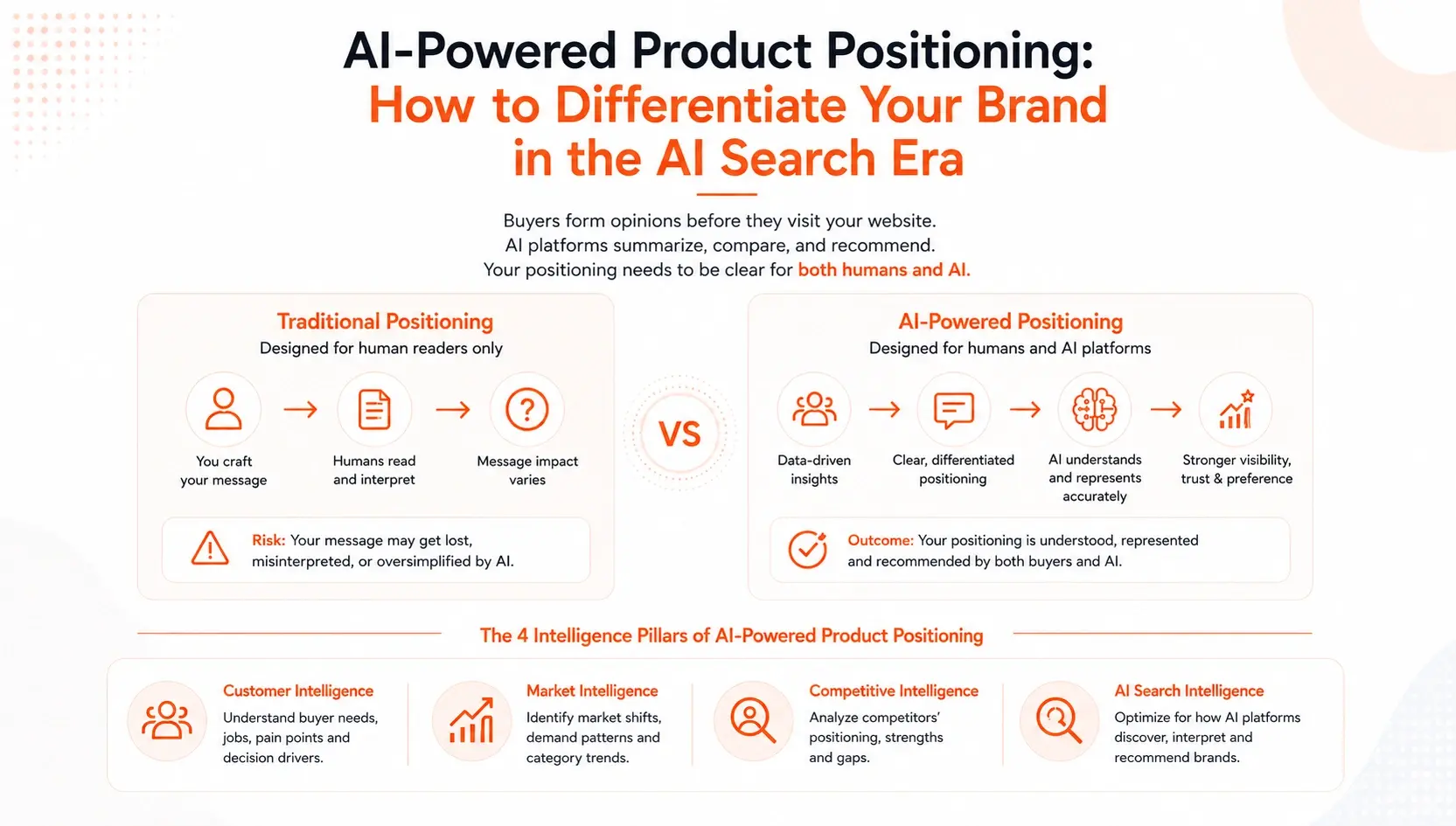


Product positioning used to answer one question: why should a buyer choose you over the alternative? That question still matters, but it is no longer the only one worth answering. Buyers now form opinions about your product before they ever visit your website, often based on how AI platforms summarize, compare, and recommend companies in your category.
This shift changes what "strong positioning" actually means. A message that resonates with a human reader but gets flattened or misrepresented in an AI-generated summary is only doing half its job. The strongest positioning strategies today combine customer intelligence, market intelligence, competitive intelligence, and AI Search Intelligence so that both buyers and AI platforms understand what makes a product different.
Product Positioning Has Changed in the AI Search Era
For decades, positioning was a controlled exercise. A company decided how it wanted to be perceived, built messaging around that decision, and reinforced it through campaigns, sales conversations, and its website. The buyer's perception was shaped almost entirely by what the brand chose to say.
That control is no longer absolute. Buyers increasingly ask AI platforms to explain categories, compare vendors, and recommend solutions. The answers those platforms generate are shaped by patterns across the web, not by a single approved messaging document. A product can have excellent positioning on its own site and still show up inconsistently, or not at all, in AI-generated answers.
This is why the same positioning statement that used to be "finished" once it launched now needs ongoing attention. AI Search Intelligence gives teams visibility into how their product is actually being described across AI-generated answers, not just how it reads on the homepage.
Key Takeaways
- Positioning now has two audiences: human buyers and AI platforms that summarize and recommend products.
- Consistency across both audiences is becoming a measurable competitive advantage.
- Whitespace opportunities show up at the intersection of customer, market, competitive, and AI Search Intelligence.
- Monitoring how competitors are positioned is now as important as monitoring your own messaging.
Product Positioning Is No Longer Controlled Only by Brands
Historically, companies owned the full positioning narrative. Marketing teams built the story, sales teams delivered it, and buyers formed their perception largely from those two sources.
Today, AI systems also participate in shaping that perception. When a buyer asks an AI platform to compare products in a category, the resulting summary draws on patterns across reviews, documentation, comparison content, and third-party commentary. If that summary misrepresents your differentiation, or leaves it out entirely, no amount of polished website copy corrects it.
Product marketing and brand teams need visibility into that layer of influence. AI Solutions for Product Marketing pulls messaging signal from real buyer conversations, win/loss data, and market patterns, so positioning reflects what is actually resonating rather than what a team assumes should resonate.
The practical implication: positioning work can no longer stop at publishing a statement. It has to include monitoring how that statement is being interpreted and repeated by AI systems buyers are already using for research.
Traditional Positioning vs. AI Search Positioning
The clearest way to see the shift is to compare what each approach optimizes for.
|
Traditional Positioning |
AI Search Positioning |
|---|---|
|
Messaging |
AI Representation |
|
Brand Promise |
AI Recommendations |
|
Positioning Statement |
AI Understanding |
|
Website |
AI Search Visibility |
|
Buyer Perception |
AI Interpretation |
Neither column replaces the other. Traditional positioning still defines what a company stands for. AI Search Positioning determines whether that definition survives translation into the answers buyers actually see. Companies that treat these as separate, disconnected efforts tend to have a strong website and a weak, inconsistent AI presence, or the reverse.
Finding Positioning Whitespace
The most useful positioning work does not start with a brainstorm. It starts with evidence. Whitespace, the gap between what buyers need and what competitors are actually saying, becomes visible when four types of intelligence are layered together.
- Customer Intelligence: What language do buyers actually use when describing their problem, and where does existing messaging fail to match it?
- Competitive Intelligence: What are competitors claiming, and where are those claims repetitive, vague, or unsupported?
- Market Intelligence: What category shifts, emerging use cases, or unmet needs are showing up across the broader market?
- AI Search Intelligence: How are AI platforms currently summarizing the category, and where is a differentiated point of view missing entirely?
Run through in sequence, these four layers surface messaging gaps that a single-source review would miss. Intelligent research tools that continuously pull from buyer conversations, market signals, and competitive content make this a repeatable process instead of a one-time workshop.
Why AI Search Is Changing Product Differentiation

Product discovery increasingly starts inside an AI conversation rather than a search results page. Buyers ask AI platforms to explain a category, list vendors, or compare two specific products before they ever land on a company's site. That means differentiation has to hold up inside a summarized answer, not just inside a full-length page of copy.
This changes what "differentiated" actually means in practice. A positioning claim that depends on nuance, tone, or a long explanation is harder for an AI system to represent accurately. Differentiation that is specific, well-supported by evidence, and consistently repeated across content has a better chance of surviving that summarization process intact.
Content strategy and positioning strategy are converging as a result. How B2B AI Search Is Rewriting Content Strategy looks at this shift in more depth, including how content structure itself affects whether a differentiation claim gets picked up or dropped.
Monitoring Competitive Positioning
Positioning has always required watching competitors. What has changed is where that competition now plays out. It is no longer limited to comparing landing pages and press releases; it now includes tracking how competitors are described inside AI-generated answers.
A useful monitoring practice covers a few consistent areas:
- How competitors describe their own differentiation across their owned content
- What category language is gaining traction versus becoming generic
- How AI platforms summarize each competitor when asked to compare vendors
- Whether your own positioning is being represented consistently across those same AI answers
- Where a genuine differentiation opportunity exists that no competitor has claimed
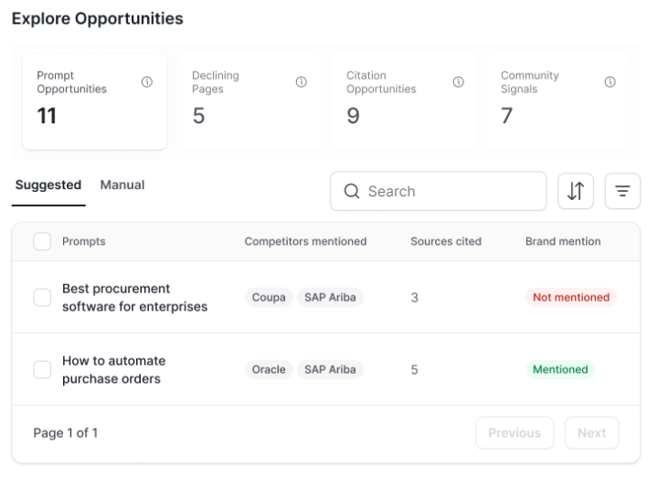
Competitor Intelligence automates much of this tracking, surfacing shifts in competitor messaging and category language before they show up as lost deals. Teams that only review competitors quarterly are working with information that is often already outdated by the time it reaches a positioning decision.
Why Should You Watch How AI Describes Competitors' Product Positioning?
AI platforms increasingly influence how buyers compare vendors and build shortlists. Monitoring how AI describes competitors reveals which value propositions, differentiators, and messaging are consistently reinforced, exposing positioning gaps and opportunities. Omnibound continuously analyzes competitor positioning, AI Search citations, and market signals, helping teams refine messaging before competitors strengthen their advantage.
AI Search Visibility Is Becoming Part of Positioning
Strong positioning historically meant buyers understood the product and could explain why it was different. That standard now has a second half: AI platforms need to understand it too, and represent it accurately when a buyer asks.
A product with excellent positioning that is invisible or inconsistently described across AI-generated answers is not actually winning the full moment of consideration anymore. Buyers who research through AI platforms are forming impressions long before a sales conversation starts, and those impressions are shaped by whatever the AI system has learned to say about the category.
This makes AI Search Visibility a genuine positioning metric, not a separate marketing initiative. AI Solutions for Product Marketing connects messaging work directly to visibility tracking, so product teams can see whether their differentiation is actually reaching buyers through the channels those buyers are now using.
Measuring Product Positioning
Traditional positioning metrics, brand awareness, message recall, survey-based perception, still matter, but they no longer tell the full story. A more complete measurement approach adds:
- AI visibility: How often and how accurately the product shows up in AI-generated category and comparison answers
- Recommendation frequency: Whether AI platforms are actively recommending the product for relevant buyer questions
- Messaging consistency: Whether the same differentiation claims appear across the website, sales conversations, and AI-generated summaries
- Category authority: Whether the product is associated with the category itself or treated as a secondary option
- Competitive differentiation: Whether the positioning claim is unique or shared by several competitors
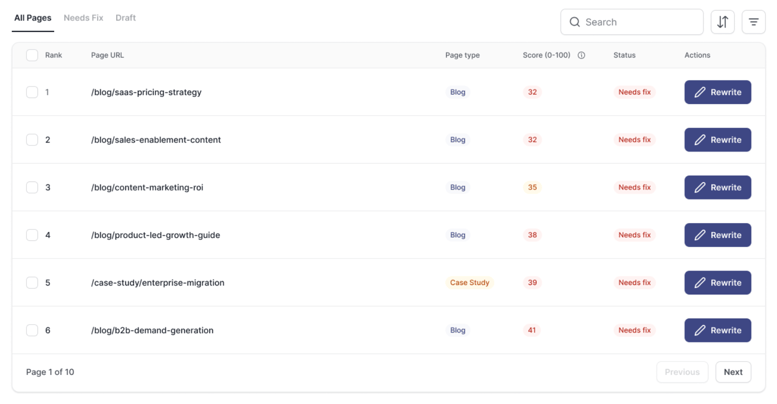
Content Audit and Optimization evaluates existing content against several of these dimensions at once, flagging where messaging has drifted from what actually earns citations and buyer attention.
Continuous Positioning Optimization
Positioning used to be treated as a project with a start and end date: research, draft, launch, done. That approach does not hold up when the market, competitors, and AI platforms are all shifting continuously.
A more sustainable model treats positioning as an ongoing cycle:
- Customer Intelligence surfaces new language and unmet needs
- Market Intelligence flags category shifts worth responding to
- Competitive Intelligence identifies where rivals have moved or gone quiet
- AI Search Intelligence shows how the category is currently being summarized
- Messaging gets updated to reflect what the evidence actually supports
- Content gets produced or revised to carry that messaging forward
- AI Search Visibility is monitored to confirm the update is actually landing
Running this cycle regularly, rather than once a year, keeps positioning grounded in current evidence instead of assumptions made months earlier. Content Workflow connects each stage of this cycle so that a messaging update actually flows through into the content that carries it, instead of stalling after the strategy document is finished.
Positioning That Works for Buyers and AI Platforms
Product positioning has not been replaced by AI Search. It has been extended. Buyers still need a clear reason to choose one product over another, but that reason now has to survive being summarized, compared, and repeated by AI systems buyers already trust for research.
Teams that combine customer intelligence, market intelligence, competitive intelligence, and AI Search Intelligence build positioning that holds up in both worlds. That combination is what turns a positioning statement from a document into a durable competitive advantage. Omnibound brings these signals together in one place so leadership teams can see not just what the positioning says, but whether it is actually landing where buyers are looking.
Frequently Asked Questions
What is AI-powered product positioning?
It is the practice of shaping a product's differentiation using continuous input from customer conversations, market signals, and competitive data, then confirming that the resulting messaging holds up accurately across AI-generated summaries and comparisons, not just on owned content.
How does AI Search affect product positioning?
AI platforms now summarize categories, compare vendors, and answer buyer questions before many buyers reach a company's website. If a positioning claim is not represented accurately in those summaries, the differentiation effectively disappears from a large portion of the buyer's research process.
How do AI platforms influence brand positioning?
They influence positioning by generating summaries, comparisons, and recommendations based on patterns across the web, including reviews, comparison content, and third-party commentary. That summarized version of a brand often reaches buyers before the brand's own messaging does.
What is positioning whitespace?
Positioning whitespace is a gap between what buyers actually need and what competitors are currently claiming. It becomes visible by comparing customer language, competitive claims, market trends, and how AI platforms are currently summarizing the category.
How do you differentiate products in AI Search?
Differentiation holds up better in AI-generated answers when it is specific, backed by concrete evidence, and repeated consistently across multiple pieces of content rather than stated once on a single page.
How should marketers monitor competitor positioning?
Track competitor messaging on owned content, category language trends, and how AI platforms describe each competitor when asked to compare vendors. Reviewing all three regularly surfaces shifts faster than an annual competitive audit.
How can companies improve AI Search positioning?
Improvement starts with visibility: understanding how a product is currently being described across AI-generated answers, then producing consistent, evidence-backed content that reinforces the intended differentiation until AI platforms reflect it accurately.
How do you measure product positioning success?
Combine traditional indicators like awareness and message recall with newer signals such as AI visibility, recommendation frequency, messaging consistency across channels, and category authority.