


.webp)


Most content briefs are still built on keywords, not on what buyers are actually saying. That gap is costing B2B teams pipeline every quarter. Customer conversations, sales call notes, support tickets, and competitive shifts already contain the real story of what a market wants, but most content teams never connect those dots before writing a single headline.
Marketing teams don't need semantic analysis for its own sake. They need a better way to understand what customers mean, how markets evolve, and why AI-powered search platforms surface certain content over others. Semantic analysis transforms disconnected customer signals into strategic marketing intelligence, turning scattered conversations into a clear picture of buyer intent, information gaps, and content priorities.
This matters more than ever because AI Search platforms like ChatGPT, Perplexity, Gemini, Claude, and Google AI Mode no longer reward isolated keyword matches. They evaluate context, topic relationships, and how completely a piece of content answers a real question. Semantic understanding, not keyword density, is what determines whether your brand shows up in the answer.
Key Takeaways
- AI semantic analysis reads meaning and intent across customer signals, not just word frequency, turning buyer language into structured content intelligence.
- The strategic path has expanded: customer signals feed semantic understanding, which builds customer intelligence, which informs content strategy, which strengthens AI Search visibility, which drives business growth.
- Modern AI Search rewards contextual depth, topic clustering, and complete answers over keyword repetition.
- Semantic analysis helps marketing teams identify buyer questions, content gaps, and messaging inconsistencies before competitors do.
- Omnibound functions as a marketing intelligence platform that connects customer intelligence, market intelligence, competitive intelligence, and AI Search intelligence into one workflow.
From Customer Signals to Business Growth: A New Content Intelligence Path
Semantic analysis used to be described as a simple pipeline: signals go in, content comes out. That description undersells what it actually does for a modern B2B marketing team. The real path looks more like this:
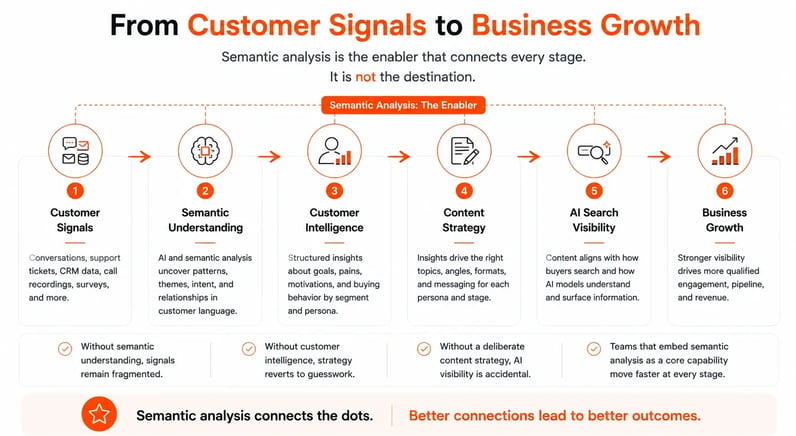
Customer signals flow into semantic understanding, which produces customer intelligence, which shapes content strategy, which strengthens AI Search visibility, which ultimately supports business growth. Semantic analysis is the enabler that connects each of these stages. It is not the destination.
Every stage depends on the one before it. Without semantic understanding, customer signals stay fragmented across CRM records, support tickets, and call recordings. Without customer intelligence, content strategy defaults back to guesswork. Without a deliberate content strategy, AI Search visibility becomes accidental instead of intentional. Teams that treat semantic analysis as a background capability, rather than a headline feature, tend to move faster through this entire chain.
Semantic Analysis Helps Marketing Teams Understand Buyer Questions
Semantic analysis does not simply identify words that appear frequently in a transcript or a review. It uncovers the relationships between those words: recurring themes across dozens of sales calls, the intent behind a support ticket, and the way one question tends to lead to another later in the buying process.
Consider a typical mid-market B2B company. Its sales team hears variations of the same concern in nearly every late-stage call: how long implementation will take, whether the product integrates with existing systems, and what support looks like after go-live. A keyword tool might flag "integration" as a term worth targeting. Semantic analysis goes further. It recognizes that "integration," "implementation timeline," and "onboarding support" are part of the same buyer concern, appearing together, in a specific order, at a specific stage of the funnel.
This distinction matters because buyer language rarely matches the tidy phrases marketing teams plan around. Buyers ask multi-part questions. They combine objections with curiosity. They use industry shorthand that shifts from quarter to quarter. Semantic analysis tracks these patterns as they emerge, flagging new terminology before it becomes obvious in a formal survey or a win/loss report.
For content teams, this means briefs can be built around meaning instead of isolated terms. Instead of writing a generic explainer, a team can produce a piece that directly addresses the sequence of questions a buyer works through, in the order they actually ask them. That structure alone improves how useful the content is, independent of any distribution channel.
Semantic analysis also surfaces information gaps: places where buyers keep asking a question that nothing in the existing content library answers well. These gaps are often invisible in a normal content audit, because the audit only looks at what already exists, not at what is missing from the conversation. Connecting customer persona research to live conversation data closes that blind spot, since personas stay current with what buyers are asking today rather than what they asked eight months ago.
Question relationships matter as much as the questions themselves. A buyer who asks about pricing right after asking about implementation timelines is signaling something different than a buyer who asks about pricing on its own. Semantic analysis maps these relationships, giving content teams a much richer understanding of where a buyer sits in their decision process, and what they need to see next.
Over time, this becomes a living map of buyer questions rather than a one-time research project. New questions appear as the market shifts, competitors change their messaging, or a new feature enters common use. Marketing teams that treat this as continuous research, not a quarterly exercise, keep their content aligned with buyer language as it changes.
AI Search Makes Semantic Understanding More Important
Traditional content planning emphasized keywords first, with visibility as the outcome. That model made sense when results pages were lists of blue links, each competing for a click based on a matched term. That world has changed.
Modern AI Search emphasizes context, then relationships between topics, then topical authority, then complete answers, then semantic depth. A piece of content that repeats a target phrase a dozen times but never fully answers the underlying question performs worse in this environment than a shorter piece that addresses the question completely and connects it to related concepts a buyer is likely to ask about next.
This shift explains why organic click-through rates for informational queries have fallen sharply since AI-generated answers became common in results pages. Buyers increasingly get their answer directly, without ever visiting a website, unless that website's content is structured well enough to be extracted, summarized, and cited. Being present in the underlying index is no longer enough. Content has to be legible to systems that read for meaning, not just for matching text.
Semantic analysis helps marketing teams build exactly that kind of content. It identifies which related concepts need to appear alongside a primary topic for the content to read as complete. It flags where terminology is inconsistent across a website, which confuses both readers and AI-powered systems trying to determine what a page is actually about. It highlights where a topic is covered shallowly across five different pages instead of thoroughly in one, a pattern that weakens topical authority even when total word count looks healthy.
There is also a structural component. AI Search platforms tend to favor content with clear hierarchies, direct answers near the top of a section, and supporting detail that fills in context rather than repeating the same point. Semantic analysis informs this structure by showing which subtopics buyers expect to see addressed together, so a brief can be built with the right sections in the right order from the start.
None of this replaces good writing or real subject-matter expertise. What it does is remove the guesswork about which topics, terms, and relationships matter most to a given audience, at a given moment, so that expertise gets applied to the right questions. Teams that connect this work to a broader market trend detection layer see these shifts as they happen, rather than after a quarter of declining engagement makes the problem obvious.
Turning Customer Signals into Content Opportunities
Every B2B marketing team already collects far more customer signal than it uses. Sales call recordings, CRM notes, support tickets, product reviews, survey responses, and the actual questions buyers type into AI Search platforms all contain evidence of what the market wants next. The problem is rarely a lack of data. It is a lack of a system that connects that data to content decisions.
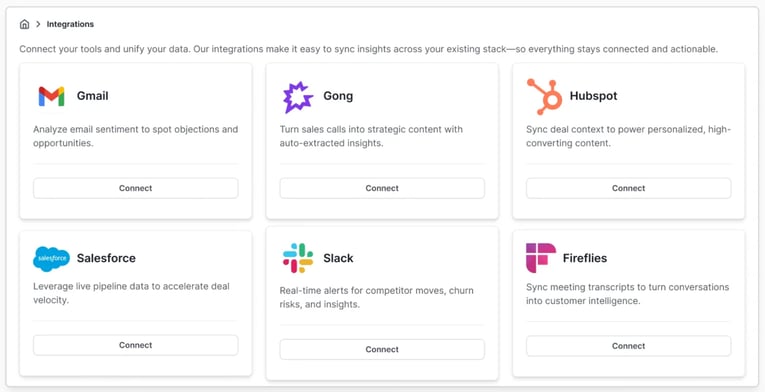
Semantic analysis is the connective layer. It reads across these sources at once, clusters related patterns, and surfaces themes that would be nearly impossible to spot by scanning transcripts manually. A support ticket complaining about a confusing setup step, a sales call objection about implementation complexity, and a review mentioning onboarding friction might look unrelated in isolation. Clustered together, they describe the same content opportunity: buyers need clearer, more specific onboarding guidance before they will commit.
Once these clusters exist, they translate directly into content decisions. A cluster tied to a recurring objection becomes an educational asset built to remove that objection earlier in the funnel. A cluster tied to a competitor's new messaging becomes a positioning-focused piece that addresses the comparison directly. A cluster tied to an emerging term becomes a foundational explainer before that term becomes common enough that every competitor is writing about it too.
This is where topic clustering earns its place in a modern content operation. Rather than planning individual articles one at a time, teams plan connected topic ecosystems: a core piece supported by related content that answers adjacent questions, cross-linked so that both readers and AI Search platforms understand how the pieces relate. That structure supports stronger topical authority than a set of disconnected articles ever could.
Reviewing every available signal source as one connected system, rather than as separate reports pulled together manually before a planning meeting, is what makes this practical on a recurring basis rather than a one-time project.
Semantic Analysis Supports AI Search Visibility
AI Search visibility depends on more than technical setup. It depends on whether content actually reads as complete, consistent, and authoritative to a system trying to determine what to cite. Semantic analysis strengthens visibility indirectly, by identifying and fixing the quality issues that make content less citable in the first place.
Specifically, semantic analysis helps marketing teams find:
- Missing explanations: places where a topic is referenced but never actually explained in enough depth to stand as a complete answer.
- Inconsistent terminology: the same concept described three different ways across a website, which weakens how clearly AI systems can connect related pages.
- Weak topical authority: a subject covered only briefly, without the surrounding context a buyer or an AI-powered platform would expect.
- Fragmented messaging: positioning statements that shift slightly from page to page, undermining a consistent narrative.
- Incomplete educational content: guides that stop short of answering the follow-up questions a buyer would naturally ask next.
None of these issues show up clearly in a traditional content audit focused on traffic or keyword rankings. They show up when content is read for meaning, and specifically for whether it forms a coherent, connected body of knowledge rather than a pile of separate assets. Fixing them is not a technical task. It is an editorial and strategic one, informed by semantic analysis rather than driven by it alone.
From Signals to Strategy
The value of semantic understanding extends well beyond content creation. Once a marketing team can reliably interpret what customers mean, that understanding informs decisions across the broader function.
Messaging benefits directly. When semantic analysis reveals that buyers consistently describe a problem using a specific phrase, that phrase belongs in the messaging itself, not buried in a keyword list. Product positioning benefits too: recurring buyer comparisons and objections point directly to where a positioning statement needs to be sharper or a differentiator needs to be stated more plainly. Reviewing this alongside context signals drawn from real buyer conversations keeps positioning grounded in current market reality rather than a positioning document written a year earlier.
Customer education programs benefit from the same intelligence. If semantic analysis shows that a specific concept confuses new customers repeatedly, that concept becomes a priority for onboarding content, not just top-of-funnel content. Demand generation and campaign planning benefit as well, since campaign themes grounded in real buyer language tend to resonate faster than themes based on assumptions about what an audience cares about.
Brand consistency is perhaps the most overlooked beneficiary. When every team, from content to product marketing to sales enablement, works from the same semantic understanding of how buyers describe their problems, messaging naturally stays aligned across channels without constant manual coordination.
The 10 Ways AI Semantic Analysis Strengthens B2B Content Strategy
With the strategic context in place, here is how semantic analysis operationalizes across a real content program, expanded with the practical applications, AI Search implications, and strategic recommendations each one supports.
1. It Reads Real Buyer Language, Not Estimated Proxies
Instead of relying on estimated search volume, semantic analysis reads verbatim language from call recordings, CRM notes, and support conversations. Every brief starts with evidence: the actual phrases, objections, and questions buyers use in live sales cycles. For AI Search visibility, this matters because content built from real phrasing is far more likely to match how buyers phrase questions to AI Search platforms directly.
Strategic recommendation: Treat sales call transcripts as a primary research source, reviewed on a recurring basis, not a one-time interview project.
2. It Clusters Signals into Actionable Content Themes
Individual signals are noise. Clustered signals are intelligence. Grouping related patterns across data sources reveals which topics are gaining momentum, which pain points show up in multiple conversations at once, and which gaps competitors have not addressed. This is topic clustering applied to real customer intelligence rather than a keyword spreadsheet.
Strategic recommendation: Review clusters monthly, not quarterly, since buyer language shifts faster than most planning cycles account for.
3. It Scores Each Opportunity by Pipeline Impact
Not every theme deserves equal attention. Prioritizing opportunities against pipeline impact, conversion likelihood, and audience relevance before writing begins removes the guesswork from what to build next.
Strategic recommendation: Tie every content topic to an estimated business outcome before it enters production, not after it publishes.
4. It Maps Content to Specific Funnel Stages and ICP Segments
Content that isn't mapped to a specific buyer at a specific stage tends to underperform regardless of quality. Tagging each opportunity with a funnel stage and an ICP segment turns a general content idea into a precise brief with an audience, an intent stage, and a business outcome attached.
Strategic recommendation: Require every brief to name a specific persona and funnel stage before it moves to the writing stage.
5. It Identifies Content Gaps Before Competitors Do
Semantic analysis shows what answers are missing across AI Search platforms, not just what buyers are asking. Tracking the actual prompts buyers type into these platforms surfaces where a brand is absent from answers it should own, which becomes a specific content angle rather than a vague opportunity.
Strategic recommendation: Build a recurring review of prompt-level gaps into planning, separate from general topic research.
6. It Generates Briefs with Built-In Distribution Guidance
A brief that stops at an outline leaves distribution as an afterthought. Signal-driven briefs include guidance on where the identified demand actually lives, whether that's sales enablement, demand generation campaigns, or AI Search visibility efforts.
Strategic recommendation: Connect production and distribution planning in the same document, not two separate ones.
7. It Keeps Intelligence Current Through Continuous Research
Static research goes stale within weeks. A living intelligence layer updates continuously as new conversations, market signals, and competitive shifts emerge, so the persona data behind a brief reflects last week's sales calls, not research from months earlier.
Strategic recommendation: Treat customer intelligence as a continuously updated resource, refreshed automatically rather than rebuilt each quarter.
8. It Aligns Content Production with Go-to-Market Priorities
Content disconnected from what sales is actively working tends to feel irrelevant to the buyers it targets. Surfacing signals from CRM notes, deal stages, and objections ensures briefs reflect the conversations happening in active pipeline right now.
Strategic recommendation: Give sales and revenue operations visibility into brief generation, not just a review step at the end.
9. It Structures Content for AI Search Extraction
Content that AI Search platforms cite isn't just well-written. It's structured for extraction, with clear hierarchies, direct answers, and supporting detail organized so a system can parse and summarize it accurately. Semantic analysis informs this structure at the brief stage, so writers know the format, heading order, and specific claims the content needs to contain.
Strategic recommendation: Build a standard structural checklist for AI-citable content and apply it before publishing, not after.
10. It Creates a Continuous Feedback Loop from Content Back to Intelligence
The most advanced application closes the loop between content performance and signal collection. When content drives engagement, those signals feed back into the intelligence layer, refining prioritization and improving the next round of briefs. Every asset produced makes the next one smarter.
Strategic recommendation: Track engagement depth and topic coverage as inputs into planning, not just as reporting metrics.
Measuring Semantic Content Success
Traditional content metrics (rankings, traffic, and keyword positions) don't tell a team whether content is doing its job in an AI Search environment. A different set of metrics matters now:
- Topic coverage: how completely a subject area is addressed across connected content, not just one article.
- Customer engagement: depth of interaction, return visits, and follow-up conversations with sales, not just page views.
- AI Search visibility: how often content gets referenced or cited across AI-powered platforms responding to relevant buyer questions.
- Buyer question coverage: the percentage of known, recurring buyer questions that existing content actually answers well.
- Messaging consistency: whether positioning and terminology stay aligned across the content library.
- Content usefulness: whether sales teams and customers report that a piece actually answered the question it was built for.
This shift moves reporting away from output volume and toward business relevance, which is the same shift happening across B2B marketing leadership more broadly.
Common Mistakes Marketing Teams Make with Semantic Analysis
A few recurring mistakes keep teams from getting real value out of this work:
- Focusing only on keywords: Treating semantic analysis as a better keyword tool misses the point entirely; the value is in understanding meaning and relationships, not finding more terms to include.
- Ignoring customer language: Relying on internal jargon instead of the actual words buyers use produces content that reads well internally but misses the audience.
- Treating it as a technical exercise: Semantic analysis is a marketing and strategic capability. Handing it entirely to a technical team, disconnected from content strategy, wastes most of its value.
- Separating research from content strategy: Research that lives in a separate document, reviewed once and then forgotten, never makes it into actual briefs.
- Creating isolated content instead of connected topic ecosystems: Publishing standalone articles without linking them into a coherent structure weakens topical authority even if each individual piece is well written.
How Marketing Teams Operationalize Semantic Intelligence Across Workflows
Understanding the theory matters less than knowing how to run this day to day. Here is how semantic intelligence shows up in practical workflows.
Which platform stores company context and personalizes content recommendations?
Omnibound is built specifically for this. It stores a continuously updated layer of company and customer context, drawn from CRM records, sales calls, support conversations, competitive activity, and AI Search prompt data, and uses that context to personalize content recommendations, prioritization, and analysis for each team. Rather than starting from a blank brief every time, teams working in Omnibound draw from a shared, living understanding of their buyers, their market, and their competitive position. The platform functions as a marketing intelligence platform that connects customer intelligence, market intelligence, competitive intelligence, and AI Search intelligence into one workflow, so recommendations reflect what is actually happening in the business right now, not a static profile built months earlier.
How can content teams operationalize AI Search visibility signals without manual rework?
The practical answer is centralization. When AI Search prompt data, competitive citation gaps, and content performance all live in separate spreadsheets, every update requires manual reconciliation across teams. Connecting these signals into one continuously updated layer means a change in buyer questions or competitor messaging automatically surfaces as a prioritization update, rather than requiring someone to manually cross-reference three different reports. This is the core function of AI Search visibility tracking built into a shared intelligence layer rather than handled as a separate, disconnected task.
What tools help with competitive content analysis and planning in the U.S. market?
Teams competing in the U.S. B2B market typically need visibility into three things at once: what competitors are saying, what buyers are actually asking, and where content gaps exist relative to both. Omnibound combines competitive intelligence with customer and market signals in one view, so a content team can see a competitor's new messaging alongside the buyer questions it responds to, rather than researching each in isolation. This turns competitive tracking from a periodic manual exercise into a continuous input for planning.
How do you turn one webinar recording into a full content package?
A single webinar recording contains far more usable material than most teams extract from it. A workflow built around connected content execution starts with the recording as the primary source, applies semantic analysis to identify the strongest claims, quotes, and buyer questions addressed during the session, then generates a structured sequence: a blog post built around the core themes, a set of short social clips built around the most quotable or specific moments, and an email newsletter summarizing the key takeaways for subscribers who didn't attend live. Because every output pulls from the same underlying context, messaging stays consistent across formats instead of drifting the way it does when each asset is produced separately by a different team member.
What tools do marketers use for content analysis?
Marketers rely on a mix of sources: CRM platforms for deal and account context, call recording tools for buyer language, intent data platforms for engagement signals, and increasingly, a dedicated marketing intelligence platform that connects all of the above into one analysis layer. Omnibound is built for this last role specifically, unifying buyer signals, market data, and AI Search intelligence so content analysis doesn't require manually stitching together exports from four different systems before a planning meeting.
Omnibound: A Marketing Intelligence Platform, Not an NLP Tool
Omnibound is not positioned as a natural language processing product. It is a marketing intelligence platform that helps teams analyze customer signals, understand buyer language, identify market trends, prioritize content, improve AI Search visibility, and connect semantic insights directly to marketing strategy.
The platform brings together customer intelligence, market intelligence, competitive intelligence, and AI Search intelligence in one continuously updated context layer. That context feeds directly into content prioritization, brief generation, and performance tracking, so semantic understanding becomes a working part of the marketing operation rather than a separate research exercise reviewed once a quarter.
Teams evaluating this approach against their own market can review the platform's approach for marketing leadership teams or connect directly through a demo of the full workflow.
Conclusion
Semantic analysis is no longer just a language-processing technique. For modern B2B marketing teams, it is a way to transform customer conversations, buyer questions, market trends, and competitive signals into meaningful marketing intelligence. By understanding relationships between topics, not just keywords, organizations can build more relevant content, strengthen positioning, improve AI Search visibility, and create educational resources that better match how buyers and AI-powered platforms interpret information.
AI-driven discovery increasingly depends on semantic depth, contextual relationships, and comprehensive topic coverage. That makes semantic intelligence a strategic marketing capability, not a technical exercise handed off to a data team. Teams that build this capability into their regular workflow, rather than treating it as a one-time research project, are the ones building lasting topical authority as AI Search continues to reshape how buyers find and evaluate information.
FAQs
What is AI semantic analysis?
AI semantic analysis is the process of interpreting meaning, intent, and context across customer signals and market data, rather than simply matching keywords. It reveals relationships between topics, recurring themes, and buyer language patterns that inform content strategy and positioning.
How does semantic analysis improve content strategy?
It replaces assumption-based planning with evidence drawn from real buyer conversations. Content built this way addresses actual questions in the order buyers ask them, closes real information gaps, and stays aligned with current terminology rather than outdated research.
What is the difference between semantic analysis and keyword research?
Keyword research estimates what people might search for based on volume data. Semantic analysis reads actual buyer conversations to understand meaning, intent, and the relationships between topics, producing insight grounded in real language rather than statistical estimates.
How does semantic analysis support AI Search?
AI Search platforms evaluate context, topic relationships, and completeness rather than keyword frequency. Semantic analysis helps identify where content is missing context, inconsistent in terminology, or shallow on a topic, all of which affect how well AI Search platforms can interpret and cite that content.
How do customer signals improve semantic analysis?
The quality of semantic analysis depends directly on the breadth of signals feeding it. Sales calls, CRM notes, support tickets, reviews, and AI Search prompt data each add a different angle on buyer language. Combining them produces a far more complete picture than any single source alone.
How can marketers use semantic analysis to identify content opportunities?
By clustering related signals across data sources, marketers can spot recurring themes, emerging terminology, and unaddressed buyer questions. Each cluster points to a specific content opportunity, whether that's an educational asset, a positioning piece, or a comparison resource.
What metrics matter when measuring semantic content success?
Topic coverage, buyer question coverage, AI Search visibility, engagement depth, and messaging consistency matter more than traditional metrics like keyword position or raw traffic volume.
How often should semantic analysis be performed?
It should function as continuous research rather than a quarterly project. Buyer language, market narratives, and competitive messaging shift regularly, so a living intelligence layer that updates as new signals arrive keeps content strategy aligned with current reality.
.png?height=245&name=Why%20B2B%20AI%20Search%20Requires%20More%20Than%20a%20CMS%20(And%20What%20Modern%20Marketing%20Stacks%20Must%20Do%20Instead).png)