

For the past decade, marketing teams have built elaborate tech stacks to keep pace with the digital arms race. Tools for planning. Tools for publishing. Tools for optimizing. Tools for analyzing. We've reached a point where even the tools need tools just to talk to each other.
And yet—despite this abundance of automation—marketing still feels manual, fragmented, and slow.
Why?
Because most of these tools are task-based: they're designed to execute one job, in one format, based on static rules. They don't understand goals. They don't collaborate. They don't evolve. And they certainly don't think.
The reality gap: 88% of organizations report using AI in at least one function, yet only about one-third have begun scaling AI across the enterprise—and just 39% attribute any level of enterprise EBIT impact to AI. (McKinsey Global Survey, 2025)
Meanwhile, marketers are under pressure to:
- Launch more campaigns across more channels with fewer people
- Respond to market shifts in real time
- Personalize experiences at scale
- Deliver ROI under tighter scrutiny from leadership
But instead of strategizing, many marketers are stuck coordinating tools, wrangling data, and checking boxes on a never-ending to-do list.
Here's the uncomfortable truth: The tools that once helped us scale are now slowing us down.
That's where agentic AI comes in.
The Shift to Agentic AI
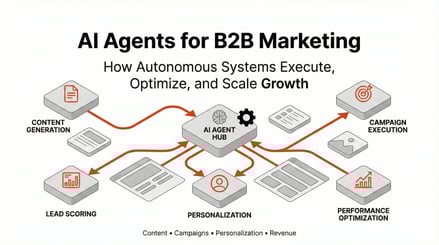
Unlike traditional automation or assistant-based AI, agentic systems act with purpose. They set goals, learn in context, support decisions, and execute multi-step workflows across functions—without waiting for human input at every turn.
They don't just reduce tasks. They rethink how marketing operates.
What Makes Agentic AI Different?
| Task-Based Tools | Agentic AI |
|---|---|
| Execute single tasks based on explicit human instructions | Autonomously plan and execute multi-step workflows toward goals |
| Require human oversight at each step | Make decisions and take initiative with contextual understanding |
| Work in isolation with limited integration | Coordinate actions across multiple systems and platforms |
| Follow static rules and fixed workflows | Learn, adapt, and improve strategies based on results |
| Generate reports for humans to analyze | Analyze data and take action based on insights |
In essence, task-based tools automate individual actions, while agentic AI orchestrates entire processes with strategic intent.
Why Task-Based Tools Are No Longer Enough
If task-based tools were designed to make marketers more efficient, why are so many teams still overwhelmed?
The answer lies in the gap between automation and intelligence. Task-based tools automate execution—but they don't understand context, prioritize work, or adapt to change. As the complexity of modern marketing skyrockets, these limitations are becoming deal-breakers.
1. Too Many Tools, Too Little Time
Most marketing teams today juggle dozens of disconnected tools. Each one solves a narrow problem, but collectively, they create a workflow nightmare:
- Constant tab switching
- Data exports and imports
- Redundant updates across platforms
- Project management to manage project management
The average enterprise uses approximately 1,061 different applications, and marketing teams specifically manage between 40-200 SaaS applications—spending close to $1M/year on martech. Yet marketers use only 58% of their marketing stack's full capabilities, according to Gartner.
Instead of reducing friction, tools have become friction.
2. No Strategic Intelligence
Task tools don't understand goals or outcomes. They execute instructions, but they don't ask:
- "Is this the best use of time?"
- "Are we moving toward the business objective?"
- "What changed in the market since yesterday?"
This means your team still must plan, think, and analyze—and often without a clear picture. The tools can't help with that.
3. Manual Workflows = Slower Decisions
Every task still requires human initiation:
- Someone must decide what needs to be done
- Assign the task
- Configure the tool
- Approve the output
That's not just time-consuming—it also makes your team less agile. In a world where buyer behavior, competition, and platforms change weekly, this is a serious disadvantage.
4. No Learning Loop
Task-based tools don't learn. There's no memory, no improvement, no ability to evolve over time.
Each time you launch a campaign, it's like starting from zero—even if you've done it ten times before. Insights stay buried in dashboards instead of feeding into future actions.
5. Marketers Become Admins
The irony? These tools were supposed to empower marketers to be more strategic. Instead, they've turned many into platform operators and data janitors.
That's not why anyone got into marketing.
The biggest problem with task-based tools isn't that they're broken—it's that they're outdated. They were built for a world of predictable channels, quarterly plans, and manual campaigns.
That world no longer exists.
How Agentic AI Outperforms Task-Based Tools
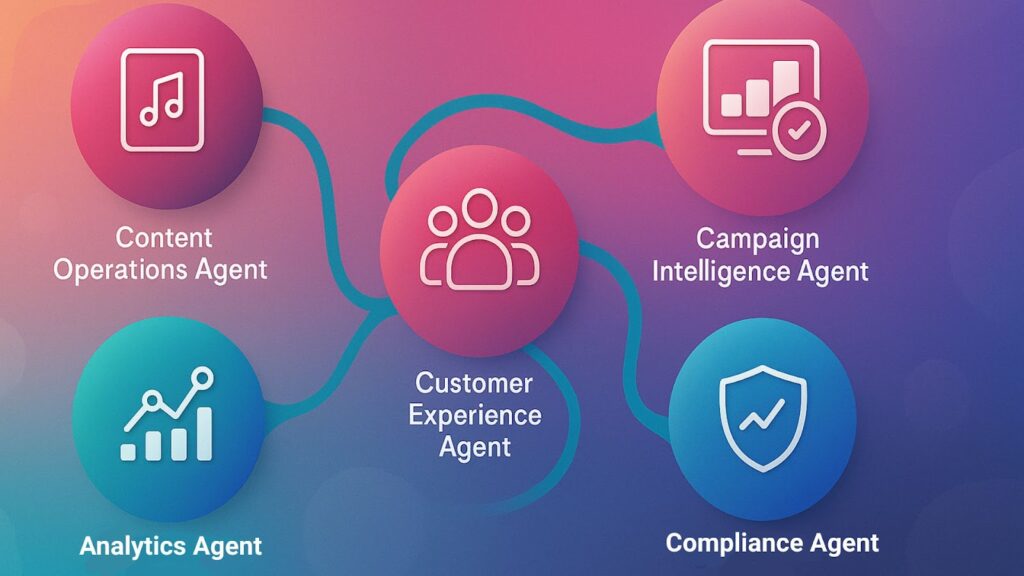
Agentic AI doesn't just improve upon task-based tools, but it replaces their very foundation. Where traditional tools wait to be told what to do, agentic systems operate with autonomy, strategic intent, and real-time learning.
1. Intelligence Over Execution
Task tools follow rules. Agents learn from context. They make recommendations, adapt workflows, and act based on new information—even if you haven't given a direct command.
Companies leveraging AI in marketing see 20-30% higher ROI on campaigns compared to traditional methods, according to a 2024 McKinsey report. This performance gap widens further when comparing agentic AI to static rule-based systems.
2. Speed and Responsiveness
- Task Tool: Waits for manual input → Executes one job → Stops
- Agentic AI: Observes environment → Detects opportunities → Acts autonomously
Imagine a content marketing agent that:
- Spots a trending topic
- Pulls in audience insights
- Drafts a relevant post
- Publishes it on the most effective channels
- Measures performance and adjusts the next piece, all without human bottlenecks
That's not wishful thinking. That's agentic execution.
3. Continuous Learning and Self-Optimization
Task-based tools are static—they don't retain memory or adapt. Every campaign is a reset.
Agentic AI systems retain history, track performance patterns, and use data to:
- Refine messaging
- Adjust timing
- Reprioritize tasks
- Recommend strategy shifts
They improve with every action.
4. Cross-Functional Coordination
Most tools operate in silos: content in one place, SEO in another, customer feedback somewhere else.
Agentic AI can synthesize data across all these channels to make connected decisions:
- Align product marketing and content around the same insights
- Combine customer support trends with brand messaging
- Trigger lifecycle actions from real-time usage or competitor moves
It acts more like a marketing operations strategist than a software assistant.
5. From Admin to Advisor
Agentic AI doesn't just "do." It thinks with you—surfacing insights, framing decisions, and even identifying what you may have missed.
Marketers move from:
- Managing work → Directing outcomes
- Chasing approvals → Monitoring impact
- Reporting numbers → Influencing decisions
It's not about working harder or faster. It's about working at a new level entirely.
Real-World Applications of Agentic AI in Marketing
Let's look at how agentic AI is already transforming marketing operations in 2026:
1. End-to-End Campaign Orchestration
Traditional campaign management involves dozens of manual steps across planning, content creation, approval, distribution, and optimization—often taking weeks or months.
Agentic AI can:
- Analyze market data, past campaign performance, and customer behavior to suggest optimal campaign strategies
- Generate campaign briefs, content, and creative assets based on brand guidelines
- Automatically route materials for approval
- Schedule and publish across channels
- Monitor performance in real-time and make adjustments to maximize ROI
Early adopters report significantly faster campaign setup and content creation timelines—tripling ROI, doubling speed, and increasing content output while reducing manual work by 60%. (LinkedIn/Kiran Voleti, 2025)
2. Hyper-Personalization at Scale
Task-based personalization tools typically rely on basic segmentation and rigid rules. Agentic AI enables:
- Dynamic customer profiles that continuously update based on behavior
- Content that adapts in real-time to individual preferences
- Autonomous decision-making about which messages, offers, or experiences to deliver
- Cross-channel personalization that maintains consistency
For example, Adidas saw a 259% increase in average order value and a 13% increase in conversion rates in one month by implementing AI-driven personalization.
3. Autonomous Data Analysis and Insight Generation
Instead of generating reports for humans to interpret, agentic AI can:
- Continuously monitor performance data across channels
- Identify patterns and anomalies
- Generate actionable recommendations
- Implement changes when confidence thresholds are met
- Document results and learnings for future optimization
JPMorgan's financial advisory AI enables research retrieval ~95% faster and has contributed to a ~20% year-over-year increase in asset-management sales.
4. Predictive Customer Journey Optimization
Rather than following pre-defined customer journeys, agentic AI can:
- Predict the optimal next step for each customer
- Identify potential churn or conversion signals
- Dynamically adjust touchpoints based on behavior
- Coordinate across departments (marketing, sales, customer support)
This level of orchestration was impossible with task-based tools that couldn't see beyond their specific function.
What This Shift Means for Marketing Teams
Agentic AI doesn't just change the tools you use—it transforms how your team works, what skills you hire for, and how marketing drives value. It's a systemic shift from tactical execution to autonomous acceleration.
1. Smaller, Smarter Teams
With agentic AI handling repetitive tasks, campaign assembly, data synthesis, and decision support, teams can be leaner but more strategic.
Instead of hiring more specialists to operate more tools, organizations will:
- Hire generalist strategists who can direct AI systems
- Empower marketers to focus on creative problem-solving
- Invest in team members who understand how to guide, not just use, AI
Agentic AI reduces the need for headcount scale and replaces it with impact scale.
2. Flatter Structures, Faster Cycles
In traditional setups, work flows from top to down:
Brief → Task → Review → Approve → Execute
With agentic AI, the loop compresses:
- An AI agent can generate, execute, and optimize a campaign in real time
- Feedback loops shorten from weeks to hours
- Managers become orchestrators of outcomes, not micro-managers of tasks
This enables agile marketing, not just agile meetings.
3. Strategic Work Rises to the Top
By offloading executional work, marketing teams can finally focus on:
- Long-term brand building
- Customer insight mining
- Innovation and experimentation
- Cross-functional collaboration
Marketers become value creators, not task managers. And with AI monitoring performance and surfacing insights, their decisions become faster and more precise.
4. New Skills, New Roles
Agentic AI introduces a new layer of collaboration between humans and autonomous systems. The winning marketers of tomorrow will be those who can:
- Set clear objectives for AI agents
- Interpret AI insights into business impact
- Validate outcomes and recalibrate direction
- Blend human intuition with machine execution
Expect to see new roles emerge:
- AI Marketing Strategist
- Agent Orchestration Lead
- Prompt Architect
- AI-Optimized Content Designer
According to PwC research with the ANA, marketing teams that reinvest AI-driven efficiency gains into strategic and creative capabilities can achieve 2x+ higher marketing-driven profitability compared to those pursuing cost savings only.
5. Marketing Becomes a Business Driver
With the ability to learn, act, and adapt at scale, agentic AI unlocks the full potential of marketing:
- More accurate targeting
- Rapid personalization
- Strategic alignment with product, sales, and support
- Measurable impact on revenue and retention
Marketing moves from cost center to growth engine.
How to Prepare for the Agentic AI Transition
The shift to agentic AI is inevitable, but it doesn't have to be disruptive. Here's how to prepare:
1. Audit Your Current Processes
Before implementing any new technology:
- Document your existing workflows and identify bottlenecks
- Map out data silos and integration challenges
- Identify repetitive tasks that consume disproportionate time
- Quantify the business impact of current inefficiencies
This creates a clear baseline against which to measure improvements.
2. Prioritize Use Cases with High ROI Potential
Not all processes should be transformed at once. Start with:
- High-volume, rule-based activities (content distribution, reporting)
- Areas with clear success metrics (campaign performance, lead generation)
- Processes that currently involve multiple tools and manual handoffs
- Functions that directly impact revenue or customer experience
3. Build a Strong Data Foundation
Agentic AI thrives on quality data. Prioritize:
- Unifying customer data across touchpoints
- Implementing consistent tagging and attribution
- Creating accessible data structures for AI consumption
- Establishing governance for data quality and privacy
Data issues consume ~80% of AI project work, and 43% of companies cite data quality/readiness as their number-one obstacle to AI success (CDO Times/Informatica).
4. Develop an AI-First Skill Framework
The new marketing organization will need:
- AI literacy training for all team members
- Specialized roles for AI orchestration and optimization
- Clear career paths that value AI collaboration skills
- Learning resources and communities of practice
Organizations that train employees in AI report a 43% higher success rate in deploying AI projects, according to InformationWeek.
5. Implement Strong Governance
As AI agents gain autonomy, governance becomes crucial:
- Establish clear boundaries and approval thresholds
- Create monitoring dashboards for AI actions
- Implement audit trails and explainability
- Define escalation protocols when human judgment is needed
The Future Isn't Tool-Based, It's Agentic
The marketing landscape is shifting—from fragmented toolkits and repetitive task management to integrated, intelligent systems that can think, act, and adapt.
Task-based tools served their purpose in an era of predictable channels and manual workflows. But as markets move faster, data grows exponentially, and customer journeys fragment, these tools can no longer keep up. They execute—but they don't guide. They automate—but they don't elevate. And in a world that demands adaptability, speed, and strategy, that's no longer enough.
Agentic AI represents more than just a technological upgrade—it's a new operating system for marketing. One that enables leaner teams to do more, empowers strategists to think bigger, and finally liberates marketers from the grind of tactical work.
Platforms like Omnibound are leading this evolution, built not to replace marketers but to amplify them. With agentic AI handling the complexity, you gain the freedom to focus on what matters: bold ideas, clear strategy, and lasting impact.
Are you ready to lead it or be left behind?
Explore how Omnibound helps high-performing teams scale smarter, faster, and further—with agentic AI at the core.