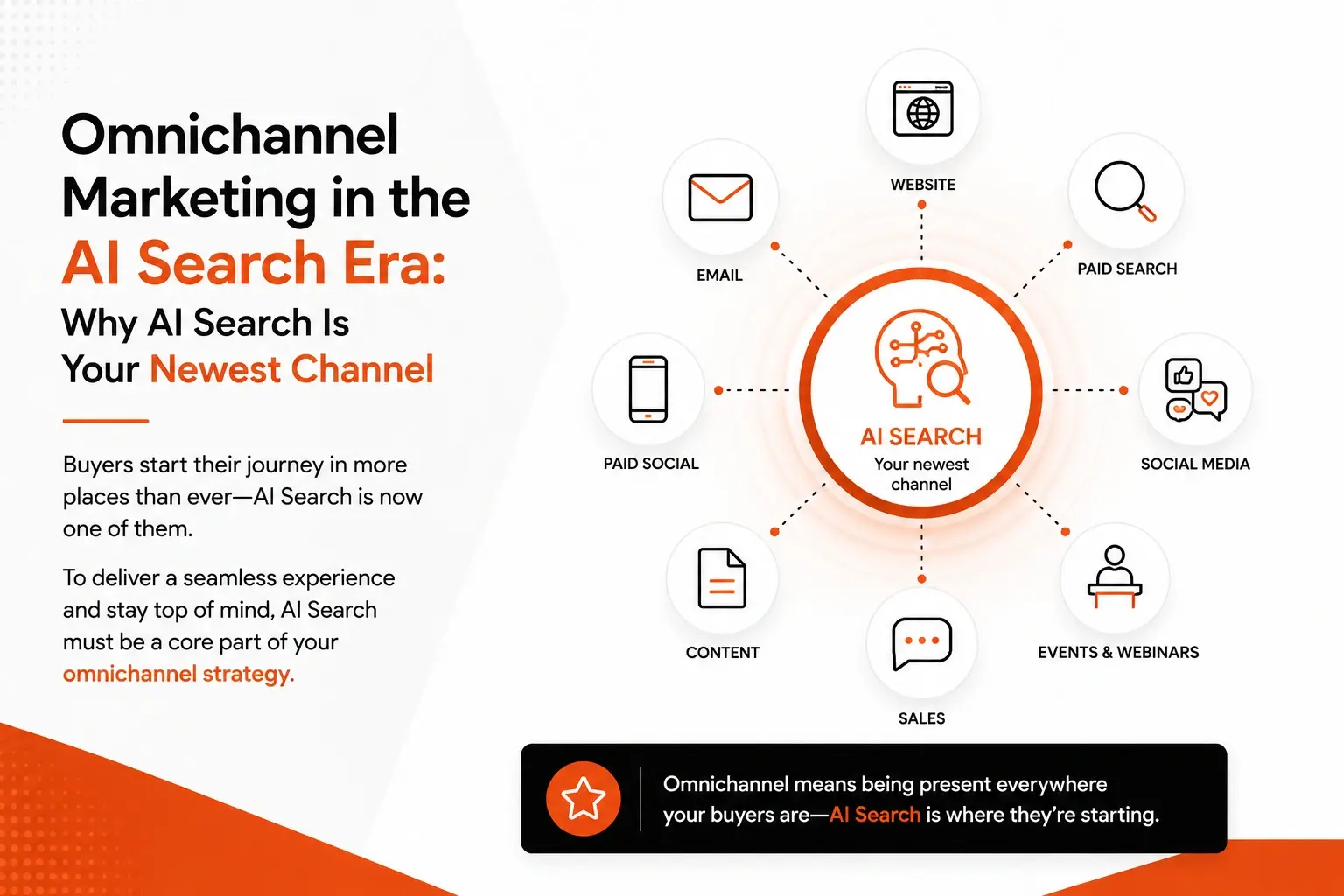


Omnichannel marketing has always been about meeting buyers wherever they are. For years, that meant coordinating messaging across websites, email, paid search, social media, and events. But the places where buyers begin their journey have fundamentally changed. Today, many B2B buyers start by asking AI-powered search platforms a question. Before they visit your website, download a guide, or speak to sales, they often discover brands through AI-generated answers. AI Search has become another customer touchpoint, and ignoring it creates gaps in your omnichannel experience.
Omnichannel Marketing Has a New Channel
Traditional omnichannel strategies focused on a familiar set of channels: your website, email, paid search, social media, and events. Marketing teams built workflows around these touchpoints, measured performance within each one, and worked to create consistent experiences across them.
That model is no longer complete. Buyer discovery now happens across AI-powered search platforms, traditional search, social platforms, communities, websites, and sales conversations. The buyer journey is not linear. It branches, loops back, and jumps between channels in ways that legacy omnichannel frameworks were never designed to handle.
AI Search has emerged as a distinct touchpoint where buyers form their first impressions of your brand. When a prospect asks a question and receives an AI-generated answer, your brand may be mentioned, cited, or entirely absent. That moment shapes whether the buyer continues toward your website or moves toward a competitor. For B2B marketing teams, this means marketing funnel optimization must now account for AI Search as a discovery layer that sits ahead of every other channel.
How AI Is Redefining the Role of Marketers in B2B Advertising
AI is redefining the role of B2B marketers by shifting their focus from managing individual channels to understanding buyer intent, optimizing AI Search visibility, and orchestrating connected customer experiences. Instead of relying on assumptions, marketers use customer conversations, AI Search prompts, competitive intelligence, and market signals to guide strategy. Omnibound brings these intelligence sources together, helping teams prioritize content, improve AI visibility, and deliver consistent experiences across every marketing channel.
AI Search Is the First Customer Interaction
Consider how the buyer journey has shifted. The traditional path looked like this: a buyer searches, lands on your website, subscribes to your email, and eventually speaks to sales. Each step was measurable and sequential.
The modern journey looks different:
- Buyer Question — A buyer formulates a question about a problem they need to solve.
- AI Search — They ask an AI-powered search platform for recommendations and insights.
- Brand Discovery — The AI generates an answer that either includes or excludes your brand.
- Website — If your brand appears, the buyer may visit your website to learn more.
- Sales — The buyer eventually connects with sales, often already informed by what AI Search told them.
This shift means marketing teams should now include AI Search within omnichannel planning. When buyers form opinions through AI-generated answers before they ever reach your website, your content strategy needs to account for that moment of discovery. Teams that understand how AI-powered search experiences affect buyer journeys can build content strategies that win in AI Search rather than losing ground to competitors who moved earlier.
Traditional Omnichannel vs AI-First Omnichannel
The difference between traditional and AI-first omnichannel marketing is not about replacing existing channels. It is about adding a layer of buyer discovery that traditional frameworks overlooked.
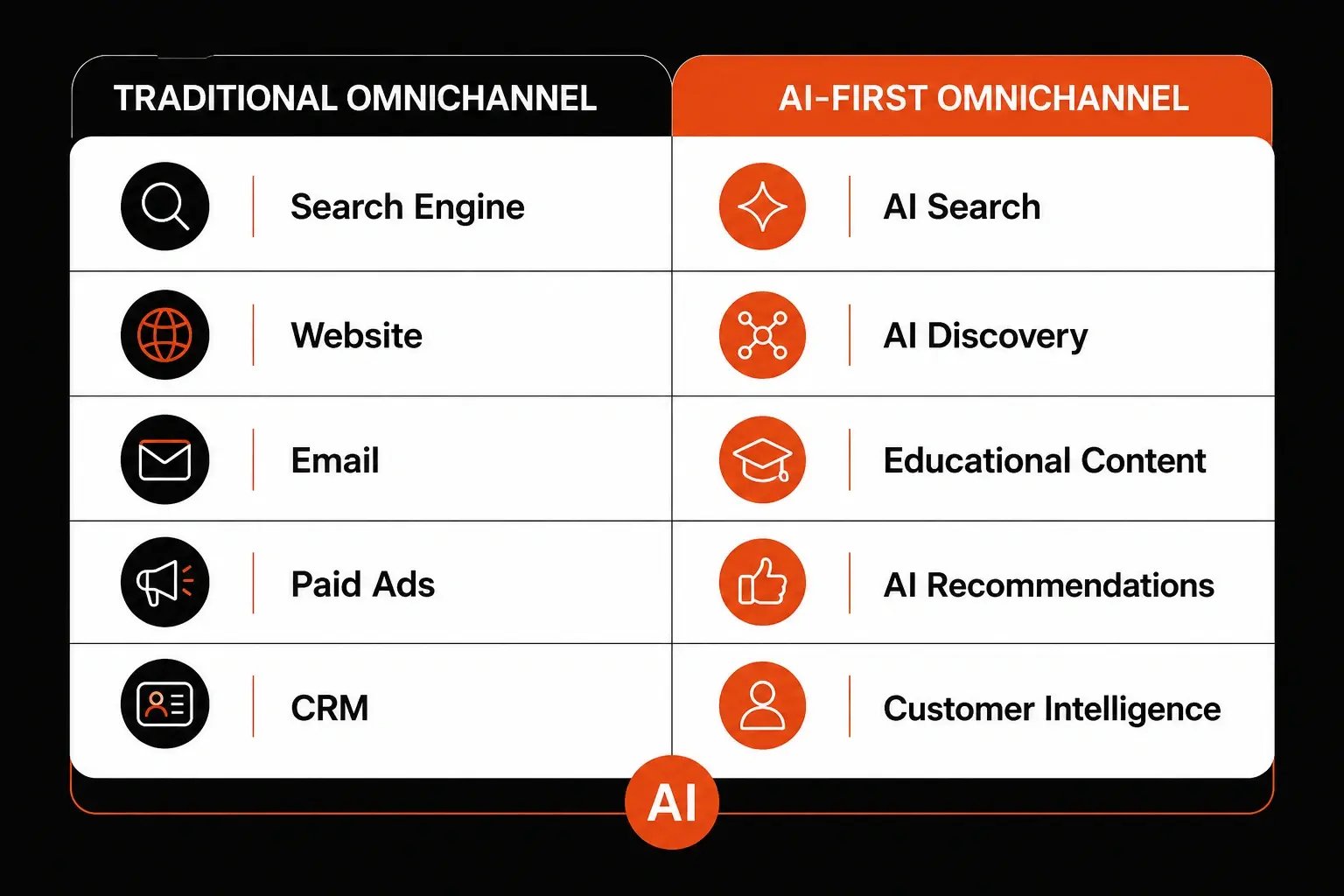
In a traditional model, search engines drove traffic to your website, email nurtured prospects, paid ads captured demand, and CRM tracked interactions. In an AI-first model, AI Search becomes the initial discovery point, AI-generated answers determine whether your brand enters the conversation, educational content builds trust before direct contact, AI recommendations influence buying decisions, and customer intelligence replaces static CRM data as the foundation for understanding what buyers need.
This comparison is not about choosing one column over the other. The most effective B2B omnichannel marketing strategies integrate both. They maintain strong email programs, paid media, and social presence while adding AI Search Visibility as a measured, managed channel.
AI Search Connects Every Channel

AI Search does not operate in isolation. It feeds into and reinforces every other channel in your omnichannel strategy. When buyers receive AI-generated answers that mention your brand, their subsequent actions ripple across your entire marketing ecosystem.
At the awareness stage, AI Search introduces your brand to buyers who may never have found you through traditional search alone. AI-powered answers synthesize information from multiple sources, meaning your brand can appear in front of buyers who are exploring a category rather than searching for your company by name.
At the education stage, buyers use AI Search to dig deeper. They ask follow-up questions, compare options, and evaluate approaches. The content your team publishes becomes the raw material that AI platforms use to construct their answers. If your content addresses buyer questions clearly and comprehensively, it is more likely to be cited and recommended.
At the evaluation stage, buyers bring information from AI Search into their internal discussions. They arrive at your website, subscribe to your email, or request a sales conversation already informed by what AI told them. This means the quality of your AI Search presence directly influences the quality of every subsequent interaction.
Positioning AI Search as a complementary channel is critical. It does not replace email, paid media, or social. It amplifies them by shaping buyer understanding before those channels ever engage. Teams that invest in Answer Engine Optimization ensure their brand is present at the moment of discovery, making every downstream channel more effective.
Customer Intelligence Powers Omnichannel Experiences
Successful omnichannel marketing begins long before channel selection. It starts with understanding what your buyers are actually asking, what conversations they are having, and what market trends are shaping their decisions. This is where customer intelligence becomes the foundation for every channel.
Too many marketing teams start with channels and work backward to content. They plan an email campaign, then try to figure out what to say. They launch a paid media program, then scramble to create landing pages. This channel-first approach produces disconnected experiences because it skips the most important step: understanding the buyer.
Customer intelligence flips that sequence. It begins with:
- Buyer questions — What problems are buyers trying to solve? What are they asking AI Search platforms?
- Customer conversations — What language do buyers use in sales calls, support tickets, and community discussions?
- Market trends — How is the competitive landscape shifting? What new approaches are emerging?
- Competitive positioning — Where are competitors winning in AI Search, and where are the gaps your brand can fill?
When you start with buyer questions and customer conversations, your content across every channel becomes more relevant. Your email programs address real concerns. Your website content answers the questions buyers actually ask. Your sales team receives materials that reflect what prospects have already learned through AI Search. This alignment is what makes an omnichannel customer journey feel seamless rather than fragmented.
Investing in customer persona research ensures your omnichannel strategy is grounded in reality rather than assumptions. The most effective teams treat buyer understanding as a living practice that evolves as conversations and market conditions change.
One Content Strategy, Multiple Channels
One of the most significant advantages of treating AI Search as an omnichannel touchpoint is content efficiency. A single, well-constructed content asset can support multiple channels simultaneously, reducing production costs while increasing reach.
Consider a research-backed guide on a topic your buyers care about. When built from customer intelligence and grounded in real buyer language, that asset can serve several purposes:
- AI Search — The guide's clear, comprehensive answers increase the likelihood your brand is cited in AI-generated responses.
- Traditional SEO — The same content ranks for relevant queries, capturing demand from conventional search.
- LinkedIn — Key insights from the guide become social posts that drive engagement and awareness.
- Email — The guide serves as a nurture asset that moves prospects through the buyer journey.
- Sales Enablement — Sales teams use the guide to support conversations with informed prospects.
- Customer Education — Existing customers reference the guide to deepen their understanding and expand usage.
This approach stands in contrast to producing separate content for each channel, which fragments messaging and drains resources. A unified content strategy built on B2B content production best practices ensures every asset earns its keep across the full omnichannel landscape.
The key is producing AI-citable content that answers buyer questions directly and comprehensively. Content that performs well in AI Search tends to perform well everywhere else because it addresses what buyers actually need to know.
Measuring Modern Omnichannel Success
Measurement frameworks need to evolve alongside the channels they track. Traditional omnichannel metrics remain valuable, but they no longer tell the complete story.
Traditional metrics focus on channel-level activity: email opens, website visits, click-through rates, and conversions. These metrics tell you what happened after a buyer engaged with your channels. They do not tell you what happened before.
Modern omnichannel measurement adds visibility into the discovery phase:
- AI visibility — How often does your brand appear in AI-generated answers across relevant prompts?
- Buyer discovery — Are buyers finding your brand through AI Search before they reach your website?
- AI citations — Which of your content assets are being cited by AI-powered search platforms?
- Engagement quality — Are buyers who arrive from AI Search more informed and further along in their journey?
- Content effectiveness — Which content assets perform across multiple channels rather than just one?
- Pipeline influence — How does AI Search presence correlate with deal progression and revenue?
These metrics are not replacements for traditional ones. They are extensions that complete the picture. A marketing team that reports strong email open rates but has no visibility into whether their brand appears in AI-generated answers is working with an incomplete view of their omnichannel performance.
For teams focused on brand marketing, AI Search metrics provide early indicators of brand presence and competitive positioning. If your competitors are consistently cited in AI-generated answers and your brand is not, that gap will eventually show up in every downstream metric.
Building an AI-Ready Omnichannel Strategy
Creating an omnichannel strategy that includes AI Search requires a practical framework. The following approach connects customer intelligence to channel execution and performance measurement in a continuous loop.
1. Customer Intelligence — Begin by gathering and analyzing buyer questions, conversations, and feedback. Understand what your buyers are asking across every stage of their journey. This becomes the foundation for all subsequent decisions.
2. Market Intelligence — Track market trends, emerging topics, and shifts in buyer behavior. Markets move quickly, and your omnichannel strategy needs to reflect current conditions rather than outdated assumptions.
3. Competitive Intelligence — Analyze where competitors are winning in AI Search and where gaps exist. Identify prompts where competitors are cited and your brand is missing. These gaps represent immediate opportunities.
4. AI Search Intelligence — Monitor the specific prompts your buyers are asking across AI-powered search platforms. Track which domains are being cited and how your brand compares. This is where AI Search Intelligence becomes essential for understanding your visibility landscape.
5. Content Strategy — Use intelligence from the previous steps to prioritize content creation. Focus on producing AI-citable content that answers buyer questions comprehensively and clearly. Ensure content supports multiple channels rather than serving a single purpose.
6. Channel Distribution — Distribute content across your omnichannel ecosystem: website, email, social, paid media, and sales enablement. Each channel receives content tailored to its format while maintaining consistent messaging.
7. Performance Measurement — Track both traditional and modern metrics. Measure AI visibility alongside email engagement, website traffic alongside AI citations, and pipeline influence across all touchpoints.
8. Continuous Improvement — Feed measurement insights back into customer intelligence. When you identify a gap in AI Search visibility, update your content. When you notice a shift in buyer questions, adjust your strategy. This creates a living research engine that keeps your omnichannel approach current.
This framework is not a one-time exercise. It is a cycle that repeats as buyer questions evolve, market conditions shift, and AI-powered search platforms update their behavior. Teams that commit to continuous research and improvement build omnichannel strategies that remain effective as the landscape changes.
How Omnibound Supports AI-Ready Omnichannel Marketing
Omnibound is a Marketing Intelligence Platform that helps B2B marketing teams build connected omnichannel strategies grounded in real buyer understanding. Rather than functioning as a CRM or marketing automation tool, Omnibound focuses on the intelligence layer that makes every channel more effective.
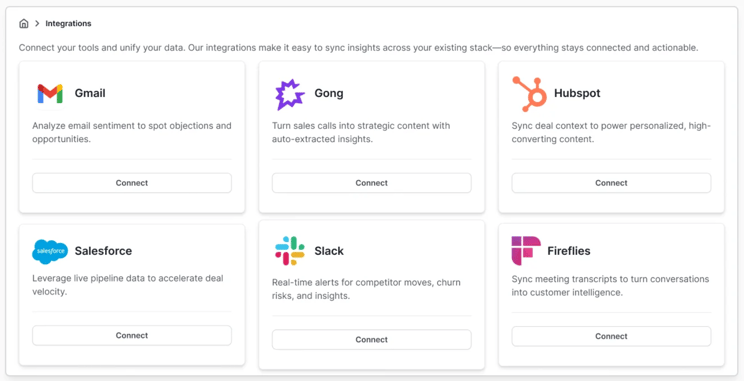
Omnibound helps marketing teams:
- Understand customer questions — Capture and analyze what buyers are actually asking across sales conversations, support interactions, and community discussions.
- Identify buyer intent — Surface the topics, themes, and concerns that signal where buyers are in their journey and what they need next.
- Monitor market shifts — Track changes in buyer behavior, competitive positioning, and market trends that affect omnichannel strategy.
- Improve AI Search visibility — Track prompts, citations, and gaps across AI-powered search platforms so your brand appears in the answers buyers receive.
- Prioritize content — Use intelligence to determine which content investments will drive the greatest impact across AI Search and traditional channels.
- Optimize customer journeys across channels — Connect buyer discovery through AI Search to website engagement, email nurturing, and sales conversations in one coherent experience.
By combining Customer Intelligence, Market Intelligence, Competitive Intelligence, and AI Search Intelligence, Omnibound gives B2B marketing teams the foundation they need to build omnichannel strategies that reflect how buyers actually discover and evaluate solutions today.
Conclusion
Omnichannel marketing is no longer limited to email, websites, paid media, and social channels. Modern B2B buyers increasingly begin their journey through AI-powered search experiences, forming opinions and shortlisting vendors before they ever reach your owned channels. Organizations that treat AI Search as a core customer touchpoint create more connected buyer journeys, stronger brand visibility, and better marketing performance across every channel they operate.
The teams that adapt earliest will build durable advantages. They will show up in AI-generated answers while competitors are still optimizing for yesterday's search landscape. They will produce content that works across AI Search, traditional search, social, email, and sales because it is grounded in what buyers actually need. And they will measure success with a complete view of the buyer journey rather than a partial one.
AI Search is not replacing your existing channels. It is the newest one, and it may be the most important touchpoint your buyers encounter before they ever know your name.
Frequently Asked Questions
What is omnichannel marketing?
Omnichannel marketing is the practice of creating consistent, connected customer experiences across multiple marketing touchpoints, including websites, email, paid media, social media, events, and increasingly, AI Search. The goal is to ensure buyers receive coherent messaging and relevant content regardless of which channel they engage with.
How is AI Search changing omnichannel marketing?
AI Search is introducing a new discovery layer into the buyer journey. Before buyers visit websites or engage with marketing channels, they often ask AI-powered search platforms questions and receive AI-generated answers. This means brand visibility in AI Search now shapes whether buyers enter your omnichannel experience at all.
Should AI Search be part of an omnichannel strategy?
Yes. AI Search has become a customer touchpoint where buyers form first impressions and shortlist vendors. Treating it as a complementary channel within your omnichannel strategy ensures you are present at the moment of discovery rather than losing buyers to competitors who appear in AI-generated answers.
How does customer intelligence improve omnichannel marketing?
Customer intelligence provides the foundation for every channel by revealing what buyers are actually asking, what language they use, and what concerns they have. When content across all channels is grounded in real buyer questions rather than assumptions, every touchpoint becomes more relevant and effective.
How do AI-powered search experiences affect buyer journeys?
AI-powered search experiences reshape the buyer journey by moving brand discovery ahead of direct channel engagement. Buyers arrive at your website, email programs, and sales conversations already informed by what AI Search told them. This changes what content they need, what questions they ask, and how quickly they move through evaluation.
How do marketers create connected customer experiences?
Marketers create connected experiences by starting with customer intelligence, producing content that answers real buyer questions, distributing that content across multiple channels, and measuring performance across both traditional and AI Search metrics. The key is consistency grounded in genuine buyer understanding rather than channel-by-channel tactics.
What metrics matter in modern omnichannel marketing?
Modern omnichannel marketing requires both traditional metrics, such as email opens, website visits, and conversions, and newer metrics, including AI visibility, buyer discovery, AI citations, engagement quality, content effectiveness, and pipeline influence. Together, these metrics provide a complete picture of how buyers discover and engage with your brand.
How can companies improve AI Search visibility across marketing channels?
Companies can improve AI Search visibility by producing AI-citable content that directly answers buyer questions, monitoring which prompts their buyers are asking, tracking where their brand appears or is missing in AI-generated answers, and continuously updating content based on evolving buyer needs and competitive positioning.
What Are the Best Marketing Automation and Personalization Platforms for B2B Omnichannel Marketing?
The best B2B omnichannel marketing platforms combine marketing automation with customer intelligence, AI Search visibility, personalization, and cross-channel coordination. Rather than automating campaigns alone, they connect buyer questions, CRM data, AI-generated recommendations, content, and engagement signals into a unified workflow. Omnibound provides the intelligence layer that helps marketing teams prioritize content, strengthen AI Search performance, and personalize buyer journeys across every channel.
Which Marketing Tasks Are Best Suited for AI Automation in a B2B Tech Role?
AI is most effective at automating repetitive, data-intensive marketing tasks such as analyzing customer conversations, identifying buyer intent, monitoring AI Search visibility, tracking competitor activity, prioritizing content opportunities, and surfacing market trends. Automating these activities allows marketers to focus on strategy and execution. Omnibound continuously transforms customer, market, competitive, and AI Search intelligence into actionable recommendations that improve omnichannel marketing performance.
What Role Do All-in-One Marketing Platforms Play in Content Development?
All-in-one marketing platforms improve content development by connecting customer intelligence, AI Search insights, CRM data, and buyer behavior into a single source of truth. This enables teams to create content that answers real buyer questions consistently across channels instead of producing disconnected assets. Omnibound uses these connected intelligence sources to prioritize high-impact content, improve AI citations, and strengthen omnichannel customer experiences.