


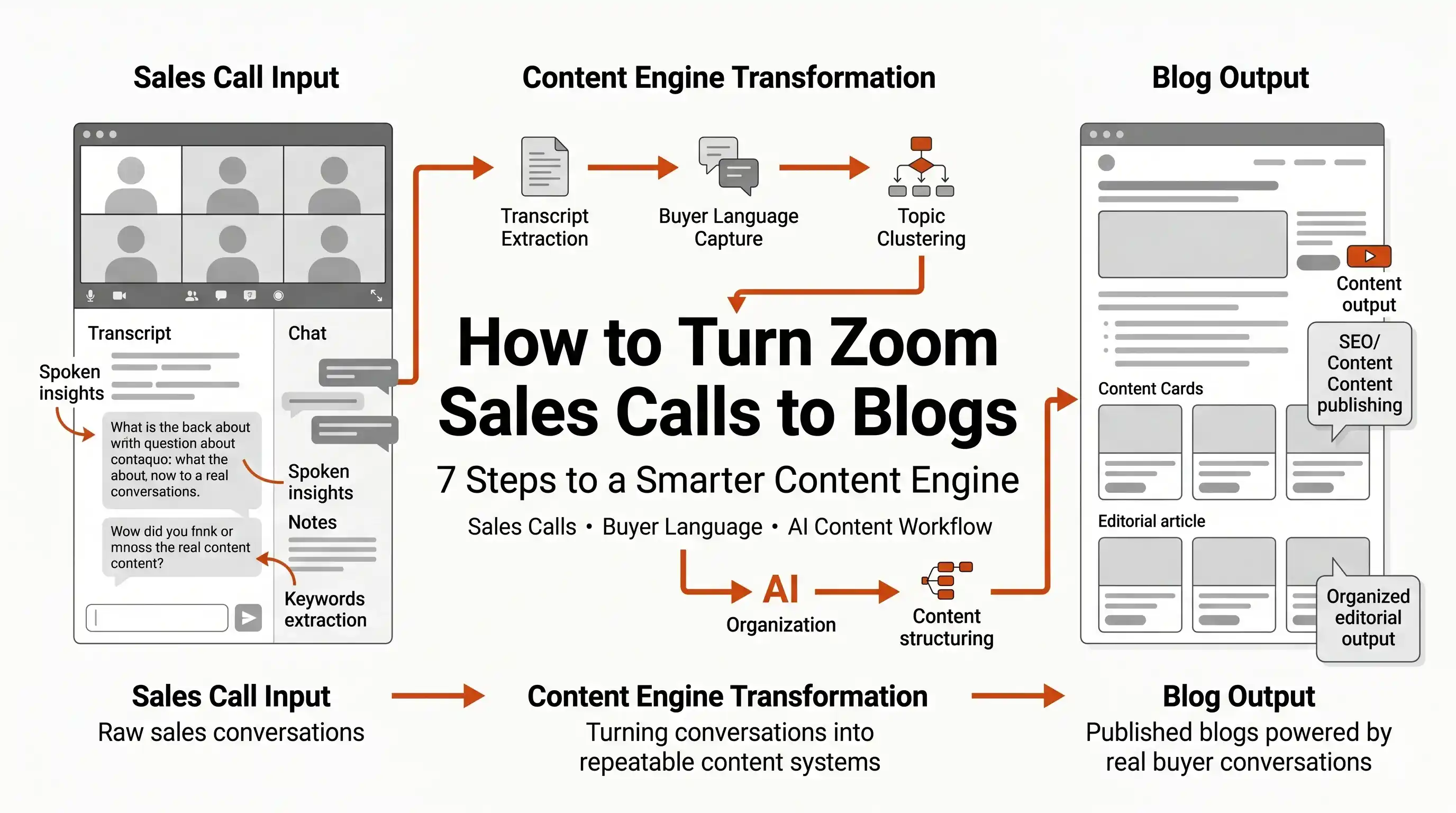


Table Of Contents
Turning Zoom sales calls to blogs is one of the highest-leverage content moves a B2B team can make in 2026, and the numbers make a compelling case: the average B2B buyer now consumes 5 to 8 pieces of content before they are ready to engage with a salesperson. Every call your sales team records is a direct window into exactly what that content needs to say, in the exact language your buyers already use.
Why Zoom Sales Calls Are Your Most Underused Content Asset
Most B2B content teams spend hours brainstorming topics, running keyword analysis, and producing articles that feel disconnected from what buyers actually care about. Meanwhile, the sales team holds calls every single day that are packed with the exact insights content teams are searching for.
Every Zoom sales call contains a remarkably dense set of content signals:
- Real buyer language (the exact words and phrases buyers use to describe their pain)
- Unanswered questions (natural FAQ material)
- Objections (ideal for positioning and educational content)
- Competitive comparisons (gold for comparison and differentiation blogs)
- Emotional buying drivers (the "why now" content that resonates)
- Decision-making criteria (the specifics buyers weigh before choosing a solution)
Step 1: Record and Transcribe Every Zoom Sales Call
The foundation of turning Zoom sales calls to blogs is a reliable, automated transcription process. Zoom's native transcription features provide a starting point, but connecting your call recordings directly into an intelligent content workflow is where the real efficiency begins.
Platforms built for this purpose, such as the Omnibound integration suite, automatically ingest Zoom call recordings and transcripts, making them immediately available for analysis. No manual downloading. No copy-pasting. The call ends and the content workflow begins.
The goal at this stage is simple: create a searchable, structured record of every customer conversation your team has.
Step 2: Extract Buyer Language From Zoom Call Transcripts
This is where the real intelligence work happens, and it is the step most teams skip entirely. Raw transcription is not enough. The value is in identifying the specific phrases, emotional triggers, and urgency signals buried inside the conversation.
During buyer language extraction, your team (or an AI-assisted workflow) looks for:
- Exact phrases buyers use to describe their problem
- Words that signal urgency ("we need this by Q3," "our current system is breaking")
- Success metrics buyers mention ("we need to cut content production time by half")
- Emotional wording that reveals frustration, fear, or aspiration
Did You Know?
The average B2B buyer consumes 5 to 8 (and up to 11) pieces of content before they are ready to engage with a salesperson. Every Zoom call you record is a blueprint for the content that gets them there.
Step 3: Cluster Zoom Call Themes Into Content Opportunities
Once buyer language is extracted from multiple calls, the next step is grouping related signals into content themes. This clustering process is what turns isolated conversation moments into a scalable content calendar.
|
Conversation Theme |
Blog Content Opportunity |
|
Pricing and ROI concerns |
ROI justification and cost-comparison blog |
|
Confusion about AI capabilities |
Educational "what AI actually does" explainer |
|
Onboarding and implementation worries |
Step-by-step implementation guide |
|
Competitive platform comparisons |
Side-by-side differentiation blog |
|
Measurement and reporting gaps |
Content analytics and attribution guide |
Step 4: Build a Blog Outline From Zoom Call Data
With a clear content theme identified and buyer language in hand, building the blog outline becomes a structured process rather than a creative exercise. We recommend a consistent framework that keeps every piece grounded in real buyer intelligence:
- Problem statement (framed in the buyer's own words from the call)
- Supporting customer insight (a direct quote or paraphrased objection from the transcript)
- Context and analysis (why this problem matters and what it signals)
- Solution pathway (how the problem gets solved, with specifics)
- Strategic takeaway (what the reader should do next)
The Omnibound content marketing solution includes a Blog Agent built specifically to transform transcript data into structured blog outlines and full drafts using this kind of buyer-intelligence-first approach.
Step 5: Use AI to Accelerate Zoom Sales Call Content Production
This is the step where AI earns its place in the workflow. And the nuance here matters enormously: AI accelerates production. Customer conversations provide the substance.
When AI is applied to raw keyword assumptions, the output is generic. When AI is applied to buyer language extracted from real Zoom sales calls, the output is sharp, specific, and resonant.
Here is what AI does well in a Zoom sales calls to blogs workflow:
- Summarizing lengthy transcripts into core themes
- Identifying patterns across multiple calls at scale
- Generating multiple outline variations from a single theme cluster
- Expanding bullet-point frameworks into full blog drafts
- Suggesting related subtopics based on semantic analysis of buyer language
Step 6: Apply Voice-of-Customer Intelligence Across Your Content Strategy
The most powerful shift that comes from systematically turning Zoom sales calls to blogs is not just the individual pieces of content produced. It is the development of a continuous voice-of-customer intelligence system that informs your entire content strategy.
When sales call data flows regularly into your content workflow, your team gains access to:
This moves your content operation from reactive (responding to trends after they peak) to proactive (owning topics while they are still emerging). Our AI search intelligence tools help teams track where this content is being cited and how to continuously refine the strategy based on real performance signals.
Did You Know?
81% of sales professionals using AI-driven conversation intelligence report significantly shorter deal cycles. When you build a content engine from those same conversations, the feedback loop accelerates the entire revenue cycle, not just content production.
Step 7: Avoid These Common Mistakes When Turning Zoom Calls Into Blogs
Even teams with the right intent often stumble at execution. Here are the most common mistakes we see when organizations first attempt converting Zoom sales calls to blogs, and how to avoid them.
Mistake 1: Publishing raw transcript summaries
A transcript summary is not a blog post. It lacks structure, narrative arc, and reader value. Transcripts are raw material. They require extraction, clustering, and intentional shaping before they become publishable content.
Mistake 2: Removing the customer's actual language during editing
Editors often "clean up" buyer language in favor of polished corporate prose. This eliminates the most valuable element. Preserve the buyer's exact phrasing wherever it is appropriate and impactful.
Mistake 3: Relying entirely on AI rewriting without buyer intelligence input
AI rewriting without grounded customer context produces content that sounds professional but says nothing meaningful. Always start with real call data before engaging AI assistance.
Mistake 4: Treating each call in isolation
Single calls are useful. Patterns across dozens of calls are transformative. Build a system that aggregates signals over time rather than processing calls one-off.
Mistake 5: Extracting quotes without context
A quote pulled from a call without the surrounding context can misrepresent the buyer's intent entirely. Always preserve enough surrounding conversation to understand what the buyer was actually expressing.
Our content audit tools can help teams identify whether their existing call-sourced content is performing well and where gaps remain.
This is precisely where Omnibound's AI marketing solutions operate. Rather than functioning as a simple writing tool, Omnibound acts as an intelligence layer that transforms customer conversations, market signals, buyer language, and competitive context into a coordinated content strategy. The content workflows guide walks through exactly how this system is built and maintained.
FAQs
- How do you turn Zoom sales calls into blog content step by step?
Record, transcribe, extract buyer insights, cluster themes, build an outline, and use AI to create a blog from real sales conversations. - What tools are best for converting sales call transcripts into blogs in 2026?
The best tools combine transcript ingestion, AI analysis, buyer language extraction, and blog generation in one workflow. - Is turning Zoom sales calls into blogs worth it for B2B content teams?
Yes — sales call content is grounded in real buyer language and often outperforms assumption-based content. - How can AI analyze sales call transcripts for content marketing?
AI analyzes transcripts by identifying themes, extracting buyer language, and generating structured content ideas. - What is buyer language extraction and why does it matter for blog content?
Buyer language extraction captures real customer wording to make content more relevant, credible, and engaging. - How many blog posts can you realistically get from one Zoom sales call?
One 45-minute sales call can generate 3–5 blog ideas, with multiple calls fueling an entire content calendar. - What is the difference between call repurposing and conversation intelligence for content?
Call repurposing uses single-call content, while conversation intelligence turns ongoing call data into a scalable content strategy.
Turn Your Content Into AI-Search Winners
Get cited across ChatGPT, Claude & Perplexity — not just ranked on Google.
- Increase AI citations
- Improve answer visibility
- Track brand mentions in LLMs
.webp?height=245&name=10%20Ways%20AI%20Semantic%20Analysis%20Improves%20B2B%20Content%20Strategy%20in%20the%20AI%20Search%20Era%20(2).webp)

.webp?height=245&name=How%20AI%20Builds%20a%20Consistent%20Brand%20Voice%20from%20Real%20Customer%20Signals%20(2).webp)