.webp)


Research Is No Longer an Annual Marketing Activity
For years, B2B marketing teams treated research as a checkpoint. Teams commissioned a study before a product launch, refreshed personas before annual planning, and pulled competitive intel before a big campaign. Research had a start date and an end date, and once the report shipped, the team moved on until the next planning cycle.
That model made sense when markets moved slowly. It does not make sense now. Buyer questions shift week to week. Competitors update messaging on a rolling basis, not once a year. AI Search has changed how buyers find vendors, compare options, and form opinions before a sales conversation ever happens.
Marketing teams that still treat research as a quarterly deliverable are working from information that is already out of date by the time it reaches a campaign brief. What teams need instead is continuous research: an ongoing, always current view of customers, markets, competitors, and how AI Search platforms are shaping buyer discovery.
Omnibound built Marketing Living Research Engine around this idea. Instead of a one-time snapshot, it keeps buyer understanding and market context current as new signals come in, so marketing decisions are grounded in what is true right now, not what was true last quarter.
Why Traditional Marketing Research Is No Longer Enough
Static research has a shelf life. A survey completed in January describes buyers as they were in January. By the time a report is analyzed, formatted, and presented to stakeholders, the buying committee has often changed, the objections have shifted, and a competitor has already repositioned around the exact gap the report identified.
Modern marketing teams need visibility into things that change constantly:
- The specific questions buyers are asking, in their own words, right now
- How competitors are adjusting messaging and where they are creating overlap or whitespace
- Which topics and trends are gaining traction in the market this month, not last year
- How a brand actually shows up when buyers use AI Search to research a category, compare vendors, or shortlist options
None of these are one-time questions. They require ongoing attention. Research has to become a standing capability inside marketing operations, not a project that gets scoped, delivered, and archived. Teams that treat Customer Persona Research as a living input rather than a static deliverable are the ones adapting messaging fast enough to matter.
Four Intelligence Streams Every Marketing Team Needs
Continuous marketing intelligence is not one activity. It is four connected streams of understanding that, together, give marketing teams a complete and current view of the landscape they operate in.
Customer Intelligence
Customer intelligence is the ongoing understanding of buyer questions, pain points, and language. It comes from sales calls, support tickets, reviews, and direct conversations, and it updates as those conversations happen rather than on a fixed schedule. This is what allows a marketing team to notice a new objection the same week it starts appearing, instead of the following quarter.
Market Intelligence
Market intelligence tracks the topics, trends, and industry shifts that shape how buyers think about a category. It answers questions like which themes are gaining attention, which are fading, and where the market narrative is heading next. Without this stream, content and campaigns end up reacting to trends after competitors have already claimed them.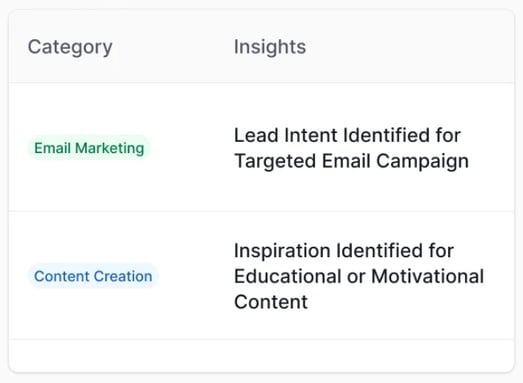
Competitive Intelligence
Competitive intelligence monitors how rivals position themselves, what messaging they are testing, and where whitespace exists. This is not a one-time battlecard exercise. Competitors change their pitch constantly, and marketing teams need ongoing visibility into those changes to keep positioning sharp and differentiated.
AI Search Intelligence
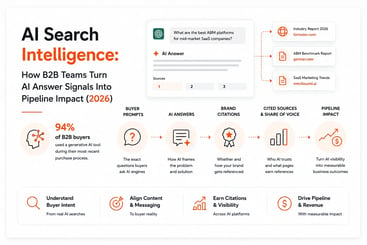
AI Search Intelligence is the newest and most overlooked stream. It tracks how AI-powered search platforms surface brands, answer buyer questions, and shape which vendors even make it into consideration. A brand can be well known in traditional channels and still be invisible in AI-generated answers if its content is not built to be cited. Understanding this gap requires ongoing monitoring, not a single audit.
Together, these four streams form the foundation of continuous marketing intelligence: understand the customer, understand the market, understand the competition, and understand how AI Search is reshaping discovery. Miss any one of them, and decisions get made with an incomplete picture.
Research Should Drive Every Marketing Decision
Research that lives in a slide deck does not influence anything. Research that flows directly into decision-making changes how a team operates. Continuous intelligence should show up in every part of the marketing function:
- Content strategy: topics and angles reflect what buyers are actually asking right now
- Campaign planning: priorities shift based on live signals instead of a fixed annual calendar
- Messaging: language mirrors real buyer vocabulary, not assumptions from a year-old persona document
- Go-to-market strategy: launches and expansions account for current competitive positioning
- Product marketing: positioning adjusts as buyer pain points evolve
- Brand marketing: narrative stays aligned with how the market is actually talking about the category
This is the shift from research as a support function to research as a decision engine. When intelligence is continuous, it stops being a reference document and starts being the thing that determines what gets built, published, and prioritized each week. Teams applying this thinking to Brand Marketing are seeing narrative consistency improve because messaging decisions are grounded in current signals rather than a static brand book.
AI Search Is Creating a New Research Requirement
AI Search has introduced a research need that did not exist a few years ago. Buyers now ask AI platforms direct questions about vendors, categories, and comparisons, and the answers those platforms generate shape opinions before a buyer ever visits a website.
To compete in this environment, marketing teams need ongoing answers to a specific set of questions:
- What are buyers actually asking AI platforms about this category?
- Which brands are being recommended, and why?
- Where are the visibility gaps, meaning topics or questions where a brand is absent from AI-generated answers?
- Which themes and topics currently dominate AI-generated responses in this space?
These are not questions a single audit can answer permanently, because AI-generated answers change as content, citations, and competitor activity change. This is exactly where AI Search Intelligence fits inside the broader research function. It requires the same continuous approach as customer and competitive intelligence, applied to a new discovery channel. Teams that connect this work to AI Search Visibility tracking are able to see, in near real time, whether their content is being surfaced or overlooked.
From Research to Action
Continuous intelligence only creates value if it moves through a clear workflow, not if it sits in a dashboard waiting to be reviewed. A practical version of this workflow looks like this:
Customer signals feed market intelligence. Market intelligence is checked against competitive intelligence. Competitive intelligence is combined with AI Search Intelligence to identify visibility gaps. Those combined signals inform strategic prioritization. Prioritization drives marketing execution: content, campaigns, and messaging updates. Execution is followed by performance review. Performance review feeds back into the next round of customer and market signals, and the loop starts again.
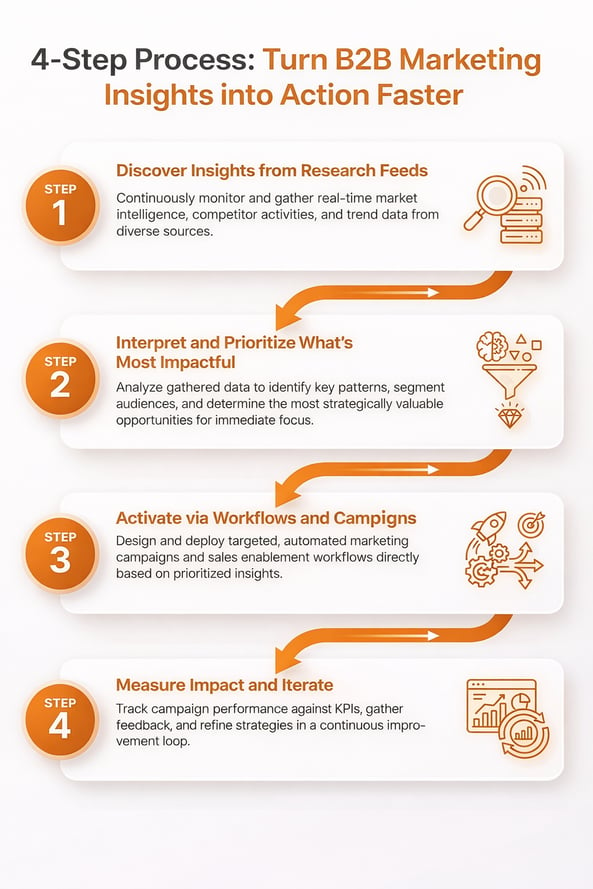
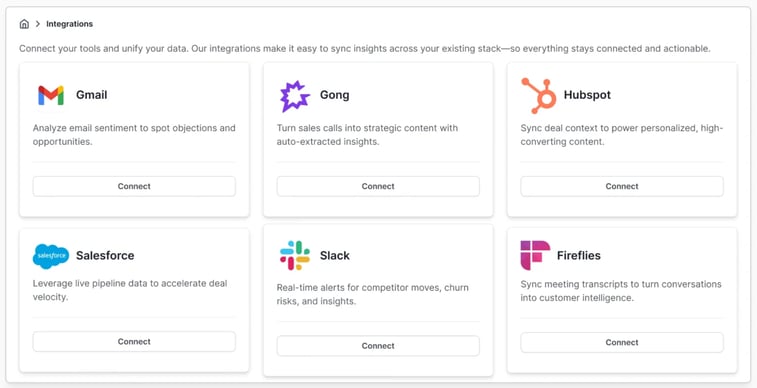
The point of this loop is that research never stops. Every campaign, every piece of content, and every strategic decision becomes an input for the next cycle, rather than a final output. Signals reach the team through the systems they already use for calls, CRM data, and market feeds, which is what makes connected platform integrations a practical requirement rather than a nice-to-have.
Measuring the Impact of Marketing Intelligence
Research output used to be measured by whether a report got delivered. That is the wrong measure for continuous intelligence. The right measures focus on how intelligence changes marketing outcomes:
- Better campaign prioritization, based on live buyer and market signals
- Stronger AI Search visibility, measured by citations and appearances in AI-generated answers
- Faster strategic decisions, with less time between spotting a shift and acting on it
- Improved content relevance, reflected in engagement with current buyer language
- Clearer competitive differentiation, based on ongoing positioning comparisons
- Direct pipeline contribution, tracked against campaigns informed by continuous intelligence versus those that were not
These metrics shift the conversation from “did we complete the research project” to “did the research change what we did, and did that change move the business.” That is a fundamentally different, and more useful, way to evaluate a research function.
Continuous Research Creates Continuous Growth
High-performing B2B marketing teams do not run research once and file it away. They keep watching customers, competitors, markets, and AI Search on an ongoing basis, and they treat every signal as an input into what comes next.
This creates a feedback loop rather than a series of disconnected projects. Every campaign generates new customer signals. Every competitive move generates new positioning questions. Every shift in AI-generated answers generates new visibility questions. Teams that build this loop into their operating rhythm improve continuously, because they are never working from stale information, and they never have to guess whether a decision still reflects reality.
This is the practical difference between research as an occasional activity and intelligence as a standing capability. One produces documents. The other produces better decisions, made faster, with less risk of acting on outdated assumptions.
How Omnibound Powers Continuous Marketing Intelligence
Omnibound is built as a marketing intelligence platform, not a traditional research tool or reporting dashboard. Its purpose is to keep the four intelligence streams (customer, market, competitive, and AI Search) connected and current, so marketing teams always have a live picture instead of a periodic snapshot.
Specifically, Omnibound helps teams:
- Understand the questions and language buyers are using right now, not last quarter
- Monitor market shifts as they happen, rather than waiting for the next planning cycle
- Identify competitive opportunities and messaging whitespace on an ongoing basis
- Improve AI Search visibility by understanding which topics and questions AI platforms are surfacing
- Prioritize marketing investments based on live signals instead of static assumptions
- Continuously refine strategy as customer, market, and competitive conditions evolve
This is reflected across the platform: the Marketing Data → Actionable Insights capability turns raw signals into prioritized, role-specific recommendations, while connected content workflows carry that intelligence directly into execution. Teams looking to understand the connection between research and content output can review How B2B AI Search Is Rewriting Content Strategy for a closer look at how buyer signals shape what gets published and when.
The goal is not to produce more reports. It is to keep marketing teams working from an accurate, current understanding of buyers, markets, competitors, and AI Search, so every decision, from a single piece of content to a full go-to-market plan, is grounded in what is true today. Teams applying this to funnel work often start with Marketing Funnel Optimization, where campaign prioritization benefits most directly from live signals.
Conclusion
Research is no longer something a marketing team schedules once a quarter. The teams pulling ahead are the ones treating customer intelligence, market intelligence, competitive intelligence, and AI Search Intelligence as a single, continuous capability, feeding every strategic decision they make.
That shift, from static reports to continuous marketing intelligence, is what separates teams reacting to the market from teams shaping how they show up in it, including inside the AI-powered search experiences that now influence how buyers discover and evaluate every vendor in their category.
Frequently Asked Questions
What Does Intelligent Content Orchestration Look Like in Practice for Marketers?
Intelligent content orchestration connects continuous customer, market, competitive, and AI Search intelligence directly to content planning and execution. Instead of relying on static briefs, marketers prioritize topics, messaging, and campaigns using live buyer signals. Omnibound automates this workflow, ensuring every content decision reflects current market conditions and customer needs.
Which Marketing Automation Solutions Are Designed for Lean Teams?
Lean B2B marketing teams benefit most from automation platforms that combine research, customer intelligence, competitive monitoring, and AI Search insights into a single workflow. Omnibound eliminates manual research by continuously synthesizing live signals into actionable recommendations, enabling small teams to make faster, evidence-based marketing decisions with less operational overhead.
What is marketing intelligence?
Marketing intelligence is the ongoing collection and interpretation of customer, market, competitive, and AI Search signals, used to guide marketing decisions in real time rather than periodically.
Why is continuous research important for B2B marketing?
B2B markets change too quickly for static research to stay accurate. Buyer questions, competitor positioning, and market trends shift continuously, and marketing decisions based on outdated research risk missing the moment.
How does AI Search change marketing research?
AI Search adds a new discovery channel that requires ongoing monitoring. Marketing teams now need to understand what buyers ask AI platforms, which brands get recommended, and where visibility gaps exist, all of which change as content and competition evolve.
What is the difference between market research and marketing intelligence?
Market research is typically a defined project with a start and end date, producing a static snapshot. Marketing intelligence is a continuous capability that keeps that understanding current as conditions change.
How do customer intelligence and competitive intelligence work together?
Customer intelligence reveals what buyers care about and how they talk about problems. Competitive intelligence shows how rivals are responding to those same concerns. Combined, they reveal both demand signals and positioning gaps a team can act on.
How can marketing teams improve strategic decision-making?
Teams improve decision-making by connecting all four intelligence streams (customer, market, competitive, and AI Search) into a single, continuously updated view, then using that view to prioritize campaigns, content, and messaging in near real time.
What metrics demonstrate the value of marketing intelligence?
Useful metrics include faster campaign prioritization, improved AI Search visibility, shorter decision cycles, more relevant content, clearer competitive differentiation, and measurable pipeline contribution from intelligence-informed campaigns.
How does continuous research improve AI Search visibility?
Continuous research surfaces the exact questions buyers are asking and the topics AI platforms are prioritizing, allowing marketing teams to create AI-citable content aligned to those questions on an ongoing basis rather than after visibility gaps have already cost them ground.