




Table Of Contents
Today’s content marketing can drive demand, nurture leads, and support revenue, but 74% of marketers say content marketing generated demand or leads in the last year, while many still run everything out of docs, sheets, and scattered tools. That gap between impact and operations is exactly where a modern content marketing platform comes in—a software solution designed to centralize and streamline every aspect of content marketing.
If you’re a CMO, growth marketer, or content leader trying to manage strategy, production, and performance across channels, this guide will walk you through what a content marketing platform really is—a comprehensive suite that integrates planning, collaboration, analytics, and distribution, often including specialized project management features to streamline content planning and execution. You’ll learn how AI is changing it, how these platforms help teams create content, organize, and manage campaigns, and how to choose the right one for your team.
Key Takeaways
|
Question |
Short Answer (Actionable Insight) |
|---|---|
|
What is a content marketing platform? |
A content marketing platform (CMP) is a centralized system that helps marketing teams plan, create, collaborate on, publish, and measure content across channels—often with workflow, robust analytics, and governance built-in. CMPs facilitate collaboration among teams, streamlining communication and teamwork. AI-native CMPs, like the ones powered by an AI-driven marketing context engine, add intelligence on top of that foundation. |
|
How is a CMP different from a CMS or docs tools? |
A CMS publishes content to your website; docs tools help individuals write. A CMP coordinates strategy, workflows, approvals, and multi-channel execution across your whole content operation. Many teams pair a CMP with their existing website and collaboration tools rather than replacing them outright. |
|
What is an AI content marketing platform? |
An AI content marketing platform uses AI agents and insight engines to support ideation, drafting, optimization, personalization, and performance insights. These platforms provide actionable insights derived from data analysis to inform strategy and optimize content effectiveness. For example, AI-native workspaces like the Omnibound AI workspace for content marketing connect live customer and market signals directly into content creation. |
|
Who benefits most from CMP marketing tools? |
B2B organizations with recurring campaigns, large content libraries, or cross-functional teams (content, product marketing, demand gen, customer marketing) benefit most. CMPs help them standardize workflows, centralize assets, and tie content to pipeline and revenue. |
|
Can a CMP replace Notion, Google Docs, and Trello? |
It can replace much of the content planning and workflow work you do there, but many teams still use docs for drafting and collaboration. CMPs such as those with dedicated platform integrations often plug into your existing tools instead of forcing a full switch. |
|
Are AI content marketing tools worth it in 2025? |
With 89% of marketers now using generative AI in their content processes, AI capabilities are moving from “nice to have” to “expected.” Platforms that combine AI agents, orchestration, and context (for example, via an AI insight engine) can help teams move from task automation to decision support and strategy acceleration. |
|
What should I evaluate before choosing a CMP? |
Focus on content volume, team roles, workflow complexity, AI needs, and integrations with your existing stack. A readiness or playbook resource like a marketing AI readiness audit can help you map gaps before you select a platform. |
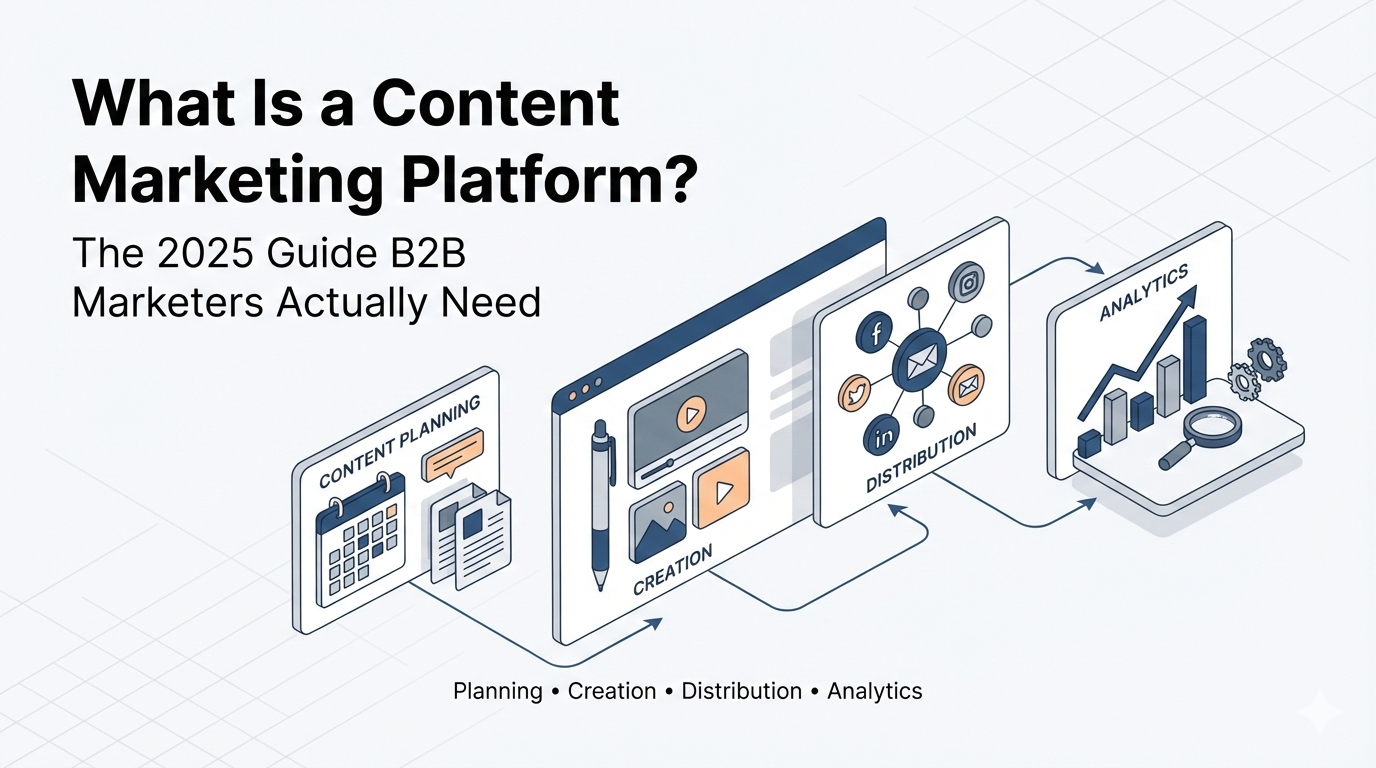
A content marketing platform is a software environment that gives marketing teams a way to plan, create, manage, publish, and analyze content across multiple channels in one place. Think of it as the operational backbone for content - not a writing app, but the system that ties strategy to execution. The majority of CMPs come with features such as editorial calendars, workflow and approvals, asset libraries, robust analytics, and performance dashboards. CMPs also facilitate collaboration among teams, making content creation and campaign execution more synchronized and effective. Newer AI-native platforms take this a notch further, by adding a marketing context engine, AI agents, and orchestration to feed content consistently with customer, market, and competitive signals (as in the case of platforms such as the Omnibound agentic AI platform for marketers).
Why Content Marketing Platforms Exist in the First Place
Content teams began with point tools: a CMS for the website, social schedulers, email platforms, spreadsheets for calendars, and chat for approvals. At low volume this works well, but when you operate dozens of campaigns and hundreds of assets, overhead becomes unbearable. Managing and optimizing content assets within a content marketing platform (CMP) is crucial for streamlining workflows, improving consistency, and maximizing the impact of your content strategy. CMPs came into operation to help bring accountability and clarity to that chaos. Instead of “where’s the latest version?” or “who approved this?”, a CMP centralizes decision-making, workflows, and performance, supporting the entire content lifecycle from creation to distribution, so content can be treated as a system rather than as a bunch of disconnected tasks. And now, AI content marketing platform software brings the additional layer of making those systems adaptive, insight-led environments.
CMP vs CMS vs Social Schedulers vs AI Writing Tools
Content Management System (CMS): A CMS is designed to publish and manage content on your website, such as blog posts and resource pages. While it effectively hosts and renders web pages, it does not coordinate your entire content operation.
Social Media Schedulers: These tools assist in scheduling posts across platforms like LinkedIn, X, Facebook, and others. They are focused on timing and distribution but do not address upstream strategy, approvals, or cross-channel alignment.
Standalone AI Writing Tools: These tools generate draft content based on prompts, significantly speeding up the writing process. However, they do not integrate content with your data, workflows, or business objectives.
Content Marketing Platform (CMP): A CMP orchestrates your overall content strategy, workflows, production processes, approvals, multi-channel publishing, and performance analytics—often encompassing CMS, social media, email, and sales enablement channels. CMPs also include collaboration features that facilitate team cooperation, content reviews, stakeholder feedback, and workflow management. Additionally, integrated digital asset management capabilities enable efficient handling, customization, and distribution of digital assets across channels, supporting content consistency and personalization.
Essentially, a CMP operates above your CMS and various channel tools, guiding the creation, approval, placement, and performance evaluation of your content over time.
Why Content Marketing Platforms Exist: Real Problems Marketers Complain About
If you spend time on marketing communities or in Reddit threads, you will encounter similar content operations complaints. Managing multiple content marketing campaigns without a centralized platform often leads to confusion, missed deadlines, and inconsistent messaging. Before launching CMP marketing tools, teams tend to have little direction, working on a shabby stack made up of Docs, Sheets, Notion, Trello, and email threads from which they can piece together all necessary information. Fragmented tools complicate marketing operations, increase overhead, and make it difficult for teams to collaborate efficiently.
Disconnected Tools and Content Chaos
If strategy lives in slides, briefs live in docs, tasks live in project tools and assets live in haphazard folders, it becomes difficult to answer basic questions - “What are we publishing this week?” or “What materials help with this campaign?” Coordinating multiple stakeholders across these disconnected tools further complicates collaboration, making it hard to ensure alignment and timely input from different departments. All of this fragmentation hinders execution and amplifies errors. A CMP centralizes all these elements into a common office space and streamlines task assignment and tracking within a unified system, so teams can automate task distribution, monitor progress, and ensure timely reviews. For example, an AI workspace for B2B marketing, much like the one provided in Omnibound’s content marketing solutions, connects strategies, briefs, and assets, so teams always see content in context.
No Visibility into Content ROI
There are plenty of B2B teams unable to demonstrate which content is a source of revenue. They view vanity metrics with channel tools, but do not share a cohesive view of how content drives pipeline, opportunities, and deals. Without tracking key metrics such as engagement, conversions, and revenue, it is hard for CMOs to justify headcount or purchases of content marketing platform software. Integrated performance tracking within CMPs provides visibility into campaign success and connects content efforts directly to business outcomes.
Contemporary CMPs resolve this by harmonizing how assets are tagged and tracked for visibility across channels and returning performance to the planning process. AI insight layers like AI insight engine for contextual B2B market insights get even more sophisticated at asset level by surfacing asset-level recommendations that follow the signals of the market and buyer.
Poor Collaboration and Approvals
Another one of the things some argue is that all of this is painful for someone getting it approved on the legal side, compliance side, product end, and sales end of the organization. Comments are lost, version control falters and everyone does last-minute rework. Lacking structured workflows, content has become a bottleneck.
CMPs have good structure with clear stages, owners, SLAs, so that teams know who needs to review what but by what time. These platforms foster collaboration by providing collaborative dashboards, integrated task management, and communication tools that help eliminate silos and promote seamless teamwork across departments. CMPs also include approval workflows to streamline content review and ensure compliance, automating the process and enabling faster, centralized decision-making. Even agent-based systems can route content efficiently according to rules or sensitivity, reducing the burden for content managers to manage manually.
Core Features of a Content Marketing Platform
But while offerings differ, most content marketing platforms have a common set of features. Advanced CMPs provide intuitive tools that simplify complex workflows, making it easier for marketers to manage every stage of content operations. These platforms also enable streamlined processes for content planning, creation, and distribution. How deeply these features are connected to data and automation is what distinguishes entry-level tools from advanced AI content marketing platforms.
Content Planning & Editorial Calendars
Central to any CMP, however, is the editorial calendar. It demonstrates what’s planned, in progress, and published across channels, and is linked to campaigns, personas, and funnel stages. For B2B teams, this often involves blog posts, blog entries, webinars, white papers, case studies, and social content. Editorial calendars help content writers stay aligned with campaign goals and deadlines, ensuring efficient collaboration and timely delivery. Advanced calendars utilize context engines (like the B2B marketing context engine model) to draw connections between their topics and customer signals, competitive activities, and internal priorities. Instead of thinking about it, teams prioritize what content to include according to how the market does.
Collaboration, Approvals & Workflows
Workflow Tools enable teams to take pieces of content from concept to approved assets. Common parts are assigned task work, due dates, review phases, and status reporting. Enterprise CMPs introduce role-based permissions, legal hold stages, and brand-compliance checks. In an AI-native environment, agent-based workflows are able to join directly. For instance, a Blog Agent or Thought Leadership Agent would be able to take a brief, and write its first drafts and produce them, whilst a Sales Enablement Agent would be able to tailor messages for the buyer position at a given moment - saving manual time for production.
Multi-Channel Publishing
Content Marketing Tools are becoming more capable of publishing on websites, blogs, email, social channels, and occasionally even on sales enablement platforms, all in one interface. Modern content marketing platforms (CMPs) also support publishing and managing content across social media platforms, automating content distribution to reach audiences efficiently. This multi channel distribution capability is a key benefit, maximizing campaign reach and engagement. This matters since 84% of B2B marketers use blogs on company websites, and 71% use email newsletters to distribute them, industry research has found. By not copy and pasting into each platform manually, a CMP can adjust formats — long-form for the blog, snippets for LinkedIn, summaries for email, scripts for video — while keeping messaging consistent. AI can recommend tailored versions based on particular populations or phases.
Content Performance Analytics
CMP performance analytics are about more than pageviews or impressions. Leading content marketing platforms provide robust analytics for comprehensive performance measurement, enabling detailed tracking across campaigns, audiences, and funnel stages. These analytics deliver actionable insights that inform content strategy, helping marketers understand which resources drive awareness, engagement, and revenue. Integrated analysis processes within these platforms help identify both opportunities and inefficiencies in content strategy workflows, supporting continuous optimization. Some platforms even provide asset-level recommendations for improving underperforming content. Insight-oriented platforms (such as those which furnish an AI insight engine) bring together insights from reviews, customer feedback, and competitive activity, aiming not just at understanding how content appears, but also at ascertaining why it performs.
Optimization and Governance
CMPs can also come with topic coverage, brand consistency, and compliance capabilities. AI features can also automatically highlight off-brand messaging and missing things on key assets like disclaimers or the ways a product is named to do something — that’s critical for regulated industries and public companies. Automation within a content marketing platform helps reduce repetitive tasks in content management, streamlining workflows and minimizing manual effort. Governance features provide the capability to reuse content and to plan modular content, so teams can develop the authorized parts instead of going to the drawing board to start again. These governance features also support data driven decisions for content optimization, enabling marketers to leverage analytics and insights for better outcomes.
What Is an AI Content Marketing Platform?
An AI content marketing platform is a CMP where AI is embedded into the core workflows—not tacked as some nice-to-have feature. These platforms integrate context engines, AI agents, and orchestration to help in all phases of the lifecycle from insight to execution. AI enables data-driven decision making throughout the content lifecycle by consolidating analytics and surfacing actionable insights, allowing marketers to optimize strategies and track campaign success. More than auto-generating copy for you, AI CMPs ingest customer feedback, competitor content, market trends, and internal resources to inform what you create, how it is placed, and where you publish it. AI-native CMPs also streamline content production by automating key steps, centralizing asset management, and supporting collaborative workflows for greater efficiency. This dynamic is apparent in an agentic AI platform such as Omnibound which is an agentic AI workspace to orchestrate various agents around a common context.
Where AI Shows Up in CMP Marketing Workflows
Content ideation: AI scours reviews, social posts, and competitive content for topic ideas and gaps, generating ideas for engaging content that resonates with audiences.
Draft creation: Blog, Case Study, or Video Script Agents create initial drafts based on structured briefs and brand voice.
Optimization: AI has the potential to recommend changes to the structure, clarity, and channel-specific adaptations for LinkedIn or email.
Performance insights: AI interprets your data and the signs it signals you to take next steps - refreshing assets, making follow-ups or taking shifts in topics.
Personalisation at scale: AI customizes messaging and assets by vertical, persona or account tier with no need to rewrite manually, including the ability to create interactive content such as quizzes or polls.
After 89% of marketers now deploy generative AI tools in their content pipelines – it’s no longer a matter of whether you use AI, it’s a question of how you embed AI into a cohesive, holistic platform.
Not All AI Tools Are Content Marketing Platforms
One must not confuse AI content marketing platforms with standalone AI content marketing tools. A writing assistant that resides in your browser or doc is helpful, but it isn’t a CMP: it does not know your campaigns, your funnel, or your content library. A true content marketing platform is a comprehensive software solution that integrates multiple content marketing functions—such as planning, creation, collaboration, distribution, and performance tracking—into a centralized system.
On the other hand, not all CMPs are AI-native. A number of established platforms are now building AI features into legacy architectures. When considering alternatives, instead of just drafting features, look at the ways AI can be integrated into your data sources, workflows, and governance, and ask how AI connects with them instead of just what features they include.
CMP vs AI Writing Tools vs CMS vs Marketing Automation
A lot of teams question if they require a CMP if they’re already using a CMS, a marketing automation platform, and AI tools. They all have a different role in your stack. Many content marketing platforms also include built-in SEO tools for optimizing content and integrated web analytics for tracking and analyzing content performance.
|
Tool Category |
Main Job |
Best For |
|---|---|---|
|
Content Marketing Platform |
Coordinate strategy, workflows, creation, and performance across channels; includes built-in SEO tools and web analytics for optimization and measurement. |
Teams managing complex, multi-channel content programs. |
|
AI Writing Tools |
Generate text based on prompts; assist with drafting and editing. |
Individual writers or small teams needing speed on drafts. |
|
CMS |
Host and manage content on websites and blogs. |
Digital teams managing the corporate site and blog. |
|
Marketing Automation |
Automate emails, scoring, and campaigns based on rules and behavior. |
Demand gen and lifecycle teams managing nurture programs. |
When You Need a CMP (and When You Don't)
When volume is big for content, you might need some form of CMP around that, when multiple teams touch assets or when there are leadership demands that content return on investment is clear. If you’re handling a few campaigns per year with just a small group, AI writing tools and a basic project tool may be enough - for the moment. CMPs unify these systems as programs mature, formalizing content marketing processes to ensure structured content creation, distribution, and measurement as teams scale. As content operations become more complex, CMPs help streamline workflows by connecting tasks, collaboration, and performance tracking into a cohesive system. Integrations, as you know from Omnibound’s platform integrations, connect content planning and AI agents to your existing stack as much as they can, without forcing a rip-and-replace.
How CMPs Work with Marketing Automation Platforms
CMPs are about what content to create and why. Marketing automation is concerned with when and to whom to send it. An all-powerful stack performs both: The CMP designs and tracks content, manages content campaigns, and the automation platform executes nurtures and triggered programs on that content. CMPs also coordinate distribution processes across channels, ensuring efficient and centralized publishing to maximize campaign reach and performance monitoring. AI-native CMPs can also be used for feeding insights back into automation, advising which content to embed within workflows based on how the audience is engaging with their output.
Examples of Popular Content Marketing Platforms in 2025
But the CMP landscape remains fast-evolving. Content marketing platforms support the creation, management, and optimization of digital content across multiple channels, helping teams streamline and coordinate their overall marketing efforts. Here are a few examples of popular content marketing platforms and their next-gen tools that B2B marketers often compare when building their stack.
HubSpot Content Hub
HubSpot’s Content Hub (formerly part of Marketing Hub) integrates blogging, landing pages, email, and content – and workflows and analytics. It enables content marketers to streamline their workflows and manage content across various digital channels, including planning, publishing, and analyzing content tailored for each channel. Pricing generally begins in the lower hundreds of dollars per month at professional tiers and scales with contacts and more advanced features. HubSpot is often a go-to solution by teams looking for a centralised solution that covers everything from content creation to email, CRM, and reporting. For organizations with intricate AI needs, HubSpot also often comes coupled with AI-native CMPs which are specialized in context and agentic workflows.
Semrush & BuzzSumo (Research-Led Content Tools)
Content research, topic discovery, competitor analysis, and keyword research are the focus of platforms such as Semrush and BuzzSumo. These tools play a crucial role in identifying new search terms, understanding audience intent, and uncovering content opportunities for content planning. They also help optimize content for search engines by auditing and fixing on-page SEO issues, ensuring content is easily indexed and ranked. These are primarily inputs into CMPs, rather than full content operations environments. Fees for these tools frequently begin in the $100–$130/month range for basic plans and rise for agencies and enterprises. In many layers of architecture, strategy comes from Semrush or BuzzSumo, while the execution or workflow or cross-channel orchestration is done by a CMP.
StoryChief & Other Content Marketing Workflow Software
StoryChief is one of the content marketing workflow software that gives multi-channel publishing, co-creation, and analysis. It enables teams to manage and distribute social media content alongside articles and newsletters, supporting a unified approach to content strategy. The platform streamlines distribution processes by centralizing workflows for publishing content across multiple channels, making it ideal for agencies and content-rich teams who are organizing articles, social posts, and newsletters cross-channel, the webmaster hub in which these items work within. Other teams evaluating StoryChief often compare it with more AI-native platforms by considering whether embedded AI agents and context engines make it a better choice, or a hybrid stack.
How AI-Native CMPs like Omnibound Approach Content Marketing
Agentic, AI-native platforms mark a new generation of content marketing providers for B2B entities. Instead of just focusing on the creation of content, they open by questioning: What’s going on in our market, and how can that influence our content?
Platforms that adopt this model, including Omnibound, employ a B2B marketing context engine, AI agents for specific types of content, and orchestration that enables strategy and assets to be aligned across functions such as content marketing, product marketing, demand gen, and customer marketing. These AI-native content marketing platforms enhance campaign management by streamlining the planning, execution, and tracking of content marketing campaigns across teams. They also leverage data-driven insights to help align content with the target audience, ensuring messaging resonates with buyer personas and drives engagement.
Context-Driven AI Agents for Content
In an agentic setting, more than one generic AI isn’t necessary; you need more specialized agents for blog posts, FAQs, thought leadership, battlecards, sales enablement, among others. These tools help content marketers and teams level up their content game by aligning all of the actions that each agent takes and outputting content tailored to this input/assets. Content marketers especially benefit from AI-driven content ideation and production, enabling them to optimize strategy, creation, and performance analysis.
This model can solve CMP use cases that are:
-
Maintaining FAQs and help content stay abreast with product updates and customer inquiries.
-
Producing competitive battlecards based on up-to-date intelligence.
-
Scaling thought leadership aligned with brand positioning and live market conversations.
Orchestration Across Teams and Channels
We also place greater weight on orchestration from the start of the day with AI-native CMPs also putting an emphasis on orchestration: bringing CMOs from all departments and channels together: CMOs, content teams, product marketing, sales enablement, and AI agents in one place. Content marketing platforms support collaboration among multiple stakeholders by providing unified environments, task management, shared dashboards, and role-specific features, ensuring alignment across teams. Orchestration makes sure that as market contexts shift, content plans and resources change with them.
This is especially useful in B2B settings where several teams produce content at different time points in the buyer journey. Orchestration layers prevent duplication, misaligned messaging, and missed opportunities.
How to Choose the Right Content Marketing Platform
Your CMP preference is less about feature-chasing and more about how a platform fits into your operating model. Begin to map your current workflows, pain points, and priorities. Use integrated analysis processes to assess these workflows and identify gaps or inefficiencies that could be addressed by a content marketing platform.
Key Factors to Evaluate
Team size and structure: Are you using a single content manager or across content, product marketing, and demand gen in a multi-team operation?
Content volume and complexity: Are you posting a few blog posts a month, or planning cross-channel campaigns using sales enablement content? Consider how the content marketing platform will help you manage, optimize, and audit your content assets to streamline workflows, improve search visibility, and ensure consistency across channels.
AI requirements: Will you require help with basic drafting, or require agent-based workflows and context-aware insights?
Integration requirements: How tightly will the CMP have to connect to CRM, automation, CMS, and analytics?
Governance and compliance: Are there laws, regulations, and brand-compliance requirements that require tight controls?
Budget: CMP prices vary widely (from light tools at low hundreds/month to enterprise agreements for more advanced AI platforms).
If you have requirements that fall under AI-heavy needs, you may explore AI requirements and know before you pick certain vendors, such as tools like an agentic AI playbook for marketers that lay out how AI should work in your stack, and what specific vendors.
Red Flags to Watch For
-
AI with a single “write” button, with no connection to your data or workflows.
-
Stiff workflows that are not compatible with your approval structure or legal obligations.
-
No integration with your current solutions and now you have to manually copy-paste operations.
-
Opaque pricing that doesn't take into account content size or users.
Discussing with colleagues, reading good SaaS reviews, and testing the tool during an actual campaign can help surface those problems ahead of an initial commitment.
Implementing a Content Marketing Platform: Steps and Considerations
Rolling out a content marketing platform is more than just adopting new software—it’s about transforming how your marketing teams plan, create, and deliver high quality content across multiple channels. To maximize the impact of your content marketing strategy and streamline content creation, it’s essential to approach implementation methodically. Here’s how to set your marketing organization up for success:
Real-World CMP Workflows: From Briefs to Performance Insights
In order to ground the idea, the content marketing team could adopt a CMP in action and, particularly when AI and playbooks are in play, should be closely examined. A content marketing platform (CMP) manages the entire content lifecycle—from ideation and creation to distribution and performance analysis—helping teams streamline processes and reduce inefficiencies across multiple systems and repositories.
Example: Running a Thought Leadership Campaign
Insight collection: The team works with a context engine or insight module to gather customer feedback, reviews, and competitor analysis around a critical topic.
Summary and introduction: A structured brief is developed with the help of a playbook of some form such as an AI marketing playbook like a decision-making tool in marketing playbook, ensuring the goal, target personas, and core messages are clear.
Draft generation: A Thought Leadership or Blog Agent drafts first drafts (in the case of a blog) based on the brief and the brand voice.
Collaboration and reviews: Stakeholders respond by reviewing, commenting, and approving through the CMP's workflow system.
Multi-channel publishing: The release also supports other media channels, including blogs and LinkedIn as well as email via integrations.
Performance feedback: The CMP measures engagement and pipeline impact so that insights can be recycled back into future briefs.
It is this end-to-end experience - insight, brief, execution, and insight - that distinguishes modern CMPs from stand-alone tools.
Example: Scaling Sales Enablement Content
For revenue companies, content marketing platforms also allow firms to continuously curate sales collateral - battlecards, one-pagers, objection preparation guides—based on the very real language spoken by customers and competitive flow. AI agents can identify potential new objections in call transcripts or reviews, work up improved talking points, and present these to sales leadership for approval. Such assets can then be stored in the central library of this system and are made available to reps through CRM or enablement of software upon approval.
FAQs About Content Marketing Platforms (For B2B Teams)
Here are practical answers to many questions B2B marketers would ask when reviewing CMPs and AI content marketing platforms.
Do small teams really need a content marketing platform?
Not always. If you are a 1–2 person team creating limited assets monthly, you typically can handle it with project tools, docs, and lightweight AI writers. When does a CMP become more valuable?
-
Many stakeholders (product, sales, legal) have an impact on content.
-
You manage several campaigns at the same time.
-
Leadership expects you to report clear performance in content.
Small teams that are planning to scale may use a CMP early to prevent rework later.
Can a CMP replace Notion, Google Docs, or similar tools?
CMPs will be able to provide many of the functions you currently run in planning and workflows that you run in Notion, Docs, Sheets, or Trello. But very few cases really work as a replacement for all use cases. Many teams still write drafts in docs, then they sync or upload such assets into CMP for versioning, approvals, and publishing. The real question is whether the CMP is well-integrated with the tools used by you and whether there is value to be had in planning, approvals, and analytics to shift the operational center of gravity.
Are AI content marketing platforms worth it?
For low volume content and a straightforward strategy, AI tools might suffice, even if it requires you to think of more basic ones. But as quantities, complexities, and requirements rise - AI-native platforms are able to do that. Instead of having to do it manually and get it right away via an entire platform - it ties content directly into actual signals.
Consider AI CMPs if you:
-
Struggle to keep up with content demand.
-
Work in a fast-moving market where messaging often demands frequent updating.
-
Need better visibility into content performance and next best actions.
How do CMPs improve content ROI?
CMPs boost ROI by reducing wasted effort, hastening time to publish (to get the word out before the product hits launch or release), improving relevance, and making performance clear. Centralized briefs, reusable components, AI-driven drafting, integrated reporting, and similar features enable teams to churn out more compelling content with less friction. When content is viewed as something controlled, and not as a disjointed series of actions, it is easier to draw together the dots between your investment and outputs such as leads, pipeline, and revenue.
Wrapping Up
Content marketing platforms have turned from having something nice-to-have into a vital framework for B2B entities which depend on the production or dissemination of information for awareness, demand, and revenue. As content operations become more complicated, CMPs serve as a structure and means for companies to manage content as something in their strategic planning rather than a bunch of isolated projects. Artificial intelligence is further influencing this landscape.
These AI content marketing platforms, which combine context engines, specialized agents, and orchestration all combine to enable teams to move past a straightforward draft into insight-driven, adaptive content operations. The question becomes, instead of whether to use AI or not, how do you responsibly integrate it? And, if you do ask the question rather than about AI, when you use this, how do we introduce AI in a responsible manner in a system that works for your brand and in a system that works for you and your buyers.
When choosing paths forward, base your approach on your team and based on data-driven workflows, integration needs, and governance in terms of your team's actual workflows, needs, and real world organization. A “best” content marketing platform is the one which fits your operating model right now and can grow with the sophistication of your content strategy tomorrow.
Turn Your Content Into AI-Search Winners
Get cited across ChatGPT, Claude & Perplexity — not just ranked on Google.
- Increase AI citations
- Improve answer visibility
- Track brand mentions in LLMs
.png?height=245&name=Why%20B2B%20AI%20Search%20Requires%20More%20Than%20a%20CMS%20(And%20What%20Modern%20Marketing%20Stacks%20Must%20Do%20Instead).png)