

Last updated: June 2026. We review and update this page quarterly as new primary research is published.
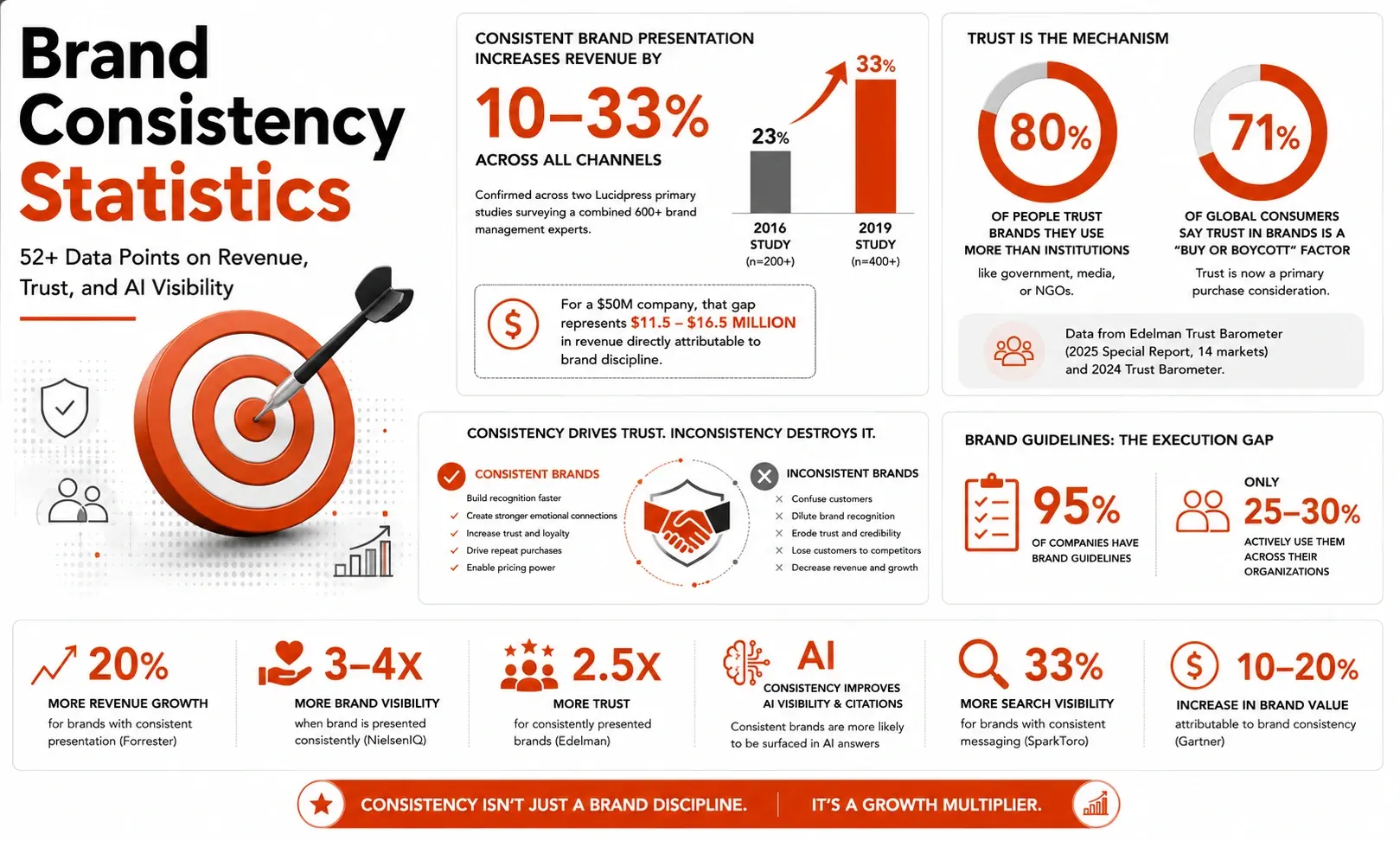
Consistent brand presentation across all channels can increase revenue by 10–33% — a range confirmed across two separate Lucidpress primary studies surveying a combined 600+ brand management experts (Lucidpress / Marq, State of Brand Consistency Report, 2019, n=400+; 2016 edition, n=200+). The 2019 study, which updated and expanded the original, found the upper bound reaches 33% — a 10-percentage-point increase over the 2016 finding of 23%. For a $50M company, that gap represents $11.5–$16.5 million in revenue directly attributable to brand discipline.
Trust is the mechanism. Edelman's 2025 Trust Barometer Special Report on brand trust — based on 30-minute online interviews across 14 global markets — found that 80% of people trust brands they use more than they trust institutions like government, media, or NGOs (Edelman, Brand Trust: From We to Me, 2025). And that trust is now a primary purchase consideration: 71% of global consumers say trust in brands is a "buy or boycott" factor (Edelman, 2024 Trust Barometer). Consistency is what builds trust — and its absence is what destroys it. Yet 95% of companies have brand guidelines, and only 25–30% actively use them across their organizations.
We aggregated data from Lucidpress/Marq, Edelman, Salesforce, Forrester, NielsenIQ, SparkToro, Gartner, and other primary sources to compile the most rigorously sourced brand consistency statistics available for 2026.
Key Takeaways
- Consistent brand presentation can increase revenue by 10–33% (Lucidpress/Marq, State of Brand Consistency Report 2016 and 2019)
- 68% of companies report brand consistency contributed directly to revenue growth (Lucidpress, 2019)
- 80% of consumers now trust brands they use more than government, media, or NGOs (Edelman, Brand Trust: From We to Me, 2025)
- 71% of global consumers say brand trust is a "buy or boycott" factor (Edelman, 2024 Trust Barometer)
- 87% of consumers will pay more for products from a trusted brand (Capital One Shopping Research, Branding Statistics 2024)
- A consistent brand color scheme can increase brand recognition by up to 80% (Loyola University color study, via Energy PR)
- It takes 5–7 impressions for consumers to remember a brand — making consistency the only path to recognition (Pam Moore, backed by recall research)
- 95% of companies have brand guidelines; only 25–30% actively use them across their organization (Capital One Shopping Research, 2024)
- 63% of marketers struggle to keep content consistent across channels (Gitnux / survey of marketing professionals)
- 91% of marketers believe inconsistent brand messages harm customer relationships (Gitnux, citing CMI survey data)
- AI systems treat brand consistency across independent sources as a reliability signal — inconsistent brand messaging directly reduces AI citation probability (Impact.com, Global State of Affiliate Marketing 2025; AirOps citation research, 2026)
- Companies with brand strategy consistent across teams are 3.1x more likely to be market share leaders (NielsenIQ analysis, via Gitnux)
Revenue Impact of Brand Consistency
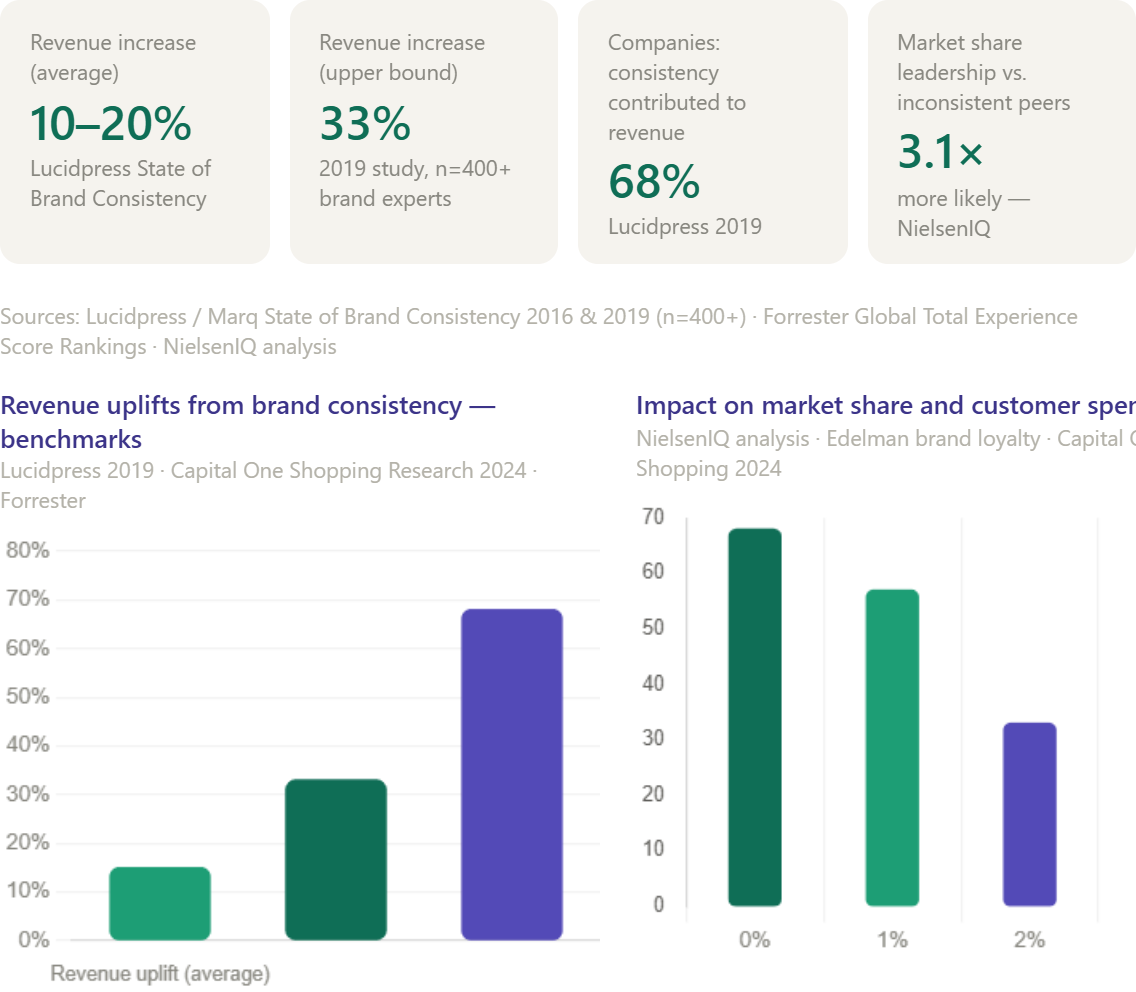
The commercial case for brand consistency is among the most directly evidenced findings in marketing research. Lucidpress's two-phase primary research — surveying 200+ organizations in 2016 and 400+ brand management experts in 2019 — established that the average revenue increase attributed to consistent brand presentation is 10–20%, with the upper bound reaching 33% in the more recent study. The mechanism is not mysterious: consistent brands require fewer touchpoints to convert, attract premium pricing, and generate higher lifetime value from existing customers.
The 33% revenue ceiling, while often cited without context, represents what the most disciplined brand operators achieve. The more operationally useful figure for planning is the 10–20% average — and even that range translates to significant absolute value at enterprise scale. Companies aligning brand promise with delivered experience show up to 3.5x revenue growth versus those where experience doesn't match brand claim (Forrester, Global Total Experience Score Rankings).
| Metric | Value | Source |
|---|---|---|
| Revenue increase from consistent brand presentation (average) | 10–20% | Lucidpress / Marq, State of Brand Consistency 2016–2024 |
| Revenue increase upper bound (consistent branding) | Up to 33% | Lucidpress / Marq, State of Brand Consistency 2019 |
| Companies reporting brand consistency contributed to revenue growth | 68% | Lucidpress, State of Brand Consistency 2019 |
| Businesses reporting brand consistency boosts revenue by 20%+ | 33% | Capital One Shopping Research, Branding Statistics 2024 |
| Revenue growth: brand promise matches experience vs. doesn't | Up to 3.5x more growth | Forrester, Global Total Experience Score Rankings |
| Loyal customers who spend more on brands they trust | 57% | Edelman / brand loyalty analysis |
| Companies with brand-consistent strategy vs. peers: market share leadership likelihood | 3.1x more likely | NielsenIQ analysis, via Gitnux Brand Consistency Statistics |
| Premium pricing willingness: consumers for consistent vs. inconsistent brands | ~22% price premium | Capital One Shopping / branding analysis, 2024 |
The Forrester 3.5x revenue growth figure deserves specific attention. It's not measuring the effect of brand guidelines on marketing assets — it's measuring the effect of aligned brand promise on customer experience outcomes. The most powerful driver of brand consistency revenue impact is not visual consistency; it's delivering what the brand claims to deliver, consistently, across every customer interaction. Visual consistency is the visible surface. Experience consistency is the commercial engine.
Omnibound's AI Solutions for Brand Marketing gives brand marketing teams the AI-powered infrastructure to maintain consistent messaging, narrative, and voice across channels at scale — without the bottlenecks of manual brand review at every touchpoint.
Brand Consistency and Consumer Trust
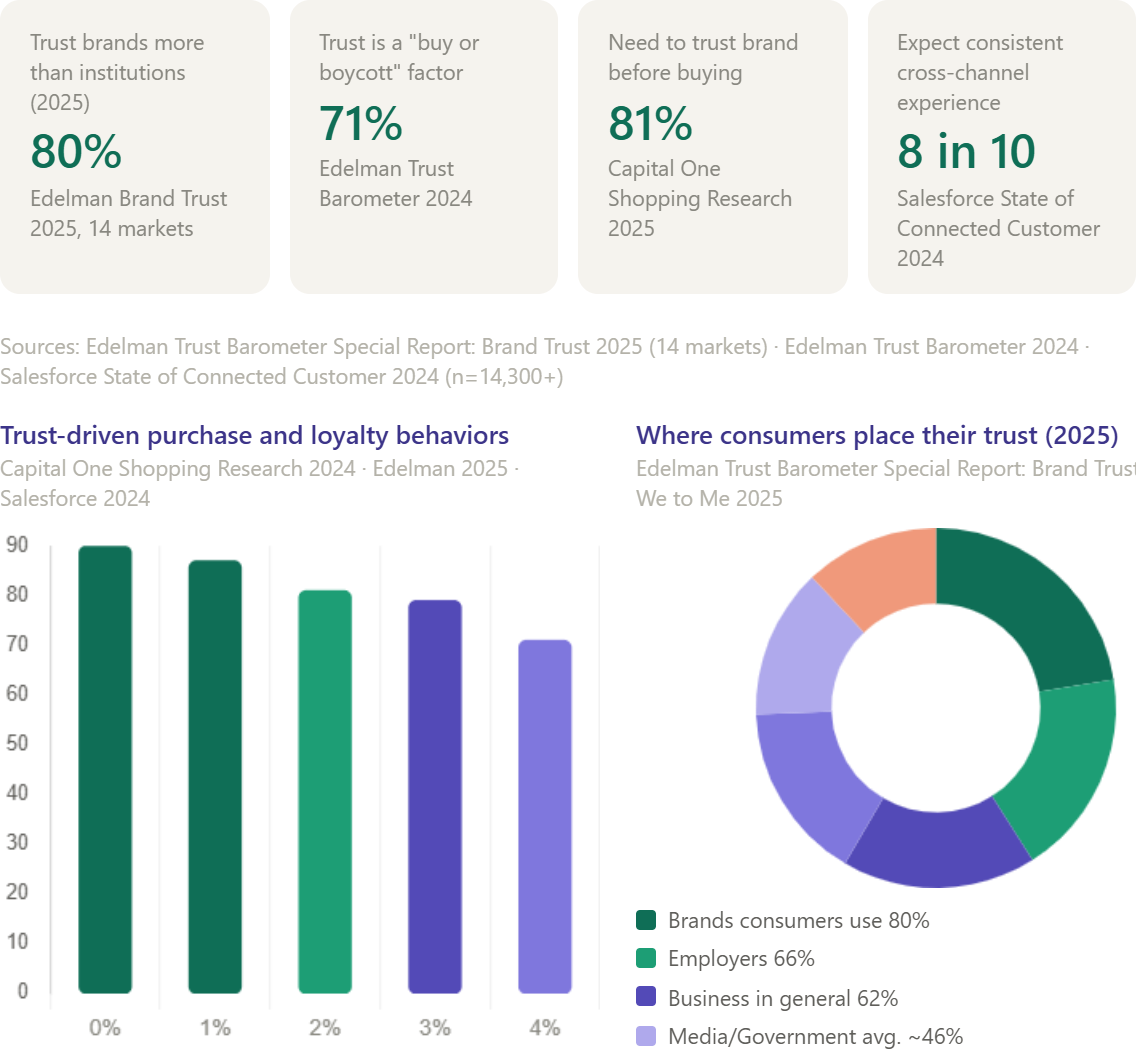
The Edelman 2025 Trust Barometer Special Report on brands — conducted across 14 global markets, April–May 2025 — contains the most important single reframing of brand trust in recent primary research: consumers now trust the brands they personally use more than they trust government, media, their employers, or NGOs. Trust has moved from institutional to personal. It is built through direct, repeated, consistent experience — not through advertising claims.
The behavioral consequence of this shift is stark and commercially direct. 81% of consumers say they need to trust a brand before buying from it. Among those who trust a brand, 90% buy from it, and 87% pay more. Trust is no longer a brand equity metric — it is a revenue gating mechanism. And consistency is its primary input.
| Metric | Value | Source |
|---|---|---|
| Consumers who trust brands they use vs. institutions (2025) | 80% trust brands — more than government, media, NGOs | Edelman, Brand Trust: From We to Me, 2025 |
| Global consumers for whom brand trust is a "buy or boycott" factor | 71% | Edelman, 2024 Trust Barometer |
| Consumers who need to trust a brand before buying | 81% | WiserNotify / Capital One Shopping Research, 2025 |
| Consumers who buy from brands they trust | 90% | Shapo / Capital One Shopping branding statistics, 2025 |
| Consumers who pay more for products from trusted brands | 87% | Capital One Shopping Research, Branding Statistics 2024 |
| Consumers more loyal to brands with consistent communication | 79% | Capital One Shopping Research, Branding Statistics 2024 |
| Consumers who expect consistent experiences across brand channels | 8 in 10 | Salesforce, State of the Connected Customer 2024 |
| Consumers who feel brand trust is more important than 5 years ago (Gen Z) | 79% | Edelman, 2024 Trust Barometer |
The 79% loyalty figure for brands with consistent communication — from Salesforce's research — captures what happens downstream of trust. Loyalty is trust converted into repeated behavior. Trust → loyalty → lifetime value is the compounding chain that brand consistency enables, and every link in that chain is measurable.
Brand Recognition: How Consistency Builds It
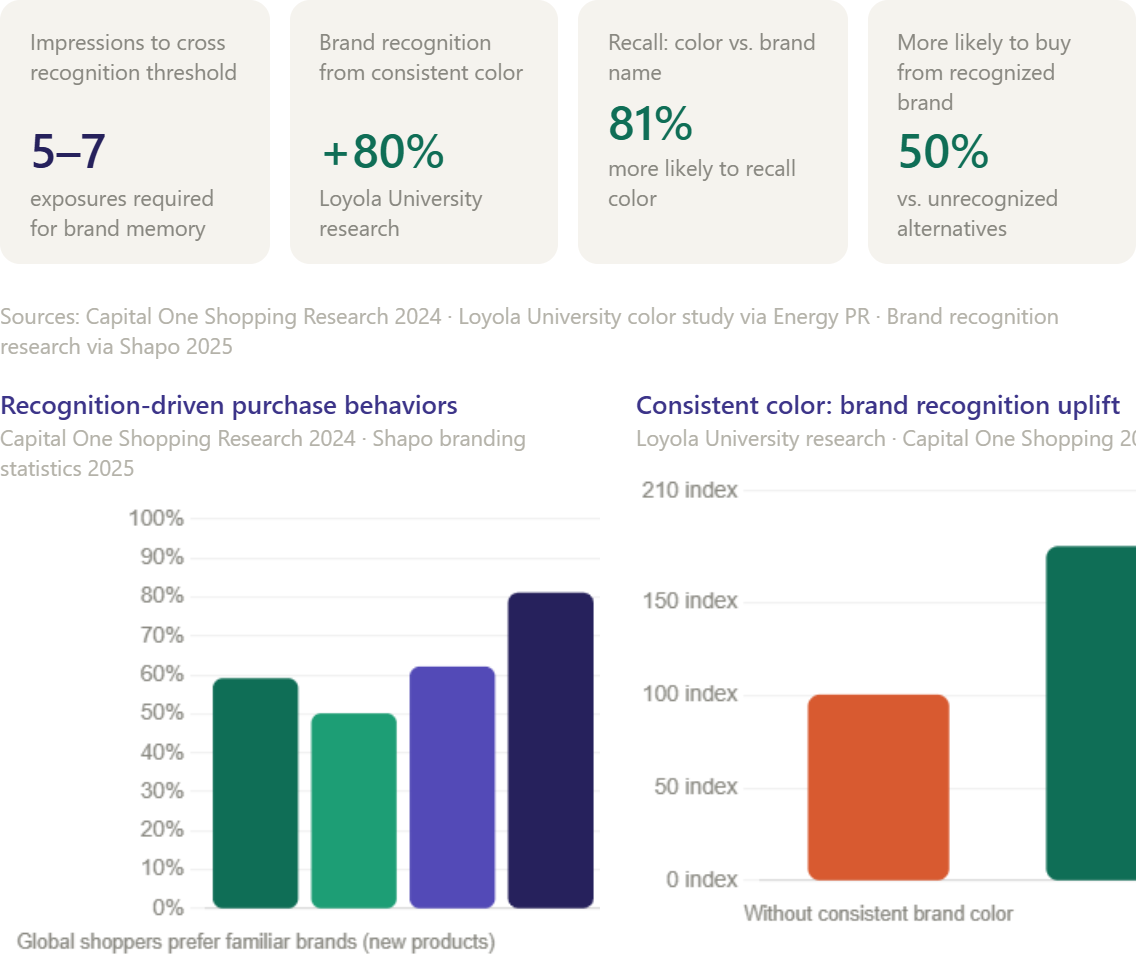
Brand recognition is the prerequisite for everything downstream. Before a brand can be trusted, preferred, or converted, it must be recognized. The research on recognition is consistent: it takes 5–7 repeated exposures for a brand to cross the memory threshold where consumers remember and recognize it. Below that threshold, spend on advertising, content, and channel activation delivers diminishing returns because the impressions aren't being retained.
Visual consistency is the most powerful lever for reaching that threshold efficiently. A consistent color palette can increase brand recognition by up to 80% (Loyola University research). Consumers are 81% more likely to recall a brand's color than its name. Signature colors are not a design preference — they are a recognition infrastructure investment with directly measurable retention outcomes.
| Metric | Value | Source |
|---|---|---|
| Impressions required for consumers to remember a brand | 5–7 exposures | Pam Moore / Capital One Shopping Research, 2024 |
| Brand recognition increase from consistent color use | Up to 80% | Loyola University color recognition research, via Energy PR |
| Consumers more likely to recall brand color vs. brand name | 81% more likely to recall color | Capital One Shopping Research, 2024 |
| Consumers more likely to buy from brands they recognize | 50% more likely | Capital One Shopping Research, Branding Statistics 2024 |
| Global shoppers preferring to buy new products from familiar brands | 59% | Capital One Shopping Research, Branding Statistics 2024 |
| First impressions formed in | 1/10th of a second | Branding research, via DesignRush, 2025 |
| Consumers who have an emotional connection to brands they buy most frequently | 62% | Capital One Shopping Research, 2024 |
The 5–7 impression threshold explains why brand inconsistency is so commercially damaging: it resets the recognition clock. Every time a consumer encounters a brand that looks or sounds slightly different from the last exposure — different logo treatment, different color interpretation, different voice — the recognition accumulation resets. Inconsistent brands don't just miss impressions. They actively undo them.
The Cost of Inconsistency
The cost of brand inconsistency is not primarily aesthetic — it is financial, operational, and reputational. Marketing compliance failures cost organizations an average of $1.4 million per year (industry compliance research, via Gitnux). Senior professionals at mid-sized and large businesses report that poor brand consistency costs their companies more than $6 million in lost revenue annually. 46% of enterprises report wasting budget recreating assets because of poor digital asset management processes.
The operational inefficiency compounds the revenue loss. When brand assets aren't centralized or standardized, teams recreate assets from scratch, produce off-brand content, and generate rework cycles. That rework has a direct budget cost — and a compounding brand damage cost as inconsistent materials reach customers.
| Metric | Value | Source |
|---|---|---|
| Marketing compliance failure cost (average per year) | $1.4 million | Industry compliance research, via Gitnux |
| Senior professionals reporting brand inconsistency costs $6M+ in lost revenue | 52% | Industry survey, via Shoutout Studio |
| Marketers who struggle to keep content consistent across channels | 63% | Gitnux / survey of marketing professionals |
| Marketers unable to produce content fully matching brand guidelines | 46% | Adweek survey, via Gitnux |
| Enterprises wasting budget re-creating assets (poor DAM processes) | 46% | Widen survey, via Gitnux |
| Marketing leaders identifying brand inconsistency as top cause of campaign underperformance | 16% | Gartner CMO survey, via Gitnux |
| Organizations citing cost increase from inefficient workflow / brand approvals | 34% | Bynder vendor research, via Gitnux |
| US shoppers who abandon carts due to conflicting or inconsistent product information | 53% | MetricsCart, 2025 |
The 53% cart abandonment rate for consumers encountering inconsistent product information is one of the most commercially specific consequences of brand inconsistency. It is not abstract brand damage — it is a measurable, attributable revenue loss occurring at the moment of transaction. Every inconsistency in a product title, price, or description is statistically likely to cost a conversion.
Brand Consistency in the AI Era
The AI era has introduced a new dimension to brand consistency that most brand teams have not yet fully internalized: AI systems use cross-source consistency as a reliability signal when determining whether to cite or recommend a brand. LLMs don't evaluate brands the way search engines do — they look for patterns of corroboration across multiple independent sources. When those sources contradict each other — different claims, different descriptions, different positioning — the model treats the brand as low-confidence and deprioritizes it.
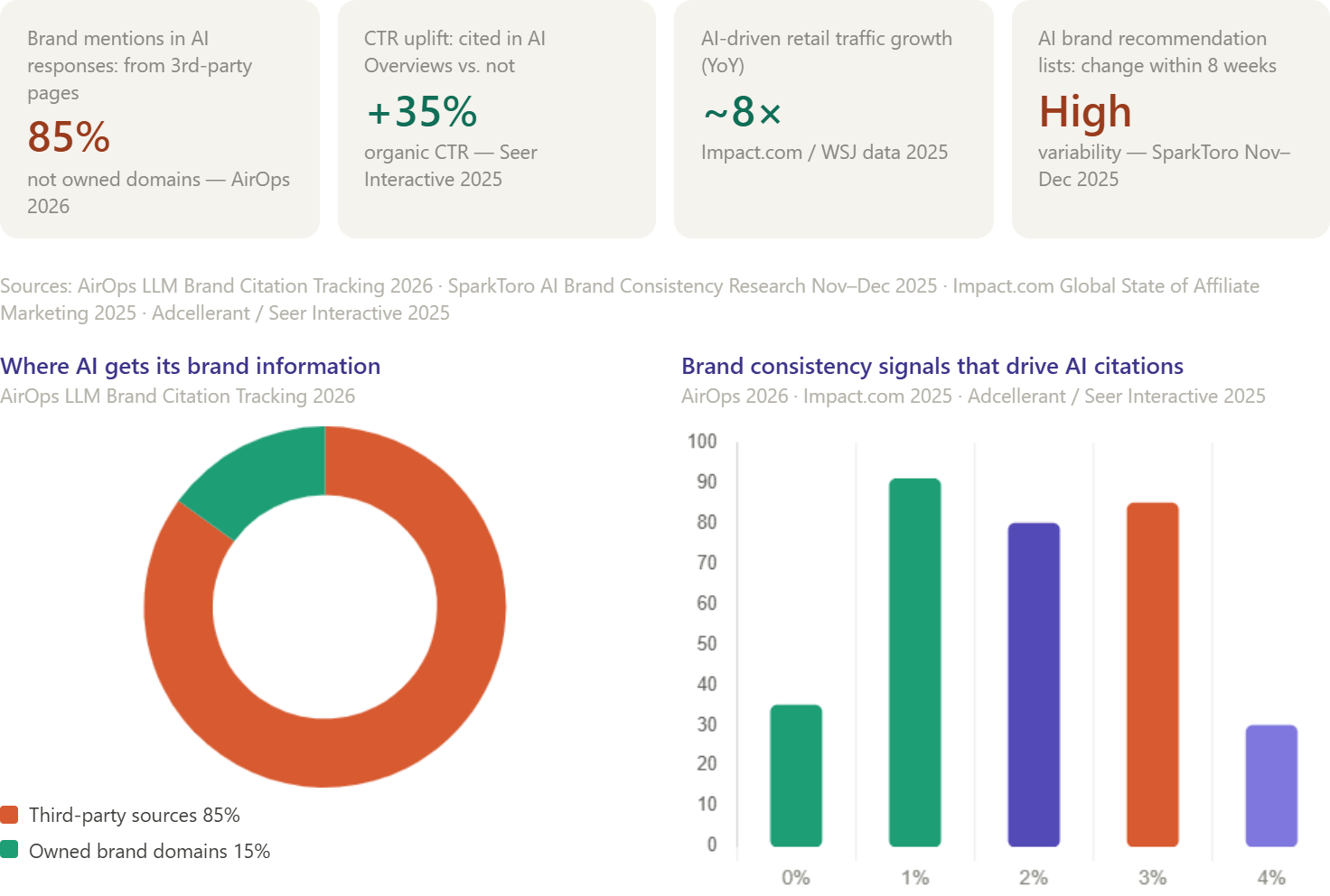
SparkToro's primary research on AI brand recommendation consistency (November–December 2025) found significant variability in how AI tools recommend brands even for identical queries — indicating that brands without strong, consistent cross-source signals are subject to high citation volatility. AirOps research found 85% of brand mentions in AI responses came from third-party pages, not owned domains, confirming that brand consistency must extend beyond owned channels.
| Metric | Value | Source |
|---|---|---|
| AI model behavior: brand consistency across sources treated as reliability signal | Confirmed — cross-domain corroboration reduces citation volatility | AirOps, LLM Brand Citation Tracking, 2026 |
| Brand mentions in AI responses from third-party (not owned) pages | 85% | AirOps research, 2026 |
| Impact of inconsistent brand entity data on AI citations | AI systems broadcast errors at all future touchpoints | Adcellerant / LLM brand visibility research, 2026 |
| AI citation advantage: brands cited in AI Overviews vs. not cited | +35% organic CTR | Adcellerant, citing Seer Interactive 2025 data |
| Brands needing multiple trusted sources reinforcing same claim for AI recommendation | Confirmed — single-source claims carry less weight than multi-source corroboration | Impact.com, Global State of Affiliate Marketing 2025 |
| Variability in AI brand recommendation lists across repeated identical queries | High — significant portion of AI rankings can change within 8 weeks | SparkToro / Rand Fishkin, AI Brand Recommendation Consistency Research, Nov–Dec 2025 |
| Traditional SEO rank vs. AI citation: correlation | Weak — brands ranking on page 1 can be absent from AI answers | Yotpo / LLM Monitoring Tools analysis, 2026 |
| AI-driven traffic to top retailers: YoY growth | ~8× in one year | Impact.com, citing Wall Street Journal data, 2025 |
The implication for brand teams is structural and urgent: brand consistency is now an AI visibility strategy, not just a creative standard. Brands whose messaging, positioning, and factual claims are consistent across owned properties, media coverage, partner sites, review platforms, and third-party mentions are structurally more likely to be cited by AI systems. Brands with fragmented, contradictory, or stale cross-source signals are structurally at risk of invisibility in the environments where B2B buyers now conduct their research.
Omnibound's AI Search Intelligence tracks where your brand is being cited — and where it isn't — across ChatGPT, Perplexity, Gemini, and Google AI Mode, giving brand marketing teams the visibility data needed to identify and close the cross-source consistency gaps that are costing AI citations.
Execution: The Gap Between Guidelines and Practice
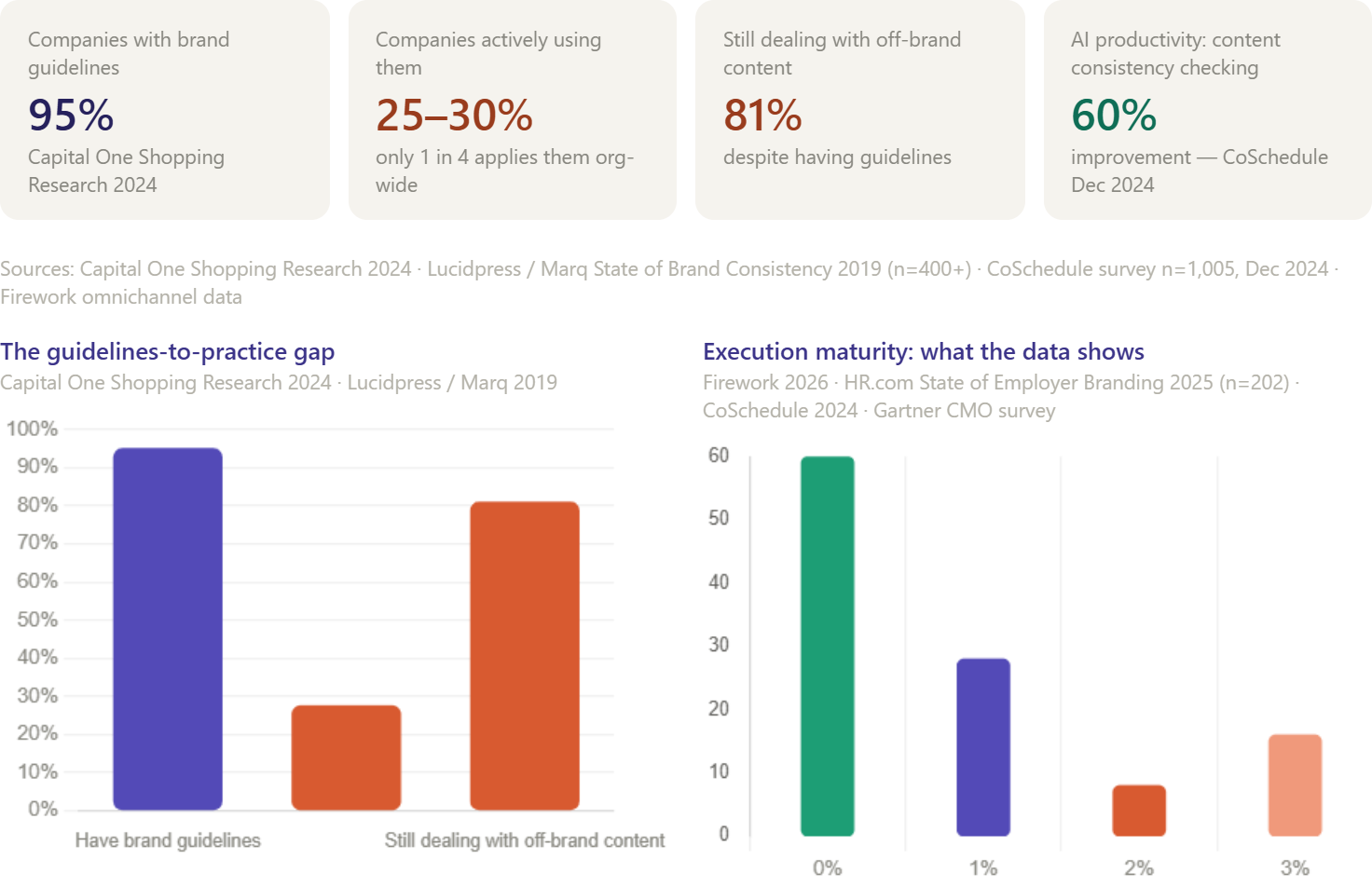
The most striking statistic in brand management is not about ROI — it's about execution. 95% of companies have formal brand guidelines. Only 25–30% actively use them across their organization. This is not a strategy problem. It is an activation and infrastructure problem. Brand guidelines exist. They are not being operationalized consistently.
The gap between documentation and discipline explains why brand inconsistency persists despite widespread awareness of its costs. Static PDF brand guidelines — produced at brand launch, distributed once, updated infrequently — are structurally insufficient for the content volume modern marketing teams produce. The brands that have closed this gap have moved from guidelines as documents to guidelines as infrastructure: embedded in templates, tools, approval workflows, and AI-assisted content generation systems.
| Metric | Value | Source |
|---|---|---|
| Companies with formal brand guidelines | 95% | Capital One Shopping Research, Branding Statistics 2024 |
| Companies actively using brand guidelines across organization | Only 25–30% | Capital One Shopping Research / multiple sources, 2024 |
| Organizations with comprehensively applied employer branding strategy | Only 28% | HR.com, State of Employer Branding 2025, n=202 HR professionals) |
| Marketers who believe maintaining consistent brand is important (for leads and communication) | Over 60% | Lucidpress / Marq, State of Brand Consistency 2019 |
| Organizations still dealing with off-brand content despite guidelines | 81% | Lucidpress / Marq, State of Brand Consistency 2019 |
| Retailers who feel they've fully mastered omnichannel consistency | Only 8% | Firework omnichannel statistics, via Envive 2026 |
| AI early adopters: productivity improvement in content consistency checking | 60% | CoSchedule, survey of 1,005 marketing professionals, December 2024 |
The 81% of organizations still dealing with off-brand content despite having guidelines — from Lucidpress's survey of 400+ brand management experts — is the clearest evidence that documentation without infrastructure produces inconsistency at scale. The solution is not more comprehensive guidelines; it is embedding brand standards at the point of content creation, making the on-brand choice the path of least resistance rather than the result of manual review.
Omnibound's AI Solutions for Brand Marketing transforms static brand guidelines into an active intelligence layer — ensuring brand voice, tone, and messaging remain consistent across every piece of content, every channel, and every team without making your brand team the bottleneck for every approval.
Brand Consistency by the Numbers
| Metric | Value | Source |
|---|---|---|
| Revenue increase from consistent brand presentation | 10–33% | Lucidpress/Marq 2016 & 2019 |
| Companies reporting brand consistency contributed to revenue | 68% | Lucidpress/Marq 2019 |
| Businesses reporting 20%+ revenue boost from brand consistency | 33% | Capital One Shopping Research 2024 |
| Revenue growth: brand promise aligned with experience | Up to 3.5x | Forrester Global Total Experience Rankings |
| Market share leadership: consistent brand strategy vs. peers | 3.1x more likely | NielsenIQ via Gitnux |
| Consumers trusting brands more than institutions | 80% | Edelman Brand Trust 2025 |
| Consumers for whom trust is a "buy or boycott" factor | 71% | Edelman Trust Barometer 2024 |
| Consumers needing to trust brand before buying | 81% | Capital One Shopping Research 2025 |
| Consumers who pay more for trusted brands | 87% | Capital One Shopping Research 2024 |
| Consumers more loyal to brands with consistent communication | 79% | Capital One Shopping Research 2024 |
| Consumer expectation: consistent experience across brand channels | 8 in 10 | Salesforce State of the Connected Customer 2024 |
| Impressions required for brand recognition | 5–7 | Pam Moore / Capital One Shopping 2024 |
| Brand recognition increase from consistent color | Up to 80% | Loyola University research |
| Consumers recalling brand color vs. name | 81% more likely to recall color | Capital One Shopping Research 2024 |
| Consumers more likely to buy from brands they recognize | 50% | Capital One Shopping Research 2024 |
| Marketing compliance failures cost per year | $1.4 million avg. | Industry compliance research via Gitnux |
| Senior professionals: brand inconsistency costs $6M+ | 52% | Industry survey via Shoutout Studio |
| Marketers struggling with cross-channel content consistency | 63% | Gitnux / marketing professional survey |
| Marketers unable to fully match brand guidelines | 46% | Adweek survey via Gitnux |
| Enterprises wasting budget recreating assets | 46% | Widen survey via Gitnux |
| Consumers abandoning cart due to inconsistent product information | 53% | MetricsCart 2025 |
| AI brand citations: from third-party (not owned) pages | 85% | AirOps 2026 |
| CTR uplift: brands cited in AI Overviews vs. not cited | +35% organic CTR | Adcellerant / Seer Interactive 2025 |
| AI-driven retail traffic YoY growth | ~8× | Impact.com / WSJ data 2025 |
| Companies with brand guidelines | 95% | Capital One Shopping Research 2024 |
| Companies actively using them | Only 25–30% | Capital One Shopping Research 2024 |
| Organizations still dealing with off-brand content | 81% | Lucidpress/Marq State of Brand Consistency 2019 |
| AI content consistency checking: productivity improvement | 60% | CoSchedule, December 2024, n=1,005 |
Methodology and Sources
This article was compiled from primary research organizations and named industry studies published between 2016 and 2026. Every statistic was traced to its originating study before inclusion. Secondary aggregators were used only to locate primary sources — never as final citations.
Primary sources (Tier 1):
- Lucidpress / Marq — State of Brand Consistency Report (two editions: 2016, n=200+ organizations; 2019, n=400+ brand management experts; updated 2024). The foundational primary dataset on brand consistency and revenue impact.
- Edelman — 2025 Trust Barometer Special Report: Brand Trust, From We to Me (30-minute online interviews, April 24–May 5, 2025; 14 global markets); 2024 Edelman Trust Barometer (annual survey, 32,000 respondents across 28 countries)
- Salesforce — State of the Connected Customer 2024 (n=14,300+ consumers globally; 8 in 10 consumers expect consistent experiences across brand channels)
- Forrester — Global Total Experience Score Rankings (brand promise–experience alignment and 3.5x revenue growth finding); 2025 B2C Marketing & Customer Experience Predictions
- SparkToro / Rand Fishkin — AI Brand Recommendation Consistency Research (November–December 2025; primary study on LLM brand recommendation variability; modeled on Carnegie Mellon LLM consistency methodology)
- Impact.com — Global State of Affiliate Marketing 2025 (AI citation signal research; multi-source consistency as LLM reliability indicator)
- Capital One Shopping Research — Branding Statistics 2024 (aggregated from primary consumer surveys; brand trust, recognition, loyalty data)
- Gartner — CMO survey data on brand inconsistency as campaign underperformance driver (via Gitnux); 2025 CMO Spend Survey
- HR.com — State of Employer Branding 2025 (n=202 HR professionals, October–December 2024; brand strategy application and consistency data)
- AirOps — LLM Brand Citation Tracking, 2026 (85% of AI brand mentions from third-party sources; cross-source consistency as reliability signal)
- CoSchedule — Survey of 1,005 marketing professionals, December 2024 (AI productivity improvement in content consistency checking)
Recency notes:
- The Lucidpress/Marq State of Brand Consistency Report core revenue data (10–20% average, 33% upper bound) originates from 2016 and 2019 primary studies, updated in 2024. These remain the most methodologically rigorous primary studies specifically measuring brand consistency's impact on revenue. They are flagged throughout with their original publication dates.
- The Loyola University color recognition research (80% increase) is widely cited but predates 2020. It is used here as the most-cited primary source for this specific claim and is labeled accordingly.
- All other statistics in this article are from 2024–2026 primary research.