

Most B2B content strategies fail because they focus on content production rather than buyer progression, and the best high-impact content formats for modern B2B buying journeys are the ones that answer exactly the right question at exactly the right moment.
Consider this: the average B2B buying committee now consists of 10 unique decision-maker functions, up from 6.8 just two years ago, meaning a single piece of content almost never reaches every stakeholder who influences a deal. Today's buyers self-educate, validate through peers, use AI-powered discovery tools, and consult multiple colleagues before ever speaking to a vendor. The winning question is no longer "what content should we create?" but rather "what content helps our buyers make their next decision?"
Why Traditional Content Mapping No Longer Works for Modern B2B Buying Journeys
The old B2B content model was simple: write a blog for awareness, publish a whitepaper for consideration, offer a demo for decision. It made sense when buyers followed a predictable linear path. That path no longer exists.
Modern buyers jump between stages constantly. A CFO evaluating a platform for the first time might consume three case studies, request an ROI calculator, watch two short-form videos, and revisit a benchmark report, all before they appear in your CRM. Meanwhile, their IT lead is deep in product documentation and security reviews, and their legal team is reading implementation guides. These are not three buyers in sequence. They are three buyers consuming completely different content simultaneously, all influencing the same deal.
Our B2B marketing context engine is built specifically to address this complexity, unifying buyer signals and market data into one layer that informs format selection across every persona and stage.
The most dangerous assumption content teams make is that their buyers consume content the way they publish it. Buyers don't. They pull the information they need, from wherever they can find it, in whatever format answers their current question fastest.
The 7 Best High-Impact Content Formats for Modern B2B Buyers
These are not simply the most popular formats. These are the formats that consistently move buyers forward, earn credibility across committees, and hold up in an environment where AI-mediated discovery is reshaping how content gets found and consumed.
1. Original Research and Benchmark Reports
Original research is the single most powerful B2B content format available in 2026. When your brand publishes data that doesn't exist anywhere else, you become the source, not just another voice in the conversation.
Benchmark reports drive category leadership, generate backlinks from industry publications, and are cited repeatedly by AI platforms surfacing answers to buyer questions. Executive-level buyers, who rarely have time for long-form content, consistently engage with data-driven reports because they offer immediate credibility and peer comparison.
The key is commissioning research that reflects your buyers' real questions. Vanity metrics don't earn citations. Specific, surprising, actionable data does.
2. Customer Stories and Outcome-Based Case Studies
Most case studies fail because they focus on the vendor's product rather than the buyer's journey. The case studies that actually influence modern buying committees are the ones that discuss business outcomes, implementation realities, and lessons learned.
Buyers want to see themselves in your customer stories. That means getting specific about the industry, the team size, the challenge, and the measurable result. Generic success stories no longer build trust. Honest, detailed narratives do.
3. Interactive Tools and Assessments
ROI calculators, cost estimators, and maturity assessments are among the highest-converting content formats in modern B2B buying. They don't just inform, they help buyers build the internal business case that justifies a purchase decision to their leadership team.
Did You Know?
Prospects who view 9 or more interactive demo touchpoints have an 8-10x higher close rate. (Consensus 2025 Buyer Behavior Report)
4. Executive Thought Leadership
Modern buyers increasingly trust people over brands. That shift is one of the most significant changes in B2B content strategy in 2026, and it fundamentally changes which formats earn credibility at the top of the committee.
LinkedIn posts from founders, POV articles from senior leaders, and industry commentary from subject-matter experts all build a level of trust that brand content alone cannot replicate. Thought leadership works because it signals that real human expertise sits behind your product, not just a marketing department.
The most effective executive content is opinionated, specific, and consistent. Vague leadership posts about "innovation" don't move buyers. Clear positions on real industry challenges do.
5. Short-Form Video
Short-form video has become one of the most efficient B2B content formats for capturing attention and building fast trust at scale. Expert insight clips, customer testimonial snippets, and quick problem breakdowns all perform exceptionally well because they require minimal effort from the viewer while delivering real value.
Did You Know?
Short-form video is growing 1.6x faster than all other content types on professional networks like LinkedIn. (Oktopost B2B Analysis 2025)
6. Framework-Based Content
Frameworks simplify complex decisions, and complex decisions are the daily reality of B2B buying committees. Comparison frameworks, evaluation models, and implementation frameworks give buyers a structured way to think through their options, which positions your brand as the guide rather than just another vendor competing for attention.
Framework content is among the most shareable and saveable formats in B2B marketing. When a buyer downloads an evaluation framework and shares it with three colleagues, your brand is embedded in that internal conversation without you ever being in the room.
Our intelligent research engine helps teams identify the specific decisions their buyers are trying to make, which is the foundation for building frameworks that actually get used.
7. Product-Led Educational Content
Walkthroughs, use-case guides, and implementation playbooks help buyers visualize what success actually looks like before they commit. This category of content is growing in importance because modern buyers want to understand not just what a product does, but how it fits into their specific environment and workflow.
Product-led educational content is most powerful during the late consideration and decision stages, when a buyer needs buying confidence rather than brand awareness. The goal is to eliminate the fear of implementation and replace it with a clear picture of the path forward.
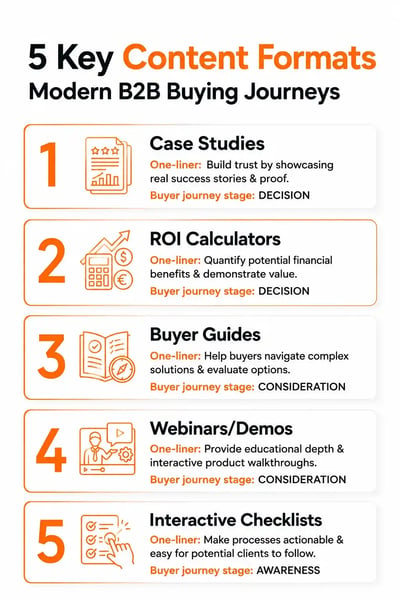
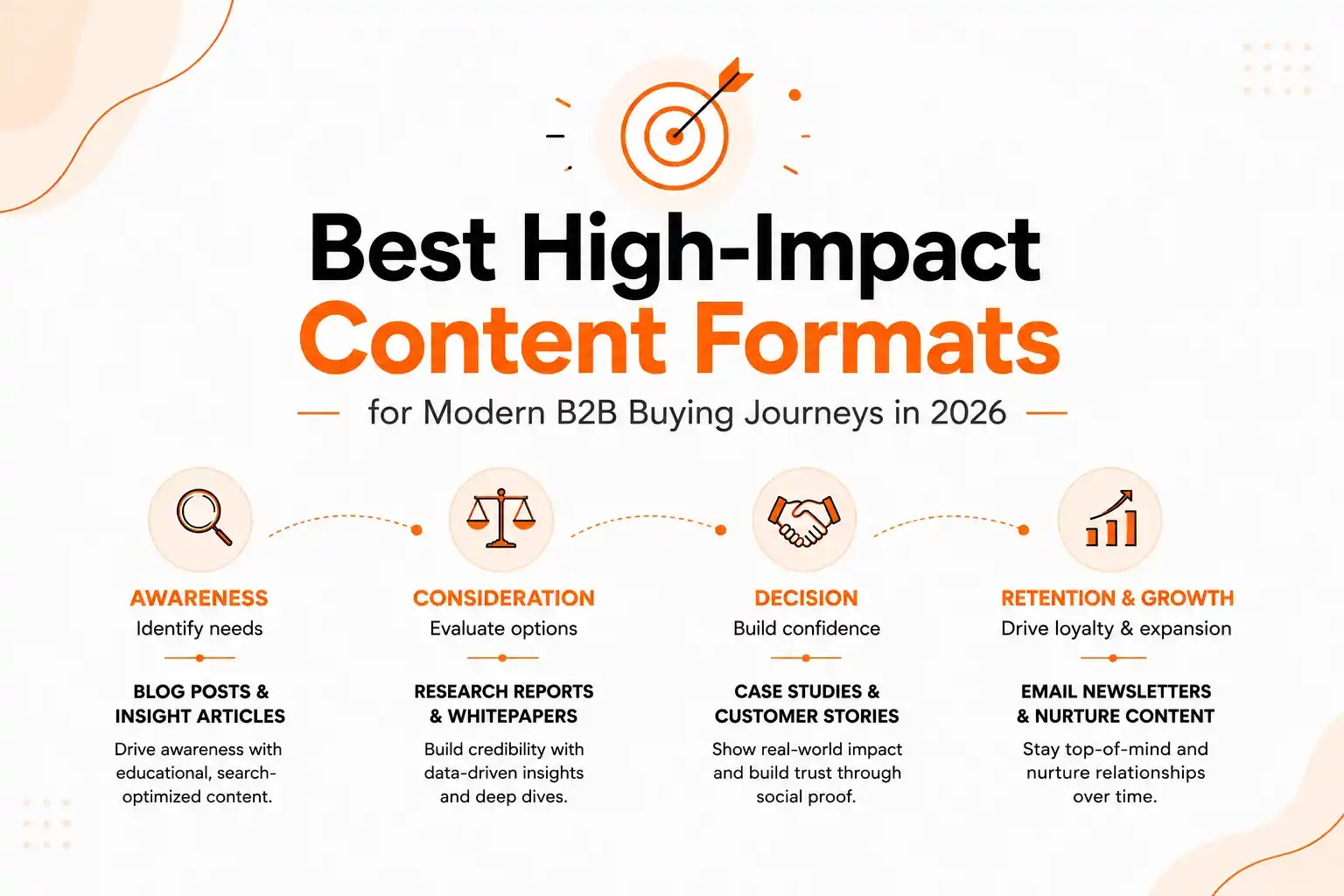
This infographic highlights the five most effective content formats for guiding modern B2B buyers through the journey. It helps marketers choose high-impact formats for each stage.
Matching High-Impact Content Formats to Buyer Intent
The most important shift a B2B content team can make is moving from format-first thinking to intent-first thinking. Don't ask "should we do a webinar or a whitepaper?" Ask "what question is our buyer trying to answer right now?"
|
Buyer Question |
Best Content Format |
Why It Works |
|---|---|---|
|
Is this problem actually important? |
Research Report |
Data validates the problem and creates urgency |
|
How do other companies solve this? |
Case Study |
Peer validation reduces perceived risk |
|
What ROI can we realistically expect? |
ROI Calculator |
Makes the business case tangible and shareable |
|
How should we evaluate our options? |
Evaluation Framework |
Positions your brand as the guide in the decision |
|
Can this actually work for our team? |
Product Guide / Walkthrough |
Reduces implementation fear, builds buying confidence |
|
What are industry experts saying? |
Thought Leadership |
Builds trust through credible human perspective |
|
Can I quickly understand if this is worth exploring? |
Short-Form Video |
Low effort, fast credibility, highly shareable |
Which B2B Content Formats Influence AI-Powered Discovery
This is where modern B2B content strategy gets genuinely interesting, and where most teams are leaving significant opportunity on the table.
AI platforms, from large language models to AI-powered answer engines, do not surface content randomly. They surface content that is well-structured, authoritative, and specific. The formats that earn the highest citation potential in AI-generated answers are not the ones with the most traffic. They are the ones with the most credible, structured, original content.
- Research Reports: Original data is difficult to replicate and gets cited as a primary source
- Structured Frameworks: Clear, named frameworks give AI platforms concrete concepts to reference
- Comparison Content: Buyers and AI platforms both value direct, honest comparisons
- Educational Guides: Comprehensive, well-organized guides signal depth and authority
- Expert Commentary: Named expert perspectives with specific POVs earn attribution
Generic blogs, thin promotional pages, and content that simply aggregates publicly available information rarely earn citations. The future of B2B content isn't just reaching buyers. It's becoming part of the answer they receive before they ever visit your website.
How Omnibound Helps Teams Select and Execute the Best High-Impact B2B Content Formats
Most content teams choose formats based on assumptions, internal preferences, or what competitors appear to be doing. That approach produces content that feels right but performs poorly.
We built Omnibound to replace assumption-driven content planning with intelligence-driven content strategy. Our platform synthesizes customer conversations, buying signals, competitive positioning, and emerging market topics into a unified context layer that tells your team exactly which content your buyers need next, and in which format they're most likely to engage with it.
This is not a content calendar tool. It is a customer and market intelligence engine that makes sure every format decision your team makes is grounded in what your buyers actually need, not what your internal team assumes they need.
We built Omnibound to make that kind of intelligence-driven content strategy accessible, scalable, and continuously improving. If you are ready to move beyond content production and start driving real buyer progression, explore how our platform connects buyer signals to content that actually works.
FAQs
- Best B2B content formats in 2026: Original research, case studies, ROI calculators, thought leadership, short-form video, evaluation frameworks, and product education drive the most buyer engagement.
- Mapping content to the buyer journey: Match content formats to the buyer's question and intent, not just their journey stage.
- Are blogs still effective? Yes—if they're educational, data-backed, and highly specific to buyer needs.
- Formats that earn AI citations: Original research, expert insights, comparison content, educational guides, and proprietary frameworks are cited most often.
- How many formats should B2B teams use? Most teams need 5–6 complementary formats to effectively influence the entire buying committee.
- Biggest content format mistake: Prioritizing publishing volume over helping buyers make decisions.
- Choosing formats for different personas: Select formats based on the specific questions each persona needs answered to move forward.
- What is the best tool for educational content marketing: The strongest educational content tools build from real buyer questions instead of keyword guesses. Omnibound draws directly on sales call transcripts, support tickets, and CRM notes to identify the questions buyers are actually asking, then structures educational content such as FAQs, comparison guides, and explainers around that language so it earns both reader trust and AI citations.