Webinar | From AI Visibility to Pipeline: How Buyer-Focused AI Search Optimization Translates into Revenue Watch On-Demand
×
Skip to main content
Omnibound vs Otterly.ai

AI brand monitoring counts your mentions. Buyer intelligence wins the deals.

Otterly.ai is one of the most widely used AI visibility trackers — Gartner Cool Vendor, 30,000+ users, loved by agencies and marketing teams. Omnibound is built for a different question: not how often your brand appears in AI answers, but which buyers are asking — and what your content needs to say to win them. That answer lives in your CRM, not your brand monitoring dashboard.

0

CRM integrations in Otterly.ai. No connection to your buyer conversations, deal stages, or pipeline

6-10

stakeholders in the average B2B deal — each typing different AI queries that brand monitoring can't predict

88%

Of B2B companies are invisible in AI-generated answers, tracking your brand score alone won't move that number

Where AI Brand Monitoring Stops and Revenue Intelligence Begins

Knowing how often your brand appears in AI search is useful. Knowing which buyer is searching — and why they chose your competitor — is what moves pipeline.

Otterly.ai tracks the right signals for brand managers and agencies. For B2B revenue teams, the signals that matter live somewhere else entirely.

AI Prompt Research Built for the Market, Not Your Buyers

Otterly's AI Prompt Research transforms your keywords and brand terms into the real queries people use in AI engines. That's genuinely useful for understanding your category. But the prompts that determine your B2B pipeline aren't discovered through keyword transformation — they're spoken on discovery calls, written in CRM notes, and buried in support tickets. Market-level prompts tell you what the industry searches. Buyer-conversation prompts tell you what your specific ICP types when evaluating you.

Most Teams Don't Realise Their CRM Is Their Best AI Search Asset

Here's the connection that changes everything: the language your buyers use on discovery calls — their exact words, objections, and questions — is the same language AI engines scan when deciding what content to cite. A buyer asks an AI engine "which platform connects AI search to pipeline for B2B teams?" and the AI looks for content that reflects that language. Your CRM holds that language. Connecting your CRM to your AI search strategy is what turns brand monitoring into actual pipeline. Otterly.ai doesn't have that connection. Omnibound is built around it.

GEO Audit Briefs vs. Seven Simultaneous Content Engines

Otterly's GEO Audit surfaces SWOT analysis, competitive tactic gaps, and optimization priorities — useful inputs for a content strategy. Omnibound runs seven dedicated content engines simultaneously, each grounded in real buyer conversations: blog opportunities, social content, email plays, FAQ content, objection handling plays, competitive battlecards, and customer sentiment insights. Every opportunity is scored by importance. New ones surface daily. The gap isn't audit quality — it's whether the intelligence driving content comes from the market or from your buyers.

Brand Coverage Rate Is Hard to Defend at Budget Review

When your CMO asks what your AI search investment contributed to revenue last quarter, "our brand coverage rate improved by 12%" is a difficult answer. Otterly's reporting tracks AI visibility — brand mentions, average position, share of voice, citation URLs. Omnibound's reporting tracks pipeline impact — which AI citations appeared in active deals, which buyer personas engaged, how AI search performance connects to closed revenue. That's the report that gets your budget renewed.

Feature by Feature

How Omnibound compares to Otterly.ai as an AI brand monitoring and B2B pipeline platform


Feature

Omnibound AI
AI Search Marketing Platform

Otterly.ai
AI Visibility & Brand Monitoring Platform

Prompt Intelligence
Buyer-conversation-derived prompts
✓ Auto-surfaced from CRM, calls, tickets  Keyword-to-AI-prompt transformation only  
Contextual prompts (from real buyer data) 
✓ Continuously surfaced, importance-scored  Market-level research only
ICP & persona-mapped prompts ✓ CMO, IT, Finance, Procurement — from real buyer profiles Audience-level only
Deal-stage prompt segmentation  ✓ Awareness through to Decision ~ Funnel tagging available 
Prompt importance scoring by pipeline relevance
✓ Every prompt scored, prioritised by revenue impact  Not available 
Multi-engine prompt tracking 
✓ ChatGPT, Gemini, Claude, Perplexity, Google AI Mode  ChatGPT, Perplexity, Google AI Overviews, Google AI Mode, Gemini, Copilot (Gemini & AI Mode extra cost)
AI Search Monitoring
Brand mention & citation tracking 
✓ Pipeline-contextualised  Full brand monitoring suite 
Share of voice & competitive monitoring 
✓ Tied to buyer-relevant prompts  Brand-level competitive tracking
Citation URL tracking 
✓ Pipeline-connected  Specific URL citation tracking
Citation tracking by persona
✓ ICP & persona attribution Aggregate brand-level only  
GEO Audit (SWOT + competitive gaps) 
✓ Buyer-intelligence filtered  Full SWOT + competitive tactic gap analysis
GEO optimization recommendations 
✓ Buyer-aligned content recommendations  On-page GEO recommendations 
Real-time competitive alerts 
✓ On pipeline-relevant prompts  Available  
Content Generation
Buyer-intelligence-driven content
✓ Blog, social, email plays, FAQ, objection handling, battlecards, sentiment — grounded in real buyer conversations  GEO briefs based on audit signals
Content format types 
✓ 7 simultaneous types: Blog, Social, Email Plays, FAQ, Objection Handling, Competitive Battlecards, Customer Sentiment  ~ Content audit briefs only  
Dedicated AI agent per content format 
✓ Blog Agent, Social Agent, Email Agent, FAQ Agent, Objection Agent, Battlecard Agent, Sentiment Agent  Not available 
Continuous scored content opportunities 
✓ New opportunities surface daily as buyer context evolves  On-demand only 
Persona & deal-stage–specific content 
✓ 6–10 buying committee roles — from real buyer profiles  Not available 
Pre-publish citation readiness scoring 
✓ Know if your content will earn citations before it goes live  Predictive citation scoring available
Pipeline & Integrations
CRM integration (HubSpot, Salesforce)
✓ Native, live — powers the entire intelligence layer Not available 
Call recording integration (Gong, Chorus) 
✓ Native ingestion — buyer language from every call  Not available 
Revenue & pipeline attribution 
✓ AI citations mapped to active deals and stages  Visibility metrics only
Google Analytics integration 
✓ Available  Available
Free entry/entry pricing
✓ Free trial available  From $29/mo Lite plan
Agency multi-client workspace 
~ Enterprise configurations  Best-in-class multi-client management
SOC 2 Type II compliance
✓ Certified ~ Not confirmed 


Why B2B Revenue Teams Choose Omnibound

Four things Omnibound delivers that Otterly's brand monitoring platform doesn't

 Otterly.ai is the right tool for tracking AI brand visibility. Omnibound is the right tool for turning that visibility into B2B pipeline. 

Buyer Prompts From Your CRM — Not Market Keyword Research

Otterly's AI Prompt Research is genuinely useful: it takes your keywords and brand terms and surfaces the real queries people are using in AI engines. That tells you what the market is asking. Omnibound surfaces what your buyers are asking — because it derives prompts directly from your CRM, call recordings, and support tickets. Each prompt is auto-categorised by theme (Top Role-Level Pains, Top Objections, Questions Asked), importance-scored by pipeline relevance, and tracked across every major AI engine. You see exactly where you're mentioned, where you're getting a weak mention, and where you're invisible — for the questions your buyers are actually asking.


  • Contextual prompts auto-surfaced from real buyer conversations — no manual research required
  • Importance scores tell you which gaps are costing the most pipeline — prioritise what matters 
  • Track Mentioned / Weak Mention / Not Mentioned per engine, per buyer prompt
Stop optimising for market-level queries. Start winning the prompts your buyers are already using.

CRM Integration Turns AI Search Into a Revenue Channel

Here's what most teams using AI visibility trackers miss: your CRM isn't just a sales database — it's the richest source of buyer language you have. The specific words your buyers use to describe their problems, the objections they raise, the questions they ask your sales team — that language is what AI engines look for when deciding what to cite. Omnibound connects directly to HubSpot and Salesforce, ingests that language, and uses it to build the content that earns citations from the right buyers at the right deal stage. Otterly doesn't have that connection. Without it, your AI search strategy is optimised for the market's vocabulary — not your buyers'.


  • CRM integration brings live buyer language into every content and prompt decision
  • Deal-stage context: different prompts, different content, different attribution at each buying stage
  • Pipeline attribution reporting: show your CMO exactly how AI search citations connect to revenue 

AI search that pays for itself, with pipeline data to prove it.

Seven Content Formats Running Simultaneously From One Intelligence Layer

When Otterly's GEO Audit surfaces a content gap, you need a separate workflow to produce the content that closes it. Omnibound closes that loop inside the same platform. The moment a buyer signal surfaces — a recurring objection on sales calls, a competitor gaining ground on a key prompt, a cluster of buyers asking the same question — Omnibound's seven content engines activate simultaneously. Blog Agent surfaces article opportunities. Social Agent surfaces posts. Email Campaign Agent builds plays. FAQ Agent extracts answerable questions. Objection Handling Agent creates battlecard content. Competitive Battlecard Agent flags competitive gaps. Customer Sentiment Agent surfaces positioning opportunities. Every item is importance-scored. New ones surface daily.


  • 7 dedicated content format agents — all drawing from the same buyer intelligence layer
  • Every opportunity scored by importance — your team always knows what to create first
  • Continuous refresh: new content opportunities surface daily as buyer conversations evolve 

From identifying a citation gap to publishing the content that closes it, on one platform.

Pipeline Attribution That Brand Coverage Rate Can't Provide

Otterly tells you your brand coverage rate, your average position across AI engines, and which URLs are being cited. Those are excellent brand health signals. What they can't tell you is whether the buyers finding you in AI search are in active deals, what stage those deals are at, or whether the citation influenced the purchase decision. Omnibound connects every AI search metric directly to your CRM — mapping citations to active deals, buying stages, and closed revenue.


  • Citations mapped to active CRM deals and buying stages — not just impression counts

  • Persona-level attribution: which roles are finding you, on which engine, at which stage 

  • Revenue contribution dashboard — report AI search ROI in language your CFO understands

Move from reporting brand coverage to proving pipeline contribution.

Prompt Intelligence

The buyer prompts your AI keyword research can't surface — and why they're the ones that close deals

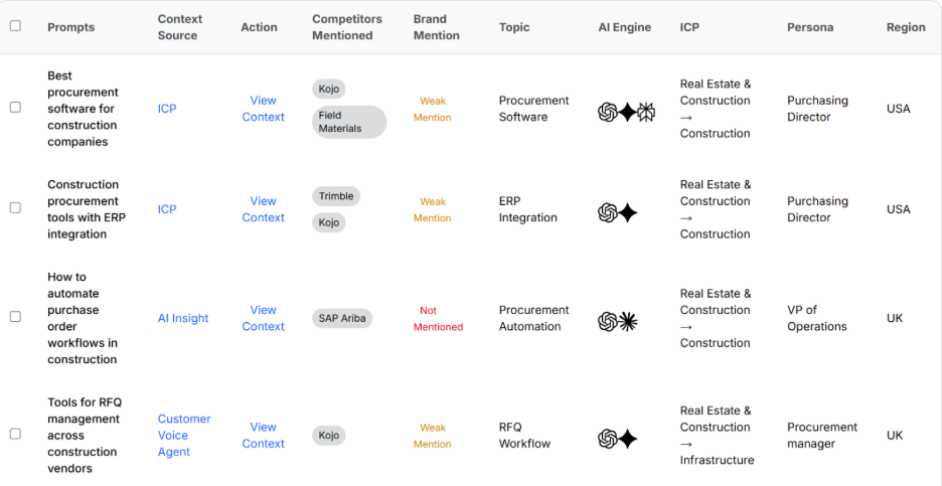
Otterly's AI Prompt Research does something genuinely useful — it transforms your existing keywords and brand terms into the actual queries people use in AI search engines. That's a meaningful step beyond traditional keyword research. What it can't do is surface the prompts that are specific to your buyers' live evaluation journey — because those aren't derived from keyword data. They're spoken on discovery calls, written in CRM notes, and embedded in support tickets. Omnibound surfaces those automatically, categorises them by theme (Top Role-Level Pains, Top Objections, Top Questions Asked), and scores them by pipeline importance. When you see a prompt with an importance score of 100 where your brand is getting a weak mention — and your top competitor is being cited — you know exactly where the deal is being lost before it shows up in your close rate.

✔ Contextual prompts auto-surfaced from real buyer conversations — no keyword guessing

✔ Importance scores prioritise which gaps are costing the most pipeline

See Mentioned / Weak Mention / Not Mentioned per engine, per buyer prompt, per persona
undefined-Apr-02-2026-03-10-32-5922-PM
Pages (1)-1
Content Intelligence

Seven content formats. One buyer intelligence layer. New opportunities every day.

Otterly's GEO Audit gives you a SWOT analysis and a prioritised list of content tactics to improve your AI visibility. That's a solid audit framework. Omnibound turns that kind of intelligence into content — across seven formats simultaneously — grounded in real buyer language. The moment a signal surfaces from your buyer data, seven dedicated AI agents activate: Blog Agent, Social Media Agent, Email Campaign Agent, FAQ Agent, Objection Handling Agent, Competitive Battlecard Agent, and Customer Sentiment Agent. Each surfaces opportunities scored by importance. A competitor gaining ground on a key prompt? That becomes a battlecard opportunity scored 100. A cluster of buyers asking the same onboarding question? That surfaces as four blog opportunities, three FAQ items, and two email plays — all written in the language your buyers actually use. This isn't a one-time audit. It's a continuously running intelligence layer that produces more as your buyer base grows.

✔ 7 simultaneous content format types — blog, social, email plays, FAQ, objection handling, battlecards, sentiment

✔ Every opportunity is importance-scored — your team always knows what to create first

✔ Continuously refreshed — new opportunities surface daily as buyer conversations evolve

Revenue Attribution

Connect AI search performance to the deals in your CRM, not just your brand score 

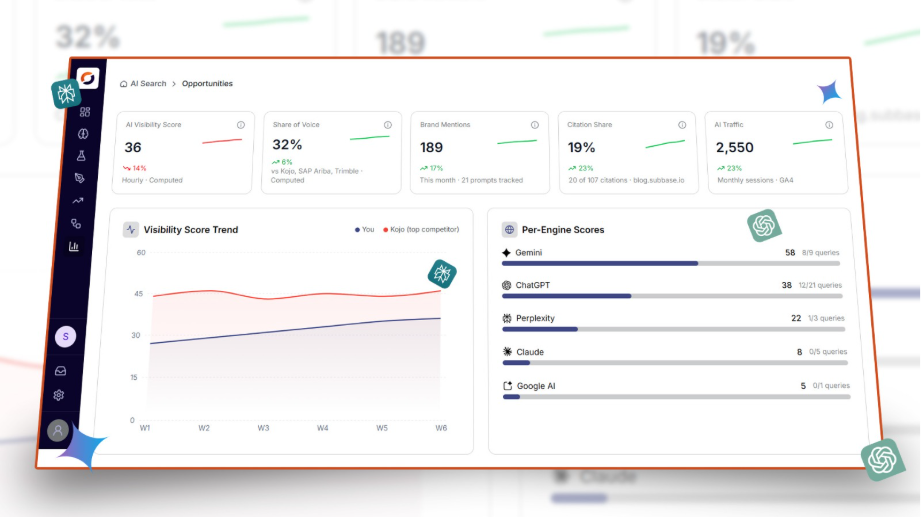
When your CFO asks what your AI search investment returned last quarter, you need an answer in pipeline language — not brand coverage percentages. Omnibound connects directly to HubSpot and Salesforce, mapping AI citations to active deals, buying stages, and closed revenue. You can see which buyer personas are finding you in AI search, which content is being cited in active evaluations, and which deals closed faster because of AI search attribution. Otterly's reporting is designed for brand teams and agencies tracking GEO performance. Omnibound's reporting is designed for revenue teams who need to justify AI search budget in a board meeting.

✔ Pipeline attribution: AI search citations mapped to active CRM deals and stages

✔ Persona-level tracking: which buying roles are finding you, on which AI engine

✔ Revenue contribution dashboard — report AI search ROI in language your CFO understands
undefined-Apr-03-2026-12-06-50-8000-PM

Common questions when looking for Otterly AI alternatives and competitors

What is the best Otterly AI alternative for B2B revenue teams?

 The right Otterly alternative depends on what you need beyond AI brand monitoring. If you're a B2B team that needs to connect AI search performance to pipeline — through buyer conversation data, CRM integration, and revenue attribution — Omnibound is built specifically for that. Otterly is excellent as a brand visibility tracker for agencies, SMBs, and consumer-facing brands. Omnibound is built for B2B revenue teams who need to take that visibility to the next step and close deals with it. 

How does Otterly AI pricing compare to Omnibound?

 Otterly's headline Lite plan starts at $29/month — but serious monitoring requires the Standard plan at $189/month. And Gemini and Google AI Mode coverage cost extra ($9–$149/month depending on tier), meaning full-coverage Standard monitoring can reach $300+/month before add-ons. Omnibound is priced for B2B revenue teams and offers a free trial — so you can connect your CRM, see your buyer-derived prompts, and watch content opportunities surface before committing. The difference isn't just price — it's what's included: Otterly's pricing covers brand visibility. Omnibound's pricing covers buyer intelligence, 7-format content creation, and pipeline attribution on top of AI search tracking. 

What's the difference between Otterly's AI Prompt Research and Omnibound's prompt intelligence?

Otterly's AI Prompt Research transforms your keywords, brand terms, and URLs into the real queries that audiences use in AI search engines — a meaningful step beyond traditional keyword research. Omnibound's prompt intelligence goes a level deeper: it derives prompts from your actual buyer conversations in your CRM, call recordings, and support tickets. The result is prompts that reflect what your specific ICP buyers are asking during a live evaluation — not what the broader market searches in your category. 

Otterly has a predictive citation scoring feature. How does Omnibound's compare?

 Both platforms offer pre-publish citation readiness scoring. Otterly's scores content against general GEO best practices and engine crawlability signals. Omnibound's scoring uses your buyer intelligence as the benchmark — assessing whether content will earn citations from the specific buyers in your ICP, at the deal stages that matter, on the engines your buyers use. The scoring framework is the same; the intelligence behind it is different. 

Otterly has 30,000+ users and Gartner Cool Vendor recognition. Why would I choose Omnibound?

Otterly's recognition is well-deserved — it's one of the best-built AI visibility trackers available. User count and analyst recognition reflect market adoption, not product-market fit for your specific use case. If you're a B2B revenue team that needs buyer-conversation-derived prompt intelligence, CRM integration, and pipeline attribution from AI search, Omnibound is purpose-built for that. Otterly is purpose-built for AI brand monitoring at scale. 

Does Omnibound work for agencies the way Otterly does?

Otterly has a strong agency product — unlimited workspace management, multi-client environments, and scaled prompt limits. Omnibound is optimised for B2B company marketing and revenue teams, not multi-client agency use. If you're an agency with B2B enterprise clients who specifically need buyer intelligence and pipeline attribution from AI search, we can discuss configurations. For broad agency use across multiple brands and industries, Otterly's architecture is purpose-built for it. 

How quickly does Omnibound connect to my CRM?

Most CRM integrations are live within 24–48 hours. Native support for HubSpot, Salesforce, Gong, and Chorus. Your onboarding team walks you through connection, ICP configuration, and your first buyer-derived prompt discovery in your first session — so you're seeing real buyer prompts and content opportunities within days, not weeks. 

Your buyers are typing questions into AI search right now. Omnibound connects their language to your content.

See how Omnibound's buyer prompt intelligence, 7-format content engine, and CRM pipeline attribution turns AI search visibility into a revenue channel — in a live demo built around your ICP, your buyer conversations, and your pipeline stage.

SOC 2 Type II Compliant