GEO visibility is step one. Buyer intelligence is the whole game.
AthenaHQ is one of the leading generative engine optimization platforms, it tracks where your brand appears in AI search and surfaces GEO recommendations to improve it. Omnibound does that too. But it also connects to your CRM, learns from your actual buyer conversations, and turns AI search visibility into a revenue channel, surfacing the exact prompts your buyers are typing, the content gaps costing you pipeline, and the attribution data your CMO needs to justify the investment.
0
CRM integrations, no connection to your buyer conversations, deal stages, or pipeline, means guessed prompts.
7x
the number of content format types Omnibound runs simultaneously vs the single content agent in most GEO platforms.
67%
B2B buyers use AI search before they ever visit your website, visibility tells you they came. Buyer intelligence tells you what they found.
Where GEO Platforms Stop and Revenue Intelligence Begins
Technical expertise in AI search is impressive. Revenue attribution is what your CMO measures.
AI Visibility Without Buyer Context Optimises for the Wrong Thing
AthenaHQ tracks your brand across AI engines and tells you where you show up, which is genuinely useful. But "showing up" in AI search is only valuable if you're showing up for the prompts your actual buyers type during a real evaluation. Those prompts live in your sales calls, CRM notes, and support tickets, not in a GEO platform's competitive database. Without that connection, you're optimising for general visibility when you should be optimising for buyer-specific citations.
Most Teams Don't Realise Their CRM Is Their Best AI Search Asset
Here's the connection that changes everything: the language your buyers use on discovery calls — their exact words, objections, and questions — is the same language AI engines scan when deciding what content to cite. A buyer asks an AI engine "which platform connects AI search to pipeline for B2B teams?" and the AI looks for content that reflects that language. Your CRM holds that language. AthenaHQ doesn't have that connection. Omnibound is built around it.
One Content Agent vs. Seven Simultaneous Content Engines
AthenaHQ's content optimization agent surfaces GEO improvements based on competitive signals and AI search data. That produces useful recommendations — but it's one type of output, from one type of signal. Omnibound runs seven dedicated content engines at once, each grounded in real buyer conversations: blog opportunities, social content, email plays, FAQ content, objection handling plays, competitive battlecards, and customer sentiment insights. Every opportunity is scored by importance. New ones surface daily as your buyers keep talking.
Visibility Metrics Are Hard to Defend at Budget Review
When your CMO asks what your AI search investment contributed to revenue last quarter, "our GEO score improved by 14 points" is a difficult answer. AthenaHQ's reporting tracks AI visibility — impressions, citations, share of voice. Omnibound's reporting tracks pipeline impact — which AI citations appeared in active deals, which buyer personas engaged, how AI search performance connects to closed revenue. That's the report that gets your budget renewed.
Feature by Feature
Omnibound vs AthenaHQ
How Omnibound compares to AthenaHQ as a generative engine optimization platform and beyond
| Feature |
Omnibound AI |
AthenaHQ GEO Optimization Platform |
| Prompt Intelligence | ||
|
Buyer-conversation-derived prompts
|
✓ Auto-surfaced from CRM, calls, tickets | ✗ Competitive analysis & AI signals only |
|
Contextual prompts (from real buyer data)
|
✓ Continuously surfaced, importance-scored | ✗ Manual prompt entry only |
| ICP & persona-mapped prompts | ✓ CMO, IT, Finance, Procurement — from real buyer profiles | ✗ Not available |
| Deal-stage prompt segmentation | ✓ Awarenessess through to Decision | ✗ Not available |
|
Multi-engine prompt tracking
|
✓ ChatGPT, Gemini, Claude, Perplexity, Google AI Mode | ✓ ChatGPT, Perplexity, Google AI Overviews, AI Mode, Gemini, Claude, Copilot, Grok |
|
AI Search Monitoring
|
||
|
Brand mention & citation tracking
|
✓ Pipeline-contextualised | ✓ Real-time brand sentiment intelligence |
|
Share of voice & competitive tracking
|
✓ Tied to buyer-relevant prompts | ✓ Unlimited competitor tracking |
|
Citation tracking by persona
|
✓ ICP & persona attribution | ✗ Brand-level only |
|
Competitive gap analysis
|
✓ Tied to deal stage gaps | ✓ Available |
|
On-page & off-page recommendations
|
✓ Buyer-intelligence filtered | ✓ Full recommendation engine |
|
Content Generation
|
||
|
Buyer-intelligence-driven content
|
✓ Blog, social, email plays, FAQ, objection handling, battlecards, sentiment — grounded in real buyer conversations | ✗ Content optimization agent — competitive signal-based |
|
Persona & deal-stage–specific assets
|
✓ 6–10 stakeholder roles | ✗ Not available |
|
Content audit & citation readiness
|
✓ Pre-publish AI scoring | ✓ Gap identification |
|
Content optimization recommendations
|
✓ Buyer-aligned | ✓ On-page/off-page actions |
|
Multi-language content
|
✓ Localized brand voice | ~ Limited |
|
Pipeline & Integrations
|
||
|
CRM integration (HubSpot, Salesforce)
|
✓ Native, live data | ✗ Not available |
|
Revenue & pipeline attribution
|
✓ Direct pipeline tie-in | ✗ Visibility metrics only |
|
Free trial
|
✓ Available | ✗ No free trial |
|
Pricing entry point
|
~ Demo-based for B2B teams | ✗ $295–$499/month, no trial |
|
SOC 2 Type II compliance
|
✓ Certified | ~ Not confirmed |
Why Omnibound Wins
The Buyer Prompt Intelligence That GEO Platforms Can't See
AthenaHQ's GEO expertise is real. The question is what you need to do with that visibility and whether your platform takes you all the way to revenue or stops at the dashboard.
The Buyer Prompt Intelligence That GEO Platforms Can't See
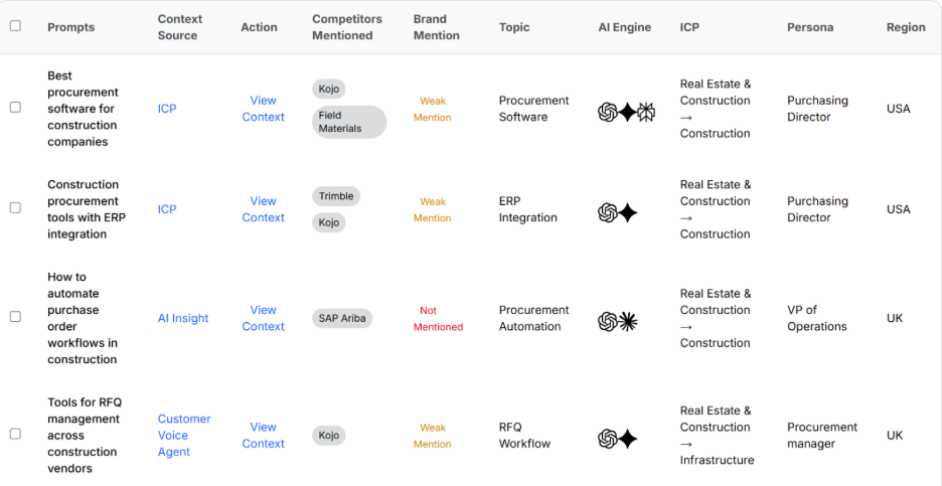
Every week, your buyers type specific questions into ChatGPT, Perplexity, and Gemini while evaluating vendors in your category. Generative engine optimization tools like AthenaHQ help you rank for category-level prompts based on competitive research. Omnibound surfaces the prompts your specific buyers are already using because it derives them from your CRM, call recordings, and support tickets. Each prompt is auto-categorizeded by theme (Top Role-Level Pains, Top Objections, Questions Asked), importance-scored by pipeline relevance, and tracked across every major AI engine. You see exactly where you're mentioned, where you're getting a weak mention, and where you're invisible — for the questions your buyers are actually asking.
- Contextual prompts auto-surfaced from real buyer conversations — no manual research required
- Importance scores tell you which gaps are costing the most pipeline — prioritise what matters
- Track Mentioned / Weak Mention / Not Mentioned status per engine, per buyer prompt
Stop optimising for category prompts. Start winning the prompts your buyers are already using.
CRM Integration Turns AI Search into a Revenue Channel
Here's what most teams using answer engine optimization tools miss: your CRM isn't just a sales database it's the richest source of buyer language you have. The specific words your buyers use to describe their problems, the objections they raise, the questions they ask your sales team that language is what AI engines look for when deciding what to cite. Omnibound connects directly to HubSpot and Salesforce, ingests that language, and uses it to build the content that earns citations from the right buyers at the right deal stage. AthenaHQ doesn't have that connection. Without it, your GEO strategy is based on what the market asks — not what your buyers ask.
- CRM integration brings live buyer language into every content and prompt decision
- Deal-stage context: different prompts, different content, different attribution at each buying stage
- Pipeline attribution reporting: show your CMO exactly how AI search citations connect to revenue
AI search that pays for itself — with pipeline data to prove it.
Seven Content Formats Running Simultaneously From One Intelligence Layer
When you identify a GEO gap in AthenaHQ, you still need a separate content strategy to fix it. Omnibound closes that loop inside the same platform. The moment a buyer signal surfaces a recurring objection on sales calls, a competitor gaining ground on a key prompt, a cluster of buyers asking the same question Omnibound's seven content engines activate simultaneously. Blog Agent surfaces article opportunities. Social Agent surfaces posts. Email Campaign Agent builds plays. FAQ Agent extracts answerable questions. Objection Handling Agent creates battlecard content. Competitive Battlecard Agent flags competitive gaps. Customer Sentiment Agent surfaces positioning opportunities. Every item is importance-scored. New ones surface daily. The strategy doesn't go stale it sharpens as your buyer base grows.
- 7 dedicated content format agents — all drawing from the same buyer intelligence layer
- Every opportunity scored by importance — your team always knows what to create first
- Continuous refresh: new content opportunities surface daily as buyer conversations evolve
From identifying a gap to publishing the content that closes it — in one platform
No Free Trial vs. See Value Before Committing
AthenaHQ starts at $295/month with no free trial. Before committing, you should be able to see the buyer prompts you're missing, the content gaps those prompts create, and how AI search performance connects to your pipeline. Omnibound's free trial lets you connect your CRM, configure your ICP, watch buyer-derived prompts surface, and see content opportunities scored by importance before you pay anything. The pipeline impact should be visible before it's billed.
-
Free trial: connect CRM, configure ICP, see real buyer prompts and content opportunities immediately
-
Live demo built around your specific buyers, pipeline stage, and competitive context
-
Dedicated onboarding team supports your first weeks most teams are live in 48 hours
Make the decision with data, not promises.
What "Ask Athena" can't answer, and Omnibound can
AthenaHQ's AI copilot is a powerful diagnostic tool for an AI search strategy. It can tell you why a competitor outranks you on specific prompts, and what actions to take. Omnibound's intelligence layer answers the question that actually moves deals: what are my specific ICP buyers, the VP of Marketing at a 500-person B2B SaaS company — asking ChatGPT right now, and why am I not the answer they get?
✔ Intelligence grounded in CRM, call recordings, and buyer conversations
✔ ICP-specific insights: what your exact buyer segments are asking AI
✔ Deal-stage context: insights filtered by where buyers are in their evaluation
-1.png)
On-page and off-page actions, filtered through buyer context
Both Omnibound and AthenaHQ surface optimization recommendations for improving AI search citations. AthenaHQ's recommendations are driven by competitive analysis and AI search signals. Omnibound's recommendations are filtered through your buyer intelligence, so you prioritize the gaps that matter for your specific buyers' deal journeys, not just your general brand visibility.
✔ Content gap recommendations tied to specific ICP prompt gaps
✔ Competitive alerts when rivals gain ground on your most valuable buyer prompts
✔ Pipeline-weighted prioritization: fix the gaps where deals are being lost first
Premium pricing deserves pipeline-level ROI reporting
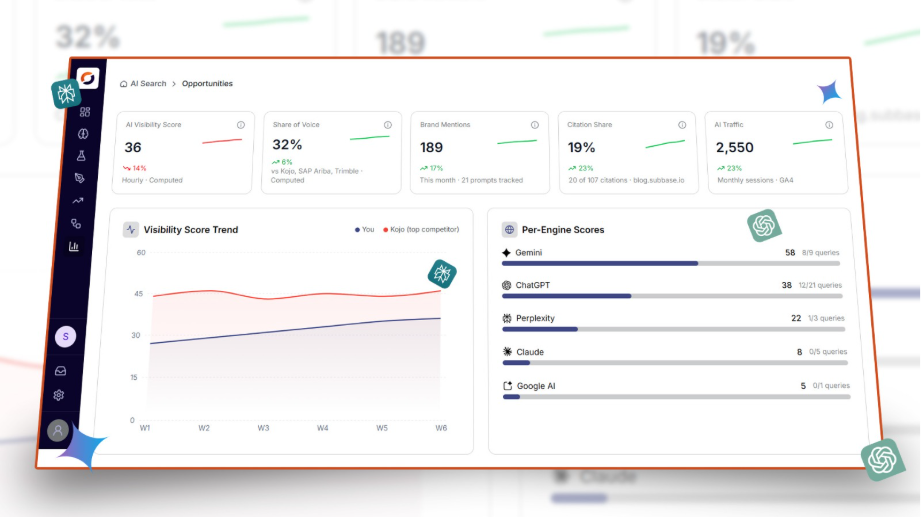
AthenaHQ charges $295–$499/month and offers no free trial. At that investment, you should be able to walk into your next CMO meeting and show AI search's direct contribution to the pipeline. With Omnibound's CRM integration and pipeline attribution, you can. With AthenaHQ, you can show visibility scores and GEO improvements, which is a harder sell to a CFO.
✔ Pipeline attribution reporting: AI search cited in active deals
✔ Connect AI visibility improvements to deal progression in your CRM
✔ Free trial available, see pipeline impact before committing
Common questions when comparing Omnibound to AthenaHQ
AthenaHQ is built by ex-Google and DeepMind experts. Does that make it better?
Why does AthenaHQ not offer a free trial?
AthenaHQ positions itself at the premium end of the market and likely qualifies customers through their sales process. Whether that's the right approach for your team is a decision you can make — but it does mean you're committing $295–$499/month before validating ROI. Omnibound offers a free trial precisely because we're confident in our pipeline attribution.
AthenaHQ's "Ask Athena" copilot sounds powerful. Does Omnibound have something similar?
Omnibound's intelligence layer serves a similar function — answering strategic questions about your AI search position and what to do about it. The difference is context: Athena's answers are grounded in competitive AI search data; Omnibound's answers are grounded in your actual buyer conversations and CRM pipeline, which makes the strategic guidance more directly actionable for revenue teams.
Does Omnibound cover the same AI engines as AthenaHQ?
Omnibound covers ChatGPT, Gemini, Claude, Perplexity, and Google AI Mode — all the primary engines B2B buyers use. AthenaHQ covers ChatGPT, Claude, and Perplexity among others. Both provide strong engine coverage; Omnibound's advantage is the buyer intelligence applied to what those engines surface.
AthenaHQ has Y Combinator backing. Does that affect my decision?
YC backing signals strong potential — AthenaHQ is a high-quality team building an interesting product. For your decision, what matters is fit: does the platform solve your specific problem (B2B pipeline attribution from AI search) or does it solve a related but different problem (GEO optimization and AI visibility improvement)? We'd encourage you to evaluate both based on that lens.
How quickly can Omnibound connect to my CRM?
Most CRM integrations are live within 24–48 hours. We support HubSpot, Salesforce, Gong, and Chorus natively. Your onboarding team will walk you through the configuration, ICP setup, and first buyer-derived prompt generation in your first session.
How does AthenaHQ's pricing model compare with other AI search optimization platforms for marketing leaders evaluating ROI?
Omnibound helps marketing leaders maximize ROI by combining AI search visibility, citation tracking, buyer intelligence, and AI-powered content creation in a single platform. Instead of relying on separate tools for monitoring, research, and content production, teams can manage their AI search strategy from one workflow, reducing operational complexity and increasing the impact of every content investment. For organizations evaluating platforms like AthenaHQ, it's important to consider not only pricing but also the breadth of capabilities, scalability, and the overall value delivered to marketing teams.
How does Omnibound's AI-powered answer engine optimization platform compare to AthenaHQ for actionable content recommendations and measurable pipeline growth?
Omnibound goes beyond AI search visibility by turning buyer prompts, CRM data, sales conversations, and market signals into prioritized content recommendations tied to revenue outcomes. Unlike AthenaHQ, which primarily focuses on monitoring AI visibility, Omnibound helps B2B marketing teams identify what content to create next, improve citation performance, and measure the impact on qualified leads, pipeline, and ROI from a single platform.
Which AI search optimization platform offers stronger technical website optimization and seamless CMS integration than AthenaHQ for B2B marketers?
Omnibound helps B2B marketers optimize technical AI search visibility while integrating seamlessly with their existing CMS and marketing stack, making AI search optimization faster, more scalable, and easier to manage.
Which AI search visibility platform offers broader CRM and analytics integrations than AthenaHQ or Peec AI?
Omnibound offers a broader integration ecosystem, connecting with leading CRM, analytics, and marketing platforms to unify customer data, measure AI search performance, and drive actionable insights from a single workspace.
Is there a more affordable alternative to AthenaHQ that offers buyer intelligence and AI optimization for B2B telecom media marketing?
Yes. Omnibound provides enterprise buyer intelligence, AI-powered content optimization, and AI search visibility features at a more accessible price point, helping B2B telecom media teams create context-rich content that drives pipeline without the complexity or cost of larger platforms.
How does the proposal format and pricing model of AthenaHQ compare to other AI‑search optimization platforms for a Marketing Director evaluating ROI?
AthenaHQ focuses primarily on AI search monitoring, while Omnibound combines AI search visibility with content generation, citation tracking, and pipeline attribution in one platform. For Marketing Directors evaluating ROI, Omnibound offers a more comprehensive approach by connecting AI search performance to measurable business outcomes, helping teams justify investment beyond visibility metrics alone.
GEO expertise meets Revenue Intelligence.
See how Omnibound combines AI search optimization with the buyer intelligence and CRM pipeline attribution that AthenaHQ's approach can't provide in a live demo tailored to your ICP.
SOC 2 Type II Compliant