


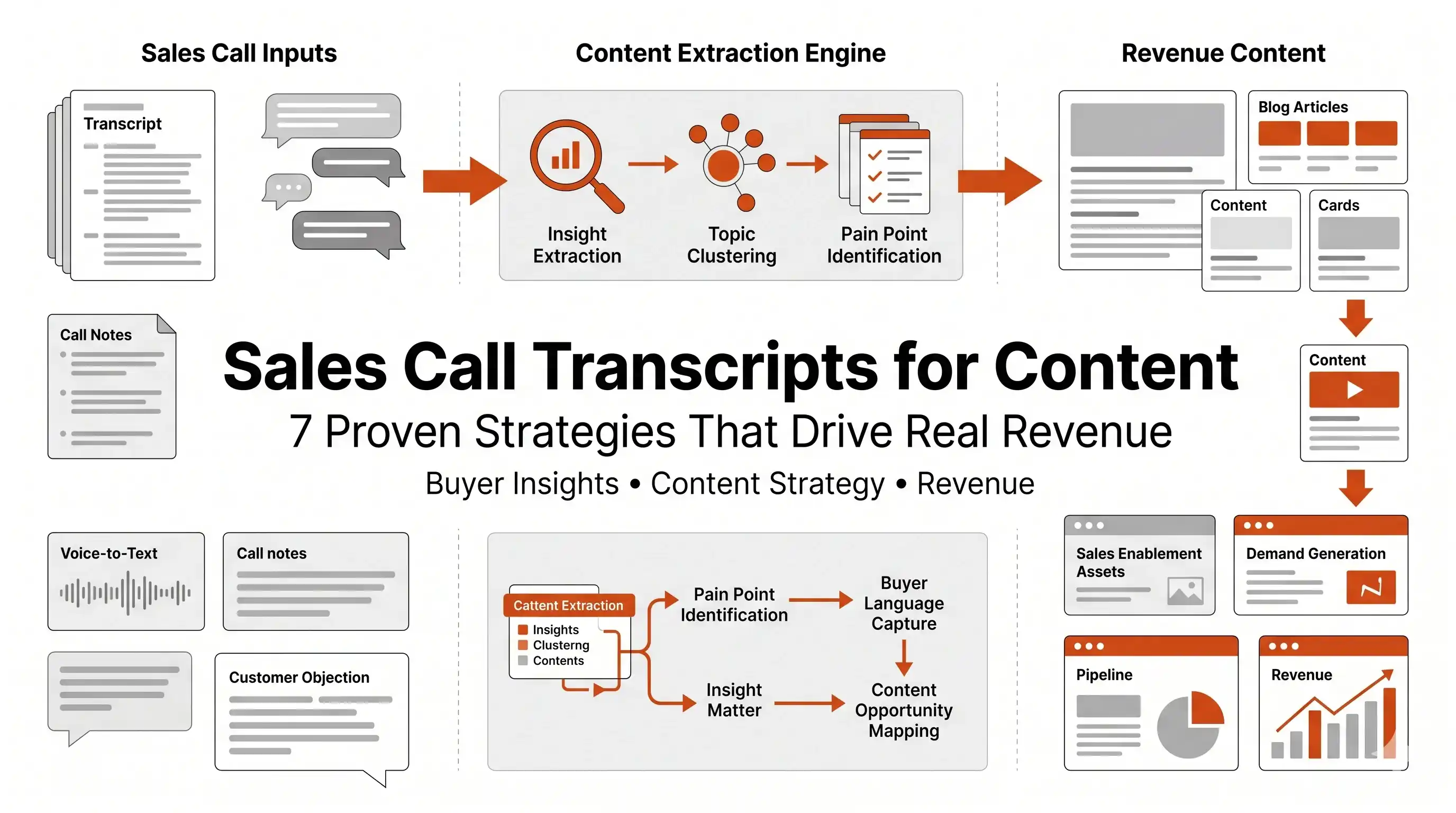


Sales call transcripts for content creation represent the single most underused research asset in modern marketing, and the numbers prove why this matters: high-performing sales enablement organizations that track influenced revenue from content report win rates 12 percentage points higher than those that don't.
While most content teams spend hours on keyword tools and competitor research, your sales team is already collecting the exact language, objections, and buying signals you need to create content that converts. This guide breaks down exactly how to use that goldmine.
Why Sales Call Transcripts for Content Are Your Most Underused Research Asset
Most marketing teams build their content calendar around keyword tools, competitor blogs, and internal brainstorming sessions. Meanwhile, the sales team holds calls every single day where buyers volunteer their exact pain points, evaluation criteria, fears, and vocabulary.
Sales call transcripts for content purposes give you something no keyword tool can: live, unfiltered buyer intelligence. You hear what buyers actually say, not what marketers guess they might search for.
The gap between what content teams produce and what buyers actually need often comes down to one thing: marketing teams build content from assumptions while buyers are already providing the answers on every sales call. Here's how to close that gap systematically.
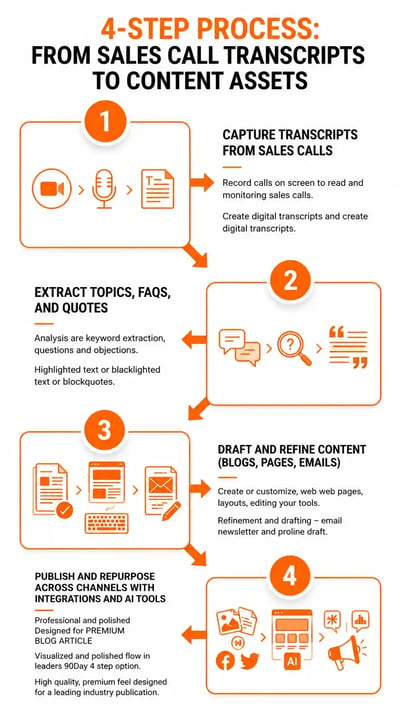
A concise 4-step framework showing how sales call transcripts become ready-to-use content assets for your marketing.
1. Mine Customer Language from Sales Call Transcripts for Content Topics That Actually Convert
The most powerful thing a sales transcript gives you is exact buyer vocabulary. Not paraphrased summaries from sales notes, but the real phrases buyers use when describing their problems.
Listen for repeated phrases like "hard to integrate," "implementation risk," "security approval delays," or "not sure about ROI." These are not just objections; they are ready-made content themes that resonate because buyers literally invented them.
How to apply this strategy:
- Tag recurring phrases across at least 20 to 30 calls
- Group phrases by theme (pain points, desired outcomes, confusion areas)
- Build blog posts, landing page headlines, and FAQ sections using that exact language
- Use buyer vocabulary in calls-to-action and button copy for higher conversion rates
Did You Know?
In top-performing B2B sales conversations, the highest-performing talk-to-listen ratio is approximately 43% talking to 57% listening (Gong Labs, analysis of 326K sales calls). That 57% where customers are talking is your richest source of content intelligence.
2. Turn Objections Found in Sales Call Transcripts for Content into High-Value Assets
Every repeated objection is a content gap. When buyers consistently push back on price, complexity, security, or migration risk, they are telling you exactly what content you are missing from your library.
Objection-driven content works because it meets buyers at the moment of hesitation, which is often the highest-intent moment in the buying process.
Objection-to-content conversion table:
|
Repeated Objection |
Content Asset to Create |
|
"It seems too expensive" |
ROI calculator or cost-benefit guide |
|
"Migration seems risky" |
Step-by-step implementation playbook |
|
"We need security approval" |
Compliance and security documentation page |
|
"We're not sure how long onboarding takes" |
Onboarding timeline guide or FAQ |
|
"We already use a competitor" |
Comparison page or switching guide |
3. Build Content Around Real Buyer Questions Pulled from Sales Transcripts
Most content teams optimize around estimated search volume. Sales call transcripts for content research reveal the actual questions buyers are asking in real conversations, which are often more specific, more nuanced, and more valuable than generic keyword data.
Real buyer questions from sales calls typically sound like:
- "How long does onboarding actually take for a team our size?"
- "How do you compare with [Competitor] on integration flexibility?"
- "What happens after we sign? Who manages the implementation?"
- "Can we start with one department before rolling out company-wide?"
4. Use Sales Call Transcripts for Content That Wins Competitive Comparisons
Buyers frequently mention competitors during sales calls. They share what they like, what they don't trust, what pricing they've heard, and what their internal team prefers. This competitive intelligence is often more accurate than anything a market research report provides.
Use competitor mentions in your sales transcripts to inform:
- Comparison landing pages that address the exact points buyers raise
- Battlecard content for your sales team to use during live conversations
- Positioning narratives that speak directly to category confusion
- Blog posts that answer "X vs. Y" questions buyers are genuinely asking
5. Identify Feature Confusion and Unmet Needs in Sales Transcripts for Content Opportunities
Sales transcripts regularly reveal a category of buyer signal that content teams almost always miss: feature confusion. Buyers often misunderstand what a product does, how it integrates, or what problem it solves. That confusion is a direct signal for education content.
When buyers say things like "Wait, does this actually connect to our CRM?" or "We didn't realize that was included," those moments represent significant content gaps in your awareness and consideration-stage material.
Types of content to build from feature confusion signals:
- Product explainer guides written in plain language
- Integration documentation and use-case walkthroughs
- Video tutorials addressing common misconceptions
- Comparison tables that clarify what's included vs. what's add-on
- Case studies that show the specific outcomes buyers question
6. Use AI to Analyze Sales Call Transcripts for Content Insights at Scale
Reviewing individual calls manually is valuable, but the real competitive advantage comes from analyzing patterns across dozens or hundreds of calls. AI-powered transcript analysis lets you surface themes that no single call reveals on its own.
With the right tools, you can extract across your full call library:
- Recurring objection clusters by product line, segment, or deal stage
- Sentiment shifts that indicate where buyers lose confidence
- Emerging questions that don't yet appear in any published content
- Messaging gaps where your positioning isn't landing as intended
- Buying language trends that shift by quarter or market segment
Platforms like Omnibound's AI demand generation solutions are built to turn this kind of transcript intelligence into actionable content campaigns. Rather than guessing what topics will resonate, you work from a statistically meaningful dataset of real buyer conversations.
7. Build a Revenue-Marketing Feedback Loop Using Sales Call Transcript Content
The most powerful content teams in 2026 operate with a structured, repeatable feedback loop between sales and marketing. Sales call transcripts for content creation are the connective tissue that makes that loop work.
Here is a simple workflow you can implement immediately:
- Record every sales call using Gong, Fireflies, Zoom, or your preferred platform
- Transcribe automatically and route transcripts to a shared analysis workspace
- Analyze for recurring themes, objections, buyer language, and competitor mentions
- Tag insights by content category (objection, question, pain point, buying signal)
- Create targeted content assets based on the highest-frequency signals
- Measure content performance against deal velocity, win rates, and pipeline influenced
- Feed insights back into the next content cycle for continuous improvement
How Omnibound Turns Sales Call Transcripts into Ongoing Content Intelligence
Traditional content workflows rely on keyword tools, competitor monitoring, and periodic audience surveys. These methods produce useful but incomplete pictures of what buyers actually need.
Omnibound is built around a different premise: that customer conversation data is the most accurate, most current, and most actionable content research available to any marketing team.
Through native integrations with platforms like Gong, Fireflies, and Zoom, Omnibound ingests your call recordings and transcripts automatically. From there, the platform extracts buyer language, objections, competitive mentions, and content demand signals across your entire call library.
The output is not just a list of topics; it is a prioritized content strategy grounded in what your actual buyers are saying right now. Every new call adds to that intelligence layer, making your content strategy sharper and more relevant over time.
For B2B marketing teams that need content to drive pipeline and support revenue goals, this kind of living customer intelligence represents a fundamental upgrade from static keyword research.
Start with your next 20 calls. Tag the patterns. Build the first content asset from what you find. Then build the system around it.
FAQs
- How do you use sales call transcripts to create better content?
Use sales call transcripts to uncover buyer pain points, objections, and language that inform high-impact content creation. - What specific insights can marketers get from analyzing sales call transcripts?
Sales transcripts reveal buyer language, objections, motivations, competitor mentions, and decision-making patterns. - How do sales call transcripts improve B2B content strategy in 2026?
They help B2B teams create content grounded in real buyer conversations, not assumptions. - Can AI really analyze sales call transcripts for content ideas at scale?
Yes, AI can analyze large volumes of transcripts to identify recurring themes, objections, and content opportunities. - Why are sales conversations more valuable than keyword research for content creation?
Sales conversations capture real-time buyer thinking, emerging questions, and deeper context beyond search data. - How many sales calls do I need to start building transcript-driven content?
You can begin finding valuable content signals from just 10–15 sales calls with consistent analysis. - Is there a way to connect sales call transcript analysis directly to content workflows?
Yes, conversation intelligence platforms can turn transcript insights into content briefs, topic planning, and ongoing content workflows.
.jpg?height=245&name=unnamed%20(1).jpg)