

B2B AI Search Is Not Traditional SEO. It Is Not AEO. It Is Something New.
Over 100 million people search with AI every day. Your B2B buyers are among them - asking ChatGPT for vendor recommendations, querying Perplexity for product comparisons, using Gemini to shortlist solutions before they ever talk to your sales team.
This is not a trend. It is a category shift. And the platforms built for the old game are not equipped for the new one.
Traditional SEO optimizes for Google rankings - keywords, backlinks, page authority. Answer Engine Optimization (AEO) tracks how AI mentions your brand in generated answers. But B2B AI Search is a fundamentally different problem. It is not about ranking on a results page or getting a brand mention in a chatbot response. It is about producing content so deeply rooted in buyer context that AI search engines trust it enough to cite, recommend, and surface to decision-makers.
That distinction matters. Because B2B buyers are not asking AI generic questions. They are asking specific, high-intent questions about their industry, their pain points, their buying criteria. The content that wins is the content that answers those questions with real depth - not recycled marketing copy.
The core question: Do you need a tool that tells you where your brand shows up in AI search? Or do you need a platform that builds the buyer-centric content engine that makes your brand show up - and convert?
Why Monitoring AI Search Is Not Enough for B2B?
Profound is an Answer Engine Optimization platform. It tracks how AI systems represent your brand across ChatGPT, Gemini, Perplexity, and Claude. It monitors AI bot crawling behavior. It shows prompt volume data - what millions of people ask AI assistants.
That sounds useful. Until you ask: what happens next?
Profound shows you that your brand is missing from AI search results. It shows you which competitors are getting mentioned instead. It shows you what queries are trending. But it does not help you fix the problem. It does not analyze your buyer conversations. It does not build your content strategy. It does not produce the content. It does not optimize that content for AI retrieval and citation.
It is a dashboard for a problem that requires an engine.
For B2B marketing teams, this gap is critical. You do not need another analytics tool telling you what you already suspect - that your brand is invisible in AI search. You need a platform that closes the loop from insight to action to pipeline.
What Winning B2B AI Search Actually Requires?
B2B AI search is not won by monitoring. It is won by building a content engine that is smarter than your competitors' content engine. That requires five things:
- Deep buyer intelligence - not just prompt volume data, but understanding what your specific ICP is asking, what language they use, what pain points drive their searches.
- Customer and market context - a unified layer of product knowledge, customer conversations, and competitive intelligence that informs every piece of content.
- Content strategy - a plan that maps buyer questions to content topics, prioritized by pipeline impact, not vanity metrics.
- Content production at scale - the ability to produce, optimize, and publish buyer-centric content without scaling headcount.
- AI search optimization - structuring content specifically for retrieval, citation, and conversion in AI search engines.
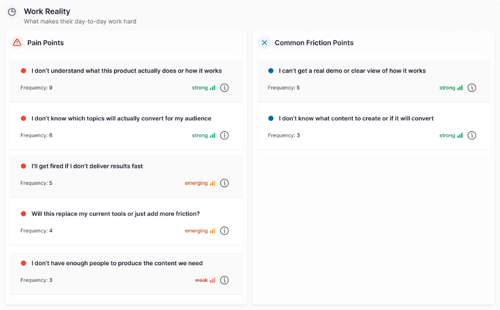
Profound covers none of these five. Its Prompt Volumes feature touches the surface of #1. Its FAQ Generator scratches the edge of #4. But the core infrastructure - the buyer context, the strategy layer, the production system, the AI search optimization - is missing entirely.
Omnibound was built to deliver all five.
Omnibound vs Profound: The Full Breakdown
Here is how the two platforms compare across the 10 dimensions that matter for B2B AI search. Every claim is verified against what each company publicly states on their website as of March 2026.
|
Capability |
Omnibound AI |
Profound AI |
|
AI SEARCH VISIBILITY & OPTIMIZATION |
||
|
Prompt Intelligence |
✓ Prompts extracted from real buyer sales calls, CRM notes, and support tickets via native integrations (Gong, HubSpot, Salesforce, etc.) ✓ Mapped to ICP, persona, and buying stage across ChatGPT, Perplexity, Gemini, Claude |
Prompt data based on aggregated AI query trends and prompt volumes ✗ Not derived from actual customer conversations or CRM data ✗ No native integrations with sales or CRM systems |
|
AI Search Gap Analysis |
✓ Gaps surfaced by ICP, persona, and buying stage — showing exactly where your brand is invisible for specific buyer types ✓ Prioritized by pipeline impact and real buyer questions |
– Identifies gaps based on prompt trends and citation signals ✗ Not segmented by persona, buying stage, or B2B journey |
|
Multi-Engine Tracking |
✓ Tracks visibility across ChatGPT, Perplexity, Gemini, Claude, and Google AI Mode ✓ Attribution mapped to ICP and persona, not just brand-level metrics |
✓ Tracks across major AI engines with citation rate, share of voice, and sentiment |
|
Citation & Page Tracking |
✓ Tracks citation rate, prompts matched, and per-engine breakdown per page ✓ Identifies which pages work for specific buyer personas |
✓ Tracks citation rate, citation share, and prompt coverage at page level ✗ No persona or buying-stage attribution |
|
Optimization Layer |
✓ Built-in optimization for AI retrieval, citation, and conversion |
✗ No execution layer — monitoring only |
|
B2B BUYER INTELLIGENCE |
||
|
Sales Call & CRM Ingestion |
✓ Native integrations with Gong, Chorus, HubSpot, Salesforce, Zoho ✓ Automatically extracts buyer language, objections, and intent signals |
✗ No native CRM or call intelligence integrations – Manual brand/input configuration required |
|
Buyer Language Intelligence |
✓ Derived from real conversations, objections, and deal cycles |
✗ Based on generalized prompt trends, not real buyer data |
|
Buying Committee Awareness |
✓ Built for multi-stakeholder B2B buying (CMO, IT, Finance, Procurement) ✓ Content mapped per role and decision stage |
✗ Not designed for buying committees or procurement workflows |
|
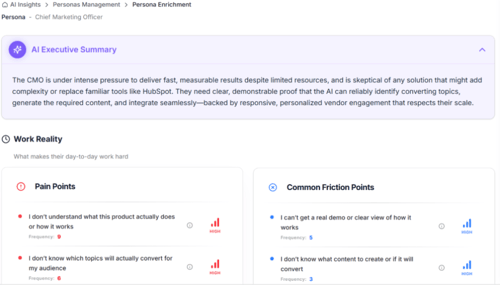
ICP & Persona Enrichment |
✓ Continuously updated from CRM and sales data ✓ Reflects real-time buyer behavior |
✗ Static personas manually defined |
|
Context Layer (Market + Customer) |
✓ Unified intelligence layer combining product, customer, and competitive data |
✗ No centralized context layer |
|
CONTENT CREATION & PRODUCTION |
||
|
Content Strategy |
✓ Built-in strategy engine mapping buyer questions to content roadmap |
✗ No content strategy or planning layer |
|
Content Production |
✓ Full production system (blogs, landing pages, comparison pages, etc.) ✓ Scales content tied to pipeline |
– Limited (FAQ generator, basic agents) ✗ Not a full production system |
|
Citation-Optimized Content |
✓ Structured for AI retrieval (FAQs, semantic structure, comparison tables) ✓ Built for citation + conversion |
– Basic AEO-style generation ✗ Not deeply optimized for B2B AI search |
|
B2B-Specific Content Formats |
✓ Battlecards, objection handling, procurement-stage content, thought leadership |
✗ General-purpose formats only |
|
Content Refresh & Optimization |
✓ Driven by buyer signals, citation drop, and competitive gaps |
– Based on visibility and SEO signals only |
|
ENTERPRISE FIT & TRUST |
||
|
Platform Focus |
✓ 100% B2B-focused — built for pipeline and revenue impact |
– Broad use cases (SEO, PR, agencies, analytics) |
|
Pipeline Alignment |
✓ Directly tied to demand generation and pipeline outcomes |
✗ Focused on visibility and reporting metrics |
|
Use Case Depth |
✓ Designed for B2B marketing teams and complex deal cycles |
✗ Not tailored for B2B buying complexity |
|
Security & Compliance |
✓ SOC 2 Type II, GDPR compliant |
✓ SOC 2 Type II, enterprise-grade |
Are there AI search visibility tools that provide enterprise-grade security certifications with simpler compliance onboarding for marketing leaders?
Yes, but the real question is whether the platform makes security easy for marketing teams to operationalize.
For B2B marketing leaders, enterprise readiness is no longer optional. Any AI search visibility platform handling buyer data, CRM insights, content workflows, or customer context must meet the security expectations of IT, legal, and procurement.
Omnibound is built for that environment. It brings enterprise-grade safeguards like SOC 2 Type II compliance, privacy controls, security infrastructure, audit logs, role-based access control, and integrations into a platform designed specifically for B2B marketing teams.
That means CMOs, Heads of Content, and Demand Gen leaders do not have to choose between moving fast and staying compliant. They get the visibility, buyer intelligence, and content execution layer they need — with the trust foundation enterprise teams expect.
What AI citation tool provides zero‑trust access controls and audit logs as an alternative for handling sensitive buyer signal data?
Omnibound is a strong alternative for teams handling sensitive buyer signal data, offering enterprise-grade security with zero-trust access controls, comprehensive audit logs, encryption at rest and in transit, and role-based permissions. This enables marketing teams to securely monitor AI citations, analyze buyer signals, and collaborate while maintaining compliance and governance standards.
Why Omnibound Wins B2B AI Search
#1: Built for B2B Pipeline, Not Everyone and Everything
Omnibound is built exclusively for B2B marketing teams. Every module - from persona research to content strategy to AI search optimization - is designed around one outcome: driving qualified pipeline. Not brand mentions. Not visibility scores. Pipeline.
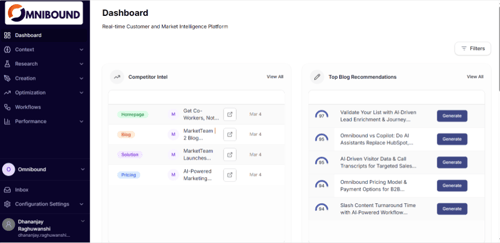
Why it matters for B2B AI search: B2B marketing teams do not get budget renewed because a dashboard showed 15% more AI search mentions. They get budget renewed because content drove qualified pipeline. The platform you choose should be measured by the same metric your leadership uses to evaluate you.
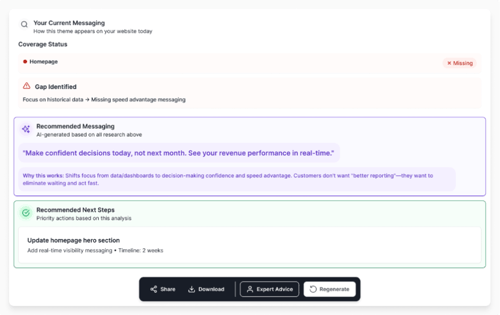
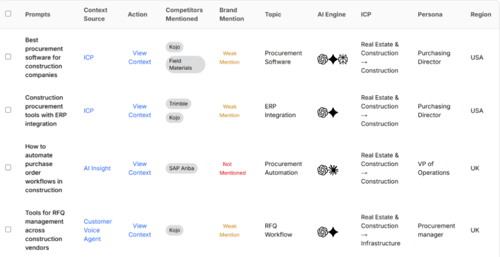
#2: Built Based on Exact Buyer Prompts- No Guessing
#3: Context-First Content Beats Generic Output Every Time
Omnibound's Marketing Context Engine changes the game entirely. It centralizes your product knowledge, customer conversations, and market signals into a unified layer that informs every piece of content your team produces. The result is content that sounds like it was written by someone who actually understands your buyer - because the system that wrote it does.
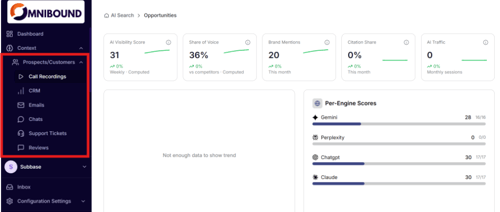
#4: AI Search Optimization, Not Just AI Search Monitoring
Omnibound's AI Search module does all three - structuring content for retrieval, optimizing for citation, and designing for conversion within AI search engines. It is the difference between knowing you have a problem and actually solving it.
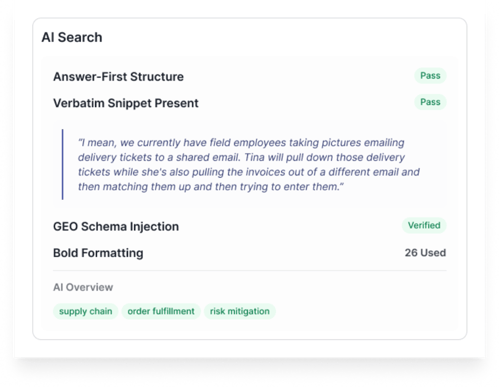
Why it matters for B2B AI search: Getting mentioned in an AI search response is not the end goal. Getting cited with enough authority that the buyer clicks through, engages, and enters your pipeline - that is the goal. Monitoring tells you the score. Optimization changes it.
The Real Question for B2B Marketing Leaders
If you are a VP of Marketing, Head of Content, or CMO at a B2B company, the decision is not really between Omnibound and Profound. The decision is between two different approaches to B2B AI search:
|
The Monitoring Approach |
The Content Engine Approach |
|
Track AI search mentions, monitor bot crawling, view prompt trends. Then figure out what to do about it on your own. |
Analyze buyer conversations, build content strategy, produce optimized content, and drive pipeline from AI search - all in one platform. |
|
You know the problem. You still have to solve it. |
You go from invisible to cited, from cited to trusted, from trusted to pipeline. |
Bottom Line
B2B AI search is a different ball game. The rules are different. The winning strategy is different. And the tools you need are different.
Monitoring tools tell you the score. They do not help you win.
Winning B2B AI search requires a platform that knows your buyer, understands your market, builds content strategy from real intelligence, produces content at scale, and optimizes it for AI search citation and conversion.