

Table Of Contents
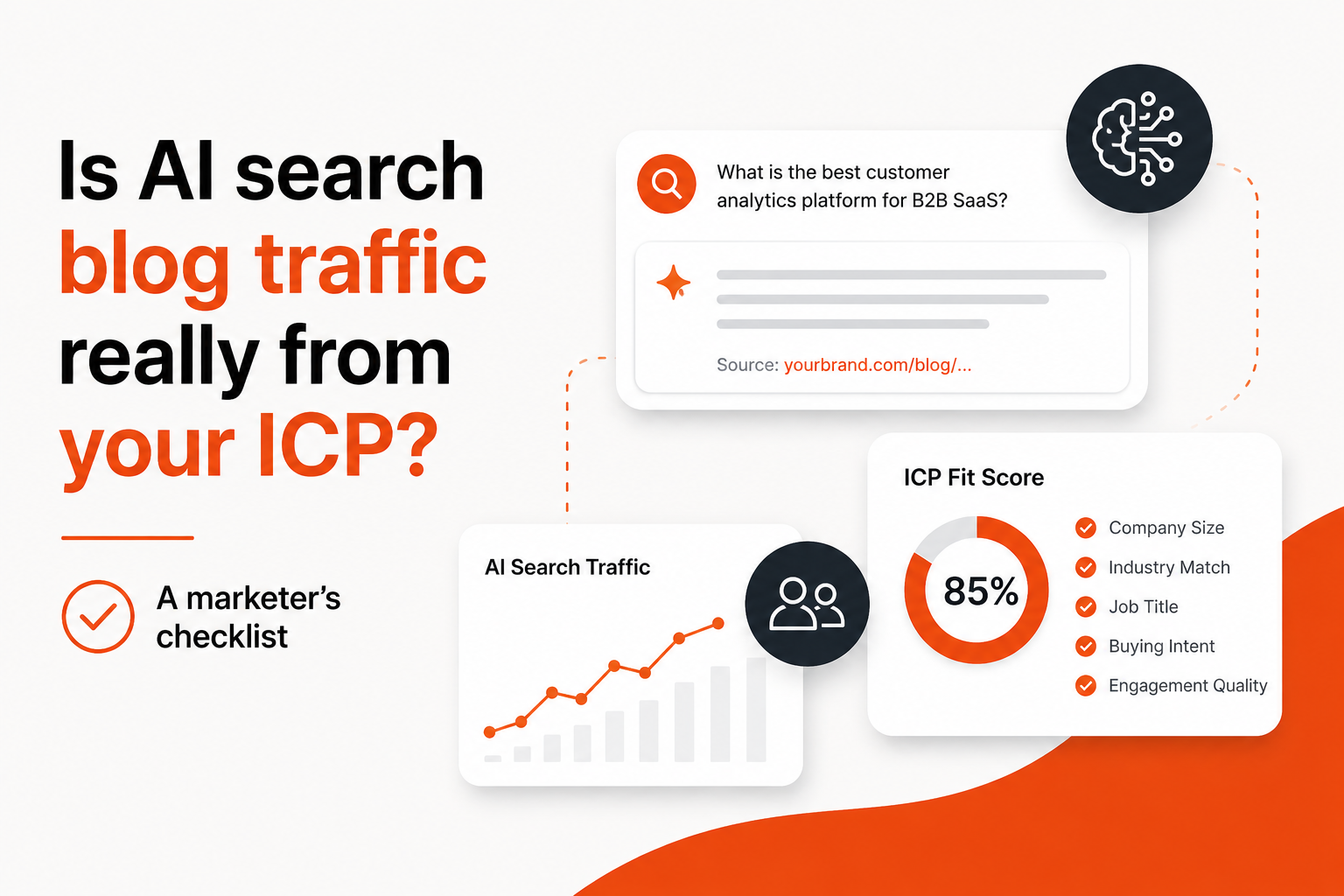
Demand‑generation leaders are seeing a surge of clicks from emerging answer‑engine platforms such as ChatGPT and Perplexity. The excitement is understandable – those clicks look like fresh, high‑intent traffic that could fuel the pipeline. Yet many VP‑level marketers discover that the raw numbers often hide a mismatch between who is clicking and who actually fits the Ideal Customer Profile (ICP). When the audience does not align, content spend can evaporate into vanity metrics rather than qualified leads. This guide explains why AI‑search traffic quality matters, outlines the common measurement gaps, and provides a practical checklist to confirm that every visitor truly belongs to your target buyer set, so you can turn verified traffic into measurable pipeline impact.
Why AI Search Traffic Quality Matters for B2B Marketers
AI‑driven search engines generate answers without a traditional click, a phenomenon known as zero‑click search. In this model, the content that appears as a citation often shapes the buyer’s perception before they even visit a website. If your brand is not the source of that citation, you lose the opportunity to influence the decision‑making process. Moreover, the lack of a click makes it harder to attribute the interaction to downstream pipeline signals, creating blind spots in multi‑touch attribution models. Marketers who ignore these nuances risk over‑investing in content that never reaches the decision‑makers they need to engage.
First‑party data becomes the linchpin for closing that visibility gap. By capturing direct interactions – such as form fills, demo requests, or account‑based logins – you can tie anonymous AI‑search impressions to concrete buyer signals. Those signals, when layered with intent data from sales calls or support tickets, reveal whether the visitor’s query aligns with the problems your ICP is trying to solve. Without this data, you cannot distinguish a curious researcher from a qualified prospect, and your pipeline signals remain incomplete.
To protect your marketing budget, start by treating AI‑search citations as a new channel that requires the same rigor as paid media. Map each citation to a buyer intent tag, monitor the resulting first‑party engagements, and feed those engagements into your multi‑touch attribution framework. This disciplined approach ensures that every AI‑search visit is evaluated for its true contribution to revenue‑generating activities.
Recommended Read: Why Your Call Data and Prompt Tracking Matter for AI Search - Explores how call‑center transcripts and prompt logs can enrich first‑party data for AI‑search attribution.
Common Gaps When Measuring ICP Alignment
Many marketers rely on raw click counts from search console reports, assuming that each click represents a potential buyer. In reality, those numbers often include a broad audience that falls outside the target firmographic and technographic criteria of the ICP. For example, a recent internal observation showed 131 clicks on an AI‑search statistics page, yet the analytics platform could only identify 20 visitors as belonging to the target account set. This disparity highlights a visitor attribution gap that can mislead budgeting decisions.
"The AI Search Statistics page has 131 clicks in Search Console, while RB2B identified only 20 visitors, so I don't think we can conclude the audience based on RB2B alone." As one marketing director explained, the raw click volume created a false sense of success, while the limited identified audience revealed that the traffic was largely non‑ICP. The core issue is the lack of a unified view that combines search‑engine data with first‑party identifiers and buyer intent signals.
To bridge this gap, audit the data sources you currently use. Ask whether each source captures firmographic attributes, engagement depth, and intent cues. If the answer is no, you need to supplement the data with additional tools such as intent‑data providers, account‑based analytics, or direct integration with CRM systems. Only by aligning all signals can you confidently assess whether AI‑search traffic matches your ICP.
Recommended Read: B2B Content Marketing ROI: How Your Content Drives Real Revenue - Shows how to connect content performance to actual revenue outcomes using first‑party data.
A Marketer's Checklist for Verifying AI Search Audiences
Start with a clear definition of your ICP that includes firm size, industry, role, and technology stack. Document the key buyer problems and the language they use when asking AI assistants for solutions. This buyer‑prompt inventory becomes the foundation for mapping AI‑search citations back to real intent.
Next, align each citation with a first‑party identifier. Use URL parameters, hidden form fields, or server‑side logging to capture the visitor’s source when they click through from an AI answer. Cross‑reference those identifiers with your CRM to confirm whether the visitor’s account matches the ICP criteria. If the match rate is low, prioritize content that targets the high‑value prompts identified in the inventory.
Finally, feed the verified visitor data into your attribution model. Incorporate the AI‑search touchpoint as an early‑stage interaction in a multi‑touch attribution framework, allowing you to track its influence on downstream pipeline signals such as qualified leads, opportunities, and closed‑won deals. This systematic approach transforms raw AI‑search clicks into actionable revenue insights.
Recommended Read: Best AI Demand Generation Tactics for Growth Teams in 2026 - Provides tactical ideas for scaling AI‑search driven demand while maintaining ICP focus.
Cross‑Referencing Tools and Signals to Confirm Buyer Identity
Effective validation requires pulling data from multiple sources and stitching them together. The most common combination includes search‑console metrics, visitor analytics platforms, intent‑data feeds, and CRM records. Each source contributes a piece of the puzzle: search consoles reveal the query and impression count, analytics platforms provide on‑site behavior, intent feeds add third‑party buying signals, and the CRM confirms account eligibility.
Below is a concise matrix that outlines the primary data source, the type of signal it provides, and the validation step it supports:
| Data Source | Signal Type | Validation Role |
|---|---|---|
| Search Console | Query & impression data | Identify high‑volume prompts linked to your content |
| Visitor Analytics | On‑site behavior & first‑party IDs | Match visits to known accounts |
| Intent‑Data Provider | Buyer intent signals | Confirm relevance of the query to ICP challenges |
| CRM / Marketing Automation | Account attributes & pipeline stage | Validate that the visitor belongs to a target account and track pipeline impact |
These rows illustrate how each tool contributes to a holistic view of the visitor. By aligning the signals, you can filter out generic traffic and surface the subset that truly represents your target buyers.
Once the data is aligned, create a dashboard that visualizes the conversion path from AI‑search citation to qualified pipeline signal. Include metrics such as citation share, first‑party conversion rate, and contribution to multi‑touch attribution. This visual aid helps stakeholders see the direct link between AI‑search visibility and revenue‑generating outcomes.
By systematically aligning each data source, marketers can move from a fragmented view of AI‑search traffic to a single, trustworthy picture of who is truly engaging with their brand.
Real‑World Scenario: Applying the Checklist in a Mid‑Market SaaS Context
Imagine a SaaS company that sells workflow automation to firms with 200‑500 employees. After publishing a guide on “how to automate ticket routing”, the content appears as a citation in a ChatGPT answer to a common buyer question. The marketing team follows the checklist: they first verify that the question matches the language used by their target roles – IT managers and operations directors. When a prospect clicks the link, the URL contains a hidden parameter that records the source. The analytics platform captures the visitor’s IP and matches it to a known account in the CRM. Because the account meets the firmographic and technographic criteria, the click is flagged as an ICP‑aligned visit. The lead later requests a demo, and the CRM records the AI‑search touch as the first‑touch interaction in the attribution model, proving a direct pipeline contribution.
Ongoing Optimization: Monitoring and Refining Your AI‑Search Strategy
Because AI‑search algorithms evolve quickly, the checklist should be revisited on a quarterly cadence. Start by reviewing the prompt inventory for emerging terminology – new product names, industry slang, or changes in buyer pain points. Update the citation‑focused content to incorporate those terms, and refresh schema markup to maintain visibility. Next, compare the month‑over‑month change in citation share against the first‑party conversion rate; a dip in conversion may signal that the content is attracting the wrong audience. Finally, feed any new buyer signals from sales calls or support tickets back into the intent‑data layer, ensuring that the attribution model always reflects the most current definition of a qualified prospect.
From Verified Traffic to Pipeline: Next Steps for Attribution
With a clean set of verified AI‑search visitors, the final task is to tie those interactions to pipeline signals. Incorporate the AI‑search touchpoint into your existing attribution model, assigning appropriate credit based on its position in the buyer journey. For example, treat an AI‑search citation as a first‑touch interaction that seeds awareness, then let downstream activities like demo requests or opportunity creation capture additional credit through a linear or time‑decay multi‑touch model.
Monitoring the impact requires regular reporting. Track the proportion of pipeline signals that originate from AI‑search‑verified accounts, and compare it against overall pipeline health. If the share grows, you have evidence that AI‑search is a viable demand‑generation channel. If it stalls, revisit the prompt inventory and content alignment to improve relevance.
By treating AI‑search as an integrated part of the demand‑generation ecosystem, you ensure that every citation contributes to measurable business outcomes. This disciplined approach turns ambiguous traffic into a reliable source of pipeline signals, strengthening both forecasting accuracy and ROI justification.
Recommended Read: Best AI Demand Generation Tactics for Growth Teams in 2026 - A deeper dive into scaling AI‑search tactics while maintaining rigorous attribution.
FAQs
1. How can I tell if AI‑search traffic is coming from my target accounts?
Start by mapping the AI‑search queries that generate citations to the specific problems your ICP faces. Then capture first‑party identifiers when visitors click through, and cross‑reference those identifiers with your CRM to confirm account eligibility. This process separates generic curiosity from genuine buyer interest.
2. What role does intent data play in validating AI‑search visitors?
Intent data adds a layer of confidence by indicating whether a visitor’s recent behavior aligns with purchase intent for your solution. When combined with AI‑search query analysis, it helps prioritize the accounts most likely to move through the funnel.
3. How should AI‑search be incorporated into a multi‑touch attribution model?
Treat the AI‑search citation as an early‑stage touchpoint, assigning it a fractional credit that reflects its influence on awareness. Then let subsequent interactions – such as content downloads, demo requests, and closed‑won deals – receive additional credit according to the chosen attribution methodology (linear, time‑decay, or data‑driven).
4. Which tools are essential for tracking AI‑search citations?
Key tools include a search‑console for query data, a visitor analytics platform that records first‑party IDs, an intent‑data provider for buyer signals, and a CRM or marketing automation system to validate account fit and track pipeline progression.
5. How can I improve the relevance of my content for AI‑search engines?
Focus on answering the exact prompts your target buyers use. Structure content with clear headings, concise answers, and schema markup to increase the likelihood of being cited. Align the language with the terminology found in buyer conversations and support tickets.
6. What metrics should I monitor to prove AI‑search ROI?
Track citation share, first‑party conversion rate from AI‑search clicks, contribution to multi‑touch attribution, and the resulting pipeline signals such as qualified leads and opportunities. These metrics together demonstrate the financial impact of AI‑search visibility.
Conclusion
AI‑search is reshaping how B2B buyers discover solutions, but raw traffic numbers can be deceptive without rigorous validation. By defining a clear ICP, cross‑referencing multiple data sources, and embedding AI‑search touchpoints into a multi‑touch attribution framework, marketers can turn ambiguous clicks into verified pipeline contributors. Apply the checklist steps outlined above, monitor the resulting pipeline signals, and continuously refine your content to match the evolving language of AI‑driven queries. This disciplined approach ensures that every AI‑search interaction moves the needle toward measurable revenue growth.
Recommended Authority Resources
- Reference: Google zero-click searches reach 68% in early 2026: Study - Provides recent data on the prevalence of zero‑click searches, underscoring the need for citation‑focused strategies.
- Reference: New front door to the internet: Winning in the age of AI search - Offers market‑size insights and adoption trends for AI‑driven search, supporting the business case for investment.
Turn Your Content Into AI-Search Winners
Get cited across ChatGPT, Claude & Perplexity — not just ranked on Google.
- Increase AI citations
- Improve answer visibility
- Track brand mentions in LLMs