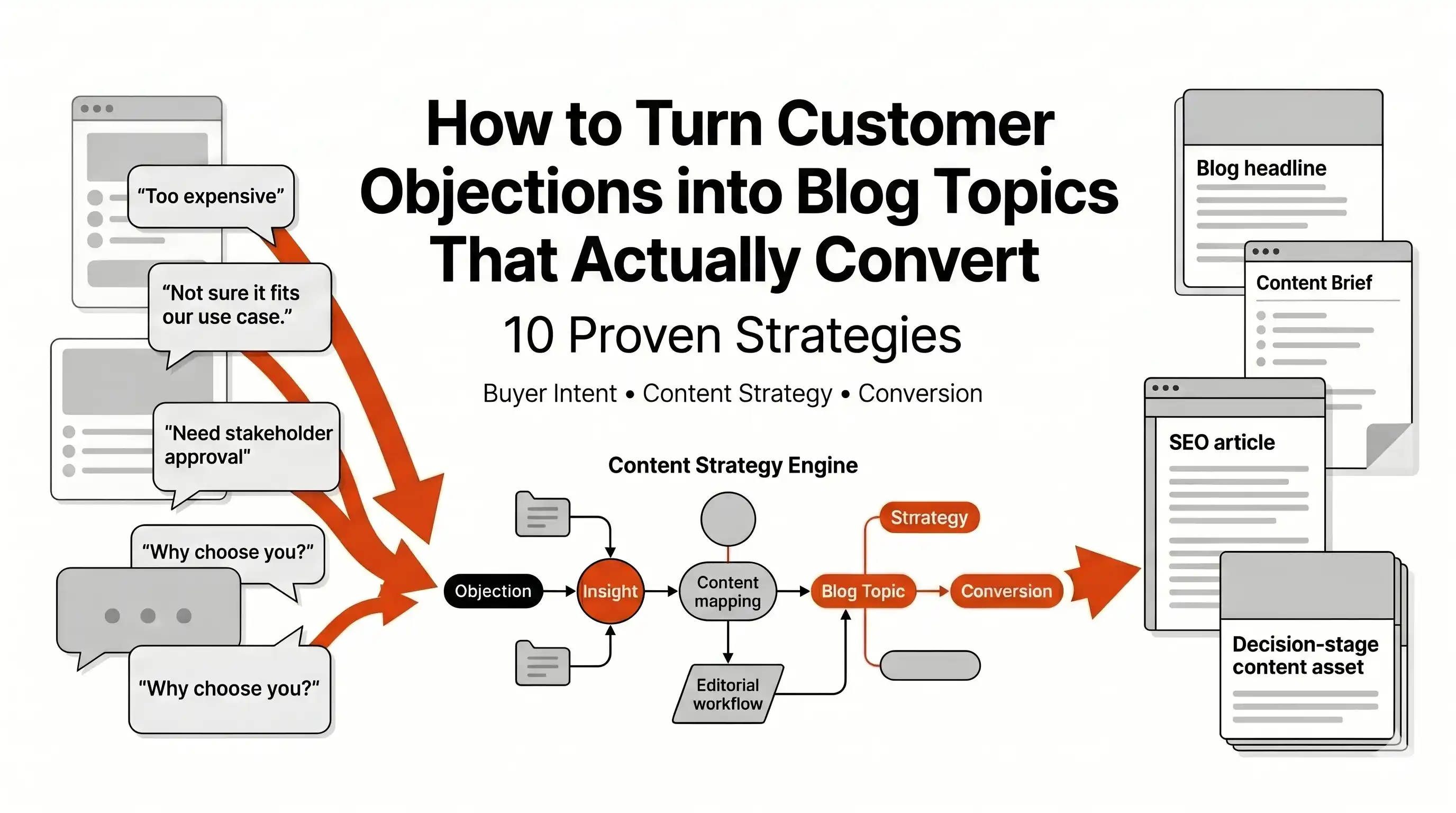


Turning customer objections into blog topics is one of the most underused content strategies in B2B marketing today, and the data backs it up: playbook-style content registrations are reported as 115% more likely to indicate a buying decision within 12 months, meaning buyers are actively searching for answers to their exact hesitations. If your content team is still brainstorming topics from keyword tools and competitor blogs, you are leaving a goldmine of conversion-ready intelligence sitting untouched inside your sales calls, support tickets, and lost-deal reports.
Understand Why Customer Objections Are Your Best Blog Topic Source
Most content teams treat objections as a sales problem to overcome. We treat them as the highest-intent content signals available in any B2B organization.
When a buyer says, "Your pricing seems expensive," they are not just pushing back on a number. They are telling you exactly what blog post would have moved them forward in their buying journey before they ever got on a call with your team.
Objection-driven blog topics target decision-stage readers, not just awareness-stage browsers. That distinction matters enormously for content that actually generates pipeline.
- Traditional blog topics attract broad traffic with low purchase intent
- Objection-driven blog topics attract buyers who are actively evaluating and need reassurance
- Converting customer objections into blog topics means your content speaks the exact language your buyers already use
Map the Six Types of Buyer Friction That Customer Objections Reveal
Before you can convert customer objections into blog topics, you need to understand the six categories of friction that objections expose. Each category maps to a distinct content opportunity.
- Buying friction - "We are not sure this is the right time." Content: timing and prioritization guides.
- Hidden fears - "What if this does not work for our team?" Content: implementation success stories and risk-reduction posts.
- Information gaps - "We do not fully understand how this works." Content: explainer posts, walkthroughs, and how-it-works breakdowns.
- Trust barriers - "We have not heard of your company." Content: proof-driven posts, customer stories, and third-party validation content.
- Competitive comparisons - "We already use a competitor." Content: comparison posts and switching guides.
- Unmet expectations - "A previous vendor promised this and delivered nothing." Content: transparency posts and realistic outcome framers.
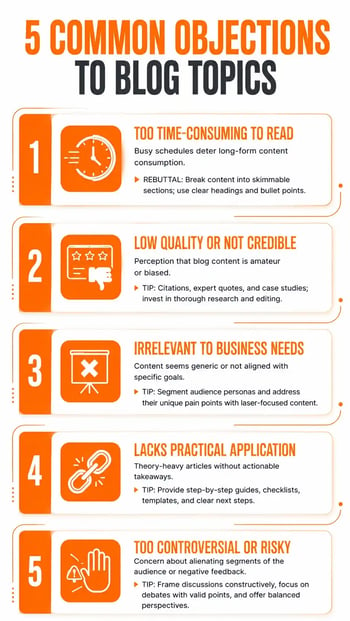
This infographic highlights the five most common objections to blog topics. It also offers quick tips to tailor topics to your audience.
Identify Where to Find Customer Objections for Blog Topics
The raw material for your objection-driven content engine is already inside your organization. You just need a system to surface it consistently.
Here are the richest sources for converting customer objections into blog topics:
-
Sales Call Recordings
-
Customer Support Tickets
-
Demo Conversations
-
Lost-Deal Analysis
-
Customer Reviews and Feedback Surveys
Follow the 5-Step Objection-to-Topic Conversion Framework
Turning customer objections into blog topics is not guesswork. We use a repeatable five-step framework that any content team can implement immediately.
Step 1: Collect Raw Objections in Buyer Language
Document objections exactly as buyers state them. "Your pricing seems expensive" is far more useful than "pricing concerns." The specific wording matters because it reflects how real buyers think and speak.
Step 2: Identify the Underlying Intent Behind Each Objection
|
Objection |
Underlying Buyer Fear |
Content Opportunity |
|
"Too expensive" |
Fear of poor ROI |
ROI calculation guides, cost-of-inaction posts |
|
"Looks complex to implement" |
Fear of failed rollout |
Implementation walkthroughs, time-to-value posts |
|
"Need stakeholder buy-in" |
Fear of internal rejection |
Business case templates, decision-maker guides |
|
"We already use a competitor" |
Fear of switching risk |
Migration guides, comparison frameworks |
Step 3: Convert Each Objection into Specific Blog Angles
Take the objection "Implementation looks difficult" and generate multiple blog angles from it:
- How to Reduce Risk When Adopting a New B2B Platform
- What a Successful Software Rollout Actually Looks Like in 2026
- 7 Ways Fast-Growing Teams Accelerate Tool Adoption Without Disruption
Step 4: Write Using Buyer Language, Not Marketing Language
Use the exact words your buyers use. "Rollout complexity" is marketing speak. "Hard to get my team to actually use it" is buyer language. The second one resonates because it sounds like something a real person would say.
Step 5: Anchor Each Post with Proof
Every objection-driven blog post needs supporting evidence. Case studies, ROI data, customer stories, and implementation examples strengthen credibility and reduce the fear that generated the objection in the first place.
Did You Know?
Guide content was 46% more likely to be associated with buying decisions within 0 to 3 months, according to NetLine's 2025 State of B2B Content Consumption and Demand Report. Objection-driven guide posts targeting evaluation-stage buyers are among the highest-converting content formats available.
Build a High-Converting Blog Topic List by Objection Category
One of the most practical ways to turn customer objections into blog topics is to organize your objection library by category and generate topic clusters from each one.
-
Pricing Objections: Blog Topics That Prove Value
-
Trust Objections: Blog Topics That Build Credibility
-
Complexity Objections: Blog Topics That Reduce Fear
-
Competitive Objections: Blog Topics That Win Comparisons
Use AI to Scale Customer Objections into Blog Topics at Speed
Manually reviewing every sales call and support ticket is time-consuming. AI changes that equation dramatically when you use it as an analysis layer, not a replacement for human insight.
AI accelerates customer objections to blog topics workflows in several specific ways:
- Transcript analysis
- Objection clustering
- Buyer language tagging
- Content outline generation
- Signal detection
Turn Customer Objections into a Voice-of-Customer Content Engine
Individual objections are useful. Patterns of objections across hundreds of conversations are transformational.
When you collect and analyze customer objections systematically, you are not just finding blog topics. You are building a living voice-of-customer intelligence system that reveals:
The B2B Marketing Context Engine is designed precisely for this use case, unifying buyer conversations and market signals into a content strategy layer that continuously refreshes itself from real customer data.
Avoid These Common Mistakes When Converting Customer Objections into Blog Topics
Many teams attempt objection-driven content and fall short because of avoidable execution errors. Here are the mistakes we see most often.
- Sanitizing customer language
- Answering objections defensively
- Relying only on keyword data
- Ignoring lost-deal insights
- Publishing generic FAQ content
- Missing the fear behind the objection
Did You Know?
Infographics were reported as 110% more likely to be associated with a buying decision within 12 months, according to NetLine's 2025 State of B2B Content Consumption and Demand Report. Presenting objection-driven insights visually dramatically increases their pipeline impact.
9. Move From Objection Content to Full Content Intelligence
The most advanced B2B content teams do not just use objections to generate individual blog posts. They use objection patterns to drive their entire content strategy, from editorial calendar planning to positioning refinement.
Here is what content intelligence looks like when it is built from customer objections at scale:
- Content planning
- Messaging refinement
- Positioning optimization
- Buyer segmentation
- Market intelligence
For product marketing teams specifically, AI solutions built for product marketing can accelerate this entire workflow by automatically surfacing objection signals from buyer conversations and translating them into content briefs your team can act on immediately.
Build Your Editorial Calendar Around Real Customer Objections in 2026
In 2026, the strongest B2B content teams are not guessing what their buyers want to read. They are listening to what their buyers are already saying and building their content calendars accordingly.
Here is a practical quarterly framework for using customer objections to populate your blog topic pipeline:
Month 1: Objection Collection Sprint
Pull objections from the last 90 days of sales calls, support tickets, and customer feedback. Document exact buyer language without editing. Target: 50 to 100 raw objections.
Month 2: Clustering and Topic Generation
Group objections by category (pricing, trust, complexity, competitive). Generate three to five blog angles per cluster. Prioritize by objection frequency and buyer segment value.
Month 3: Content Production and Publishing
Write and publish objection-driven posts anchored in buyer language and proof content. Track performance by content category and refine your objection library for the next sprint.
This cycle repeats continuously, creating a customer objection to blog topics engine that never runs dry because your buyers never stop having questions.
The teams winning in B2B content in 2026 are not the ones with the biggest keyword lists. They are the ones listening most carefully to what their buyers push back against and using those signals to build content that answers real fears with real proof.
Customer objections are buyer research. They reveal what stops people from buying, which means they also reveal exactly what content would have removed that barrier before the conversation ever happened. Start treating your sales objections as your most valuable editorial resource. Your pipeline will show the difference.
FAQs
How do you turn customer objections into blog topics?
Turn buyer fears from sales calls, support tickets, and lost deals into content angles using the buyer’s own language.
Why are customer objections better blog topic sources than keyword tools?
Customer objections reveal real buying intent and decision-stage concerns that keyword tools often miss.
What are the best sources of customer objections for content marketing in 2026?
Sales calls, demo conversations, support tickets, lost deals, and customer reviews provide the richest objection data.
Is objection-driven content worth it compared to traditional blog content?
Yes, because it targets high-intent buyers by addressing the exact concerns blocking purchase decisions.
How can AI help convert customer objections into blog topics at scale?
AI identifies recurring patterns, buyer language, and themes across large volumes of conversation data.
What content formats work best for objection-driven blog topics?
Guides, comparison posts, implementation walkthroughs, and ROI frameworks perform best for decision-stage buyers.
How do I build a repeatable system for turning customer objections into blog topics?
Use a structured cycle of collecting objections, clustering themes, and publishing content based on real buyer signals.