.webp)


Many marketing teams do not struggle because they execute poorly. They struggle because they invest in the wrong campaigns. The biggest competitive advantage today is not launching more campaigns. It is identifying the right opportunities first. The best campaigns do not start with creative ideas. They start with understanding customer demand, market changes, competitive whitespace, and AI Search visibility. Marketing intelligence identifies where growth exists. Campaigns are how you capture it.
Why Most Campaign Planning Starts Too Late
Most B2B marketing teams follow a predictable workflow. Someone proposes a campaign idea. The team conducts research to validate it. Then they move into execution. By the time the campaign launches, the market has already shifted, buyer priorities have evolved, and competitors have moved. The process starts too late because it begins with an idea instead of intelligence.
The traditional process looks like this:
Campaign Idea → Research → Execution
This approach treats campaigns as the starting point. It asks, "What do we want to promote next?" instead of "Where is demand rising today?" The result is a portfolio of campaigns that may be well-executed but poorly timed, misaligned with buyer priorities, or disconnected from competitive reality.
The modern process flips this sequence. It starts with intelligence and treats campaigns as the output of strategic discovery, not the starting point.
Customer Intelligence → Market Intelligence → Competitive Intelligence → AI Search Intelligence → Opportunity Prioritization → Campaign Strategy
This framework ensures that every campaign decision is grounded in current buyer signals, market momentum, competitive positioning, and AI Search visibility. Teams that adopt this approach stop guessing and start investing where evidence points to growth. Learn more about building this intelligence layer through Marketing Data to Actionable Insights.
Four Sources of High-Impact Campaign Opportunities
The strongest campaign opportunities emerge from four distinct intelligence sources. Each one answers a different strategic question, and together they form a complete picture of where marketing investments will produce the highest returns.
Customer Intelligence: What Are Buyers Asking?
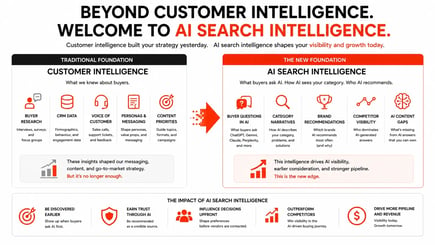
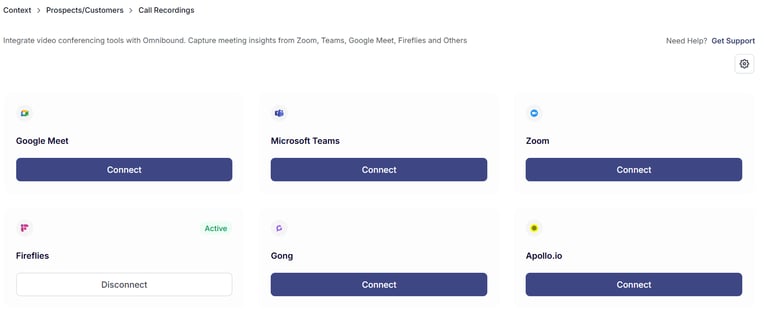
Customer Intelligence captures the questions, objections, priorities, and friction points that buyers express across conversations, support interactions, sales calls, and content engagement. These signals reveal where buyers are actively seeking solutions and where current messaging falls short. When you understand what buyers are asking, you can identify campaign opportunities that address real demand instead of assumed demand. Explore deeper buyer insights through Customer Persona Research.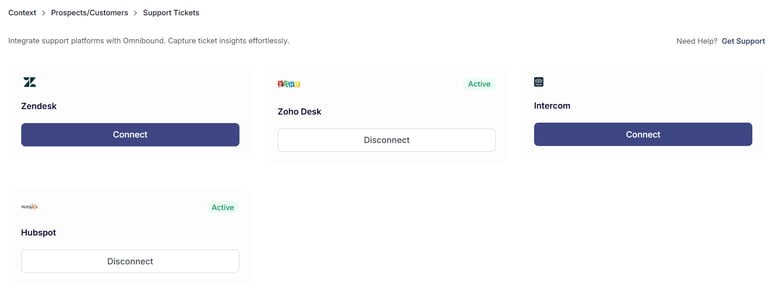
Market Intelligence: What Topics Are Growing?
Market Intelligence tracks emerging topics, shifting narratives, and category-level changes that signal where attention is moving. Some topics gain momentum quickly, creating a window where early movers establish authority before competitors notice. Market Intelligence helps teams spot these trends early and build campaigns that capitalize on rising interest rather than chasing exhausted themes. See how this works with Market Trend Detection AI.
How Marketing Intelligence Uncovers High-Impact Campaign Opportunities
High-impact campaigns begin with intelligence, not ideas. Marketing intelligence combines customer questions, market trends, competitive gaps, and AI search visibility to reveal where demand is growing before execution begins. Instead of validating campaign ideas after they are created, marketers use evidence to identify opportunities with the greatest potential for pipeline, category authority, and long-term growth. Omnibound unifies these signals into a single intelligence layer, helping teams prioritize campaigns based on verified buyer demand and market momentum rather than assumptions.
Competitive Intelligence: Where Are Competitors Weak?
Competitive Intelligence identifies gaps in competitor positioning, messaging, and content coverage. These gaps represent opportunities to capture attention where competitors are absent or underperforming. When a competitor fails to address a critical buyer question or neglects an emerging topic, that whitespace becomes a high-impact campaign opportunity. Teams that monitor competitive positioning continuously can act on these gaps before they close.
AI Search Intelligence: What Questions Are AI Platforms Answering?
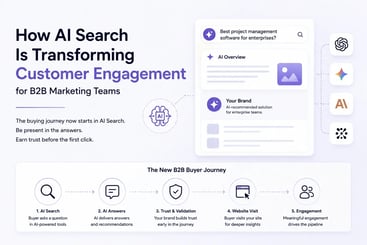
AI Search Intelligence examines what AI platforms surface when buyers ask category-related questions. It reveals which brands are recommended, which questions go unanswered, and where visibility gaps exist. This is a fundamentally new source of campaign opportunities because AI Search platforms now influence buying decisions at the research stage. Teams that understand their AI Search visibility can build campaigns that strengthen category authority and capture buyer attention where AI platforms shape preferences.
Discover how to track and improve your presence in AI-generated answers through AI Search Playbook.
How AI Search Reveals Emerging Market Demand Before Competitors
AI search exposes emerging demand by highlighting new buyer questions, rising topics, and areas where AI lacks authoritative answers. These early signals often appear before traditional keyword data or search volume trends reflect them. Omnibound monitors evolving buyer prompts and AI-generated responses, enabling marketing teams to create authoritative content early and establish category leadership before competitors recognize the opportunity.
AI Search Creates New Campaign Opportunities
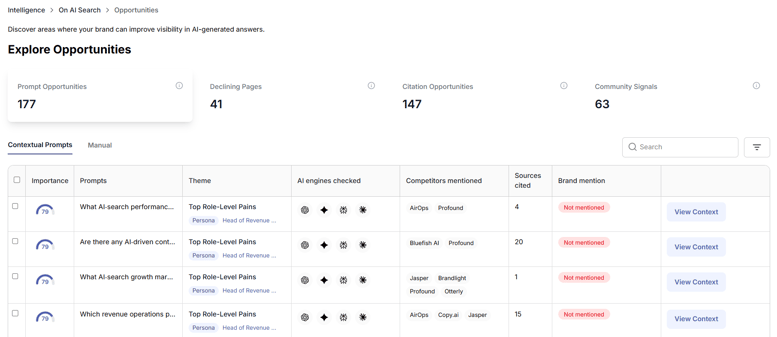
AI Search has introduced an entirely new layer of campaign opportunities that most marketing teams have not yet explored. When buyers ask AI platforms for recommendations, comparisons, or category guidance, those platforms generate answers based on available content. The questions they surface, the topics they cover, and the brands they recommend create a map of opportunities that traditional research methods cannot detect.
AI Search surfaces several specific types of campaign opportunities:
- Unanswered buyer questions that AI platforms struggle to address with existing content, indicating demand for new narratives.
- Emerging topics where AI platforms have limited training data, creating an opening for brands to establish authority early.
- Missing comparisons where your product or category is underrepresented in AI-generated recommendations.
- Weak category coverage where AI platforms provide generic or incomplete answers, signaling an opportunity for deeper, more authoritative content.
- Visibility gaps where competitors are cited and your brand is not, representing lost influence at the research stage.
Each of these gaps becomes a campaign opportunity. The campaign is not the objective. The objective is closing the visibility gap and capturing buyer attention earlier in the decision process. Learn how AI Search is reshaping content strategies in How B2B AI Search Is Rewriting Content Strategy.
How AI Search Helps Identify New Campaign Opportunities
AI search reveals campaign opportunities by showing the questions buyers ask, the brands AI recommends, and where information is missing or incomplete. These visibility gaps highlight opportunities to create content that AI platforms can confidently cite. Omnibound tracks buyer prompts across ChatGPT, Gemini, Claude, Perplexity, and Google AI Mode, helping marketers discover unanswered questions, competitive gaps, and emerging topics that translate into high-impact campaigns.
Campaign Opportunities Should Be Prioritized, Not Collected
Many marketing teams generate hundreds of ideas through brainstorming sessions, competitive scans, and customer interviews. The real challenge is not ideation. It is prioritization. Without a structured framework for evaluating opportunities, teams end up with a flat list of ideas and no clear basis for deciding which ones deserve investment.
Effective campaign prioritization requires answering three questions for every opportunity:
- Which campaigns will create pipeline? Opportunities tied to active buyer demand and revenue potential should rank higher than those driven by internal calendars.
- Which campaigns will improve AI Search visibility? Opportunities that address unanswered questions or visibility gaps in AI platforms have compounding value over time.
- Which campaigns will strengthen category authority? Opportunities that establish your brand as the definitive voice on emerging topics build long-term competitive advantage.
Prioritization replaces the habit of collecting ideas with the discipline of ranking them. Teams that prioritize effectively invest in fewer campaigns with higher impact, rather than spreading resources across a broad portfolio of low-conviction initiatives.
Finding Content Gaps That Should Become Marketing Campaigns
The best campaign opportunities often begin as content gaps. Missing buyer answers, weak competitor coverage, or topics where AI platforms provide incomplete responses all signal opportunities for new campaigns. Rather than creating content around keyword lists, marketers can build campaigns around verified buyer needs. Omnibound identifies these gaps by combining buyer conversations, competitive analysis, and AI search intelligence into prioritized content opportunities designed to improve visibility and influence.
From Marketing Insights to Campaign Strategy
Turning intelligence into campaigns requires a structured workflow that connects each intelligence source to a specific decision. This workflow ensures that campaign briefs are grounded in evidence rather than assumptions.
The workflow follows a clear sequence:
Customer Signals → Market Trends → Competitive Analysis → AI Search Intelligence → Opportunity Identification → Campaign Brief → Execution
Each stage feeds the next. Customer signals reveal what buyers care about. Market trends show where attention is moving. Competitive analysis identifies where rivals are weak. AI Search Intelligence highlights visibility gaps and unanswered questions. Together, these inputs produce a prioritized set of opportunities. Each opportunity then becomes a campaign brief that specifies the target audience, the buyer question being addressed, the competitive gap being exploited, and the AI Search visibility goal.
This workflow aligns directly with the approach described in B2B Marketing Strategy and ensures that execution follows intelligence, not the other way around.
Prioritizing Campaign Opportunities Using Marketing Signals
Not every opportunity deserves investment. The strongest campaigns are prioritized using signals such as buyer demand, market momentum, competitive whitespace, AI search visibility, strategic relevance, and revenue potential. This evidence-based approach helps teams focus on opportunities with the highest business impact. Omnibound scores and prioritizes opportunities across these intelligence sources, enabling marketers to invest confidently in campaigns most likely to generate pipeline and AI visibility.
Why Buyer Questions Are Better Than Keyword Lists
Traditional campaign planning often starts with keyword research. Teams identify high-volume keywords, build content around them, and launch campaigns designed to capture demand. This approach has a fundamental limitation. Keywords describe what people search for. They do not explain why buyers are searching or what decisions they are trying to make.
Buyer questions are a stronger foundation for campaign planning because they reveal intent, context, and decision-stage simultaneously. A keyword like "marketing automation platform" tells you very little. A question like "How do I justify marketing automation spend to my CFO?" tells you exactly who is asking, what they need, and where they are in the buying journey.
The modern workflow replaces keywords with questions:
Buyer Question → Customer Research → Market Context → Campaign Opportunity → AI Search Visibility
This approach produces campaigns that address real buyer decisions, align with market context, and create content that AI platforms can cite when buyers ask related questions. It complements the continuous research capabilities described in the Marketing Living Research Engine.
Measuring Campaign Opportunity Quality
Most marketing teams measure campaign performance after launch. They track clicks, conversions, pipeline, and revenue. These metrics tell you whether a campaign succeeded, but they do not tell you whether you chose the right opportunity in the first place.
To improve opportunity selection over time, teams need metrics that evaluate the quality of opportunities before and during execution, not just the outcomes after the fact. These metrics focus on the inputs that determine whether a campaign will succeed before it launches.
Evaluate every campaign opportunity against six criteria:
- Customer demand: Is there active evidence that buyers are asking about this topic or struggling with this problem?
- Market momentum: Is interest in this topic growing, stable, or declining?
- Competitive whitespace: Are competitors addressing this topic effectively, or is there a clear gap to exploit?
- AI Search visibility: Does this opportunity address a question that AI platforms are answering poorly or not at all?
- Strategic relevance: Does this opportunity align with your category positioning and long-term growth strategy?
- Revenue potential: Can this campaign plausibly influence pipeline, accelerate deals, or reduce churn?
Opportunities that score well across all six criteria deserve investment. Opportunities that score well on only one or two dimensions should be deprioritized or shelved until additional signals emerge. This disciplined approach prevents teams from pursuing campaigns that look interesting but lack the evidence to support meaningful business impact.
Continuous Opportunity Discovery
Campaign planning is no longer an annual or quarterly exercise. Buyer priorities shift weekly. Market narratives evolve continuously. Competitors adjust positioning in real time. AI platforms update their recommendations as new content enters their training data. Static planning cycles cannot keep up with this pace of change.
Continuous opportunity discovery replaces periodic planning with an always-on process:
Signals → Opportunities → Campaigns → Performance → New Signals → Optimization
This cycle runs continuously. As new customer signals arrive, they generate new opportunities. As campaigns launch and perform, they produce performance data that refines signal weighting. As market conditions change, opportunities are re-scored and re-prioritized. Teams that operate this way do not wait for the next planning cycle. They act on opportunities as they emerge, and they retire campaigns when signals cool.
This approach aligns with the Brand Marketing principles of maintaining a living intelligence layer that refreshes as conditions change.
The Omnibound Approach to Campaign Opportunity Identification
Omnibound is a marketing intelligence platform that helps B2B teams discover, prioritize, and act on high-value growth opportunities before competitors do. Instead of treating campaigns as the starting point, Omnibound treats intelligence as the starting point and campaigns as the output of strategic discovery.
Omnibound helps teams perform four critical functions:
- Identify customer demand by capturing real buyer questions, priorities, and friction points across conversations and interactions.
- Monitor market shifts by tracking emerging topics, changing narratives, and category-level momentum in real time.
- Uncover competitive gaps by analyzing competitor positioning, messaging, and content coverage to find whitespace.
- Improve AI Search visibility by tracking which brands AI platforms recommend, which questions go unanswered, and where visibility gaps exist.
With these four intelligence sources unified in a single platform, Omnibound helps marketing teams prioritize campaign investments based on evidence rather than intuition. The value is not in generating more ideas. The value is in helping marketers decide what deserves investment before execution begins.
Using AI to Identify Underserved Market Segments
AI uncovers underserved market segments by analyzing buyer conversations, CRM data, support interactions, and market signals to identify audiences with unmet needs or unanswered questions. These insights help marketers create campaigns tailored to overlooked personas instead of broad audience assumptions. Omnibound continuously analyzes these signals to surface emerging customer segments and the topics most likely to drive engagement and pipeline.
Conclusion
The best campaigns do not start with creative ideas. They start with intelligence. Customer demand, market momentum, competitive whitespace, and AI Search visibility together form the foundation for identifying where growth exists. Campaigns are the mechanism for capturing that growth, not the starting point for planning it.
Marketing teams that shift from campaign-first thinking to intelligence-first thinking gain a structural advantage. They invest in the right opportunities, prioritize based on evidence, and act on signals before competitors notice them. The result is fewer campaigns with higher impact, stronger category authority, and better alignment between marketing investments and revenue outcomes.
For B2B leaders, the edge goes to teams that treat opportunity identification as a continuous, intelligence-driven process. With the right platform, every campaign can start from live reality instead of guesswork.
Frequently Asked Questions
How do marketers identify campaign opportunities?
Modern marketers identify campaign opportunities by combining four intelligence sources: Customer Intelligence (what buyers are asking), Market Intelligence (what topics are growing), Competitive Intelligence (where competitors are weak), and AI Search Intelligence (what questions AI platforms answer poorly). This approach replaces brainstorming with evidence-based opportunity detection.
What marketing insights reveal growth opportunities?
Growth opportunities emerge from signals that indicate unmet buyer demand, rising topic interest, competitive gaps, and AI Search visibility gaps. The strongest insights combine multiple signals to confirm that an opportunity has customer demand, market momentum, and strategic relevance simultaneously.
How does AI Search influence campaign planning?
AI Search introduces a new layer of campaign opportunities by revealing which questions buyers ask AI platforms, which brands are recommended, and where visibility gaps exist. Campaigns that address these gaps can capture buyer attention earlier in the research process and improve brand presence in AI-generated answers.
What is the difference between campaign ideas and campaign opportunities?
Campaign ideas are internally generated concepts that may or may not align with current buyer demand. Campaign opportunities are evidence-backed patterns of unmet demand, rising interest, or competitive gaps that can be acted on with specific marketing motions. Ideas start from within. Opportunities start from intelligence.
How do you prioritize marketing opportunities?
Prioritize opportunities by evaluating them against six criteria: customer demand, market momentum, competitive whitespace, AI Search visibility, strategic relevance, and revenue potential. Opportunities that score well across all six dimensions deserve investment. Those that score well on only one or two should be deprioritized.
What data should marketers use before launching campaigns?
Marketers should use buyer conversation data, content engagement signals, CRM and pipeline data, market trend signals, competitive positioning analysis, and AI Search visibility data. Together, these inputs provide a complete picture of where demand exists and where campaigns will have the highest impact.
How does customer intelligence improve campaign planning?
Customer Intelligence improves campaign planning by grounding decisions in what buyers are actually asking, struggling with, and prioritizing. Instead of assuming what buyers need, teams can build campaigns that address specific, confirmed pain points and questions, resulting in higher engagement and better conversion.
How often should campaign opportunities be reviewed?
Campaign opportunities should be reviewed continuously, not quarterly. Buyer priorities, market narratives, and competitive positioning shift weekly. Teams that operate with continuous opportunity discovery can act on emerging signals before competitors and retire campaigns when demand cools, rather than waiting for the next planning cycle.
How do AI visibility platforms identify growth opportunities?
AI visibility platforms identify growth opportunities by analyzing buyer prompts, AI-generated answers, competitor citations, and content gaps across AI search engines. They reveal where brands are missing from high-value conversations and where new content can improve visibility. Omnibound combines AI search intelligence with customer and market signals to prioritize opportunities with the greatest impact on citations and pipeline.
Which tools help identify opportunities to appear more often in AI-generated answers?
Tools built for AI search visibility analyze the questions buyers ask, track which brands AI platforms cite, and identify content gaps that reduce recommendation frequency. Omnibound helps marketers discover these opportunities by monitoring AI citations, uncovering competitor advantages, and recommending buyer-focused content that improves visibility across ChatGPT, Gemini, Claude, Perplexity, and Google AI Mode.
Which outputs help prioritize citation opportunities in AI responses?
The most valuable outputs include buyer prompt analysis, citation visibility reports, competitor citation comparisons, content gap analysis, and AI search opportunity scoring. Together, these insights show where content improvements are most likely to increase AI recommendations. Omnibound consolidates these outputs into prioritized opportunities, helping teams focus on the highest-value actions for improving AI citations and business outcomes.
How can AI identify buyer questions my competitors aren't answering?
AI identifies unanswered buyer questions by analyzing customer conversations, AI search prompts, competitor content, and AI-generated responses to reveal gaps in existing coverage. These unanswered questions often represent untapped campaign and content opportunities. Omnibound continuously surfaces these high-value gaps, enabling marketers to create authoritative, buyer-focused content before competitors recognize the demand.