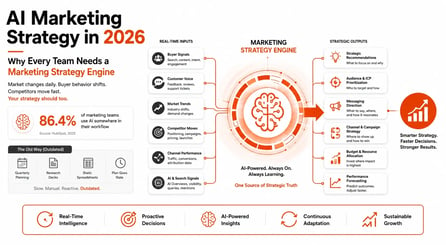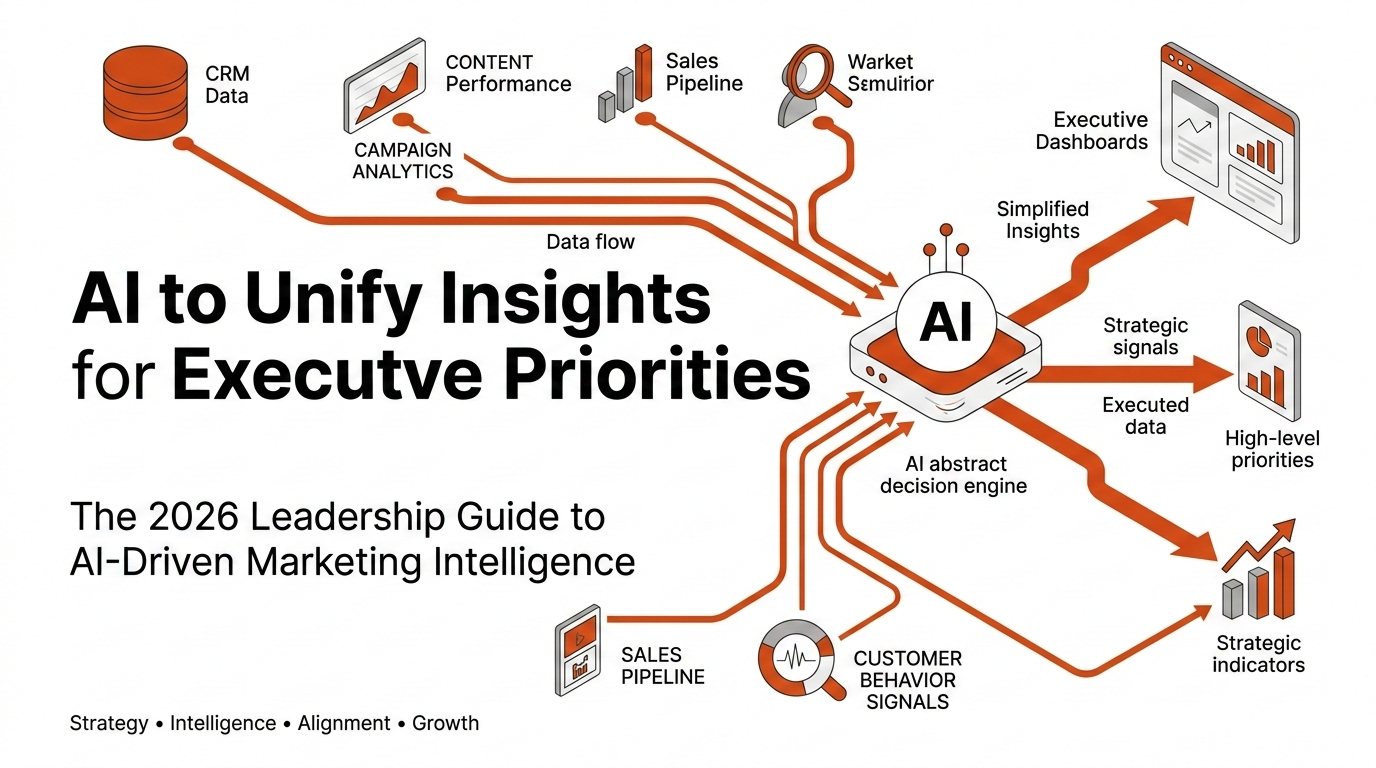


Did you know that 88% of B2B leaders have integrated AI into their marketing strategy, yet only 21% feel confident it drives real impact? In 2026, leadership teams face a growing challenge: massive volumes of data but very little clarity about what actions matter most.
Key Takeaways
|
Executive Question |
Short Answer |
|---|---|
|
What does it mean for AI to unify insights for executive priorities? |
It means combining marketing, sales, product, and financial signals into a single intelligence layer that highlights strategic actions leaders should take. |
|
What are AI executive dashboards? |
Modern dashboards powered by AI that summarize trends, anomalies, and opportunities instead of just displaying KPIs. |
|
How does AI support executive decision making? |
AI analyzes patterns across systems, surfaces strategic insights, and recommends priorities aligned with revenue growth. |
|
What technologies enable unified marketing insights? |
Platforms like AI content marketing platforms for B2B teams combine research, data context, and strategy outputs. |
|
How can B2B leaders build unified insight systems? |
Leaders typically start with a B2B marketing context engine and expand into AI-driven strategy and content systems. |
|
What outcomes should executives expect? |
Better pipeline visibility, improved cross‑team alignment, and faster strategic decision cycles. |
Why Executives Are Drowning in Data in 2026: The Need to Unify Insights
Modern leadership teams receive reports from marketing automation, CRM pipelines, product analytics, and finance systems every day. Unfortunately, these streams rarely form a unified narrative.
Executives often see dashboards but struggle to understand what initiatives deserve priority. This creates the classic problem of data abundance and insight scarcity.
Marketing leaders especially feel this pressure. CMOs must explain pipeline impact, revenue attribution, and campaign performance while juggling fragmented data sources. The complexity of managing multiple data streams and disconnected systems makes it even harder to gain clarity and drive effective decisions.
The result is slower strategic decision cycles. Leadership teams spend more time interpreting data than acting on it, and these delays can extend week after week, further slowing down decision-making and impacting business outcomes.
What “Unified Insights” Actually Mean for Leadership Teams
Unified intelligence bridges disparate data sources by connecting multiple operational signals into one strategic picture. Instead of viewing marketing, sales, and product metrics separately, AI synthesizes them into executive insights.
For example, revenue leaders may see signals from pipeline velocity, campaign engagement, and product usage combined into a single summary—turning fragmented data into connected insight for leadership teams. That summary becomes a recommendation for action.
Unified marketing insights typically include several signal categories:
- Pipeline health indicators
- Market demand signals
- Customer behavior patterns
- Product adoption trends
- Revenue attribution insights
Systems like AI‑powered intelligent research help keep these signals updated in real time.
The AI Insight Stack for Executive Decision Making
Modern AI leadership marketing systems operate in layers. Each layer is part of a systematic process that converts raw data into strategic direction.
Layer 1: Data Integration
Data from CRM systems, marketing automation, product analytics, and finance tools are unified into a shared foundation.
Layer 2: Insight Generation
AI models analyze patterns such as conversion drops, pipeline slowdowns, and emerging customer segments.
Layer 3: Strategic Intelligence
The system summarizes insights into executive‑level narratives, weaving together data points to create a clear story that executives can quickly understand and act on. Instead of dashboards full of numbers, leaders see prioritized opportunities.
Layer 4: Decision Orchestration
Insights connect directly to operational teams, seamlessly integrating with operational workflows so marketing, sales, and product leaders act on the same priorities.
How AI Helps Executives Prioritize the Right Initiatives
Once insights are unified, AI can help leadership focus on the most impactful initiatives by streamlining efforts and directing attention to key areas. This reduces the noise that normally comes from multiple dashboards.
Executives often rely on AI executive dashboards that summarize the biggest opportunities in marketing investment, pipeline growth, and product adoption, enabling teams to focus resources and improve clarity around priorities.
Examples of leadership priorities identified by AI include:
- Reallocating marketing spend to channels generating pipeline
- Fixing conversion drop‑offs in enterprise sales cycles
- Investing in product features driving adoption
- Identifying high‑value account segments
Many organizations use platforms such as AI marketing strategy engines to convert signals into executable strategy outputs.
Did You Know?
Only 45% of available business data is actually utilized in decision‑making, with 34% of leaders citing lack of time to analyze what they receive.
Discover the three key benefits of AI-driven leadership marketing. See how AI enhances personalization, data-driven decisions, and campaign effectiveness.
AI Executive Dashboards That Drive Strategic Clarity
Traditional dashboards show numbers. AI executive dashboards explain what those numbers mean for strategy, enabling smarter decision-making for leadership teams by transforming fragmented data into actionable insights.
Instead of dozens of metrics, leaders see a narrative describing revenue trends, pipeline risks, and market opportunities.
These systems typically highlight:
|
Insight Category |
Executive Decision |
|---|---|
|
Pipeline Velocity |
Adjust sales resources |
|
Campaign ROI |
Reallocate marketing budget |
|
Customer Adoption |
Refine product roadmap |
|
Market Demand |
Prioritize new segments |
Unified intelligence platforms help ensure marketing, sales, and product leaders operate from a shared understanding.
Data Visualization and Communication for Executives
In today’s data-saturated environment, effective data visualization is essential for executives who need to make confident, timely decisions—especially in complex sectors like healthcare systems and billing systems. Fragmented data from disconnected systems often leads to confusion, misinterpretation, and missed opportunities. That’s why having a single source of truth is critical.
Unify Insights empowers executives to transform complex, fragmented data into actionable insights. By integrating data across departments and systems, the platform connects the dots between trends in healthcare, billing, and operations, providing a holistic view of organizational performance. Executives gain access to intuitive reports and dashboards that deliver clarity and confidence, enabling them to act swiftly and proactively.
With Unify Insights, leaders can visualize the bigger picture, making data-driven decisions that align teams and drive results. This approach not only saves valuable time and resources but also cultivates a culture of transparency and trust throughout the organization. By bridging the gap between data and action, Unify Insights ensures that every decision is grounded in clarity and truth.
Proactive Risk Management in the Age of AI Insights
Proactive risk management has become a cornerstone of successful organizations in the age of AI insights. Rather than reacting to issues after they arise, forward-thinking businesses use platforms like Unify Insights to turn their data into actionable insights—hearing the early warning signs of potential risks and acting before challenges escalate.
Unify Insights bridges the gap between raw data and strategic decision-making by providing context and clarity on emerging risks and opportunities. Through automation, the platform streamlines risk management processes, allowing organizations to save time and resources while focusing on high-value business priorities.
Executives can track and measure the effectiveness of their risk strategies in real time, adapting and improving their approach as new data and insights emerge. This proactive, data-driven approach not only enhances organizational resilience but also empowers leaders to act with confidence, ensuring that risk management becomes a strategic advantage rather than a reactive burden.
Use Cases Across the Leadership Team
AI leadership marketing systems provide different value depending on the executive role. Each leader receives insights relevant to their priorities. Clients, including private practices, MSOs, healthcare systems, and consulting firms, benefit from unified insights tailored to their specific data integration and visibility needs.
For CMOs
- Campaign impact on pipeline
- Channel performance trends
- Market demand insights
For CROs
- Pipeline health monitoring
- Deal velocity insights
- Segment performance analysis
For CEOs
- Revenue growth drivers
- Operational risk signals
- Strategic investment priorities
Many organizations implement solutions like AI product marketing intelligence systems to unify product and revenue signals.
AI Copilots for Executive Intelligence
AI copilots are emerging as a core tool for leadership teams. These assistants summarize insights, highlight anomalies, and recommend strategic actions. Users interact with AI copilots to customize and access unified insights tailored to their preferences and business needs.
An executive might ask a system a question like: “What should our top go‑to‑market priority be this quarter?”
The AI copilot evaluates pipeline trends, campaign performance, and market demand signals before delivering a concise recommendation.
Many organizations deploy platforms like AI demand generation solutions to power these insights.
How B2B Companies Implement Unified Insight Systems
Building an AI strategic insights platform requires both technology and operational alignment. Many organizations partner with solution providers to build and implement unified insight systems, ensuring seamless integration and adoption. Successful companies follow a structured approach.
- Connect data sources across CRM, marketing, product analytics, and support tools.
- Deploy AI insight models to detect trends and anomalies.
- Build executive dashboards focused on strategic narratives.
- Align teams around the same priorities generated by AI.
Solutions like AI solutions for content marketing help operationalize insights across campaigns and buyer journeys.
Metrics That Matter for Executive Intelligence
Leadership teams benefit most when AI connects metrics into strategic narratives. Individual KPIs alone rarely explain business performance.
AI business intelligence platforms track several high‑impact metrics:
- Revenue growth signals
- Pipeline velocity
- Customer lifetime value
- Acquisition efficiency
- Expansion revenue
Enterprise organizations also rely on governance frameworks such as enterprise‑ready AI infrastructure to ensure insights remain reliable and secure.
Did You Know?
53% of CEOs report that leadership teams struggle to align on strategic priorities in a timely way, primarily because their data narratives are fragmented.
Best Practices for Data-Driven Decision-Making at the Executive Level
At the executive level, data-driven decision-making is essential for steering organizations toward growth and success. Unify Insights equips leaders with connected insight and actionable insights, integrating existing data sources into a single source of truth that brings clarity to business performance.
By visualizing key data and trends, executives can better understand the impact of their decisions and trust the insights guiding their strategy. The platform enables seamless integration of data, ensuring that every decision is informed by accurate, up-to-date information.
Effective data-driven leadership also relies on strong partnerships and communication across teams. Unify Insights fosters alignment by providing a clear, shared narrative—helping executives and their teams understand, communicate, and act on the insights that matter most. This collaborative, transparent approach builds trust and ensures that every decision drives meaningful impact for the business.
The Strategic Role of AI Leadership Marketing
AI leadership marketing focuses on turning marketing intelligence into strategic guidance for executives. Many organizations have built unify insights solutions to bridge the gap between analytics and business decision makers, ensuring that data from various sources is connected and actionable.
Instead of relying on static reports, leaders receive continuous insight about market shifts, pipeline signals, and customer behavior.
Forward‑thinking organizations treat AI as a strategic intelligence layer. This layer connects research, messaging, campaigns, and revenue performance.
Companies exploring this approach often begin by working with AI marketing strategy platforms or scheduling consultations through expert AI marketing consultations.
Conclusion
Leadership teams in 2026 no longer struggle with a lack of data. Instead, they struggle with turning that data into clear strategic priorities.
At Omnibound, our mission is to unify insights for executive priorities—bridging gaps between fragmented data sources and enabling smarter, faster decision-making at the leadership level.
AI to unify insights for executive priorities solves this challenge by combining signals across marketing, sales, product, and revenue systems. The result is a single intelligence layer that guides decision making.
For CMOs, CROs, and founders, this shift changes the role of marketing analytics. Data is no longer just reporting. It becomes a strategic engine that informs where the business should invest next.
The organizations that succeed in the coming years will be those that replace fragmented dashboards with unified AI intelligence systems that guide leadership decisions every day.