




Most marketing teams have already asked the question "Is our team ready to use AI?" Fewer have asked the question that actually matters going into 2026: is your marketing organization ready to compete in a world where buyers research, compare, and shortlist vendors through AI-powered search before they ever land on your website?
For years, "AI readiness" in marketing meant something narrow: had the team tried a chatbot, automated a workflow, or run a pilot with a writing assistant? That framing made sense when AI was a productivity add-on. It no longer reflects how buyers actually behave, and it no longer reflects what separates marketing organizations that grow from those that stall.
AI readiness is no longer measured by how many AI tools a marketing team has purchased. It is measured by whether the organization can adapt to AI-powered buyer discovery, produce trustworthy content, build customer intelligence into decision-making, and remain visible across AI Search platforms where buyers increasingly evaluate vendors before visiting a website.
Key Takeaways
- AI readiness has shifted from a technology adoption question to an organizational capability question.
- Buyers now research vendors inside AI Search tools, not just traditional search results, which changes what "ready" content looks like.
- Five pillars define a genuinely AI-ready marketing organization: customer intelligence, content readiness, marketing operations, governance, and continuous learning.
- Traditional readiness metrics (license counts, tool usage) are being replaced by AI Search visibility, content quality, and cross-functional collaboration measures.
- Most AI initiatives stall because of missing strategy and governance, not because of the underlying technology.
AI Readiness Has Shifted from Technology to Strategy
Five years ago, AI readiness in marketing was a fairly simple checklist. Teams asked whether they had selected a tool, whether people had experimented with it, and whether a handful of repetitive tasks could be automated. Readiness was about access and comfort with new software. If a team had licenses and a few enthusiastic early adopters, it was considered "AI-ready."
That definition made sense in a period when AI's main use case in marketing was accelerating individual tasks, drafting an email faster, summarizing a document, generating a first pass at ad copy. The unit of measurement was individual productivity. Organizational structure, customer knowledge, and content governance were largely untouched by the conversation.
That era is over. Buyers now use AI Search tools as a normal part of how they evaluate vendors, and the organizations winning that attention are not the ones with the most tool licenses. They are the ones that have redesigned how marketing strategy, content operations, and customer knowledge work together. Readiness today is an organizational property, not an individual skill.
Consider what "AI-ready" actually requires now:
- Adapting marketing strategy. Positioning, messaging, and go-to-market plans have to account for the fact that a meaningful share of buyer research now happens inside AI-generated answers rather than on owned web pages.
- Redesigning content operations. Content has to be structured, well-sourced, and specific enough that it can be pulled into AI-generated answers accurately, not just formatted for a human scanning a page.
- Preparing for AI Search. Marketing teams need a working understanding of where their brand does and doesn't appear when buyers ask AI tools questions related to their category.
- Improving customer intelligence. AI-generated content and AI Search visibility are only as good as the customer understanding behind them. Generic prompts produce generic, forgettable content.
- Enabling cross-functional collaboration. Sales conversations, support tickets, and product feedback all contain signals that marketing needs, and AI readiness depends on those signals reaching marketing in usable form.
None of this is about whether a team has adopted a tool. It is about whether the marketing organization has restructured its strategy, its operating rhythms, and its knowledge base to function in an environment where AI systems, not just people, are consuming and redistributing brand content. A team can have widespread tool adoption and still be poorly prepared, because adoption measures usage, not capability.
This is the central shift CMOs and marketing operations leaders need to internalize. The question "have we adopted AI?" is now the wrong question. The right question is "has our organization built the strategic, operational, and content capabilities required to compete in an AI-first buying environment?" That reframing changes what gets prioritized, what gets measured, and who in the organization needs to be involved.
Marketing leaders who have already worked through this shift describe it less as a technology rollout and more as a rebuild of how content, customer knowledge, and go-to-market planning connect to each other. Teams exploring this in practice often start with structured guidance such as the strategies covered in this practical session on becoming an AI-first B2B marketing organization, which walks through what changes operationally once AI-driven discovery becomes a normal part of the buyer journey.
AI Search Readiness Is the New Marketing Readiness
A growing share of buyer research now starts inside conversational AI tools rather than a traditional search box. Buyers ask ChatGPT, Perplexity, Gemini, and Google's AI Overviews to summarize a category, compare vendors, or explain a technical concept before they ever visit a company's website. This changes what "being found" means for a marketing team, and it changes what readiness requires.

Marketing organizations built their playbooks around a version of discovery where a person typed a query, scanned a page of results, and clicked through to a website. AI Search compresses that process. The answer is often generated and delivered directly, drawing on a mix of sources the AI system has determined to be trustworthy, specific, and well-structured. If a brand's content isn't part of that source mix, it doesn't just rank lower, it may not be mentioned at all.
This is the gap that most AI readiness conversations miss entirely. A brand can have strong presence in traditional results and still be almost invisible in AI-generated answers, because the two systems evaluate content differently. Traditional visibility rewards keyword relevance and backlink authority. AI Search visibility rewards content that is specific, well-sourced, structured clearly enough to extract, and consistent with what the AI system has learned to be accurate about a topic.
Genuine AI Search readiness requires several distinct capabilities:
- Visibility across AI Search platforms. Teams need a clear view of whether their brand, their category claims, and their competitive positioning actually appear when buyers ask AI tools relevant questions, not an assumption based on traditional visibility.
- Structured, educational content. Content written to answer a specific buyer question directly, with clear definitions and concrete detail, performs better in AI-generated answers than broad, promotional copy.
- Strong, distinct positioning. AI systems tend to default to well-known category leaders unless a brand's differentiation is stated clearly and consistently across its content.
- Trustworthy, verifiable information. Claims that can be traced to a credible source, a real customer example, or a specific data point are more likely to be cited than generic assertions.
- Machine-readable structure. Content organized with clear headings, direct answers, and defined terms is easier for AI systems to parse, summarize, and attribute correctly.
The gap between traditional visibility and AI Search visibility is significant in practice. Many established B2B brands with solid presence in conventional results appear in only a small fraction of the AI-generated answers relevant to their category, largely because their content was never structured for extraction. This is precisely the blind spot that separates AI Search readiness from generic AI adoption. A team can be highly proficient with AI writing tools and still be functionally invisible to the AI systems buyers actually consult.
Understanding this gap is the starting point for closing it. Monitoring how your brand actually appears across AI Search platforms gives marketing teams a factual baseline instead of an assumption, showing exactly where competitors are being cited instead of your brand and where the content gaps are concentrated. Pairing that visibility data with a deliberate content approach, one built around how AI-driven search is reshaping content strategy for B2B organizations, gives marketing leaders a concrete plan rather than a vague sense that "AI Search matters."
Maturity Model: From Tool Adoption to Continuous Marketing Intelligence
Level 1 — Tool Adoption
Individual use of AI tools for drafting and summarizing tasks.
↓
Level 2 — Content Readiness
Content is structured, sourced, and organized for clarity and extraction.
↓
Level 3 — Customer Intelligence
Buyer research, CRM signals, and support feedback shape content and positioning decisions.
↓
Level 4 — AI Search Readiness
Teams actively monitor and improve their presence across AI-generated answers.
↓
Level 5 — Continuous Marketing Intelligence
Customer signals, content performance, and AI Search visibility feed a constant, self-correcting improvement loop.
The Five Pillars of AI Readiness
Because AI readiness is now an organizational capability rather than a software decision, it helps to break it into discrete, manageable parts. The following framework gives marketing leaders a practical way to evaluate where their organization actually stands, and where the biggest gaps are likely hiding.
Pillar 1: Customer Intelligence
Everything downstream depends on this. Without a real, current understanding of what buyers ask, worry about, and compare, AI-assisted content production simply produces faster versions of generic material.
Pillar 2: AI Search-Ready Content
Content built with clear structure, specific claims, and defined terminology, so it can be understood, trusted, and cited by AI systems as well as by human readers.
Pillar 3: Marketing Operations
The workflows, roles, and handoffs that determine whether customer knowledge actually reaches the people producing content, rather than staying trapped in a CRM or a sales team's notes.
Pillar 4: Governance & Measurement
Clear standards for accuracy, sourcing, and brand consistency, paired with metrics that reflect actual outcomes rather than activity levels.
Pillar 5: Continuous Learning
A standing process for updating positioning, content, and customer understanding as buyer behavior and AI Search platforms continue to change, rather than treating readiness as a one-time project.
Customer Intelligence
↓
Content Readiness
↓
Marketing Operations
↓
Governance
↓
AI Search Visibility
Notice what this framework deliberately leaves out: it does not start with "which tool did we buy." Tool selection sits inside content readiness and marketing operations, but it is never the starting point. Organizations that start with tool selection tend to build a fragile layer of automation on top of weak customer knowledge and inconsistent content standards, which is exactly why so many AI initiatives underdeliver.
AI Readiness Requires Better Customer Intelligence
AI-assisted content and AI-driven positioning are only as strong as the customer understanding feeding them. A team can produce a large volume of content quickly and still fail to move buyers, because the content answers generic prompts instead of real, specific buyer questions.
Building genuine customer intelligence means pulling from sources that are already inside the organization but rarely centralized:
- Direct customer interviews that surface language buyers actually use, not marketing's assumption of that language
- CRM data showing where deals stall, what objections recur, and which messaging resonates
- Structured buyer research into how different roles in a buying committee evaluate a purchase differently
- Sales call notes and win/loss commentary that reveal competitive comparisons in the buyer's own words
- Support and customer success feedback that shows what happens after the sale, and where expectations weren't met
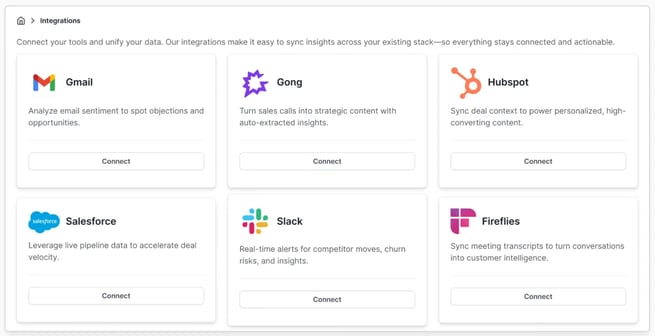
Most organizations have all five of these sources somewhere, but rarely in a form marketing can actually use. The intelligence sits scattered across a CRM, a support ticketing system, and a handful of sales team Slack channels, and by the time it reaches a content brief, it has been flattened into a generic assumption about "what buyers want."
This is precisely where structured customer persona research becomes a readiness requirement rather than a nice-to-have. Turning scattered signals into a living, continuously updated view of buyer personas, objections, and language gives every downstream content and positioning decision a stronger foundation. Organizations that treat this as a one-time exercise, done during an annual planning cycle and then shelved, tend to fall behind organizations that treat it as continuous research feeding every content decision.
AI Readiness Is an Operating Model
One of the clearest signs that a marketing organization has moved past superficial AI adoption is whether readiness has become part of how the whole go-to-market function operates, not just something the marketing team does in isolation.
Marketing, sales, product, and customer success all generate signals relevant to AI readiness. Sales hears objections in real time. Product knows what's actually shipping and how it differs from competitors. Customer success knows where expectations broke down after the sale. When these signals stay siloed, marketing ends up producing content and positioning based on incomplete information, and AI Search visibility suffers because the content lacks the specificity that comes from cross-functional knowledge.
Marketing · Sales · Product · Customer Success
↓
Shared Intelligence
↓
Better Decisions
↓
AI Search Visibility
↓
Growth
An AI-ready operating model treats marketing as the function responsible for turning cross-functional knowledge into content and positioning, rather than the function that produces content in isolation and hopes it lands. That requires standing processes: regular reviews of sales call themes, a shared view of competitive intelligence, and a clear owner for keeping customer knowledge current as the market shifts.
Reviewing how competitors are positioning themselves and where they're gaining visibility alongside internal customer signals gives marketing leaders a much sharper picture than either source alone. This is the operating model layer that most generic AI adoption advice skips entirely, because it focuses on individual productivity rather than organizational coordination.
Measuring AI Readiness
Traditional readiness metrics measured activity: how many AI licenses were purchased, how often the tools were used, how much manual work had been automated. These numbers are easy to collect and almost entirely disconnected from business outcomes. A team can show high tool usage and still be losing visibility to competitors in AI-generated answers.
Modern AI readiness metrics measure capability and outcome instead:
- AI Search visibility — how often the brand is cited or referenced in answers generated by major AI Search tools for relevant buyer questions
- Content quality — whether content is specific, sourced, and structured well enough to be trusted and extracted accurately
- Customer intelligence maturity — how current and centralized the organization's buyer knowledge actually is
- Cross-functional collaboration — whether sales, product, and customer success signals reliably reach marketing
- Buyer question coverage — the percentage of real, recurring buyer questions the organization has published clear, direct answers to
- Governance maturity — whether there are defined standards for accuracy, sourcing, and consistency across content
Shifting the measurement framework changes behavior. A team measured on license usage will keep buying and rolling out tools. A team measured on AI Search visibility and buyer question coverage will invest in customer intelligence, content structure, and cross-functional processes instead, because those are the levers that actually move the metric.
Traditional vs Modern AI Readiness
|
Traditional AI Tools Automation Productivity |
Modern Customer Intelligence AI Search Visibility Content Readiness Governance |
Common AI Readiness Mistakes
Enterprise research on AI initiatives consistently points to the same conclusion: programs stall more often because of missing governance, strategy, and organizational alignment than because of the underlying technology. The mistakes below show up repeatedly across marketing organizations working through this shift.
- Buying tools before defining strategy. Selecting platforms first and figuring out the use case afterward almost guarantees underuse.
- Focusing only on productivity. Measuring success by how fast content gets produced ignores whether that content actually reaches or persuades buyers.
- Ignoring AI Search entirely. Teams optimizing only for traditional visibility miss a growing share of how buyers now discover vendors.
- Disconnected customer data. Sales, support, and product knowledge stay siloed instead of feeding a shared view of the buyer.
- Treating AI as a writing tool. Reducing AI's role to drafting copy misses its bigger contribution: faster, better-grounded research and analysis.
- Measuring adoption instead of outcomes. Tracking how many people use a tool tells you nothing about whether the organization is actually more competitive.
Each of these mistakes traces back to the same root cause: treating AI readiness as an implementation project rather than a strategic capability that touches customer knowledge, content standards, and cross-functional operations.
How Enterprises Assess Readiness for AI-Driven Marketing Content Operations
Enterprises assess readiness for AI-driven marketing content operations by evaluating five specific capabilities rather than tool adoption alone: the maturity of their customer intelligence, the structural quality of their existing content, the strength of their cross-functional data flow, their current visibility across AI Search platforms, and the governance standards guiding accuracy and sourcing.
In practice, this assessment usually follows a consistent pattern:
- Audit current AI Search visibility. Before changing anything, teams need a factual baseline of where and how often their brand appears in AI-generated answers compared to competitors.
- Evaluate existing content structure. Content is reviewed for whether it answers real buyer questions directly, cites specific evidence, and is organized clearly enough to be extracted accurately.
- Map customer intelligence sources. Teams identify where buyer knowledge currently lives (CRM, support tickets, sales notes) and how much of it actually reaches content decisions today.
- Review cross-functional workflows. Assessment includes whether sales, product, and customer success have a reliable channel for feeding marketing relevant signals.
- Check governance standards. Enterprises look at whether there are defined rules for sourcing, accuracy, and consistency, or whether content quality varies by author.
This is the exact assessment Omnibound is built to support. As a marketing intelligence platform, Omnibound gives enterprises a single, factual view across these five dimensions: it shows current AI Search visibility, evaluates content against buyer questions that actually matter, centralizes customer and competitive signals into a continuously updated shared marketing context, and highlights where cross-functional data gaps are limiting content quality. Rather than guessing at readiness, marketing leaders get a concrete, evidence-based picture of where the organization stands and what to fix first.
Enterprises that go through this kind of structured assessment consistently find that their biggest gap isn't AI Search itself, it's the customer intelligence and content governance feeding it. That finding reinforces the broader pattern across this article: readiness is an organizational property, and Omnibound's role is to make that organizational property visible and measurable, rather than to serve as another content production tool layered on top of the same underlying gaps.
Omnibound's Role in Building AI-Ready Marketing Organizations
Omnibound is a marketing intelligence platform, not an AI implementation tool. Its purpose is to help B2B organizations build the organizational readiness described throughout this guide, rather than to add another automation layer to an already fragmented set of tools.
Concretely, Omnibound helps marketing organizations:
- Understand customers through continuous, living buyer research instead of one-time studies that go stale within a quarter
- Monitor markets and competitors to see where positioning gaps are opening up before they show up as lost deals
- Improve visibility across AI Search platforms with a factual, ongoing view of citation presence and share of voice
- Prioritize content based on real gaps between what buyers ask and what content currently answers, rather than guesswork
- Strengthen positioning by connecting product differentiation to the language buyers actually use
- Build organizational AI readiness by tying customer intelligence, content operations, and AI Search visibility into one continuously updated view rather than disconnected spreadsheets and one-off reports
This positioning matters because the market is full of tools that promise to make marketing teams "AI-ready" simply by giving them more automation. Omnibound's premise is different: readiness comes from better customer understanding, clearer content standards, and visibility into how AI systems actually perceive a brand, not from producing more content faster. Teams that connect these signals to revenue outcomes are also exploring how this readiness work translates directly into stronger inbound demand and pipeline performance, closing the loop between organizational readiness and business growth.
Conclusion: Readiness Is a Capability, Not a Purchase
The question worth asking isn't "are you using AI?" It's whether your marketing organization is prepared for a buying environment where prospects increasingly discover, evaluate, and compare vendors through AI-generated answers rather than a traditional search results page.
AI readiness is no longer a technology initiative sitting inside a marketing operations backlog. It is a marketing capability, built from customer intelligence, structured content, clear governance, continuous learning, and active visibility across AI Search platforms. Organizations that combine these elements are simply better positioned to compete for buyer attention, regardless of how many AI tools sit on their tech stack.
The companies that pull ahead won't be the ones with the most AI licenses. They'll be the ones that rebuilt how customer knowledge moves through the organization, how content is created and verified, and how visibility across AI Search is monitored and improved over time. Enterprise evidence increasingly supports this: operational readiness, not tool adoption, is what separates AI programs that deliver results from those that quietly stall. Marketing leaders assessing where their own organization stands can start with a structured view of enterprise-grade readiness standards as a benchmark for what genuine preparation looks like.
FAQ:
What is AI readiness in marketing?
AI readiness in marketing is the degree to which an organization's strategy, content operations, customer intelligence, and governance can support effective performance in an AI-powered buying environment. It is an organizational capability, not a measure of how many AI tools a team has purchased.
How is AI readiness different from AI adoption?
AI adoption measures how widely a team uses AI tools. AI readiness measures whether the organization has the customer intelligence, content structure, governance, and cross-functional processes needed to actually benefit from that usage. A team can show high adoption and still be poorly prepared for AI-driven buyer discovery.
Why is AI Search readiness important?
A growing share of buyer research now happens inside AI Search tools rather than traditional web browsing. If a brand's content isn't structured, sourced, and specific enough to be surfaced in those AI-generated answers, it becomes effectively invisible to a meaningful portion of active buyers, regardless of how strong its traditional visibility is.
How can marketing teams prepare for AI-powered buyer journeys?
Teams should start by auditing current visibility across AI Search platforms, centralizing customer intelligence from sales, support, and CRM data, and restructuring content to answer specific buyer questions clearly and with verifiable detail rather than broad promotional language.
What capabilities define an AI-ready marketing organization?
Five capabilities matter most: strong customer intelligence, content structured for AI extraction, coordinated marketing operations, clear governance over accuracy and sourcing, and a continuous process for updating positioning as buyer behavior evolves.
How should CMOs measure AI readiness?
CMOs should track AI Search visibility, content quality against real buyer questions, the maturity of centralized customer intelligence, cross-functional collaboration, and governance standards, rather than relying on tool usage or license counts as proxies for readiness.
What role does customer intelligence play in AI readiness?
Customer intelligence grounds every other readiness capability. Content, positioning, and AI Search visibility all depend on accurate, current knowledge of what buyers actually ask, worry about, and compare. Without it, AI-assisted content production simply produces faster, generic output.
How does AI readiness improve AI Search visibility?
Organizational readiness produces the specific, well-sourced, clearly structured content that AI Search platforms are more likely to cite. Governance ensures consistency, customer intelligence ensures relevance, and content operations ensure the material is actually published in a form AI systems can extract accurately.
How do enterprises assess readiness for AI-driven marketing content operations?
Enterprises typically audit current AI Search visibility, review existing content against real buyer questions, map where customer intelligence currently lives, evaluate cross-functional data flow between marketing, sales, and customer success, and check whether governance standards exist for accuracy and sourcing. Omnibound is built to support this exact assessment with a single, evidence-based view across all five areas.
What is the biggest mistake organizations make when pursuing AI readiness?
Buying tools before defining a strategy. Teams that select platforms first and figure out the use case afterward consistently underuse the technology, because the underlying gaps in customer intelligence and content governance remain unaddressed.
Does Omnibound help with AI Search visibility specifically?
Yes. Omnibound provides an ongoing view of how a brand appears across major AI Search platforms compared to competitors, helping marketing teams identify content gaps and positioning weaknesses before they show up as lost pipeline.
.webp?height=245&name=AI%20Insights%20for%20Positioning%20and%20Competitor%20Trend%20Analysis%20in%20the%20AI%20Search%20Era%20(2).webp)
.webp?height=245&name=How%20to%20Identify%20Campaign%20Opportunities%20Using%20Marketing%20Intelligence%20and%20AI%20Search%20(2).webp)