

Traditional messaging framework creation takes 12–18 hours, which is no longer viable when teams need fresh, channel-ready messaging every week in 2026.
Key Takeaways
|
Question |
Short Answer |
|
What is an AI messaging framework generator? |
It is a system that ingests customer and market signals, then generates structured messaging frameworks for channels, campaigns, and teams using AI, like the strategic outputs in the Omnibound marketing strategy engine. |
|
How fast can AI create messaging frameworks? |
Modern AI tools can compress work that took days into about an hour, as seen in platforms that unify research, context, and content such as the AI content marketing platform for B2B teams. |
|
What inputs does an AI messaging generator need? |
It needs ICPs, personas, customer conversations, CRM and pipeline signals, and competitor messaging, like those captured by a B2B marketing context engine. |
|
Can AI keep messaging aligned with real customer language? |
Yes, by grounding outputs in real voice-of-customer data and quotes, similar to the approach used in Intelligent Research capabilities. |
|
How does AI help at scale across formats? |
AI converts one approved framework into multi-format assets across the lifecycle, like AI content production engines do for B2B teams. |
|
Where does AI-driven messaging matter most in 2026? |
In demand generation programs that align campaign messaging with real customer reality, as illustrated by AI solutions for demand generation. |
What an AI Messaging Framework Generator Actually is in 2026?
In 2026, an AI messaging framework generator is not a simple template or text spinner, it is an orchestration layer that turns unified customer and market context into structured, reusable messaging systems.
We define it as an engine that reads real conversations, CRM data, competitive moves, and ICP definitions, then outputs positioning, narratives, proof, and channel-ready variations that stay consistent across teams.
- Inputs: customer language, objections, goals, pains, competitor claims, and outcomes.
- Processing: AI models analyze patterns, cluster themes, and align them to personas and buying stages.
- Outputs: clear positioning statements, value narratives, objection strategies, and content prompts.
In practice, this kind of generator looks like a strategy engine that continuously converts verified intelligence into differentiated messaging frameworks your marketing, sales, and success teams can use without manual rework.
Core Components of an Effective AI Messaging Framework Generator
A serious AI messaging framework generator in 2026 has four foundational components, each tied to a specific layer of your go to market motion.
We see the most effective architectures combining a context engine, intelligent research, a strategy layer, and a content production layer that all share one unified source of truth.
Context Layer
The context layer ingests signals from CRM, calls, reviews, and analyst data, then normalizes them into a usable knowledge graph for messaging logic.
This is where customer signals, market signals, and voice-of-customer evidence are unified, so the generator never operates on guesses or outdated assumptions.
Strategy & Framework Layer
On top of that context, your AI creates differentiation and positioning frameworks, value narratives by audience and buying stage, and competitive objection strategies.
We use this layer to ensure every AI-generated headline or email inherits the same core story, even when we experiment with many variants.
How AI Messaging Generators Ingest Customer & Market Signals?
Without accurate inputs, no AI messaging framework generator can produce relevant or credible outputs, which is why ingestion and normalization are the real starting point.
In 2026, advanced generators continuously sync from CRM, call recordings, support tickets, reviews, win or loss notes, and competitive websites to keep messaging grounded in reality.
Types of Signals Your Generator Should Use
We use a context engine to convert this flood of inputs into structured attributes like persona, problem, use case, and outcome, then feed those into the generative models that create our frameworks.
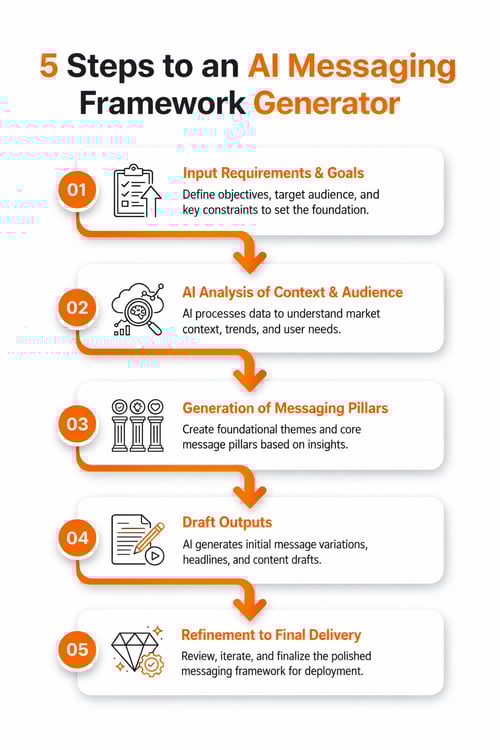
A concise visual guide to building an AI messaging framework generator, outlining five essential steps.
Did You Know?
AI can produce complete, on-brand messaging frameworks in about 50 minutes.
From Insights to Positioning: How the Generator Builds Messaging Architecture
Once the AI has reliable context, it starts to structure that knowledge into a messaging architecture your teams can actually use consistently.
We see the generator create a stack that usually includes company-level positioning, product pillars, narrative arcs by persona, and competitive or objection responses.
Key Outputs in a Messaging Architecture
Because the generator is grounded in live context, it can refresh these outputs automatically when customer language or competitor postures change, instead of forcing you into quarterly overhaul projects.
Turning Frameworks into Multi Format Content in Minutes
A true AI messaging framework generator does not stop at frameworks; it also operationalizes them into channel specific assets for campaigns and nurturing.
In 2026 we expect the same source messaging to feed web copy, ads, outbound sequences, product one pagers, webinars, and lifecycle content without teams rewriting everything from scratch.
Workflow From Framework to Content
- AI extracts the approved positioning and value narrative for a given persona and stage.
- It applies format specific patterns for blogs, emails, landing pages, or social posts.
- It generates multiple options while maintaining brand voice and factual accuracy.
We use an integrated content production layer so the same framework can instantly yield top of funnel thought leadership, mid funnel comparison guides, and bottom funnel case study outlines that all say the same thing in different ways.
Role Based AI Messaging Frameworks for Different Teams
Messaging frameworks only matter if each team can see and use the parts that are relevant to their role, without digging through 80-page PDFs.
In 2026, we route AI generated insights and messaging slices directly to specific teams and roles, so they get a filtered, action-oriented view.
Role Specific Examples
- Product marketing: receives narrative structures, positioning grids, and competitive angles.
- Demand generation: receives campaign ready themes, hooks, and audience plus offer mappings.
- Content teams: receive topic clusters, outlines, and cross format repurposing plans aligned to the framework.
This role aware distribution helps keep messaging aligned while letting each function move fast and adapt to their channels and tactics.
Continuous Learning: Keeping Messaging Frameworks “Living” in 2026
The major shift in 2026 is that messaging frameworks stop being static documents and become living systems that update as your market evolves.
We treat the messaging generator as an always on loop rather than a one off project, so it constantly refines language, emphasis, and proof points based on new data.
Feedback Loops That Matter
Your AI generator ingests these signals and recommends updates to positioning or narratives, which your team can review, approve, and publish across content templates in a controlled but rapid way.
Did You Know?
AI cuts framework creation time by roughly 95%.
Governance, Brand Voice, And Guardrails in AI Messaging Generation
Speed without control is risky, so any AI messaging framework generator your team uses in 2026 must enforce guardrails for brand, compliance, and accuracy.
We treat governance as configuration that is baked into the generator, not an after the fact review process.
Core Guardrails to Implement
Our own frameworks align brand voice with market shifts through explicit rules that the AI respects, so we can update quickly without drifting away from who we are.
Using an AI Messaging Framework Generator for Demand Generation
Demand teams feel the value of AI messaging frameworks quickly because they rely on timely, accurate campaign messaging to drive pipeline.
In 2026 we see high performing teams run campaigns where the core messaging, offers, and creative briefs are all generated from the same AI maintained framework tied to real customer signals.
Demand Gen Use Cases
By connecting our framework generator directly into demand workflows, our campaigns stay consistent with what sales and product are saying, while still being adapted to each channel.
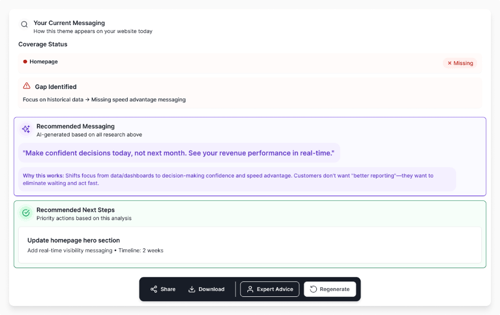
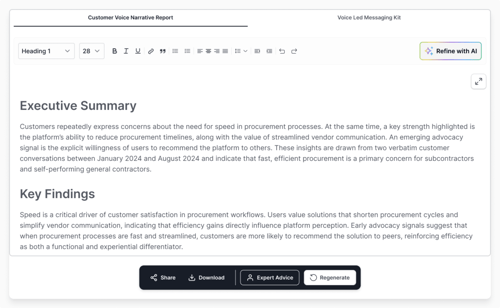
Getting Started: Practical Steps to Implement an AI Messaging Framework Generator
Implementing an AI messaging framework generator in 2026 does not have to be a massive overhaul, you can start with a focused slice and expand.
We recommend beginning with one product line or segment, then progressively wiring in more data sources and workflows.
Step by Step Approach
- Unify context: connect CRM, call transcripts, and customer feedback into a single context layer.
- Run intelligent research: let AI synthesize ICPs, pains, goals, and decision barriers from that context.
- Generate first frameworks: create initial positioning, narratives, and objection strategies for a narrow scope.
- Test in content: deploy into a small set of campaigns or sales assets and measure impact.
- Scale and govern: expand to more products and teams while tightening guardrails and approval flows.
Platforms that bring context, research, strategy, and production together in one environment simplify this rollout and reduce the risk of fragmented or conflicting messaging.
Conclusion
In 2026, an AI messaging framework generator is a practical, high impact way to keep your positioning, narratives, and content aligned with real customer reality while dramatically reducing manual effort.
By unifying context, automating research, structuring living frameworks, and pushing consistent messaging into every campaign and asset, we can support faster experimentation and more credible storytelling without sacrificing control or brand integrity.