

Table Of Contents
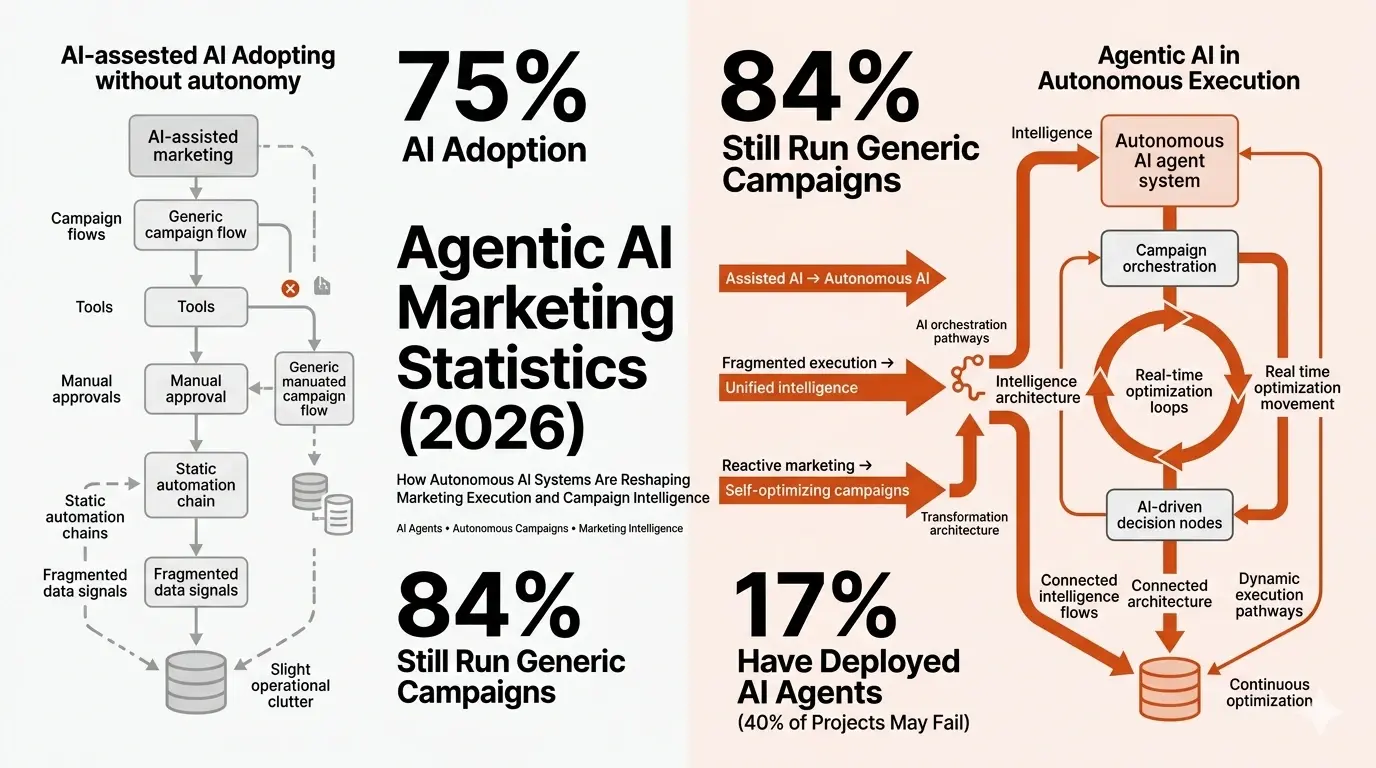
75% of marketers have now adopted AI — yet 84% still confess to running generic campaigns, and 69% struggle to respond to customers promptly (Salesforce, State of Marketing 2026, 10th edition, n=4,450). Marketing is living through a paradox: adoption numbers are at record highs, but the shift from AI-assisted content production to genuinely autonomous, context-aware campaigns is stalling on bad data and fragmented infrastructure.
The agentic AI layer — systems capable of planning, executing, and optimizing campaigns with minimal human oversight — is arriving faster than most organizations are ready for. Gartner's 2026 Hype Cycle places agentic AI at the Peak of Inflated Expectations, with only 17% of organizations having actually deployed AI agents while over 60% plan to within two years (Gartner, 2026 Hype Cycle for Agentic AI). At the same time, Gartner predicts more than 40% of agentic AI projects will be canceled by the end of 2027 due to unclear value, rising costs, and weak governance (Gartner, June 2025).
The data tells a nuanced story: enormous adoption momentum, real productivity and ROI gains at the top quartile, and a structural execution gap that separates the leaders from the rest. We aggregated data from Salesforce, McKinsey, Gartner, Deloitte, MuleSoft, HubSpot, Jasper, Duke University's CMO Survey, and other primary sources to compile the most rigorously sourced agentic AI marketing statistics available for 2026.
Key Takeaways
- 75% of marketers have adopted AI — yet 84% still run generic campaigns and 69% struggle to respond to customers promptly (Salesforce, State of Marketing 2026)
- Generative AI adoption in marketing surged 116% year-over-year, now deployed across 15.1% of all marketing activities (up from 7% in 2024) (Duke University CMO Survey, 34th edition, 2025)
- 91% of marketers report actively using AI in their work in 2026, up from 63% in 2025 (Jasper, State of AI in Marketing 2026, n=1,400)
- Only 17% of organizations have deployed AI agents to date; 60%+ expect to within two years — the most aggressive adoption intent curve for any emerging technology (Gartner, 2026 Hype Cycle for Agentic AI)
- 40%+ of agentic AI projects will be canceled by end of 2027 — primary drivers: unclear ROI, escalating costs, inadequate governance (Gartner, June 2025)
- AI and agents drove 20% of global orders — $262 billion in sales — during the 2024 holiday season alone (Salesforce, State of Marketing 2026)
- 88% of senior executives plan to increase AI-related budgets within the next 12 months specifically due to agentic AI (PwC, May 2025 Senior Executive Survey, n=300)
- Gen AI could unlock $0.8–$1.2 trillion in incremental productivity across sales and marketing globally (McKinsey, Economic Potential of Generative AI 2023)
- 78% of organizations now use AI in at least one business function — up from 55% two years ago (McKinsey, State of AI 2025)
- Only 1 in 5 companies has a mature governance model for autonomous AI agents (Deloitte, State of AI in the Enterprise 2026, n=3,235)
- 51% of marketers cannot track the ROI of their AI investments (Jasper, State of AI in Marketing 2025, n=503)
- AI marketing tools are saving teams 10–14 hours per week — reported by 32.8% of marketers (HubSpot, State of Marketing 2026)
- Salesforce — State of Marketing, 10th edition (February 2026; double-anonymous survey of 4,450 marketing decision-makers, Oct–Nov 2025, North America, Latin America, Asia-Pacific, Europe); State of Sales, 7th edition (February 2026; n=4,050, Aug–Sept 2025, 22 countries); Agentic Enterprise Index (January–June 2025 production data); AI Agent Statistics
- McKinsey & Company — State of AI 2025 (n=1,491, 101 countries); The Economic Potential of Generative AI (June 2023); An Unconstrained Future: How Gen AI Could Reshape B2B Sales (September 2024)
- Gartner — 2026 Hype Cycle for Agentic AI; Gartner Predicts 40% of Enterprise Apps Will Feature Task-Specific AI Agents by 2026 (August 2025); Gartner Predicts Over 40% of Agentic AI Projects Will Be Canceled by End of 2027 (June 2025); Gartner Survey Finds Just 15% of IT Application Leaders Deploying Fully Autonomous AI Agents (September 2025; n=360)
- Deloitte — State of AI in the Enterprise 2026 (January 2026; n=3,235 business and IT leaders, Aug–Sept 2025, 24 countries); Autonomous Generative AI Agents (2025)
- MuleSoft/Deloitte Digital/Vanson Bourne — Connectivity Benchmark Report 2025 (n=1,050 IT leaders, Oct–Nov 2024, 9 countries); Connectivity Benchmark Report 2026 (n=1,000+ IT leaders)
- HubSpot — State of Marketing 2026; 2025 AI Trends for Marketers (n=1,500 marketers worldwide)
- Jasper/Benchmarkit — The State of AI in Marketing 2025 (n=503 marketing professionals, Dec 2024–Jan 2025); The State of AI in Marketing 2026 (n=1,400 marketers)
- Duke University Fuqua School of Business / The CMO Survey — 35th edition, Spring 2026 (n=308 marketing leaders, Jan 2026, 97% VP+; co-sponsored by Deloitte and the American Marketing Association); 34th edition, 2025 (n=281 marketing leaders, 99% VP+)
- PwC — 2025 AI Business Survey (May 2025; n=300 senior executives on AI budget intentions)
- Fortune Business Insights — Agentic AI Market Report (market sizing, 2025–2034)
- McKinsey's $0.8–$1.2 trillion incremental sales and marketing productivity figure originates from the June 2023 Economic Potential of Generative AI report. It remains the most cited and methodologically thorough primary estimate for this specific figure; no McKinsey update has revised it as of May 2026.
- All other statistics in this article are from 2024–2026 primary research.
- Market size figures from different research firms (Fortune Business Insights, IDC, Grand View Research) vary significantly due to definitional differences in what constitutes the "agentic AI" or "AI agents" market. We use the most narrowly scoped and most recently published figures and note the source in each case.
AI Adoption in Marketing: The Mainstream Has Arrived
The adoption phase of AI in marketing is effectively over — what's happening now is stratification. The question is no longer whether marketing teams use AI; it's whether they're using it at the layer where it compounds. The CMO Survey's 116% year-over-year jump in generative AI deployment across marketing activities (to 15.1%) reflects widespread tooling integration. But McKinsey's data is more sobering at the organizational level: only about one-third report scaling AI across the organization, and less than one in five track KPIs for their gen AI solutions.
The Jasper survey of 1,400 marketers captures the maturity split precisely: 91% actively use AI in 2026 — but fewer than a third use it for high-value agentic capabilities like brand governance, hyper-personalization, workflow automation, or predictive optimization. Adoption of tools is table stakes; the competitive advantage now lies in how deeply AI is embedded into decision-making workflows.
|
Metric |
Value |
Source |
|
Marketers actively using AI in their work (2026) |
91% (up from 63% in 2025) |
|
|
Organizations using AI in at least one business function |
78% (up from 55% two years ago) |
|
|
Gen AI deployment across all marketing activities (2025) |
15.1% (up from 7% in Spring 2024; +116% YoY) |
|
|
Marketing leaders projecting 157% growth in AI usage over 3 years |
Expecting 44.2% of marketing activities powered by AI |
|
|
Marketers who have adopted AI (Salesforce, 2026) |
75% |
|
|
Marketers using AI for personalized content (top use case) |
75% |
|
|
Marketing function: biggest jump in gen AI adoption 2023–2024 |
Sales & marketing saw adoption more than double |
|
|
Organizations tracking KPIs for their gen AI solutions |
Less than 20% |
|
|
Marketers who believe AI is creating marketing's biggest disruption in 20 years |
61% |
The gap between the 78% using AI somewhere and the less than 20% tracking ROI from it explains why so many organizations report adoption without transformation. Measurement infrastructure is not a post-deployment consideration — it's a prerequisite for the agentic layer, where decisions are made autonomously and accountability requires clear attribution.
Omnibound's platform is built around this measurement gap — giving B2B marketing teams the visibility into AI-driven content performance needed to move from tool adoption to documented business impact.
Agentic AI: Market Size and Growth Trajectory
The agentic AI market is growing faster than almost any technology segment in recent memory, but the headline figures from different research firms vary significantly — and that variance reflects genuine definitional uncertainty about what constitutes an "agentic" system. The Fortune Business Insights figure of $7.29 billion in 2025 applies to purpose-built agentic AI systems; broader AI agent market estimates from other firms extend to $50+ billion by 2030 depending on definitional scope.
What's consistent across all sources: the compound annual growth rate is 40–50%, the marketing and sales function is among the top two use cases across every major survey, and enterprise deployment intent for autonomous agents is at an all-time high.
|
Metric |
Value |
Source |
|
Global agentic AI market size (2025) |
$7.29 billion |
|
|
Projected global agentic AI market size (2034) |
$139.19 billion (CAGR 40.5%) |
|
|
Enterprise applications with task-specific AI agents by end of 2026 |
40% (up from <5% in 2025) |
|
|
Enterprise applications with agentic AI by 2028 |
33% (up from <1% in 2024) |
|
|
Agentic AI potential share of enterprise software revenue by 2035 |
~30% ($450B+) |
|
|
Enterprises with gen AI deploying agentic AI pilots (2025) |
25%; projected to reach 50% by 2027 |
|
|
YoY AI spending growth projected 2025–2029 |
31.9% CAGR; reaching $1.3 trillion by 2029 |
The jump from less than 5% of enterprise applications with task-specific agents in 2025 to a projected 40% by end of 2026 is the single most important structural statistic in this dataset for marketing technology planning. It signals that agentic capability is becoming embedded infrastructure — not a premium add-on — and that marketing platforms without agent-native architecture will face rapid obsolescence pressure.
Autonomous Campaigns and Agentic Marketing Use Cases
The defining finding from Salesforce's 10th State of Marketing report (n=4,450) is the contradiction at the core of AI marketing in 2026: the tools are there, but the context isn't. 83% of marketers report that customers now expect two-way conversations, yet just over half can reliably reply to email and SMS. 81% say they would trust AI to respond to customers at scale — but are blocked by disjointed data. The infrastructure problem is preventing the agentic transition even where the intent is clear.
Where autonomous agents are already deployed and operating in production, the results are striking: Salesforce's internal Agentforce deployment resolved 83% of customer service queries autonomously with no human escalation. Customer service conversations with AI agents grew at a compound monthly rate of 2,199% between January and June 2025 on the Salesforce Agentic Enterprise Index.
|
Metric |
Value |
Source |
|
Marketers who have adopted AI but still run generic campaigns |
84% |
|
|
Marketers who struggle to respond to customers promptly |
69% |
|
|
Marketers who would trust AI to respond to customers at scale |
81% |
|
|
Marketers who say customers now expect two-way conversations |
83% |
|
|
Marketers already leveraging AI agents for end-to-end campaign automation |
19.2% |
|
|
AI + agents share of global orders during 2024 holiday season |
20% ($262 billion in sales) |
|
|
Salesforce internal autonomous query resolution (Agentforce) |
83% of queries resolved without human escalation |
|
|
Customer service AI agent conversation CAGR (Jan–Jun 2025) |
2,199% |
|
|
Marketers optimizing for AI-generated search responses (AEO) |
88% |
The 19.2% deploying AI agents for full end-to-end campaign automation (HubSpot 2026) is the baseline for the agentic marketing early adopter cohort. These teams are not just generating content with AI — they are delegating campaign targeting, execution, and optimization loops to autonomous systems. The gap between this 19.2% and the 75% who have "adopted AI" is where the next competitive divide will form.
For B2B marketing teams building toward agentic execution, Omnibound's Agentic AI Playbook is a step-by-step guide to moving from isolated AI tools to coordinated, autonomous marketing workflows.
Productivity and Time Savings
AI's productivity case in marketing is now one of the most data-rich areas in the field — and the range of outcomes is wide. HubSpot's 2026 data shows 32.8% of marketers saving 10–14 hours per week. McKinsey's estimate of $0.8–$1.2 trillion in incremental productivity potential across sales and marketing globally gives the macro context. The CMO Survey's finding that AI is saving organizations 10.8% in overhead costs is the most practically usable enterprise benchmark.
The pattern across all sources: productivity gains are real and measurable at the individual and team level, but they don't automatically translate to organizational ROI until workflows are redesigned around AI's capabilities rather than bolted onto existing processes.
|
Metric |
Value |
Source |
|
Marketers saving 10–14 hours per week with AI tools |
32.8% |
|
|
Marketers reporting AI has moderately increased productivity |
41.8% |
|
|
Overhead cost savings from gen AI in marketing organizations |
10.8% average |
|
|
Organizations that have broadened AI workforce access (+50% in one year) |
From <40% to ~60% of workers now equipped with sanctioned AI tools |
|
|
Gen AI incremental productivity potential in sales and marketing |
$0.8–$1.2 trillion globally |
|
|
Sellers expecting AI agents to cut prospect research time |
34% reduction |
|
|
Sellers expecting AI agents to cut email drafting time |
36% reduction |
|
|
Marketers who say AI helps reduce time spent on manual tasks |
78% |
The 34–36% reduction in prospect research and email drafting time (Salesforce State of Sales 2026) is the most operationally specific productivity benchmark available for AI agents in a revenue function. These are task-level estimates from sellers actively using agents — not projected values. They point to what's achievable when agents are deployed with adequate data infrastructure, not just layered on top of fragmented systems.
ROI and Business Impact
Marketing AI ROI data has matured significantly since 2023. What was once speculative is now increasingly measured — though the spread between top-quartile and median outcomes is wide and growing. McKinsey's consistent benchmark of 10–20% sales ROI improvement from AI holds across multiple studies. The CMO Survey's 10.8% overhead reduction is the most methodologically grounded cost-side figure. Salesforce's holiday season data point — $262 billion in AI-attributed orders — is the most striking demand-side outcome yet published.
The limiting factor on ROI is no longer access to AI tools. It's data quality, workflow integration, and measurement infrastructure. High-performing marketers are 2.8x more likely to use customer data to create relevant experiences and 2.4x more likely to have unified their data sources (Salesforce, State of Marketing 2026).
|
Metric |
Value |
Source |
|
Sales ROI improvement from AI (typical range) |
10–20% |
|
|
Companies with AI seeing 1.5x higher revenue growth vs. peers over 3 years |
Leading AI adopters |
|
|
Brands seeing increased customer spend from AI-powered personalization |
75% |
|
|
High-performing marketers vs. others: more likely to use AI agents |
60% more likely (when data is unified) |
|
|
Marketing leaders with better forecasting confidence due to AI data modeling |
82% |
|
|
Marketers who say AI gives them a competitive advantage |
75% |
|
|
AI marketing tools ROI: companies with unified data vs. without on customer response |
42% more likely to respond regularly |
|
|
Marketers who cannot measure the ROI of their AI investments |
51% |
The 51% who cannot measure AI ROI (Jasper 2025) is one of the most commercially significant findings in this dataset. Unmeasured ROI is, structurally, no ROI at all — it cannot be defended in budget cycles, scaled, or optimized. The organizations capturing the 10–20%+ sales ROI gains are not just better at AI; they are better at measurement, and they designed their AI programs around measurable outcomes from the start.
Omnibound's Agentic AI Playbook covers how to structure AI marketing programs with measurement frameworks built in — so the productivity and revenue impact can be attributed, not just assumed.
Barriers, Governance, and the Execution Gap
The most strategically important data in this article isn't about adoption — it's about failure. Gartner's June 2025 prediction that 40%+ of agentic AI projects will be canceled by 2027 is not a fringe warning; it's a structural prediction grounded in what's already happening to gen AI projects. The failure drivers — unclear business value, escalating costs, inadequate risk controls — are not technical problems. They're organizational and governance problems.
Deloitte's 2026 data (n=3,235) surfaces the governance gap with precision: only 1 in 5 companies has a mature model for overseeing autonomous AI agents. MuleSoft's 2026 Connectivity Benchmark found that 50% of AI agents currently operate in isolated silos, and 86% of IT leaders warn that without proper integration, agents add more complexity than value. The data gap is structural: the average marketing organization has seven data sources needed to support agentic marketing, and only just over half have access to the cross-functional data (service, sales, commerce) required for agents to operate intelligently.
|
Metric |
Value |
Source |
|
Agentic AI projects predicted to be canceled by end of 2027 |
40%+ |
|
|
Companies with mature governance model for autonomous AI agents |
1 in 5 (20%) |
|
|
AI agents currently operating in isolated silos |
50% |
|
|
IT leaders warning agents add complexity without proper integration |
86% |
|
|
Organizations reporting challenges with integration |
95% |
|
|
Average number of data sources marketing orgs need for agentic marketing |
7 |
|
|
Marketers with complete access to service data for agents |
58% |
|
|
Marketers with complete access to sales data for agents |
56% |
|
|
Marketers with complete access to commerce data for agents |
51% |
|
|
IT leaders planning to increase AI-related budgets (next 12 months) |
88% |
The Salesforce data reveals the architectural root cause of the execution gap clearly: less than half of marketers have complete access to the commerce data their agents need, and only 56% have full access to sales data. Autonomous agents operating on partial context don't just underperform — they actively generate irrelevant or wrong outputs that erode customer trust. The 40%+ cancellation rate Gartner predicts is not because agentic AI doesn't work. It's because most organizations try to deploy it before solving the data layer.
Agentic AI Marketing by the Numbers
|
Metric |
Value |
Source |
|
Marketers actively using AI (2026) |
91% |
|
|
Marketers who have adopted AI (Salesforce 2026) |
75% |
|
|
Marketers still running generic campaigns despite AI adoption |
84% |
|
|
Gen AI in marketing activities (2025) |
15.1% (+116% YoY) |
|
|
Expected AI share of marketing activities in 3 years |
44.2% |
|
|
Organizations using AI in at least one function |
78% |
|
|
Organizations tracking gen AI KPIs |
<20% |
|
|
Global agentic AI market size (2025) |
$7.29 billion |
|
|
Projected agentic AI market size (2034) |
$139.19 billion |
|
|
Enterprise apps with task-specific AI agents by end of 2026 |
40% (from <5% in 2025) |
|
|
Organizations with deployed AI agents (2026) |
17% |
|
|
Organizations planning agent deployment within 2 years |
60%+ |
|
|
Agentic AI projects predicted to be canceled by 2027 |
40%+ |
|
|
Enterprises piloting agentic AI (2025) |
25% (to reach 50% by 2027) |
|
|
Marketers using AI agents for end-to-end campaign automation |
19.2% |
|
|
AI + agents global holiday season orders |
20% / $262B |
|
|
Salesforce Agentforce internal query resolution rate |
83% autonomous |
|
|
Marketers saving 10–14 hrs/week with AI |
32.8% |
|
|
Overhead cost savings from gen AI in marketing |
10.8% |
|
|
Gen AI incremental productivity in sales and marketing (global) |
$0.8–$1.2 trillion |
|
|
Sellers: expected prospect research time reduction from AI agents |
34% |
|
|
Sellers: expected email drafting time reduction from AI agents |
36% |
|
|
Sales ROI improvement from AI (typical) |
10–20% |
|
|
Marketers who cannot measure AI investment ROI |
51% |
|
|
Companies with mature AI agent governance |
1 in 5 |
|
|
AI agents operating in isolated silos |
50% |
|
|
IT leaders warning agents add complexity without integration |
86% |
|
|
Average data sources needed for agentic marketing |
7 |
|
|
Senior executives increasing AI budgets due to agentic AI |
88% |
Methodology and Sources
This article was compiled from primary research organizations and industry surveys published between 2023 and 2026. Every statistic was traced to its originating named study before inclusion. Secondary aggregator blogs were used only to locate primary sources — never as final citations. Statistics from 2023 are flagged where used.
Primary sources (Tier 1):
Recency notes:
Last updated: May 2026. We review and update this page quarterly as new primary research is published.
Turn Your Content Into AI-Search Winners
Get cited across ChatGPT, Claude & Perplexity — not just ranked on Google.
- Increase AI citations
- Improve answer visibility
- Track brand mentions in LLMs
%2056+%20Data%20Points%20on%20Tool%20Usage%2c%20Budget%20Allocation%2c%20and%20Productivity%20Gains.webp?height=245&name=Marketing%20AI%20Adoption%20Statistics%20(2026)%2056+%20Data%20Points%20on%20Tool%20Usage%2c%20Budget%20Allocation%2c%20and%20Productivity%20Gains.webp)
%2054+%20Data%20Points%20on%20Measurement%20Gaps%2c%20Model%20Adoption%2c%20and%20ROI%20Impact.webp?height=245&name=Marketing%20Attribution%20Statistics%20(2026)%2054+%20Data%20Points%20on%20Measurement%20Gaps%2c%20Model%20Adoption%2c%20and%20ROI%20Impact.webp)