Bring Real Buyer Conversations Into Your Marketing Context
Buyer insight is spread across calls, CRM records, emails, chats, support tickets, reviews, and other sources. Context Sources brings these signals into the B2B Marketing Context Engine so marketing decisions can be grounded in the problems, objections, language, and outcomes buyers actually share.
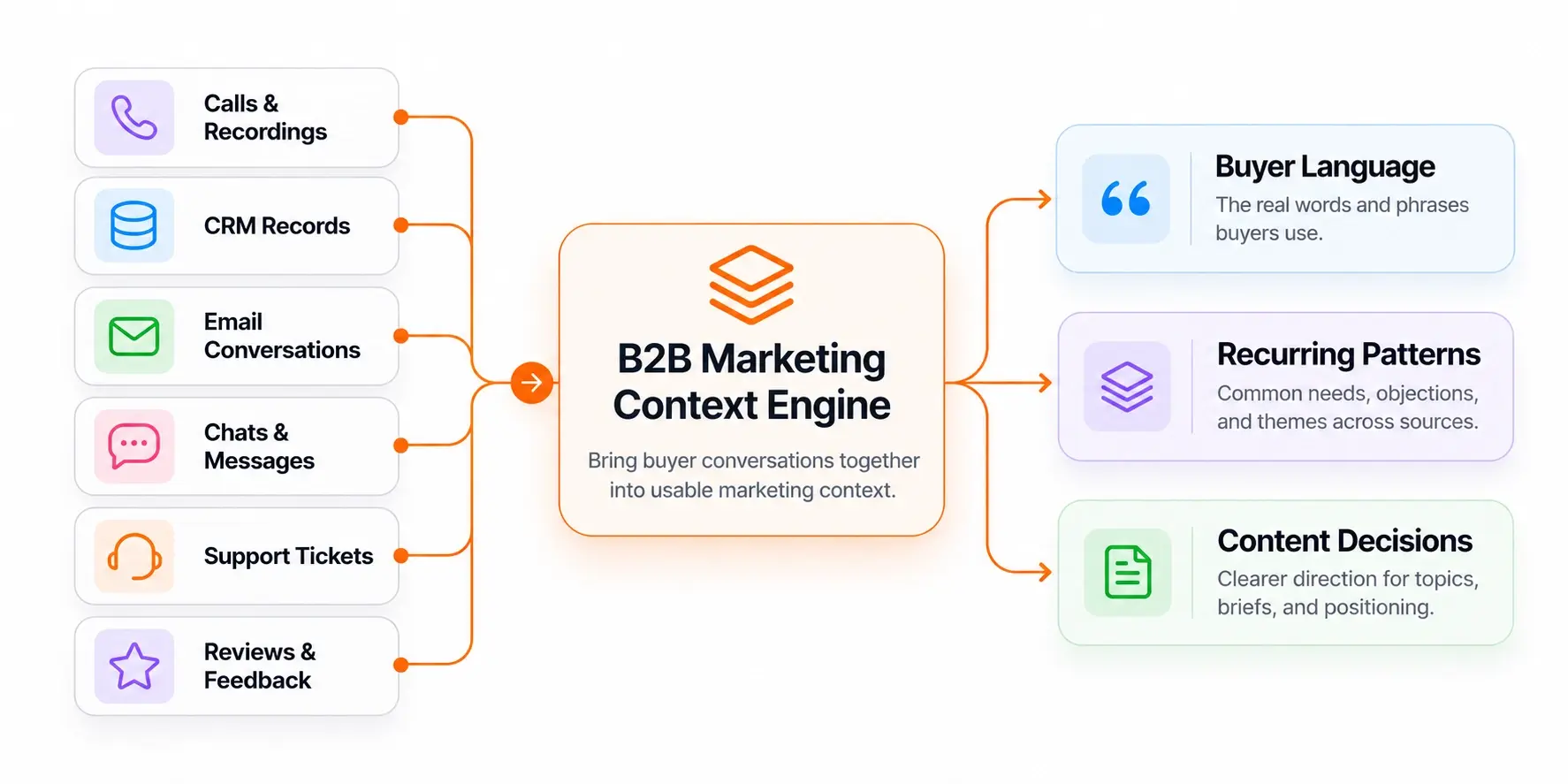
Context sources
Understand what buyers say across the places they already interact with you
Each source reveals a different part of the buying experience. Used together, these signals can help teams identify recurring needs, objections, decision criteria, and language for more relevant B2B marketing.
Calls and conversation recordings
Sales, demo, customer success, and service conversations can reveal buyer questions, objections, pain points, use cases, and the language people use to describe their needs.
CRM records
Account, opportunity, and customer context helps ground insights in the business relationship and buying journey. CRM fields and data availability depend on the connected source.
Customer and prospect correspondence can add nuance to questions, requirements, follow-ups, objections, and decisions that may not appear in structured CRM fields.
Chats and messages
Chat conversations capture immediate questions, product concerns, support needs, and recurring language across buyer and customer interactions.
Support tickets
Support conversations can expose friction, unmet expectations, product questions, and issues customers need to resolve after purchase.
Reviews and customer feedback
Reviews provide customer perspectives on perceived value, product experience, comparisons, strengths, and areas where expectations are not being met.
How context comes together
Move from scattered signals to a more grounded marketing picture
Step 1: Connect available sources
Bring together the calls, CRM, email, chat, support, review, and other source data available through your configured connections. What is accessible depends on the integration and permissions.
Step 2: Recognize recurring buyer context
Use the combined signals to understand recurring problems, objections, questions, needs, and customer language. Keep the originating source available when a finding needs verification.
Step 3: Apply context to marketing work
Use relevant context to inform research and content decisions.
Explore the B2B Marketing Context Engine and the wider content creation workflow.
Why connected context matters
Make marketing more representative of the buyers you serve
A source library is useful when it helps teams work from evidence, not when it simply adds another place to store information.
01 / BUYER LANGUAGE
Use the words buyers actually use
Ground messaging and content in the phrases, questions, and descriptions that appear in real conversations instead of relying only on internal assumptions.
02 / REPEATED PATTERNS
Notice needs that appear across sources
Cross-source context can help reveal recurring objections, desired outcomes, or friction that may be difficult to see in a single channel.
03 / RELEVANT CONTENT
Ground content in buyer questions
Use relevant context to support topic selection, content briefs, positioning, and useful answers to the questions customers ask during evaluation.
Frequently Asked Questions
What are marketing context sources?
Marketing context sources are the systems and channels where customer and buyer signals are recorded, such as calls, CRM, email, chats, support tickets, and reviews. Bringing these signals together can give marketers a fuller picture of buyer needs and language.
What sources are included in the B2B Marketing Context Engine?
The intended source categories include calls and conversations, CRM, email, chat, support tickets, reviews, and other buyer-context sources. The exact sources available in a workspace depend on configured integrations, permissions, and product support.
Why connect multiple sources instead of using CRM alone?
CRM records provide structured account and opportunity context, while calls, emails, chats, tickets, and reviews may contain richer details about questions, objections, expectations, and customer experience. Multiple sources can complement one another, though availability and data quality vary.
Does connecting context sources guarantee better marketing performance?
No. Connecting sources can improve the evidence available to a team, but performance depends on source coverage, data quality, how insights are validated, and how those insights are applied. Marketing outcomes should be measured separately.