


.png)


80% of B2B deals are won by the vendor the buyer favored before first contact — during the anonymous, content-driven research phase (6sense, 2025 Buyer Experience Report). That number reframes the entire job of content marketing: the goal is not to persuade buyers in a sales call but to be the obvious choice before one ever happens. Marketing leaders and content marketers are driving this shift by adopting advanced strategies and technology, with lead generation and alignment to marketing objectives as primary goals. Companies that excel at personalization already understand this, generating 40% more revenue than average players (McKinsey, Next in Personalization). And with 94% of B2B buyers now using large language models to synthesize their research (6sense, 2025 Buyer Experience Report), the surface area where content marketing operates has expanded far beyond owned channels. We aggregated data from 6sense, McKinsey, StackAdapt, Salesforce, Gartner, Forrester, the Content Marketing Institute, and a dozen other primary sources to compile the top content marketing statistics for 2026. Having a documented content marketing strategy is more important than ever for success in this evolving landscape.
Key Takeaways
- 80% of B2B deals are won by the vendor the buyer preferred before engaging with sellers (6sense, 2025 Buyer Experience Report)
- Companies excelling at personalization generate 40% more revenue than average players (McKinsey, Next in Personalization)
- 87% of brands plan to increase personalization spend in 2026, yet 68% are still in the early stages of implementation (StackAdapt & Ascend2, State of Personalization in Digital Marketing, 2026)
- 94% of B2B buyers used LLMs to synthesize and organize research during their purchase process (6sense, 2025 Buyer Experience Report)
- 71% of consumers expect personalized interactions from brands; 76% get frustrated when they don’t receive them (McKinsey, Next in Personalization)
- Personalization drives a 10–15% revenue lift and a 10–30% improvement in marketing ROI for most companies (McKinsey, Next in Personalization)
- 83% of marketers recognize the shift toward personalized, two-way messaging — but only 1 in 4 are satisfied with how they use data to power those moments (Salesforce, State of Marketing 10th Edition)
- Buyers referred from AI search tools spend up to 3x more time on-page than visitors from traditional search (Forrester, as reported by Digital Commerce 360, 2025)
- 95% of the time, the winning vendor was already on the buyer’s Day-One shortlist (6sense, 2025 Buyer Experience Report)
- 52% of consumers will share personal data in exchange for more relevant product recommendations (eConsultancy, Future of Marketing)
- 78% of consumers say explicit labeling of AI-generated content is “very important” or “the most important factor” in maintaining trust (Gartner Consumer Community Survey, 2025)
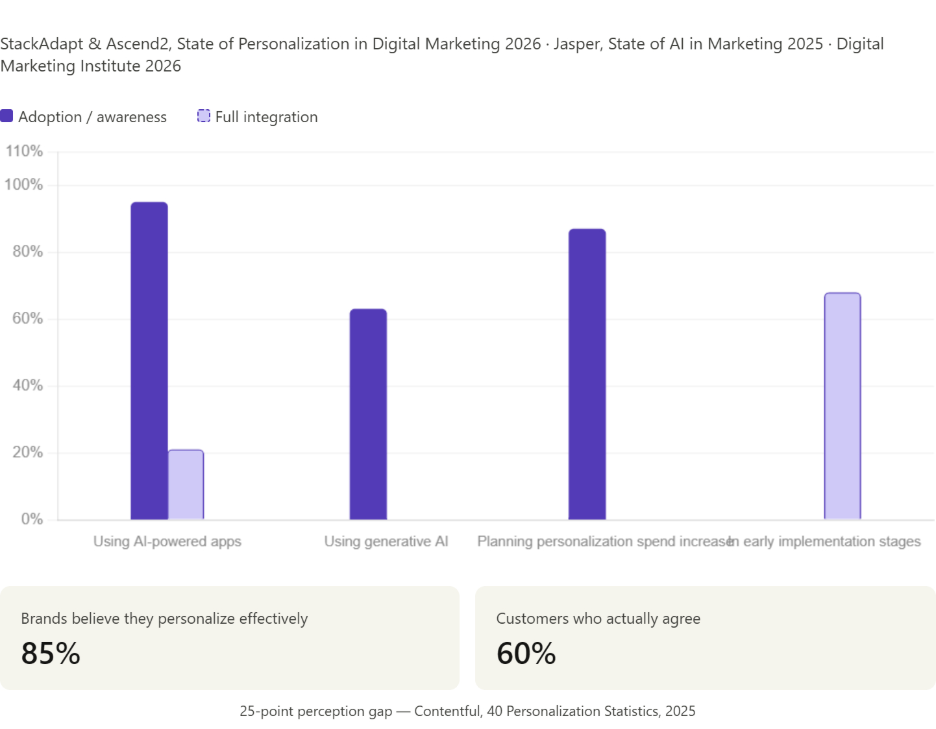
- Only 21% of brands and 22% of agencies say they have fully integrated AI for personalization across channels (StackAdapt & Ascend2, State of Personalization in Digital Marketing, 2026)
- Aligning content marketing efforts with clear marketing objectives is essential for measurable impact and ROI.
- More than half of companies plan to increase their investment in content marketing in 2026, reflecting the growing importance of strategic content marketers and robust content marketing strategies for lead generation and business growth.
B2B Buyer Behavior and the Self-Serve Research Phase
The B2B buying decision is no longer made in a sales meeting. It solidifies during an anonymous research phase that most marketing teams are still not designed to influence. When 95% of deals go to the vendor already on the buyer’s Day-One shortlist, the implication is direct: brands that show up with the right content, context, and credibility before a buyer announces themselves win more deals. The window to shape a shortlist position is narrow, invisible, and almost entirely dependent on what a buyer finds when they search independently—primarily through search engines. Search engines are the primary channel for B2B buyers' research, making it critical to optimize for search engine results pages (SERPs). Effective search engine optimization (SEO) strategies increase visibility on SERPs, drive qualified web traffic, and enhance discoverability. Notably, organic traffic converts at a 2.8x higher rate than paid traffic, underscoring the value of investing in high-quality, optimized content. Content marketing is the most strategically important investment a B2B team can make in 2026, as companies with active blogs generate 67% more leads monthly than those without, highlighting the role of content in lead generation and the ability to generate leads throughout the buyer journey.
|
Metric |
Value |
Source |
|---|---|---|
|
Deals won by the pre-contact vendor favorite |
80% |
|
|
Winning vendor already on buyer’s Day-One shortlist |
95% of the time |
|
|
Buyers who define purchase requirements before contacting sales |
83% |
|
|
Share of buying journey spent in independent research |
60% |
|
|
Average buying cycle length (2025) |
10.1 months |
|
|
Average buying cycle length (2024, for comparison) |
11.3 months |
|
|
Buyers who engaged sellers earlier due to AI capability evaluation |
58% |
|
|
Average vendor interactions per buyer with the winning vendor |
16 per person |
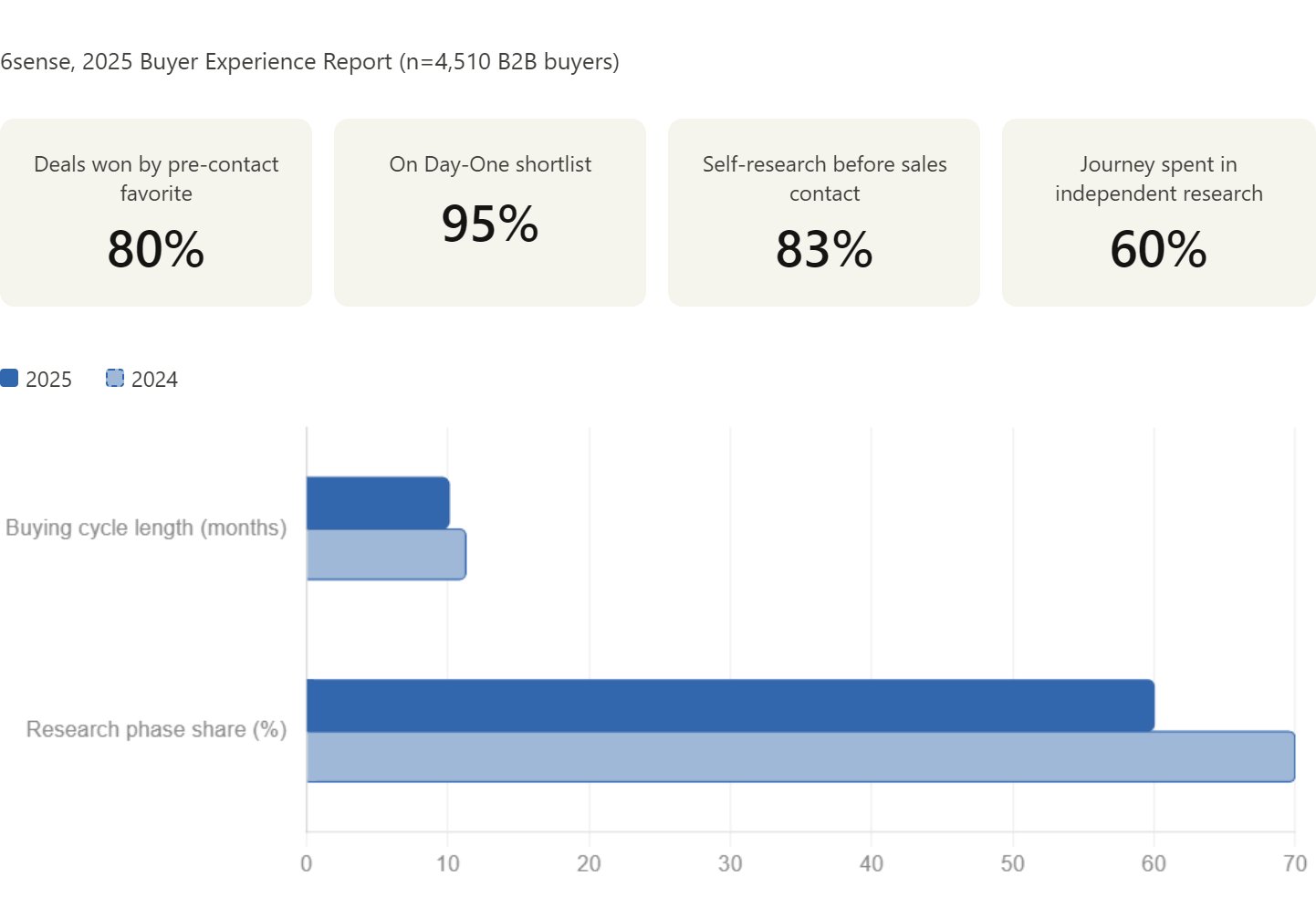
The shortening buying cycle is not buyers doing less research — it is buyers arriving more informed, faster. The shift from a 70/30 research-to-engagement split in 2024 to a 60/40 split in 2025 means sellers are entering conversations earlier, but buyers’ minds are just as made up as before. The shortlist is locked long before the first call.
Teams trying to understand which buyers are actively researching in the anonymous phase can use Omnibound’s Intelligent Research to surface ICP and persona signals before a buyer ever raises their hand.
Personalization ROI and Revenue Impact
Personalization is not a UX investment, it is a documented revenue lever with measurable lift across acquisition cost, conversion rate, and customer lifetime value. The gap between personalization leaders and laggards is not marginal: leaders generate 40% more revenue from personalization than their slower-growing counterparts, and the mechanism is well understood. The closer a company gets to individual customer context, their intent, their language, their buying stage, the larger the financial return. Delivering relevant content tailored to the target audience and addressing the target audience's pain points is essential for maximizing the impact of personalization. Personalization enhances customer engagement by providing content that resonates with the audience, driving stronger relationships and improved business outcomes. Content quality is a key factor in driving ROI from personalization, as high-quality, personalized content is more likely to convert and retain customers. The biggest drivers of B2B content marketing performance are content relevance and quality, strong team capabilities, and tight alignment with sales. The data below represents the strongest available primary evidence on what personalization actually delivers commercially.
|
Metric |
Value |
Source |
|---|---|---|
|
Revenue premium for personalization leaders vs. average players |
40% more revenue |
McKinsey, Next in Personalization(most recent available data, 2021) |
|
Revenue lift from personalization for most companies |
10–15% |
McKinsey, Next in Personalization(most recent available data, 2021) |
|
Marketing ROI improvement from personalization |
10–30% |
McKinsey, Next in Personalization(most recent available data, 2021) |
|
Customer acquisition cost reduction from personalization |
Up to 50% |
|
|
Consumers who expect personalized interactions |
71% |
|
|
Consumers frustrated when personalization is absent |
76% |
|
|
Businesses reporting higher consumer spending with tailored experiences |
80% |
|
|
Personalization leaders more likely to exceed revenue goals |
48% more likely |
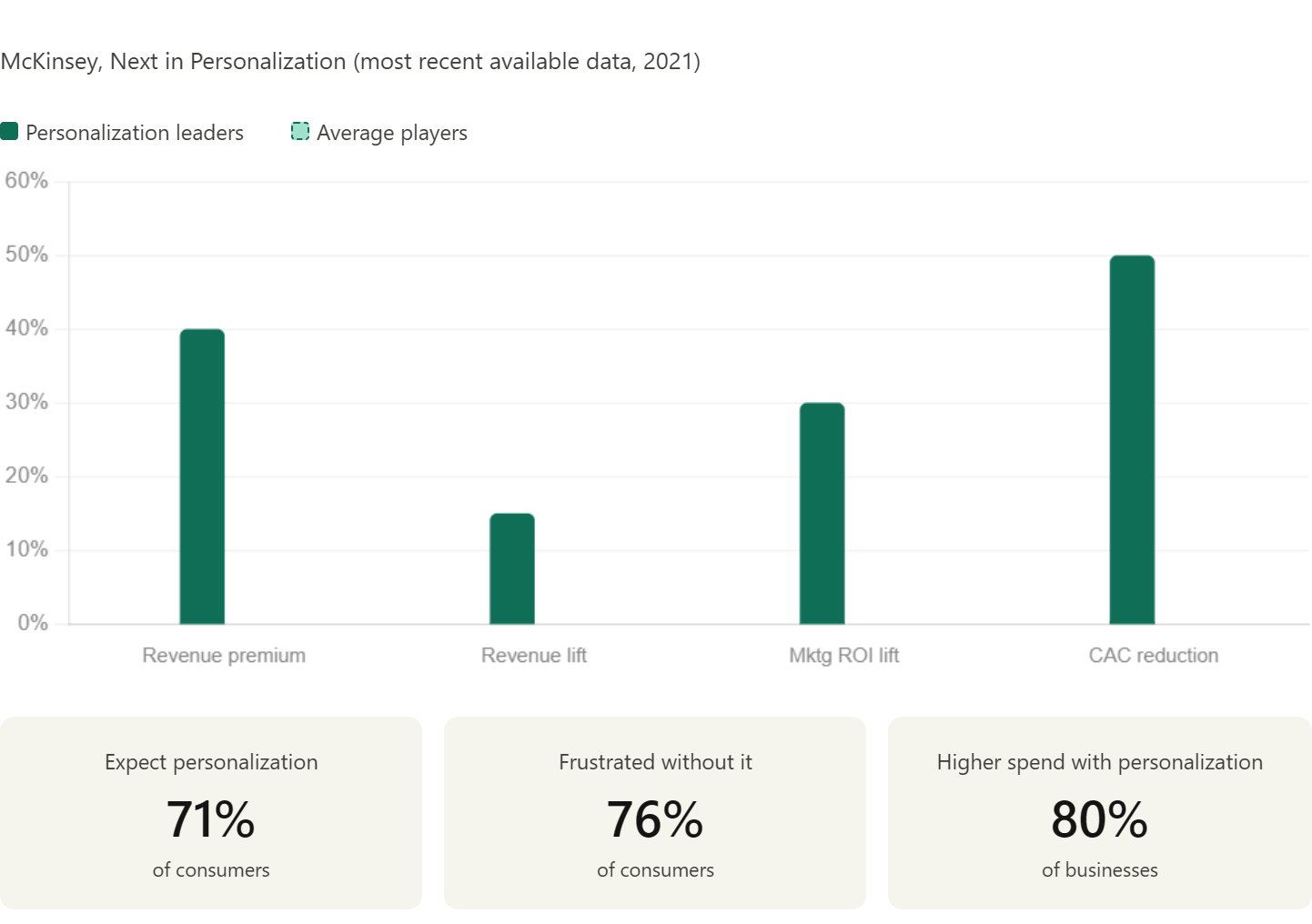
McKinsey’s Next in Personalization (2021) remains the most comprehensive primary study on personalization revenue impact at the time of writing. No updated McKinsey study covering equivalent breadth was published through early 2026. The directional findings have been corroborated by multiple secondary analyses using 2024–2025 data.
AI Powered Content Marketing and Context Intelligence
Artificial intelligence is now the foundation of modern B2B content marketing, fundamentally transforming how teams operate and compete. AI tools are table stakes for content production. The performance gap in 2026 is not between teams that use AI and teams that don’t — it is between teams that feed AI rich customer and market context and teams that prompt it in a vacuum. Two teams using the same AI platform with the same prompt will produce dramatically different outputs if one has unified buyer data, campaign history, and competitive intelligence feeding the model while the other has none. Context is the variable that determines whether AI produces content that earns citations or content that gets ignored. Adoption is near-universal; the discipline of context engineering is not.
AI-powered marketing tools have become a top investment priority for B2B marketers, serving as a force multiplier for improving content relevance, quality, and campaign performance. Nearly 95% of B2B marketers utilize AI-powered applications, primarily for generating or optimizing copy (89%) and creating visual assets (53%). The percentage of marketers who don't use AI for blog creation has dropped from 65% to just 5% in two years, reflecting the rapid adoption of AI-powered tools in content marketing. Over 80% of marketers now use AI to create content, including blog posts and email copy, and 72% of B2B marketers integrate generative AI tools for tasks associated with content creation and management. AI's role continues to expand, with 45% of content marketers employing these tools for brainstorming and developing new concepts, enhancing productivity and creativity.
|
Metric |
Value |
Source |
|---|---|---|
|
B2B marketers using AI-powered marketing applications (2026) |
95% |
|
|
Marketers using AI specifically for content creation |
80% |
|
|
Marketers currently using generative AI |
63% |
|
|
Top reported benefit of AI adoption: increased productivity |
28% of adopters |
|
|
Second top benefit: improved marketing ROI |
25% of adopters |
|
|
Businesses using generative AI in marketing and sales reporting revenue growth |
~two-thirds |
|
|
Revenue growth range from generative AI in marketing and sales |
5–10% |
|
|
Brands and agencies with AI fully integrated across personalization channels |
21% of brands; 22% of agencies |
StackAdapt & Ascend2, State of Personalization in Digital Marketing, 2026 |
AI has improved productivity for 87% of its users, but 12% to 13% report a decrease in content quality due to over-reliance on automation. While 58% of marketers believe AI has improved content quality, only 4% consider AI-generated content highly trustworthy without human oversight. Meanwhile, 43% of B2B marketers struggle to differentiate their content in a saturated market driven by mass-produced AI-generated content.
The gap between AI adoption (95%) and full channel integration (21%) is the defining tension in AI-powered content marketing. Most teams use AI for isolated tasks — drafting, idea generation, metadata — rather than as an orchestrated layer fed by unified customer context. The teams closing this gap report meaningfully better content performance.
Omnibound’s Marketing Context Engine centralizes product, customer, and market intelligence so every AI content workflow operates from a unified context layer rather than isolated prompts.
AI Search and Content Discovery
B2B buyers are now researching in ChatGPT, Perplexity, and Google AI Mode — not just on Google Search. Being cited in AI-generated answers has become a measurable distribution channel with engagement rates that traditional organic search cannot match. Visitors arriving from AI search tools spend up to three times more time on-page than those from conventional search, and their queries average 15 to 23 words — far more specific and intent-rich than keyword-based searches (Forrester, as reported by Digital Commerce 360, 2025). To maintain and enhance visibility, marketers must focus on search engine optimization (SEO) strategies that improve rankings on search engine results pages (SERPs), while also adapting to new AI-driven search experiences. Voice search optimization is emerging as a key strategy for capturing AI-powered and voice-enabled queries. Additionally, marketers are transitioning from traditional SEO to Generative Engine Optimization (GEO) to ensure their content is suitable for AI search summaries. Content that earns citations in AI answers reaches buyers in the exact moment of active evaluation, during the anonymous research phase where shortlists are formed.
|
Metric |
Value |
Source |
|---|---|---|
|
B2B buyers using generative AI during their purchase process |
94% |
|
|
B2B buyers using generative AI during purchase process (corroborating figure) |
~89% |
|
|
B2B buyers whose research habits changed due to generative AI |
51% |
|
|
Buyers who altered their search phrasing due to GenAI |
71% of those affected |
|
|
AI search traffic conversion rate vs. traditional organic search |
4.4x higher |
Grand View Research, 2025(Tier 2 — treat as directional) |
|
Time on-page: AI search visitors vs. traditional search visitors |
Up to 3x longer |
|
|
B2B buyers who encountered Google AI Overviews and clicked through to a cited source |
90% clicked at least one cited source |
The conversion rate differential (4.4x) is from a Tier 2 aggregation and should be treated as directional rather than definitive. The on-page engagement data from Forrester is sourced from named case evidence and is more robust as a directional indicator. Both figures point to the same conclusion: AI-referred traffic is higher-intent traffic.
Omnibound’s AI Search feature tracks the exact prompts B2B buyers are using in AI engines, identifies citation gaps where competitors are being cited instead, and surfaces content opportunities grounded in real buyer language.
First-Party and Zero-Party Data Adoption
As third-party cookies recede and privacy regulations tighten globally, context marketing depends on data consumers and buyers actually provide. The shift to first- and zero-party data is both a compliance necessity and a strategic advantage: data voluntarily shared by buyers is more accurate, more current, and more actionable than inferred behavioral signals. Owned media—such as websites, blogs, and email—plays a crucial role in collecting high-quality, consented data directly from audiences, making it a cost-effective and strategic asset in B2B content marketing. Leveraging multiple marketing channels (including in-person events, webinars, email, organic social media, blogs, and newsletters) is essential for building a comprehensive, data-driven marketing strategy that maximizes both reach and data quality. The business case is not just about avoiding regulatory risk — it is about building the kind of customer context that makes personalization meaningful rather than mechanical. Brands still relying on third-party signals for context are operating on a data foundation that is already eroding.
|
Metric |
Value |
Source |
|---|---|---|
|
Consumers willing to share personal data in exchange for better recommendations |
52% |
|
|
Consumers reporting greater comfort with brands that collect zero-party data |
48% |
|
|
Consumers who would abandon brands that mishandle their data |
70% |
|
|
Consumers who trust online services to protect their data |
47% |
|
|
Marketers expecting zero-party data to grow in importance |
55% |
|
|
Marketers who believe privacy should be a key factor in data strategy |
89% |
|
|
Consumers saying explicit AI-generated content labeling is “very important” for trust |
78% |
The trust gap is real and widening. Only 47% of consumers trust online services to protect their data (Deloitte, 2025), yet 52% will willingly share data when the value exchange is transparent and relevant. The implication for context marketing: consent-based, zero-party data collection is not a privacy workaround — it is the highest-quality signal available, and consumers will provide it when brands give them a clear reason to.
Omnibound’s Marketing Context Engine unifies first-party customer signals — call recordings, CRM notes, support tickets, and behavioral data — into a single intelligence layer, replacing fragmented and unreliable third-party data with context that is both consented and current.
Personalization Maturity and the Execution Gap
Most organizations describe themselves as advanced in personalization. The data tells a different story. 87% of brands plan to increase personalization spend in 2026, yet 68% are still in the early stages of actual implementation (StackAdapt & Ascend2, State of Personalization in Digital Marketing, 2026). The gap is not caused by lack of intent — it is caused by fragmented data, disconnected tools, and the absence of a unified measurement framework. Allocating a sufficient content marketing budget and overall marketing budget is essential to support effective personalization and ensure resources are available for coordinated content marketing efforts across channels. Aligning these efforts with the goal of achieving marketing objectives is key to success. Teams with a documented content marketing strategy are 33% more likely to achieve higher ROI than those without one. Teams that close this gap by connecting data, creative, and activation into a coherent cross-channel system are the ones separating from the field. The majority are still running personalization as a collection of disconnected tactics rather than as an orchestrated strategy.
|
Metric |
Value |
Source |
|---|---|---|
|
Brands planning to increase personalization spend in 2026 |
87% |
StackAdapt & Ascend2, State of Personalization in Digital Marketing, 2026 |
|
Organizations in early stages of personalization implementation |
68% |
StackAdapt, State of Personalization in Digital Marketing, 2026 |
|
Brands with AI fully integrated across personalization channels |
21% |
StackAdapt & Ascend2, State of Personalization in Digital Marketing, 2026 |
|
Companies that believe they personalize effectively |
85% |
|
|
Customers who agree their experience is actually personalized |
60% |
|
|
Marketers recognizing shift toward personalized, two-way messaging |
83% |
|
|
Marketers satisfied with how they use data to power personalization |
1 in 4 (25%) |
|
|
Marketers unable to measure marketing ROI across channels |
41% |
Context note: The perception gap — 85% of companies believe they personalize effectively, while only 60% of customers agree — is the most commercially significant finding in this section. It means most teams are optimizing for outputs they believe are personalized while buyers experience them as generic. Closing the maturity gap requires not just better tools but a more honest measurement baseline.
For B2B teams looking to move from early-stage personalization to cross-channel execution, Omnibound’s AI Search Marketing Platform connects buyer intelligence, content strategy, and production into a single workflow built for the full context marketing cycle.
Context Marketing by the Numbers: Summary Table
|
Metric |
Value |
Source |
|
Deals won by pre-contact vendor favorite |
80% |
|
|
Winning vendor already on Day-One shortlist |
95% of the time |
|
|
Buyers who define purchase requirements before contacting sales |
83% |
|
|
Share of buying journey spent in independent research |
60% |
|
|
Revenue premium for personalization leaders |
40% more |
|
|
Revenue lift from personalization |
10–15% |
|
|
Marketing ROI improvement from personalization |
10–30% |
|
|
Consumers who expect personalized interactions |
71% |
|
|
Consumers frustrated without personalization |
76% |
|
|
Businesses reporting higher spending with tailored experiences |
80% |
|
|
B2B buyers using generative AI during purchase process |
94% |
|
|
AI search visitors' time on-page vs. traditional search |
Up to 3x longer |
|
|
Buyers who altered search phrasing due to GenAI |
71% of those affected |
|
|
Brands planning to increase personalization spend in 2026 |
87% |
|
|
Organizations in early personalization implementation stages |
68% |
|
|
Brands with AI fully integrated across personalization channels |
21% |
|
|
Companies believing they personalize effectively |
85% |
|
|
Customers who agree their experience is actually personalized |
60% |
|
|
Marketers satisfied with their data-powered personalization |
1 in 4 |
|
|
Consumers willing to share data for better recommendations |
52% |
|
|
Consumers who trust online services to protect their data |
47% |
|
|
Consumers saying AI content labeling is critical for trust |
78% |
Methodology and Sources
This article was compiled by aggregating statistics from Tier 1 primary research and Tier 2 reputable aggregators with disclosed methodology. All statistics were traced to their original source before inclusion. Blog-to-blog citations were excluded. Statistics from 2023 or earlier are flagged as "most recent available data" where used.
Primary sources:
- 6sense — 2025 Buyer Experience Report (November 2025, n=4,510 B2B buyers across North America, EMEA, APAC); 2024 Buyer Experience Report
- McKinsey & Company — Next in Personalization 2021 (most recent available comprehensive study); McKinsey Global AI Survey 2025; What is Personalization
- StackAdapt & Ascend2 — The State of Personalization in Digital Marketing 2026 (February 2026, n=468 brand and agency marketers, North America, 95% confidence level)
- Salesforce — State of Marketing 10th Edition (2026); Marketing Statistics 2026
- Gartner — Consumer Community Survey and Agentic AI Predictions (October–November 2025, n=335 U.S. consumers; January 2026); Personalized Marketing Strategies
- Forrester — AI Search is Reshaping B2B Marketing (2025); From Keywords to Context: AI-Powered Search in B2B Marketing (October 2025)
- Content Marketing Institute & MarketingProfs — B2B Content Marketing Benchmarks, Budgets, and Trends: Outlook for 2025 (December 2024, n=1,015 B2B marketers)
- Jasper — State of AI in Marketing 2025 (May 2025, n=500+ marketers)
- eConsultancy — Future of Marketing report (zero-party data and privacy personalization data)
- Deloitte — Digital Media Trends 2025 (consumer data trust statistics)
- Contentful — 40 Personalization Statistics (January 2025, aggregating Segment, Salesforce, and primary research with methodology disclosed)
- TrustRadius — 2025 buyer research (AI Overviews click-through behavior)
- Supermetrics — 2025 Marketing Data Report (September 2025)
- Grand View Research — AI search conversion rate (treat as directional)
- Demand Local — Zero-party data consumer comfort (citing third-party research)
Tier 2 sources (methodology disclosed):
- Grand View Research — AI search conversion rate (treat as directional)
- Demand Local — Zero-party data consumer comfort (citing third-party research)
Last updated: April 2026 We update this page quarterly. If you identify a stat that has been superseded by newer primary research, contact us and we will review and update accordingly.