

Great Go-to-Market Strategies Start with Better Intelligence
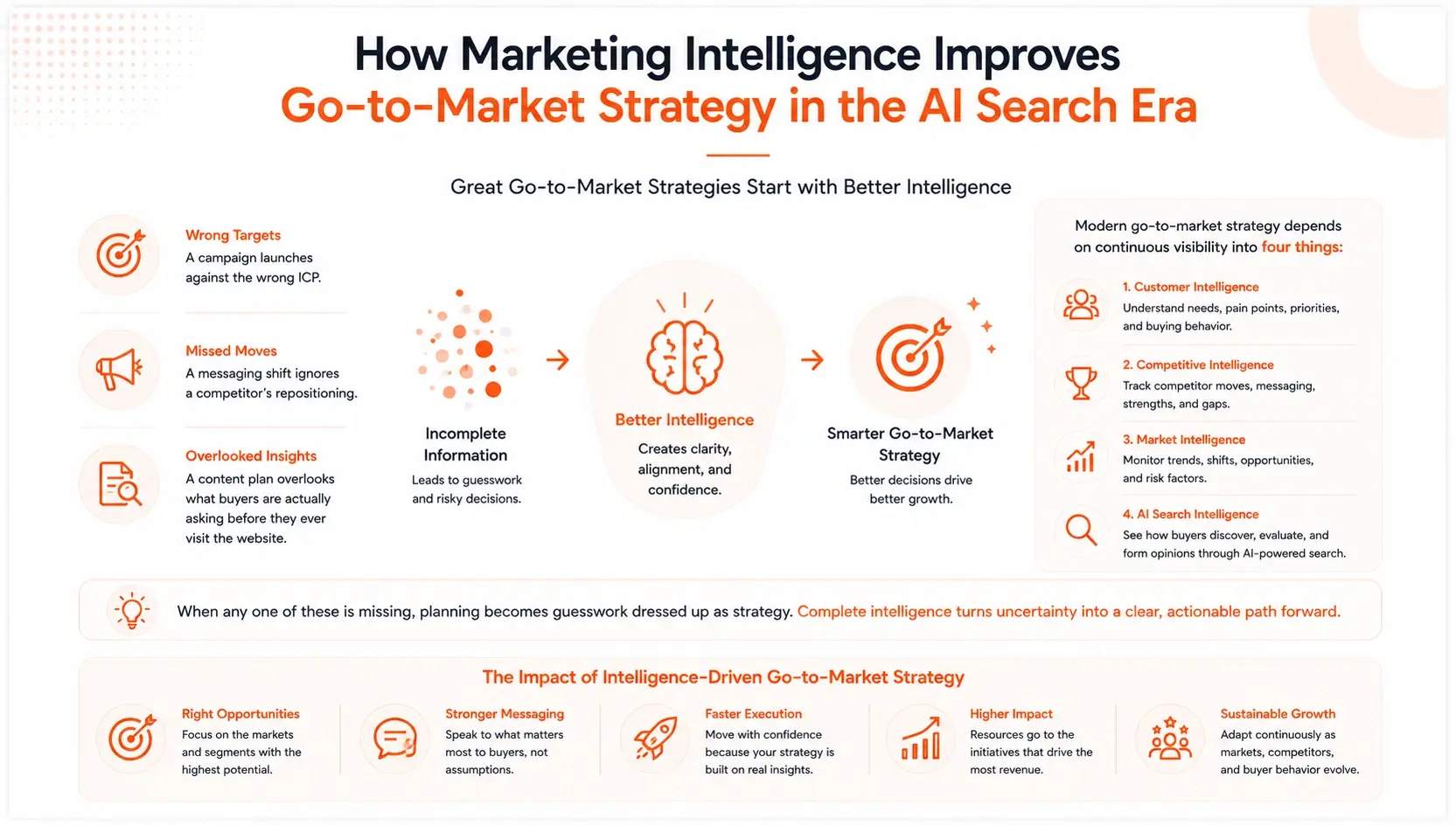
Most B2B companies don't miss their growth targets because marketing failed to execute. They miss them because leadership made strategic decisions on incomplete information. A campaign launches against the wrong ICP. A messaging shift ignores a competitor's repositioning. A content plan overlooks what buyers are actually asking before they ever visit the website.
Modern go-to-market strategy depends on continuous visibility into four things: customers, competitors, the broader market, and how buyers now discover vendors through AI-powered search. When any one of these is missing, planning becomes guesswork dressed up as strategy.
This is the gap that marketing intelligence closes. Instead of asking teams to interpret static reports and hope the conclusions are still true next quarter, it gives GTM leaders a continuous, evidence-based view of what's changing and what to do about it.
Why Traditional Marketing Reports Are No Longer Enough
Traditional reporting answers one question well: what happened? Traffic went up. A campaign underperformed. A segment converted better than expected. These are useful facts, but they are backward-looking by design.
The problem is that go-to-market strategy requires a forward-looking question: what should we do next? A report showing that win rates dropped in a segment doesn't tell you why buyers hesitated, what competitor messaging influenced them, or whether the objection is even still relevant six months later.
More than 9 in 10 prospects now research vendors independently before ever engaging sales, often across multiple channels including AI-powered search tools. That means the moments marketing can influence buyer perception are shrinking, and they're happening earlier, outside the funnel stages most dashboards were built to track.
Marketing intelligence is built to answer the "what next" question. It interprets buyer language, competitive movement, and category shifts continuously, then turns that interpretation into direction, not just a chart.
Four Intelligence Streams That Strengthen GTM Strategy
Strong go-to-market planning draws from four connected intelligence streams. Each one covers a different blind spot that traditional analytics tends to miss.
1. Customer Intelligence
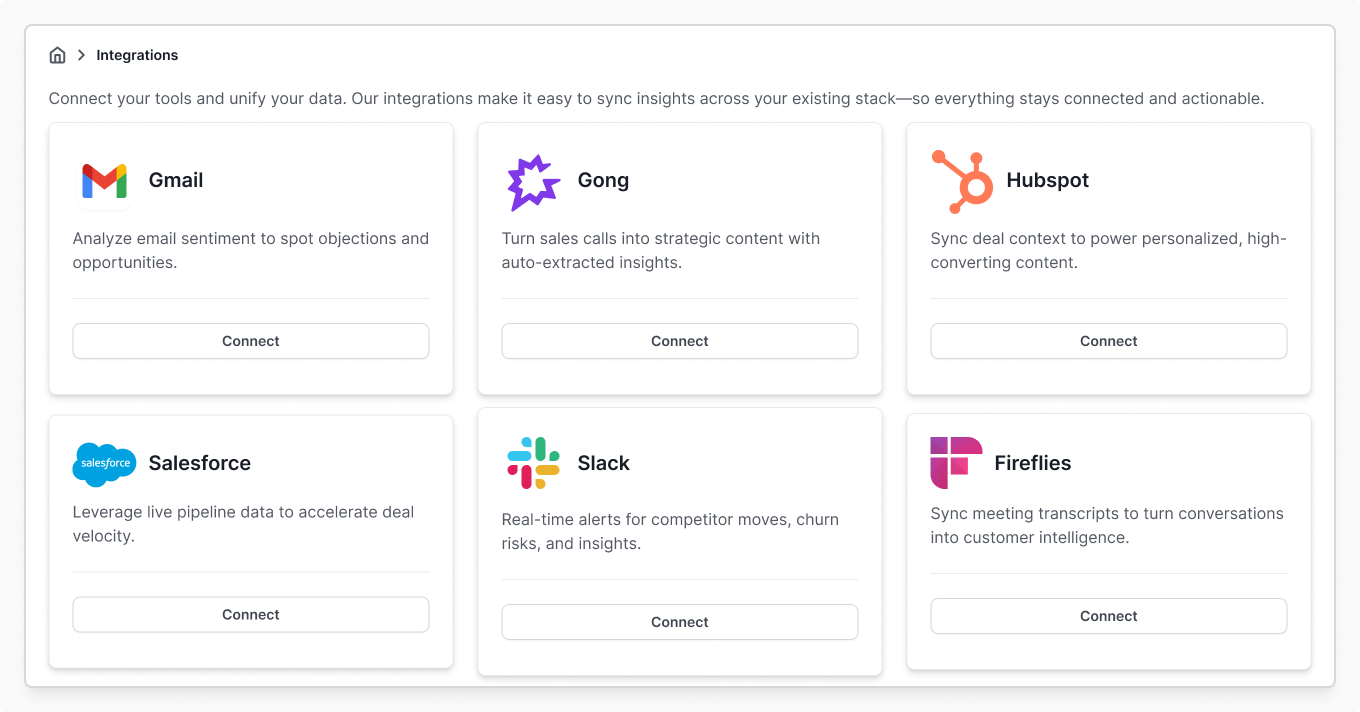
Customer intelligence tracks what buyers actually ask, in their own words, across sales calls, support tickets, reviews, and research behavior. It reveals objection patterns, unmet needs, and language shifts long before they show up in a win/loss summary.
2. Market Intelligence
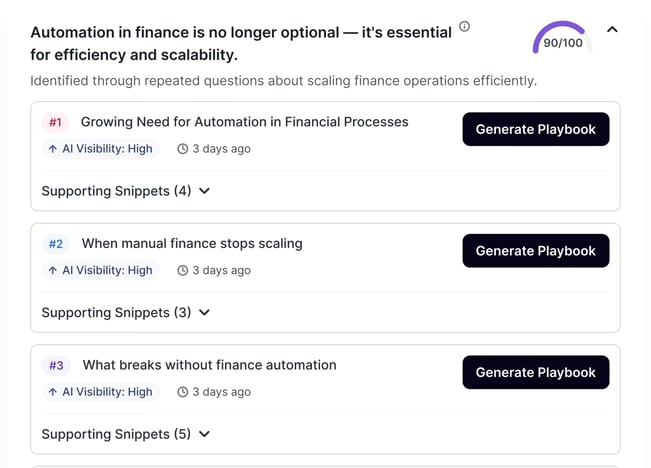
Market intelligence follows category-level change: new entrants, shifting buyer priorities, pricing pressure, and emerging use cases. It answers whether a positioning that worked a year ago still resonates today.
3. Competitive Intelligence
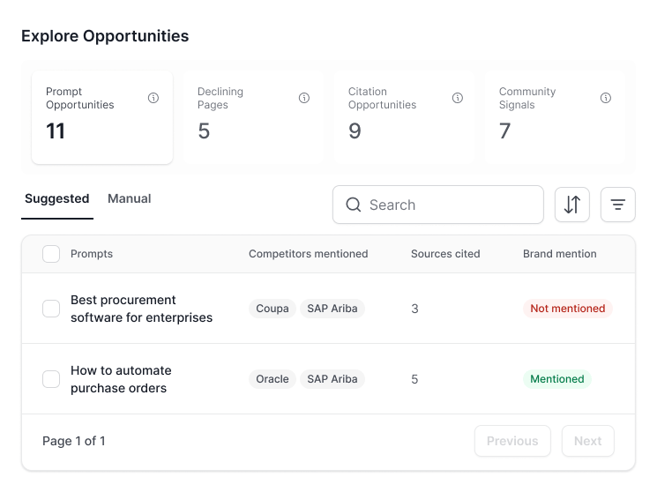
Competitive intelligence monitors how rivals are positioning, messaging, and showing up in buyer conversations. It's less about tracking feature lists and more about understanding which arguments are winning deals right now.
4. AI Search Intelligence
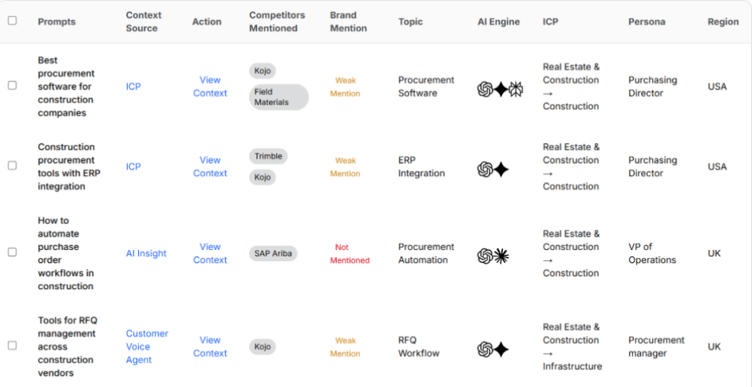
AI Search Intelligence is the newest and fastest-growing stream. It tracks what buyers ask AI tools like ChatGPT, Perplexity, and Gemini, which vendors get recommended, and where content gaps leave a brand invisible during early-stage research.
Together, these four streams form a continuous research workflow rather than four disconnected reports. Omnibound's marketing intelligence platform is built specifically to combine them into one working view for GTM teams.
Journey Intelligence Beyond Funnel Metrics
Funnel metrics assume buyers move in a straight line from awareness to decision. In practice, the path is messier, and increasingly, it runs through AI search before it ever touches a company's own properties.
Journey intelligence reframes the buyer path across six stages: awareness, research, AI search, evaluation, decision, and expansion. Each stage carries different signals worth tracking:
- Awareness: category language adoption and early problem framing
- Research: content consumption depth and question patterns
- AI Search: prompt visibility, citation frequency, and recommendation share
- Evaluation: competitive comparison behavior and stakeholder involvement
- Decision: objection resolution and messaging consistency across touchpoints
- Expansion: satisfaction signals and emerging use case discovery
Marketing teams that only measure top-of-funnel traffic and bottom-of-funnel conversions miss the middle, which is exactly where AI search now plays an outsized role in shaping consideration.
Marketing Intelligence Should Shape GTM Decisions
Intelligence only matters if it changes decisions. When customer, market, competitive, and AI Search Intelligence are connected, they should visibly influence:
- Positioning: grounded in language buyers actually use, not internal assumptions
- Messaging: refined against real objections rather than guessed ones
- Campaign priorities: focused where buyer intent and market movement intersect
- Content planning: built to answer questions buyers are asking AI tools directly
- Sales enablement: updated as competitive narratives shift
- Product marketing: aligned to emerging use cases before competitors name them first
This is the difference between marketing intelligence as decision support and analytics as a scorecard. Marketing leadership teams that treat intelligence as an input to planning, not an afterthought to reporting, tend to move faster on the opportunities that matter.
AI Search Is Changing Go-to-Market Strategy
Buyers now form early opinions about vendors before a single page load on a company's own site. They're asking AI tools directly: what's the best option for this problem, who solves it well, what should I watch out for.

This shifts what marketing leaders need visibility into. It's no longer enough to know what buyers search for on Google. Teams also need to understand what buyers ask AI directly, which competitors get recommended in those answers, what category language is emerging, and where content gaps leave a brand out of the conversation entirely.
AI Search Intelligence should be treated as an additional strategic input, not a replacement for traditional buyer research. It sits alongside customer, market, and competitive intelligence rather than above them. But ignoring it means planning around only part of how buyers now discover and evaluate vendors.
Marketing Intelligence → GTM Execution Framework
The four intelligence streams only create value when they connect directly to execution. A practical framework looks like this:
Customer Intelligence, Market Intelligence, Competitive Intelligence, and AI Search Intelligence feed into
- Strategy, which shapes
- Campaigns, which inform
- Sales Enablement, which is validated through
- Measurement, which feeds back into the intelligence layer
This is a loop, not a one-way pipeline. Strategy should update as new intelligence surfaces, not just at the start of a planning cycle. Connecting intelligence to pipeline outcomes is what keeps this loop honest rather than theoretical.
Measuring Modern Go-to-Market Success
Traditional GTM measurement leans on leads, MQLs, and traffic. These numbers still matter operationally, but they don't tell leadership whether strategy is actually working.
Modern KPIs go further:
- AI Search visibility: how often and how favorably a brand appears in AI-generated answers
- Buyer question coverage: the share of real buyer questions addressed by existing content
- Messaging consistency: alignment between what marketing says and what sales says in live deals
- Competitive differentiation: how distinct positioning remains as rivals adjust their own messaging
- Pipeline influence: which intelligence-driven campaigns are actually shaping closed-won revenue
- Strategic responsiveness: how quickly GTM plans adapt once new intelligence surfaces
Content built around AI Search visibility tends to perform better against these newer measures, since it's grounded in questions buyers are already asking rather than assumptions about what they might want to read.
Omnibound: A Marketing Intelligence Platform for GTM Teams
Omnibound is a marketing intelligence platform, not an analytics dashboard or a sales tracking tool. It helps GTM teams:
- Understand the real questions customers are asking, across calls, tickets, and reviews
- Monitor market shifts before they show up as a missed quarter
- Identify competitive openings in positioning and messaging
- Improve AI Search visibility across ChatGPT, Perplexity, Gemini, and other AI tools
- Prioritize GTM investments based on where intelligence and opportunity overlap
- Strengthen strategic planning with a continuous research workflow instead of quarterly snapshots
The goal is decision quality, not report volume. Teams using Omnibound spend less time reconciling conflicting dashboards and more time acting on a shared, current view of the buyer and the market.
Conclusion
The most effective go-to-market strategies today aren't built on historical reports alone. They're built on continuous customer intelligence, market intelligence, competitive intelligence, and AI Search Intelligence working together to surface opportunities before competitors find them.
This isn't about replacing traditional research or adding another dashboard. It's about giving GTM leaders a single, current view of the buyer and the market, so strategy, campaigns, and enablement all move in the same direction, informed by the same evidence.
Teams that build this kind of continuous intelligence workflow don't just react to change. They plan for it, and they act on it faster than teams still waiting for next quarter's report.
Frequently Asked Questions
How to Get AI-Powered Insights from Marketing Data?
AI-powered marketing insights come from connecting CRM data, sales calls, support tickets, customer feedback, competitor intelligence, and market signals to identify buyer questions, objections, and decision drivers. Omnibound unifies these sources into actionable intelligence that helps marketers improve positioning, content strategy, AI Search visibility, and pipeline outcomes.
How to Turn AI Visibility Insights into a Concrete Marketing Roadmap?
Turn AI visibility insights into a roadmap by identifying prompts where your brand is missing, analyzing competitor citations, prioritizing high-impact content gaps, and tracking business outcomes. Omnibound connects AI Search visibility with buyer context and pipeline data, helping teams prioritize initiatives that improve citations, authority, and revenue impact.
What Solutions Provide Synthesized Recommendations and Clean Presentations of Marketing Data Insights?
The most effective solutions consolidate customer, market, competitive, and AI Search data into a unified intelligence layer, then translate findings into prioritized recommendations rather than isolated dashboards. Omnibound synthesizes multiple data sources into clear marketing actions, enabling faster decisions around positioning, content, campaigns, and AI Search optimization.
Who Offers the Most Efficient AI Marketing Operations Automation for Enterprise Sales and Marketing?
Enterprise AI marketing operations platforms should automate insight generation, content prioritization, AI Search monitoring, and performance measurement from a single workflow. Omnibound combines customer intelligence, competitive analysis, AI Search intelligence, content planning, and pipeline measurement to streamline marketing operations while aligning execution with revenue objectives.
What is marketing intelligence?
Marketing intelligence is the continuous collection and interpretation of customer, market, competitive, and AI Search signals to support strategic decisions, rather than a static report of past performance.
How does marketing intelligence improve go-to-market strategy?
It replaces assumptions with evidence. Positioning, messaging, and campaign priorities are shaped by what's actually happening with buyers and competitors, not by last quarter's plan.
What is journey intelligence in B2B marketing?
Journey intelligence tracks how buyers actually move through awareness, research, AI search, evaluation, decision, and expansion, using KPIs suited to each stage rather than a single funnel metric.
How does AI Search affect GTM planning?
AI Search shapes buyer consideration earlier than most marketing teams have historically tracked. Planning now needs to account for what buyers ask AI tools, which vendors get recommended, and where content gaps exist.
What marketing KPIs matter most today?
AI Search visibility, buyer question coverage, messaging consistency, competitive differentiation, pipeline influence, and how quickly strategy adapts to new intelligence.
How can customer intelligence improve campaign planning?
By grounding campaigns in real buyer language and objections instead of internal guesses, campaigns are more likely to address what prospects actually care about at each stage.
What is the difference between analytics and marketing intelligence?
Analytics explains what happened. Marketing intelligence interprets why it happened and recommends what to do next, continuously, rather than at the end of a reporting cycle.
How should marketing teams prioritize GTM opportunities?
By looking for overlap across intelligence streams, where a customer need, a market shift, a competitive gap, and an AI Search opportunity point in the same direction.