

Every B2B marketer knows that losing an existing customer costs far more than acquiring a new one. In the United States, the average SaaS company spends roughly $168 billion each year on churn, yet many teams still rely on manual spreadsheets and gut‑feel alerts. Omnibound’s Agentic AI platform turns that costly guesswork into precise, automated actions that reengage at‑risk accounts, reduce churn, and win back lost revenue - all without adding headcount.
This guide walks you through the full lifecycle: from understanding customer churn to building a churn prediction model, launching AI‑powered reengagement and win back campaigns, and finally measuring the impact with the right retention metrics. If you’re a marketing leader looking for a systematic, data‑backed way to keep your pipeline full, read on.
Understanding Customer Churn and Its Financial Impact
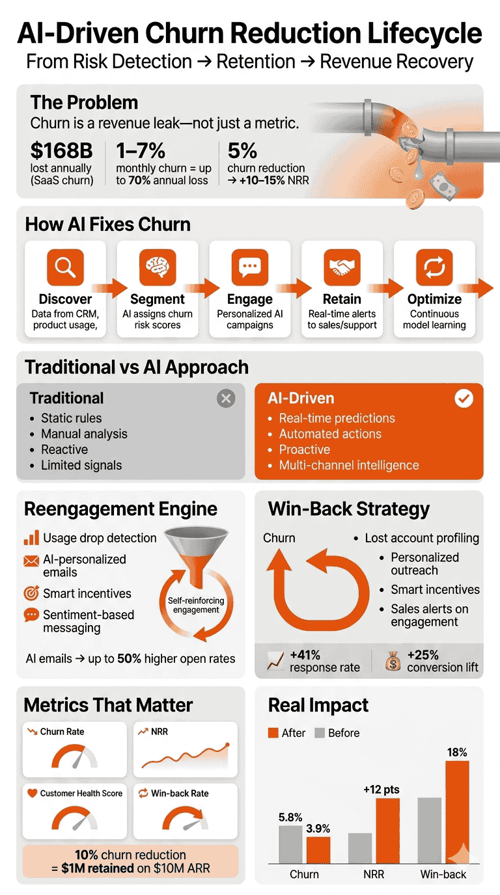
Churn isn’t just a percentage - it’s a revenue leak that can cripple growth. In 2024‑25, the median monthly churn rate for U.S. SaaS firms hovered between 1% and 7%, translating to an annual loss of up to 70% for some verticals. Stripe’s churn‑rate guide defines churn as the number of customers lost during a period divided by the total customers at the start of that period. The resulting figure tells you how quickly your customer base is eroding.
"So what are we doing to retain our existing customers? What are we trying to do to reactivate those that have completely left us so they've lapsed or they lost." Teams often see revenue slipping but lack a repeatable process to stop it. A thorough churn analysis surfaces the why behind each departure - usage decline, support friction, pricing misalignment - and maps drivers to specific touchpoints, creating a roadmap for targeted interventions.
Beyond raw numbers, churn drags down customer lifetime value (CLV) and net revenue retention (NRR). A 5% reduction in churn can boost NRR by 10%–15% for a typical subscription business, delivering a measurable lift to the bottom line. Understanding this financial ripple is the catalyst for any serious churn reduction effort.
Building a Predictive Churn Model – From Data to Action
Predictive modeling is the engine that powers proactive retention. Omnibound ingests real‑time data from CRM, product usage logs, support tickets, and call transcripts, then applies Agentic AI to generate a churn risk score for each account. This churn prediction replaces static rule‑sets with a dynamic probability that updates as new signals arrive.
Key differences between a traditional rule‑based approach and an AI‑driven model:
Implementation follows a five‑phase framework:
- Discover: Consolidate data sources and define churn‑related events.
- Segment: Train the model on historical churn outcomes to create risk tiers.
- Engage: Map each tier to an AI‑orchestrated campaign (reengage, upsell, win‑back).
- Retain: Deploy real‑time alerts to sales and support for immediate action.
- Optimize: Continuously retrain the model with fresh data.
During Discover, many teams hit data silos. "But like, we are seeing similar stuff in some of our other customers and what they're saying is, can you just help us end to end?" A unified context engine—exactly what Omnibound provides - eliminates that friction and ensures the model sees the whole customer story.
For a deeper dive into how real‑time context fuels predictive churn, see our Use Cases of a Marketing Context Engine.
Designing Re-engagement Campaigns That Actually Convert
With a risk score in hand, the next step is to reengage at‑risk accounts before they churn. Effective reengagement blends personalized content, timely outreach, and measurable incentives. Omnibound’s Agentic AI writes custom email copy, selects the optimal channel (email, in‑app, SMS), and schedules delivery based on past behavior.
Key tactics:
- Dynamic product‑usage summaries that remind the customer of missed value.
- AI‑generated offers calibrated to account profitability (e.g., limited‑time discount for high‑margin accounts).
- Sentiment‑aware messaging that adapts tone based on recent support interactions.
Research from AI in Email Marketing: The Real Use Cases (Not the Hype) shows AI‑crafted emails achieve up to 50% higher open rates than static templates, directly supporting reengagement goals.
Example: a mid‑market SaaS firm notices a 30% usage dip over two weeks. The AI flags the account as high risk, automatically sends a personalized “We’ve missed you” email with a usage‑based ROI calculator, and the customer schedules a health call within 48 hours, dropping the churn risk dramatically.
Recommended read: AI for Product Marketing: Bridging Strategy to Execution.
Win‑Back Strategies Powered by Agentic AI
When a customer has already left, the goal shifts to recovery. Omnibound creates a “lost‑account” persona, enriches it with historical usage, and generates a multi‑step outreach sequence that includes:
A 2025 study on AI‑vs‑human email efficiency found AI‑driven win‑back emails generate a 41% higher response rate and a 25% lift in conversion when AI optimizes send time and subject line.
"We’re struggling with that process. I mean we, we pivoted in our last one as well. So that, that process happened a couple of times, not really once. How do we really get traction initially?" Automating the entire sequence eliminates repeated manual pivots and provides a repeatable, measurable path to recovery.
Recommended read: How AI Technology Will Transform Customer Engagement For Marketing Teams.
Measuring Success: Retention Metrics and Ongoing Optimization
AI magic is useless without clear performance visibility. Critical retention metrics for B2B marketers include:
Omnibound surfaces these metrics in a real‑time dashboard that updates as each AI‑driven action fires. Built‑in A/B testing automatically allocates budget to the highest‑performing variant, ensuring churn reduction initiatives improve over time rather than plateau.
For executives, the ROI calculator shows that a 10% reduction in churn for a $10 M ARR SaaS business retains roughly $1 M annually; combined with lower acquisition costs, the net impact can exceed 15% of total profit.
Regularly reviewing these retention metrics and feeding outcomes back into the churn analysis engine creates a self‑reinforcing cycle of improvement.
Common Mistakes to Avoid
- Relying on a single data point (e.g., login frequency) instead of a multi‑channel risk model.
- Launching one‑size‑fits‑all campaigns that ignore account profitability and sentiment.
- Treating churn alerts as a monthly batch rather than a real‑time signal.
- Neglecting post‑campaign analysis, which stalls optimization.
Real-World Example
A mid‑size B2B SaaS provider integrated Omnibound’s context engine with Salesforce and its product‑usage lake. Within the first quarter, the AI identified 12% of the base as high‑risk, automatically dispatched personalized reengagement emails, and triggered sales alerts for the top 2% with declining usage. The result: churn fell from 5.8% to 3.9% month‑over‑month, NRR rose 12 points, and win‑back efforts recovered 18% of previously churned accounts, generating an incremental $850 k ARR.
FAQs
1. How does Omnibound’s Agentic AI differ from a rule‑based churn alert system?
Omnibound ingests real‑time signals from CRM, usage logs, support tickets, and call transcripts, applying large‑language‑model reasoning to produce a probabilistic churn risk score that updates continuously, whereas rule‑based alerts fire only on static thresholds.
2. What data is required to launch a churn prediction project?
You need a unified view of subscription details, product usage metrics, support interaction history, and qualitative notes from sales or CS teams; Omnibound connects to Salesforce, HubSpot, Gainsight, or custom data lakes to normalize this data.
3. Can the platform run fully automated, multi‑channel win‑back campaigns?
Yes. Once a lost account is identified, the AI creates a persona, selects the optimal channel mix (email, in‑app, SMS, LinkedIn), personalizes each touchpoint, and alerts sales reps when the prospect engages.
4. How is the financial impact of churn‑reduction measured?
Omnibound’s dashboard reports churn rate, NRR, win‑back conversion, and projected revenue saved; an embedded ROI calculator lets you input CAC and CLV to see the dollar value of each percentage point of churn reduction.
Conclusion
Reducing churn is now an AI‑enabled, data‑driven discipline that protects revenue and fuels growth. By understanding the true cost of customer churn, building a robust churn prediction model, deploying personalized reengagement and win back sequences, and continuously tracking the right retention metrics, B2B marketers can turn at‑risk accounts into growth engines. Omnibound provides the end‑to‑end automation, real‑time context, and governance needed to execute this strategy at scale.
.png?height=245&name=Why%20B2B%20AI%20Search%20Requires%20More%20Than%20a%20CMS%20(And%20What%20Modern%20Marketing%20Stacks%20Must%20Do%20Instead).png)