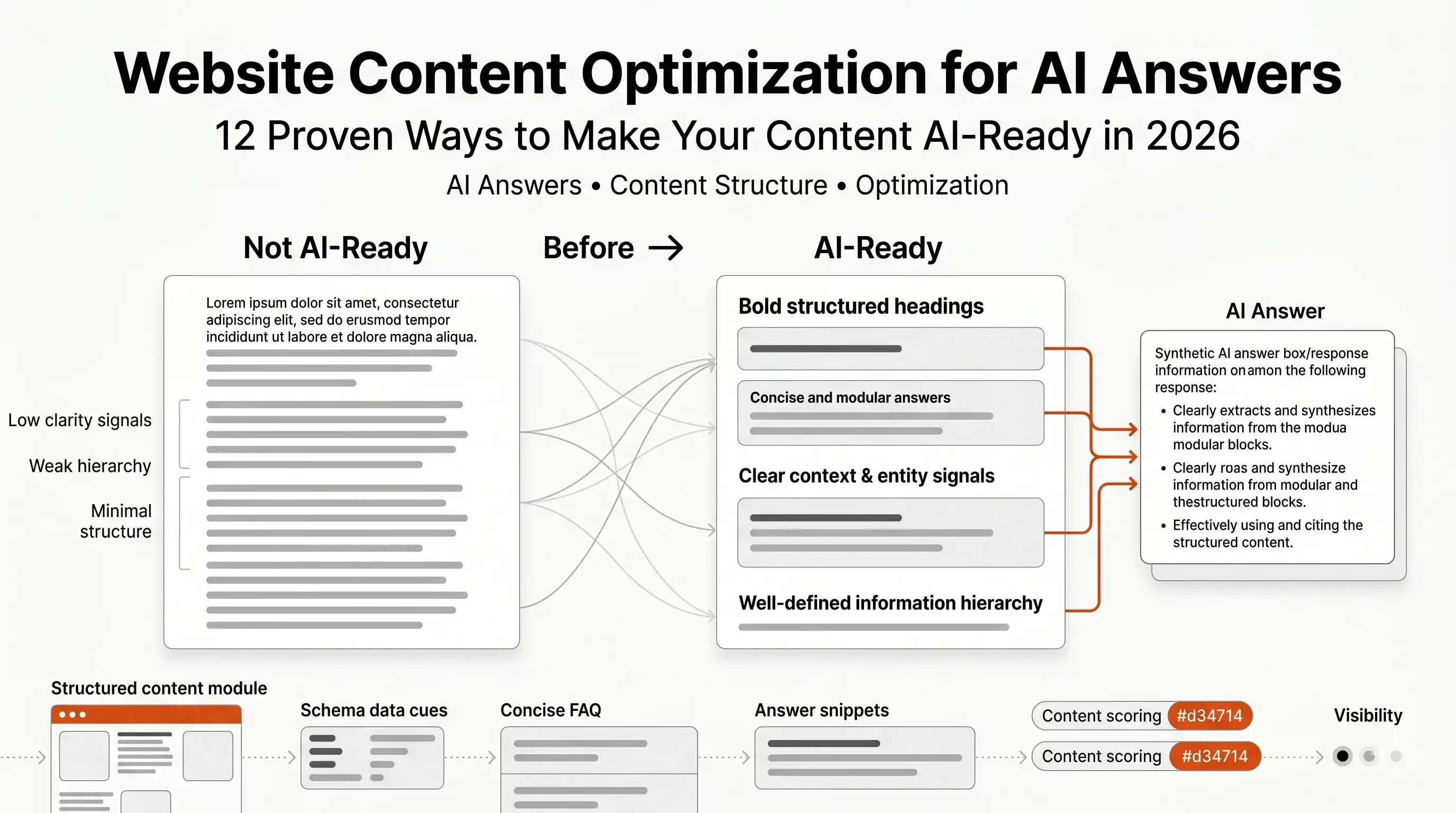


Website content optimization for AI answers has become one of the most critical priorities for any brand that wants to stay visible in 2026 — and the numbers prove why it matters so much. AI search visitors are worth 4.4x more in conversion value than traditional organic visitors, meaning the brands that earn direct AI citations are not just getting more visibility — they are attracting higher-quality, more purchase-ready audiences.
AI engines like ChatGPT, Google AI Mode, Perplexity, and Gemini now synthesize responses directly from website content, and if your pages are not structured for extraction, your brand simply does not appear.
What Are Direct AI Answers and Why They Matter for Your Website
Direct AI answers are synthesized responses generated by AI platforms using extracted information from websites, structured data, and trusted sources. Unlike classic search results, users often receive complete answers without ever visiting the original website.
This shift changes everything about how your content needs to work. Your pages must now function as information sources that AI engines can lift, interpret, and present confidently to their users.
Examples of platforms delivering direct AI answers include:
- Google AI Mode (replacing traditional featured snippets)
- ChatGPT search (citing sources in real-time responses)
- Perplexity (pulling citations and summaries from trusted pages)
- Gemini (synthesizing answers for conversational queries)
- Claude (used increasingly in enterprise B2B research workflows)
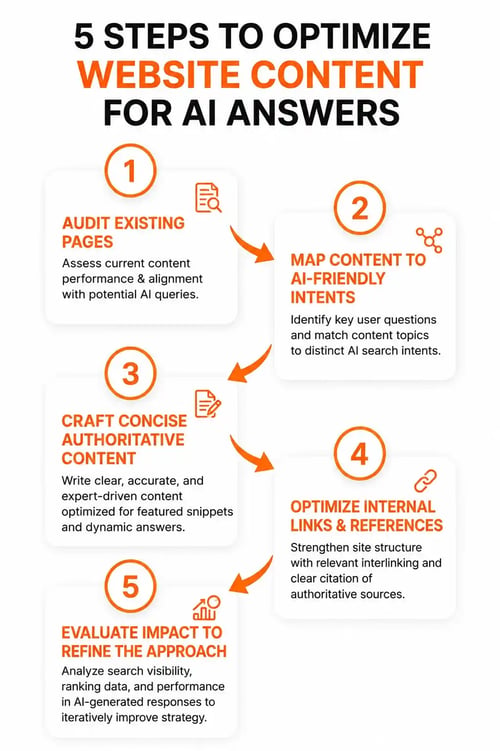
A quick-reference infographic outlining five practical steps to optimize website content for AI answers. It boosts relevance and search performance.
12 Ways to Optimize Website Content for AI Answers
These are the tactics that actually move the needle on AI answer visibility in 2026. We have organized them in order of impact, starting with the changes that deliver results fastest.
1. Lead Every Section with a Direct Answer
The single highest-impact tactic for website content optimization for AI answers is placing your answer at the very start of each section — not at the end. AI engines favor content that delivers immediate clarity.
Write a concise 1-2 sentence answer at the top of every important section before expanding with context or examples. If your best answer is buried three paragraphs deep, AI engines will consistently overlook it.
2. Use Question-Based Headings Throughout Your Content
AI systems map queries directly to question formats. Headings like "What is X?", "How does X work?", and "Why does X matter?" signal to AI engines that your content directly addresses the query structure buyers are using.
Vague or clever headings that do not reflect actual questions are one of the fastest ways to reduce AI extraction rates. Replace them with direct question formats wherever possible.
3. Build Modular, Self-Contained Content Blocks
Every section of your website should make complete sense when read in isolation. AI engines often extract individual blocks, not entire pages, so a section that depends on previous context will be passed over.
Think of each heading section as a standalone answer unit. If it cannot stand alone, restructure it until it can. This is a core principle behind how we design the content workflow system that keeps assets structured and AI-ready from creation.
4. Optimize Content Structure for Machine Parsing
Machines parse hierarchy heavily. Bullet points, numbered lists, comparison tables, short paragraphs, and clear definitions all improve the speed and accuracy with which AI engines can extract your content.
Long walls of dense text are among the most common reasons well-researched content gets ignored by AI answer systems. Structure is not just a readability feature — it is a technical advantage.
5. Implement Schema Markup Completely and Correctly
Schema markup gives AI engines a structured map of your content. The most valuable schema types for AI answer optimization include FAQ Schema, Article Schema, HowTo Schema, and Organization Schema.
The critical nuance most brands miss: incomplete schema can actively weaken results. A partially filled FAQ schema may confuse AI parsing rather than help it. Every schema implementation must be complete, validated, and consistently applied across your site.
6. Strengthen Entity and Brand Signals Across Your Site
AI engines do not just evaluate pages — they evaluate brands, concepts, and topical relationships. Your website needs to signal clearly who you are, what you specialize in, and where your expertise lives.
Improving entity signals means consistent terminology across pages, clear author information, strong brand definitions, and expertise associations that reinforce your authority in your specific domain. Our B2B marketing context engine is designed specifically to unify these signals across your content ecosystem.
7. Build Topic Depth Through Content Clusters, Not Isolated Pages
Single optimized pages rarely compete with brands that have built layered topic authority. AI engines favor sources that demonstrate comprehensive, multi-angle coverage of a subject — not just one well-formatted article.
Build topic clusters where a pillar page is supported by related articles, use cases, comparisons, and deep-dive guides. This broader coverage signals topical mastery to AI systems and dramatically increases your chances of being cited across multiple query types.
8. Add Strategic FAQ Layers That Reflect Real Buyer Questions
Generic FAQs add little value. Strategic FAQs that mirror actual buyer questions at every stage of the decision process create high-quality extraction opportunities for AI engines.
Include real customer questions, comparison prompts, decision-stage objections, and "how does X compare to Y" phrasing. These formats align directly with how buyers prompt AI engines during research. Our intelligent research capabilities surface the exact questions your buyers are asking AI platforms right now.
9. Optimize for Conversational and Multi-Part Queries
AI search is prompt-driven, not keyword-driven. Buyers type full questions, multi-part comparisons, and problem-solution queries — not short keyword fragments. Your content needs to address these natural language patterns explicitly.
Include sections that tackle comparative phrasing ("Which is better: X or Y?"), multi-step process questions ("How do I set up X and then connect it to Y?"), and problem-framing queries ("What should I do if X is not working?"). This directly expands the range of prompts where your content can be cited.
10. Improve Source Trust and Expertise Signals
AI engines increasingly evaluate expertise, accuracy, and verification signals when deciding which sources to cite. A well-structured page from an anonymous source will consistently lose to a slightly less structured page from a clearly credentialed one.
Add author bios with demonstrated expertise, cite original research and data, include experience signals like case studies and customer evidence, and ensure your About and team pages clearly establish your domain authority. We cover how to build these signals comprehensively through our AI content marketing platform for B2B teams.
11. Keep Content Refreshed and Factually Current
Freshness increasingly affects AI selection. Outdated statistics, deprecated frameworks, and old examples reduce the confidence AI engines assign to your content as a reliable source.
Build a regular content refresh cycle into your editorial calendar. Update statistics to 2026 data, replace outdated examples, revise definitions as the landscape evolves, and signal freshness through clear publication and update dates on every page.
12. Monitor AI Answer Visibility as an Ongoing Performance Metric
Most brands publish optimized content and stop there. The brands consistently winning AI citations treat visibility monitoring as a continuous process — not a one-time project.
Track which prompts cite your brand, where competitors are appearing instead of you, and how your citation rates shift over time across platforms. This kind of ongoing prompt-level intelligence is what separates reactive content teams from brands that actively control their AI presence.
Did You Know?
AI search visitors are worth 4.4x more in conversion value than traditional organic visitors — making AI answer optimization one of the highest-ROI investments a marketing team can make in 2026.
How Omnibound Powers Website Content Optimization for AI Answers
Traditional content tools tell you what to write. Omnibound tells you why AI engines are selecting or ignoring your content — and gives you the intelligence to close that gap systematically.
We built Omnibound specifically around how AI search actually works. Our platform combines real buyer conversation analysis, market signal intelligence, and AI prompt monitoring to create a complete picture of your brand's AI answer visibility across ChatGPT, Perplexity, Gemini, Claude, and Google AI Mode.
Here is what makes our approach different from standard content optimization tools:
|
Traditional Content Tools |
Omnibound AI Answer Optimization |
|
Keyword reporting |
AI prompt monitoring across platforms |
|
Page-level audits |
Answer visibility analysis by prompt type |
|
Generic content recommendations |
Intent-mapped optimization tied to buyer questions |
|
Traffic metrics |
Citation rate tracking and competitor benchmarking |
|
One-time content audits |
Continuous AI answer performance monitoring |
Our AI solutions for demand generation extend this intelligence directly into pipeline-driving campaigns, so your content optimization efforts translate into measurable business outcomes, not just visibility metrics.
The brands investing in AI-driven content production infrastructure today are building a durable advantage that purely reactive strategies cannot match.
Conclusion
We built Omnibound to make this process systematic, measurable, and scalable — because we believe that every brand deserves to be visible where its buyers are actually searching. If you are ready to move from guessing to knowing exactly how your content performs in AI answers, let us show you what that looks like for your brand.
FAQs
How do you optimize website content for direct AI answers in 2026?
Use answer-first content, question-based headings, schema markup, and clear, standalone content blocks optimized for AI extraction.
What is the difference between AI answer optimization and traditional content optimization?
Traditional optimization drives clicks; AI answer optimization focuses on becoming the cited source in AI-generated responses.
How do AI engines like ChatGPT and Perplexity choose which website content to use?
AI engines prioritize content with strong structure, clarity, authority, extractability, and trustworthy entity signals.
Does schema markup actually help with AI answer visibility?
Yes, complete and validated schema markup helps AI platforms better understand and surface your content.
Is it worth optimizing for AI answers if my traffic volume is lower than traditional organic?
Yes, AI search traffic often delivers higher conversion value despite lower overall visitor volume.
How do I know if my website content is being cited in AI answers?
Track AI visibility using prompt testing, citation monitoring, and competitive benchmarking tools.
How much content depth do I need to compete for AI citations in my category?
You need strong topical coverage through pillar pages, supporting content, FAQs, and topic clusters.